Starting your own business is an exciting thing. Being your own boss and being able to spend more time at home can be a dream come true, but figuring out the logistics of running your business from home can be challenging. These tips from Burr Consulting can help you establish your business and set up the perfect home office space, so you can get down to business right away.
Establishing Your Business
One of the first steps of opening a business is deciding how you want to file. Do you want to form a corporation, be a sole proprietor, organize a partnership or something else? As you weigh your options, note that for small businesses, filing as a limited liability company, or LLC, can have many advantages. As the name implies, an LLC limits the liability you incur as a business owner. Unlike a partnership or sole proprietorship, owners of LLCs don’t risk losing personal assets to repay debts or settle lawsuits if their business gets into trouble.
Along with creating an entity for your business, you’ll need to file an annual report each year. While this isn’t a huge project, it will take some of your focus away from running your business. The filing process can be simplified by filing online.
Setting Up Your Office Space
Once you have all of the paperwork out of the way, it’s time to set up the perfect office space in your home. Your office should be a place where you feel comfortable, relaxed, happy and productive. Investing in your home office can do wonders for your job satisfaction and the success of your business. First, Architectural Digest explains you’ll need to determine how much space you need, any business-specific needs and the style that you want. Then, you can get to planning!
Some homes just don’t have enough space to accommodate an office, and a small home shouldn’t hold your business back. If you need more room, research your market and talk to a realtor about buying a new home. You can explain your price range and exactly what you want for your home office and living space, and receive personalized help finding the perfect house that fits all of your needs and your budget.
Sometimes, a house has a room that would be perfect for an office, but it needs a little bit of TLC to spruce the place up. If that’s the case for you, then consider renovating the existing space. Small changes, such as adding new lighting, replacing furniture, adding an area rug, and hanging up some wall art can go a long way in creating your dream office. These quick and easy projects will help set up an incredible office in no time, so you can get to work right away.
If you already have a home office but the area has some room for improvement, consider redesigning your office space. You can build an addition to increase your office space, remove walls to improve the layout or make cosmetic changes. These design changes will help you create a brand new office that’s perfect for you and your business.
Whatever you decide to do, be diligent about keeping and storing receipts and any necessary documentation. Purchases for your business can be included as tax deductions, while renovations can increase your home’s value and need a paper trail to back it up. Stay organized by keeping all your files digitally organized in one place. You can even combine PDFs into one file so that you’ve got everything in a single place.
There’s a lot of work that goes into running a home business, but the payoff is well worth it. Setting up your home-based business right from the beginning puts you on a strong foundation for success.
Burr Consulting can help your business solve critical HR issues. Reach out to learn how we can help your organization. 607-227-4386
On November 8, 2021 New York governor Kathy Hochul signed a new law which will require all employers to provide an electronic monitoring notice to all employees.
The law will take effect on May 6, 2022 and will require all private employers to provide a written notice to all new employees upon hire if the employer plans to monitor any telephone calls, internet use or emails. The notice must be in writing or in an electronic form and must be acknowledged by the employee. Employers are also required to post the notice in the workplace where it can be available for viewing.
“Under a new statute, New York employers are required to notify employees if they intend to monitor their company-controlled phones, email, or internet use.
Requires all private employers to notify their employees of their intention to monitor work phones, email, or internet use. The law is effective as of May 6, 2022.
Under the new law, any employer that monitors or otherwise intercepts email or transmissions by employees must provide them with written notice upon hiring. (The law does not specifically address notice requirements for current employees.) The notice must be in writing or electronic format and must be acknowledged in writing or electronically by the employee.
Additionally, employers must post a notice in a “conspicuous place which is readily available for viewing by its employees.” The notice must advise employees that “any and all telephone conversations or transmissions, electronic mail or transmissions, or internet access or usage by an employee by any electronic device or system, including but not limited to the use of a computer, telephone, wire, radio or electromagnetic, photoelectronic or photo-optical systems may be subject to monitoring at any and all times and by any lawful means.”
According to the “justification” section of the bill provided by the sponsors, employers “will retain the right to monitor computer usage, simply with the stipulation that employees are informed of surveillance practices,” which they say “will increase transparency within the organization,” “help to avoid lawsuits and litigation regarding invasion of privacy,” and “permit employees to make informed decisions about their internet use with full knowledge of the ramifications of their actions, while supporting companies’ ability to monitor Internet activity within their organization.”
The bill specifically provides that it does not apply to processes that (1) are designed to manage the type or volume of incoming or outgoing electronic mail or telephone voice mail or internet usage, (2) are not targeted to monitor or intercept the activities of a particular individual, and (3) are performed solely for the purpose of computer system maintenance and/or protection.
Any employer that violates the law will be subject to a maximum civil penalty of $500 for the first offense, $1,000 for the second offense, and $3,000 for the third and each subsequent offense. The law will be enforced by the state Attorney General, not the Department of Labor, and does not provide for a private right of action. (The statute is an amendment to the state’s Civil Rights Law, not the Labor Law or the Human Rights Law.)” (https://www.jdsupra.com/legalnews/new-york-employers-must-notify-3192761/)
It is recommended to review any handbook, policies, and procedures throughout your organization. Ensure any changes are communicated to the workforce and new policies have signature pages. Continue to watch for any labor and employment posting changes or requirements based on the changes to this legislation.
Many businesses handle HR internally with 54% of small businesses dealing with employment processes. If you’re doing it alone, you’re likely wasting time that could go toward core business activities that help your company grow. Find out how all companies, even small startups, can benefit from using HR consultants.
Streamline Recruitment
The average time to fill a position is 36 days with screening taking an average of seven days, interviews taking eight days, and making a hiring decision taking an average of five days, according to the Society for Human Resource Management. HR consultants can help you refine your recruitment process to make it more efficient. They can help you attract more candidates, handle applicant tracking, improve interviewing, and other recruitment activities.
They can help you explore various recruitment methods, such as using internships. According to Zenbusiness, hiring interns gives you a chance to train potential full-time employees while testing them out to see if they’re a good fit for the company.
Amplify Employee Performance
HR consultants can evaluate your overall employee management practices to identify issues and suggest improvements. Many options can improve productivity and employee performance. Examples include:
Time tracking and attendance
Performance reviews
Employee development
Mentoring and coaching
Focus on Retention
High employee retention saves you money and keeps productivity high. Calculating your retention rate gives you a baseline, so you can determine if employee turnover is an issue. An HR consultant can help you evaluate your rate and give you strategies for improving it.
Meet Compliance
Employment law includes lots of regulations that you must follow to stay compliant. For example, employers are required to display certain workplace posters regarding specific regulations, such as the minimum wage and the Family and Medical Leave Act. Specific requirements can vary based on the size, industry, and other factors of your business. You also face compliance issues for payroll. Hiring Burr Consulting makes it easier to understand those requirements so you can stay in compliance.
Improve Training
Training ensures your employees have the skills and knowledge to perform well. HR consultants can provide tailored training programs that fit your company’s needs. Outsourcing your training planning saves you significant time and ensures the training is valuable with the right topics. The training can cover workplace basics that everyone needs, such as workplace violence and harassment, or specific topics, such as managerial training.
Help With Benefits
Creating a competitive benefits package is crucial for attracting and keeping talent. Designing your benefits program can be difficult, especially if you have a tight budget. It can be difficult to know which benefits offer the most value and appeal to employees. An HR consultant can help you maximize your benefits budget and choose the perks that your employees really want.
Get a Fresh Perspective
If you’re not an HR professional, you might not know the best practices. It’s difficult to stay current on HR trends when you’re dealing with other aspects of running your business. Using a professional HR service gives you instant access to expertise, which can give you a different perspective and fresh ideas.
Consider HR Consultants
Using an HR consultant can streamline and improve all of your employment tasks and free up your time. Explore the HR services from Burr Consulting, LLC.
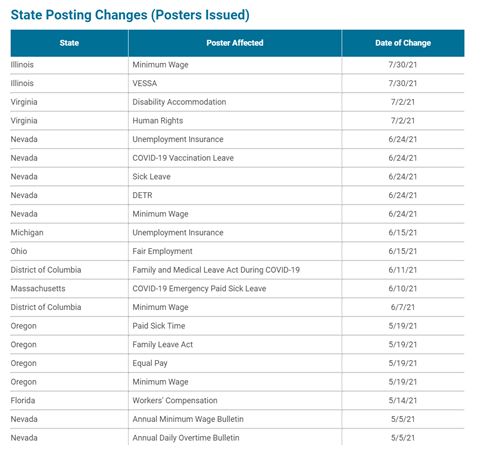
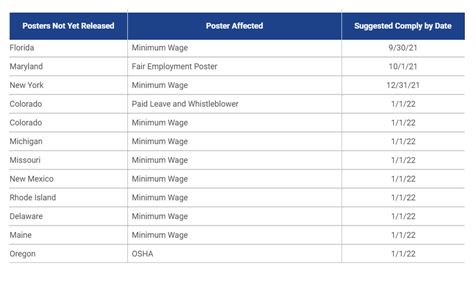
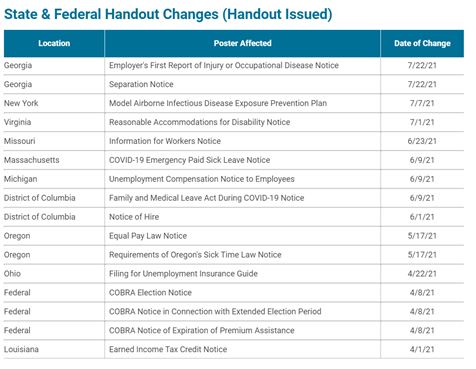
There are a variety of upcoming poster changes in states and Washington DC. Minimum wage increases and new laws are expected to bring a mandatory poster change to more than 20 states in early 2022.
Many changes take effect on January 1, 2022, with New York minimum wage increase and posting updates taking effect on December 31, 2022. New Jersey’s misclassification law takes effect on February 1, 2022.
Expected posting changes are based on regulatory changes or laws that were passed in 2021. Updates are expected in 2022, but mandatory changes can occur at any time.
JJ Keller Information
Federal Contractor Labor Poster Changes:
Federal contractor minimum wage will increase to $11.25 per hour on January 1, 2022. Employers covered by the executive order will need to display updated minimum wage rates.
Do not forget any COVID related postings through state and local guidelines as well. Signing up for a poster service will provide updates as required under state and federal law. During all compliance audits I have found mistakes with postings. I’m happy to work with any organization on posting requirements.
On Sept. 22, 2021, the New York State Division of the Budget issued its report on the minimum wage rates scheduled to take effect on Dec. 31, 2021. Nassau, Suffolk, and Westchester counties will now join New York City and large fast-food companies with a minimum wage of $15.00 per hour, which is an increase from the current rate of $14.00 per hour. For companies upstate (outside of fast food), the minimum wage will increase to $13.20, which is an increase from $12.50 per hour.
The minimum wage rise to $15 in Nassau, Suffolk, and Westchester counties in 2022, joining New York City and large fast-food firms statewide (see Table 1 link below) and,
The Upstate minimum wage rise annually by the sum of the annual growth rates for the Consumer Price Index for all Urban Wage Earners and Clerical Workers and labor productivity, as defined by real output per hour of all persons in the nonfarm business sector, where annual growth is measured for the period ending in June of the prior calendar year. This rule implies a minimum wage of $13.20 for the Upstate area for the 2022 calendar year.
Minimum Wage for Fast Food Employees The minimum wage for fast food employees working outside of New York City will increase to $14.50 per hour. The final scheduled increase to $15.00 per hour will take effect on July 1, 2021.
Tipped Employee Minimum Cash Wage (2021 Information) The minimum cash wage for tipped employees will increase as follows:
Hospitality Industry Tipped Minimum Wage Rate Schedule (Food Service Workers)
Location
12/31/20
12/31/21
NYC – Large Employers (of 11 or more)
$10.00 Cash $5.00 Tip
$10.00 Cash$5.00 Tip
NYC – Small Employers (10 or less)
$10.00 Cash $5.00 Tip
$10.00 Cash$5.00 Tip
Long Island & Westchester
$9.35 Cash $4.65 Tip
$10.00 Cash$5.00 Tip
Remainder of New York State
$8.35 Cash $4.15 Tip
$8.35 Cash$4.15 Tip
Hospitality Industry Tipped Minimum Wage Rate Schedule (Service Employees)
Location
12/31/20
12/31/21
NYC – Large Employers (of 11 or more)
$12.50 Cash $2.50 Tip
$12.50 Cash$2.50 Tip
NYC – Small Employers (10 or less)
$12.50 Cash $2.50 Tip
$12.50 Cash$2.50 Tip
Long Island & Westchester
$11.65 Cash $2.35 Tip
$12.50 Cash$2.50 Tip
Remainder of New York State
$10.40 Cash $2.10 Tip
$10.40 Cash$2.10 Tip
Tip Credit Eliminated in Miscellaneous Industries Employers of employees covered by the Minimum Wage Order for Miscellaneous Industries won’t be able to take a tip credit as of December 31, 2020.
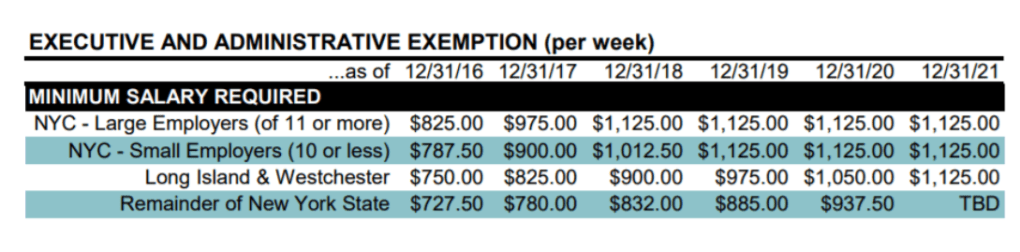
Exempt Administrative and Executive Minimum Salaries The minimum salary for exempt executive and administrative employees in New York will increase as follows:
Nassau, Suffolk, and Westchester counties: $1,050 per week, which equals $54,600 per year.
The rest of the state outside New York City: $937.50 per week, which equals $48,750 per year.
(The minimum in New York City previously increased to $1,125 per week.)
Now is the opportunity to review payrates and job descriptions. Is the position truly an exempt executive or administrative position? Ensure that job duties align with requirements under the Fair Labor Standards Act. I am happy to work with any organization to determine exempt vs. non-exempt duties and responsibilities. Continue to monitor for any significant changes at the federal level in 2021-2022 as well, minimum wage has not been increased federally since July 2009.
Tis the season for Halloween decorations, office parties and costumes. Holiday parties can be a great opportunity for employee engagement, communication, team building and simply having fun with coworkers. There is tremendous benefits to gatherings such as this in the workplace. However, we should recognize when decorations, parties or costumes go awry, we will need to address these concerns. Not all employees want to participate in decorating the office, participate in the office party or wear a costume to work (me included). Leaders need to recognize that workplace rules and dress code policies still exist, while maintaining workplace professionalism (yes, I am that guy)!
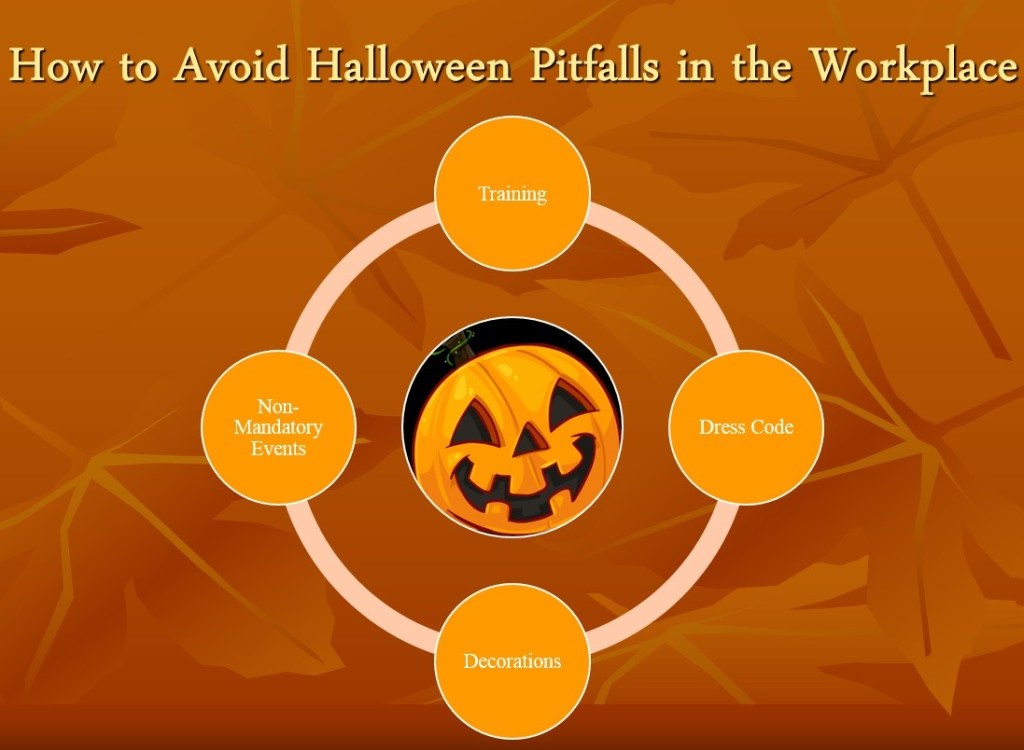
Below are my 4 thoughts on Halloween pitfalls:
Manger and Supervisor Training: “Some employees may be offended or even afraid to celebrate something they associate with evil, and supervisors need to be sensitive to that…Any parties, department decorations or costume contests should be clearly presented as voluntary, and equal support should be given to those who don’t participate and those who do.”[i]
What Dress Code: “People magazine and Amazon have identified some popular 2018 Halloween costumes that raise red flags:
An inflatable, giant “poop” emoji.
A Bill Cosby costume that depicts the comedian hauling away an unconscious woman.
Costumes that depict celebrities who’ve recently died from overdoses or committed suicide.
A President Donald Trump costume, complete with a garish, comb-over wig.
Sexy costumes inspired by the dramatic series “The Handmaid’s Tale,” which explores themes of women in subjugation.”[ii]
Halloween parties, costume events and even athletic jersey days allow employees to depart from the normal dress code, we normally expect at work. However, the dress code policy still needs to be enforced. Advice from SHRM, is a simple metric, employees should be covered from shoulders to knees. Organizations should give examples of appropriate and inappropriate costumes, jersey’s or other dress down days to ensure adherence to the dress code and to proactively avoid any future pitfalls. What if an employee violates the policy? Simple, send them home to change or ask them to cover the inappropriate attire. Coach and council or discipline as needed. Set the example and hold folks accountable.
3. Halloween Decorations: “Generally speaking, I would not advise companies to decorate,” Wilson said. “If employees want to put a small pumpkin on their desk, that can be a personal decision, but perhaps send an e-mail advising all employees that any gruesome or graphic or otherwise distracting decor is not allowed… witches, demons and goblins can be unprofessional and potentially offensive to co-workers and customers.”[iii]
4. Is this Mandatory: The organization should make clear, that participation in any Halloween festivities; decorating, party or costumes will be voluntary, and no one will be forced to participate.
Seasonal parties can be a great event for team building, communication and having fun as an organization. As leaders, we still need to enforce rules and ensure there are no issues related to inappropriate decorations, dress code violating costumes and/or mandatory parties. Communicate expectations and hold everyone accountable. The tone is always set at the top.
I have conducted many HR compliance audits over the past years and labor and employment law postings continue to be an audit issue for many organizations. The posting requirements continue to be an evolving area for any organization to keep up with. I encourage all organizations to review postings annually, if not semi-annually. If you are unclear what to look for, seek guidance, this is an area that can be a problem for organizations of all sizes.
Examples of Current Requirements:
The Family and Medical Leave Act (FMLA) notice is required to be displayed by covered businesses with 50 or more employees and by all public agencies regardless of the number of employees.
The “Equal Employment Opportunity is the Law” poster is required for federal contractors as well as employers with 15 or more workers.
Transportation industry employers in New York State need to display the Commercial Goods Transportation Industry Fair Play Act posting.
Employers must display required federal posters in a conspicuous place, and face penalties for noncompliance:
The penalty for violating the Occupational Safety and Health Administration (OSHA) posting requirement could reach $13,260;
An employer violating any provision of the Employee Polygraph Protection Act of 1988, including the posting requirement, faces a fine of up to $21,039;
Covered employers who do not post a notice of anti-discrimination rights (“Equal Employment Opportunity is the Law”) face a fine of $559; and
• Employers covered by the Family and Medical Leave Act (FMLA) who willfully refuse to display the notice could be fined $173.
New York State Voting Leave Rights (Modified from 2019 Posting)
New York State Voting Leave Rights Section 3-110 of the New York State Election Law, which relates to providing employees in New York State time off to vote, was recently amended effective April 3, 2020.
New York Paid Sick Leave (Watch for Updates from the State)
Below is the New York City Example:
Under New York City’s Earned Safe and Sick Time Act (Paid Safe and Sick Leave Law), certain employees have a right to safe and sick leave. Employees who work for employers who must provide safe and sick leave must receive a written notice from their employer when they begin employment or by June 4, 2018, whichever is later. You have a right to be given a notice in English and, if available on the DCA website, your primary language.
Under OSHA’s recordkeeping regulation, certain covered employers are required to prepare and maintain records of serious occupational injuries and illnesses using the OSHA 300 Log. This information is important for employers, workers, and OSHA in evaluating the safety of a workplace, understanding industry hazards, and implementing worker protections to reduce and eliminate hazards.
However, there are two classes of employers that are partially exempt from routinely keeping injury and illness records. First, employers with ten or fewer employees at all times during the previous calendar year are exempt from routinely keeping OSHA injury and illness records. OSHA’s revised recordkeeping regulation maintains this exemption.
Second, establishments in certain low-hazard industries are also partially exempt from routinely keeping OSHA injury and illness records. Due to changes in OSHA’s recordkeeping requirements that went into effect Jan. 1, 2015, certain previously exempt industries are now covered. See the lists of both exempt and newly covered industries for details. The previous list of partially exempt industries was based on the old Standard Industrial Classification (SIC) system and injury and illness data from the Bureau of Labor Statistics (BLS) from 1996, 1997, and 1998. The new list of partially exempt industries in the updated rule (link) is based on the North American Industry Classification System (NAICS) and injury and illness data from the Bureau of Labor Statistics (BLS) from 2007, 2008, and 2009.
Complete this form if you would like to order the Unemployment Insurance Notice to Employees (IA 133) poster. The poster is available in various languages. You are required to display this poster.
New York State Department of Labor, Registration Subsection State Office Building Campus Albany, NY 12240-0339 Phone: (518) 485-8589 Fax: (518) 485-8010
New York Minimum Wage poster has been updated to reflect an increase to the minimum wage for tipped workers. The tip credit for employees under the Miscellaneous Industries Wage Order was reduced by 50% on June 30, 2020 and will be eliminated entirely on December 31, 2020. This posting appears on the New York Combination Poster. This is a mandatory change.
Nevada Minimum Wage poster has been updated to reflect the minimum wage effective July 1, 2020. The minimum wage increased from $7.25 per hour to $8.00 per hour for employees to whom qualifying health benefits are offered or made available. The minimum wage will increase from $8.25 per hour to $9.00 per hour for all other employees. This posting appears on the Nevada Combination Poster. This is a mandatory change.
Old Labor Law Poster Suggestions
A recent Society of Human Resources Article (SHRM) recommends, “old employment law posters should be saved to help prove past compliance, even though retaining old posters isn’t required…employers also should take pictures of old posters with time-and-date stamps to have a physical record that they were displayed…save them for the applicable time employees have under the statute of limitations.”[i] The suggestion is based on any potential employee litigation, the plaintiff’s attorney could claim an older poster was not displayed, “and that the statute of limitations should be suspended, permitting older claims to be filed.”[ii] Ensure these posters are displayed and visible for employees, in break rooms or where employees clock in. One poster is not always sufficient. Certain posters need to be displayed for applicants as well.
“The current penalties for first offenses in failing to display federal posters are:
$12,675 for failure to display the Occupational Safety and Health Administration poster.
$534 for failure to post the Equal Employment Opportunity poster.
$166 for failure to display the Family and Medical Leave Act poster.”[iii]
The article also recommends updating the posters or reviewing annually. Last year, we did see changes in August in multiple federal sections. Reviewing more than once per year is a proactive approach for any organization, companies do offer a monthly service to send your organization updated posters anytime changes are made federally and/or state specific regulation. The risk is not worth a potential $12,000 fine. Ensure your organization is compliant with up-to-date labor and employment law posters. If you have questions, ask for assistance.
A law that many of us are familiar with, The Age Discrimination in Employment Act of 1967. “The Age Discrimination in Employment Act of 1967 (ADEA) protects workers age 40 and over by prohibiting discrimination against workers 40 and over in any employment or employment-related decision. The Act applies to most employers with 20 or more employees…One of the main provisions of the ADEA is that employers, with very few exceptions, can no longer force an employee to retire. Voluntary retirements are allowed; however, very specific conditions must be met in order to avoid violation of the Act…. Penalties for non-compliance: Employees may be awarded back pay, reinstatement, retroactive seniority, and attorney’s fees. Liquidated damages equal to the amount of back pay may be awarded if the violation is willful.” (SHRM Article) In the event we have layoffs or terminations, organizations need to ensure they check the following boxes with a severance package or any exit process in the organization with protected workers under the ADEA.
“be written in a manner calculated to be understood by the average worker;
Specifically refer to rights or claims arising under the ADEA,
Not include a waiver of rights or claims that may arise after the date of execution of the waiver;
Be made in exchange for consideration beyond anything to which the individual already was entitled;
Contain a written statement advising the individual to consult with an attorney prior to executing the agreement; and
Provide the individual with at least 21 days within which to consider the agreement (or 45 days where the waiver is part of an exit incentive or other employment termination program offered to a group of employees) and with another seven days after the execution of the agreement to revoke the agreement.”[i]
The waiver agreement that meets these requirements is enforceable, only after the revoke period has expired. The ADEA is enforced by the EEOC, with slight differences in regulations, then we see with Title VII. Remember, this is a federal law, there are protections against age discrimination at the state and even local levels as well, be aware of the law and potential changes in legislation.
“It shall be unlawful for an employer-
(1) to fail or refuse to hire or to discharge any individual or otherwise discriminate against any individual with respect to his compensation, terms, conditions, or privileges of employment, because of such individual’s age;
(2) to limit, segregate, or classify his employees in any way which would deprive or tend to deprive any individual of employment opportunities or otherwise adversely affect his status as an employee, because of such individual’s age; or
(3) to reduce the wage rate of any employee in order to comply with this chapter.
(b) It shall be unlawful for an employment agency to fail or refuse to refer for employment, or otherwise to discriminate against, any individual because of such individual’s age, or to classify or refer for employment any individual on the basis of such individual’s age.”[ii]
Title VII & ADEA Comparisons (not an all-encompassing list):
Additional Expansions to New York’s Workplace Laws and Regulations:
“The new laws contain the following additional provisions that New York employers should note:
All employers will now be subject to the state’s anti-discrimination law, regardless of size.
Nonemployees, such as independent contractors, will also be entitled to anti-discrimination protections. The laws also protect domestic household workers from all forms of harassment.
Employees who win state-law discrimination, harassment or retaliation claims will be able to recover uncapped punitive damages and will automatically be awarded their attorney fees.
The limitations period to file sexual harassment claims with the New York State Division of Human Rights will increase to three years from one year.
Employers will be required to distribute additional notices and other materials to new and existing employees about sexual-harassment prevention (in English and the employee’s primary language), including a copy of any information presented at the employer’s annual sexual-harassment-prevention training sessions.
The laws also bar contractual clauses that require mandatory arbitration for harassment and discrimination claims. However, federal law will likely pre-empt this change.”[i]
When all employees work remotely, the Department of Labor (DOL) says a business can use electronic postings to satisfy posting requirements. Essentially, they are required if everyone is remote. The DOL also notes that, for electronic posters to be compliant, employees need to have readily available access to them. In addition, workers need to usually get information electronically.
Some of our employees are remote and others are in the office. Do we need electronic posters?
The DOL encourages the use of electronic posters in this situation but doesn’t require them. It’s certainly a best practice to make them available, as they’re a great way to show that you’re providing workers with information about their rights. In addition, they might be required under a state law. At the office, you’ll need to display paper posters
Which electronic posters do we need?
All employees need access to federal postings. They also need access to state and local postings that relate to where they are working, so if they work from home they need to have access to posters for the state (and maybe the city) they live in.
Our employees work at a customer’s location. Do they need electronic posters?
If employees have access to the paper posters at the customer’s location, that should satisfy your posting obligations. You’ll want to make sure the posters are up-to-date and that all required postings are displayed. If the customer’s posters are in an area your employees can’t access, work with the customer to see if you can put up a set of posters in a place where they’re visible to your employees.
How quickly do employees need to receive their electronic posters?
There is no specific time frame or grace period for providing electronic posters to remote employees. If all workers are remote, it’s best to make the effort to provide them as soon as possible and document your efforts. When some workers are remote, and electronic posters aren’t required, it’s still a good idea to provide access as soon as you can. This shows a good faith effort to make all employees aware of their rights. (JJ Keller)
As many of our organizations have been implementing and utilizing remote worker options, we cannot forget the requirements for labor and employment law posters. Local, State and Federal laws have different requirements and definitions for remote workers.
Broad Definition of Remote Workers: · Works at home · Does not report to a physical job site · Is an employee
Other Considerations: · Independent Contractors: Organization is not required · Digital Nomads: Organization is not required · Gig Workers: Depends on payrolling of the individual · Temporary Workers: Depends on payrolling · Workers on site at customer’s office: If the customer’s office has posters, more than likely no, but you do want to work with the customer to ensure compliance. General Posting Requirements: · Visible · Conspicuous Location · Readable · Not Defaced · Post Where Employees Report to Work Each Day Remote Workers with Internet Access: · Internal website link · Conspicuously Displayed: Ensure it is easy to find on your intranet portal and not buried in folders. · Ensure workers are aware of how to access · Make remote workers aware of their rights · Can send them their own set of posters · Electronic posters = best practice · Still need paper posters at main office and other locations
EEOC: In most cases, electronic posting supplements physical posting but does not itself fulfill the employer’s basic obligation to physically post the required information in its workplaces. The majority of the agencies, laws and regulations were written prior to the remote work became a popular model for organizations to implement. However, there are a few federal and state laws that have implemented electronic posting language.
· USERRA Notice: May be posted or distributed in other ways. · FMLA Notice: May be distributed electronically if all other requirements are met. · EEOC: employers are encouraged to post the electronic notice on their internal websites in a conspicuous location · Colorado Paid Leave, Whistleblowing & PPE: Provide through electronic communication, or conspicuous posting in the web-based platform · FFCRA: An employer may also directly mail the required notice to any employees who are not able to access information at the worksite, through email, or online.
Other Considerations: · Traveling Workforce: Cleaning Crews, Landscapers, etc. · Create Binders of PDF postings or work with your poster provider These are a few thoughts on the evolving labor and employment law posting requirements throughout the country. There are a number of changes expected at the end of 2021 and early 2022. Ensure you are monitoring for changes to Paid Sick Leave posting requirements in New York State. I am happy to work with any organization to ensure you are compliant with posters, remote worker options, intranet options and creating PDF binders for work vehicles. We can design a process that will ensure legal compliance. I do suggest semiannual audits to all posters throughout the workplace.
NY Department of Labor published the model workplace airborne infectious exposure prevention standards, a general airborne infectious disease exposure prevention standard, and several template prevention plans for the following areas/industries: Agriculture, Construction, Delivery Services, Domestic Workers, Emergency Response, Food Services, Manufacturing and Industries, Personal Services, Private Education, Private Transportation, and Retail.
Exposure Prevention Plan During an Airborne Infectious Disease Outbreak
When a highly contagious communicable disease is designated by the Commissioner of Health as presenting a serious risk of harm to the public health, employers must:
Immediately review their exposure prevention plans and update the plans, if necessary, to ensure that they incorporate current information, guidance, and mandatory requirements issued by federal, state, or local governments related to the infectious agent of concern;
Finalize and promptly activate the worksite exposure prevention plan;
Provide a verbal review of the employer’s safety policies, employees’ rights under the HERO Act, and the written exposure prevention plan (which can be conducted via audio or video conference technology);
Provide each employee with a copy of the exposure prevention plan in English or in the language identified as the primary language of such employees, if the NYSDOL makes a translation available;
Post a copy of the exposure prevention plan in a visible and prominent location at the worksite; and
Ensure that a copy of the exposure prevention plan is accessible to employees during all work shifts.
While the airborne infectious disease designation remains in effect, the General Standard states that employers must ensure that their exposure prevention plans are effectively followed by:
Assigning enforcement responsibilities and ensuring that adequate enforcement of the exposure prevention plan takes place;
Monitoring and maintaining exposure controls (as defined below); and
Regularly checking for updated information and guidance provided by the NYSDOH and the CDC concerning the airborne infectious disease and updating the exposure prevention plan, when necessary, so that the plan reflects current NYSDOH and CDC recommended control measures. (National Review)



 BURR CONSULTING, LLC