When federal agency forms (such as DOL or USCIS paperwork) pass their printed expiration date, employers can typically continue using the current version unless a brand-new edition have been officially released or check USCIS I-9 Central for direct updates.
Understanding Expiration Dates
OMB Control Dates: The printed date represents approval from the Office of Management and Budget for data collection, not a strict legal cutoff for the document content itself.
Grace Periods: Agencies often extend past expiration dates or roll them over while review processes happen behind the scenes.
Active Validation: Always check the issuing government agency website to see if a replacement version is actively required for new filings.
Best Practices for Compliance
Keep Using Current Stock: Continue using the existing form safely if no replacement has been published yet.
Swap When Released: Update internal HR portals and software systems immediately once a newer edition is formally issued.
Do Not Retroactively Fix: You generally do not need to redo past correctly filled forms just because a new version was later released.
1. Identify Expired Forms The first step is to conduct a thorough review of all employment forms currently in use. This includes:
W-4 Forms: Federal Employee’s Withholding Certificate
I-9 Forms: Employment Eligibility Verification
State-Specific Forms: Varies by state, including tax withholding forms and labor law posters.
2. Stay Informed on Updates Employers should regularly check for updates from relevant federal and state agencies. This can be done by:
Subscribing to newsletters from the IRS, Department of Labor, and state labor departments.
Visiting official websites for announcements regarding form changes or expirations.
3. Replace Expired Forms Once expired forms are identified, employers should:
Obtain Updated Forms: Download the latest versions from official government websites.
Communicate Changes: Inform employees about the need to complete new forms, emphasizing the importance of compliance.
4. Implement a Compliance System To prevent future issues with expired forms, employers should establish a compliance system that includes:
Regular Audits: Schedule periodic reviews of employment forms to ensure they are current.
Tracking System: Use a digital or physical tracking system to monitor the expiration dates of forms.
5. Train HR Staff Ensure that human resources personnel are well-informed about the importance of using current forms. Training should cover:
The implications of using expired forms.
Procedures for updating forms and communicating changes to employees.
6. Maintain Employee Records Employers should keep accurate records of all employment forms, including:
Completed Forms: Store both current and expired forms for reference.
Documentation of Updates: Maintain a log of when forms were updated and distributed to employees.
7. Address non-compliance If an employer inadvertently uses expired forms, they should:
Assess the Situation: Determine the extent of non-compliance and any potential penalties.
Correct the Issue: Promptly replace expired forms and ensure all employees complete the new versions.
Consult Legal Counsel: If necessary, seek legal advice to navigate potential repercussions.
Proactive audits and awareness of expiration dates are necessary to remain legally compliant. In the many audits I have conducted, expired forms continue to be an issue. I am happy to answer any questions related to compliance, process and correcting.
Like most professional fields, Human Resources continues to undergo an evolution. Once seen as an administrative function; payroll, policies, benefits, hiring, etc. We continue to align the function with strategic goals and objectives or our respected organizations. But what does that mean? How are we aligning ourselves with these goals and objectives, without being seen as just a “cost center” and ensuring we have a “seat at the table?”
HR Metrics that align with the organization’s goals and objectives, while providing valuable insight to the decision-making processes. As part of a strategic planning session, ask organizational leadership the following questions to gain a better insight into what is important to the organization in regard to HR Metrics:
What HR metrics are important to the organization?
What data do we need to gather and/or track to calculate these metrics?
How will we analyze the data and what benchmarks will we use?
Once we have the data what plan of action will be used, how will we develop and measure improvement?
Take it one step farther in the meeting and provide the team with commonly used examples, definitions and calculations to ensure accuracy and buy in. Below is a list of commonly used HR Metrics, some will work for your organization, others will not and other’s will be need to be modified or tweaked to ensure the organization is measuring what it values:
Absence Rate: Number days absent in month ÷ (average number of employees during a month x number of workdays)
Benefit Costs Per Employee: Total cost of employee benefits program/total number of employees
Benefits as a Percent of Salary: Annual benefits cost/annual salary
Cost Per Hire: Recruitment costs/ (compensation cost + benefits cost)
Engagement Rating: Percentage of employees engaged with a given aspect of the workplace
Percent of Performance Goals Met or Exceeded: Number of performance goals met or exceeded/ total number of performance goals
Time to Fill: Total days taken to fill a job/ number hired
Training and Development Hours: Sum of total training hours/ total number of employees
Tenure: Average number of years of service at the organization across all employees
Turnover (annual): Number of employees exiting the job during 12-month period/ average number of employees (Turnover can be broken down into semiannual, monthly, etc.)
Turnover Costs: Total cost of separation + vacancy + replacement + training (This number will vary depending on position, generally it is 6 to 12 months of salary)
Utilization Percent: Total number of employees utilizing a program, benefit or service/ total number of employee’s eligible
Workers Compensation Cost Per Employee: Total worker’s compensation costs per year/ average number of employees
Yield Ratio: Percentage of applicants from a recruitment source (indeed, monster, CareerBuilder, Craigslist) that make it to the next state in the selection process
These just a few examples of the many HR Metrics that can be implemented into any organization, without the buy in and agreement on which metrics to implement, the value significantly decreases. Organizations I have worked for in the past have developed an “HR Dashboard,” to track key metrics that are important to the respected organization.
Knowing what is important to the organization will help to ensure a successful implementation of key HR Metrics.
1. Improved Decision-Making HR metrics provide a factual basis for decision-making. Instead of relying on intuition or anecdotal evidence, organizations can use data to understand workforce dynamics. For example, metrics such as turnover rates and employee satisfaction scores can help HR leaders identify issues before they escalate, allowing for timely interventions.
2. Enhanced Recruitment Processes By analyzing recruitment metrics, organizations can refine their hiring processes. Metrics such as time-to-fill, cost-per-hire, and source of hire can reveal which recruitment channels are most effective. This data enables HR teams to allocate resources more efficiently and attract the right talent.
3. Increased Employee Engagement Employee engagement metrics, such as participation in surveys and feedback mechanisms, provide insights into how employees feel about their work environment. By regularly measuring engagement levels, organizations can implement strategies to boost morale, leading to higher productivity and lower turnover rates.
4. Better Talent Management HR metrics can help organizations identify high performers and those who may need additional support. By tracking performance metrics, organizations can tailor development programs to meet individual needs, fostering a culture of continuous improvement and professional growth.
5. Cost Efficiency Understanding HR metrics can lead to significant cost savings. For instance, analyzing turnover rates can help organizations identify the root causes of employee departures. By addressing these issues, organizations can reduce recruitment and training costs associated with high turnover.
6. Compliance and Risk Management HR metrics can also play a crucial role in ensuring compliance with labor laws and regulations. By tracking metrics related to diversity, equity, and inclusion, organizations can identify potential compliance issues and take proactive measures to mitigate risks.
7. Strategic Workforce Planning HR metrics enable organizations to forecast future workforce needs based on current trends. By analyzing data related to employee demographics, skills, and performance, organizations can develop strategic plans for hiring, training, and succession planning.
8. Benchmarking Against Industry Standards Organizations can use HR metrics to benchmark their performance against industry standards. This comparison can highlight areas where an organization excels or falls short, providing valuable insights for strategic planning and improvement.
Implementing HR Metrics To effectively implement HR metrics, organizations should follow these steps:
1. Define Objectives Clearly outline the objectives of using HR metrics. Whether it’s improving employee retention, enhancing recruitment processes, or increasing engagement, having specific goals will guide the selection of relevant metrics.
2. Select Relevant Metrics Choose metrics that align with organizational goals. Common HR metrics include:
Turnover Rate: Measures the percentage of employees who leave the organization over a specific period.
Employee Satisfaction Index: Gauges employee happiness and engagement levels.
Training ROI: Assesses the return on investment for training programs.
3. Collect Data Implement systems for collecting and analyzing data. This may involve using HR software, conducting surveys, or leveraging existing data sources.
4. Analyze and Interpret Data Regularly analyze the collected data to identify trends and insights. Use visualization tools to present data in an easily digestible format for stakeholders.
5. Take Action Based on the insights gained from HR metrics, implement strategies to address identified issues. Monitor the impact of these changes and adjust as necessary.
6. Review and Refine Continuously review the effectiveness of HR metrics and refine them as needed. As organizational goals evolve, so too should the metrics used to measure success.
10 Common HR Metrics
Employee Turnover Rate
Definition:The employee turnover rate measures the percentage of employees who leave an organization over a specific period.
Importance: High turnover can indicate issues within the workplace, such as poor management or lack of career advancement opportunities. Monitoring this metric helps HR identify trends and implement retention strategies.
Time to Fill
Definition: Time to fill measures the number of days it takes to fill a vacant position from the moment it is posted until an offer is accepted.
Importance: This metric helps HR evaluate the efficiency of the recruitment process. A longer time to fill may indicate challenges in attracting suitable candidates or inefficiencies in the hiring process.
Cost per Hire
Definition: Cost per hire quantifies the total cost involved in hiring a new employee, including advertising, recruitment agency fees, and onboarding expenses.
Importance: Understanding the cost per hire allows HR to budget effectively and assess the return on investment (ROI) of recruitment strategies.
Employee Engagement Score
Definition: Employee engagement score gauges the level of employee commitment and satisfaction within the organization, often measured through surveys.
Importance: High engagement levels correlate with increased productivity and lower turnover rates. Regularly measuring this score helps HR identify areas for improvement in workplace culture.
Absenteeism Rate
Definition: The absenteeism rate measures the percentage of workdays missed due to unplanned absences.
Importance: High absenteeism can signal employee dissatisfaction or health issues. Monitoring this metric helps HR address underlying problems and improve workplace conditions.
Training Effectiveness
Definition: Training effectiveness assesses the impact of training programs on employee performance and productivity.
Importance: Evaluating training effectiveness ensures that resources are allocated to programs that yield tangible benefits, thereby enhancing employee skills and organizational performance.
Diversity and Inclusion Metrics
Definition: Diversity and inclusion metrics track the representation of various demographic groups within the workforce and the inclusivity of the workplace culture.
Importance: These metrics are essential for fostering a diverse workforce and ensuring equitable opportunities for all employees. They help HR identify gaps and implement targeted initiatives.
Performance Management Metrics
Definition: Performance management metrics evaluate employee performance against set goals and objectives.
Importance: These metrics help HR identify high performers, areas for improvement, and the effectiveness of performance management systems.
Performance can be assessed through regular reviews, goal completion rates, and feedback from peers and supervisors.
Offer Acceptance Rate
Definition: The offer acceptance rate measures the percentage of job offers accepted by candidates.
Importance: A low acceptance rate may indicate issues with the job offer itself, such as salary or benefits, or the organization’s reputation. This metric helps HR refine their offers to attract top talent.
Employee Net Promoter Score (eNPS)
Definition: The Employee Net Promoter Score measures employees’ likelihood to recommend the organization as a place to work.
Importance: A high eNPS indicates strong employee loyalty and satisfaction, while a low score can highlight areas needing improvement.
Employees are typically asked to rate on a scale from 0 to 10, and the eNPS is calculated by subtracting the percentage of detractors (0-6) from promoters (9-10).
(External Costs) + (Internal Costs) / Total # of Hires in a Time Period.
Time to Fill
Total days elapsed to fill requisitions / # Hired
Turnover Rate
(# of separations during month/Avg. # of employees during month) x 100
Turnover Cost
Total of the costs of separation + vacancy + replacement + training
Vacancy Rate
(Total number of vacant positions as of today / Total number of positions as of today) x 100
Vacancy Cost
Total of the costs of temporary workers + independent contractors + other outsourcing + overtime – wages and benefits not paid to vacant position(s)
Absence Rate
[(# Days Absent in Month) / (Avg. # employees in Month) x (# workdays)] x 100
Workforce Growth Rate
End of Period Headcount / Beginning of Period Headcount
Recruiting Cost Ratio
(External Costs) + (Internal Costs) / Total of First-Year Compensation of Hires in a Time Period * 100
TRAINING
# Employees Trained
(Name of training, if applicable)
Training Investment
Total training cost / # of employees
Training (ROI)
( Total Benefit – Total Cost) x 100
SAFETY
# of WC Incidents
Workers’ Compensation Incident Rate
(Number of injuries and/or illnesses per 100 FTE ∕ Total hours worked by all employees during the calendar year) x 200,000
HR PERFORMANCE
HR Expense
HR Expense / Total Operating Costs
HR Expense per Employee
HR Costs (include indirect costs, if applicable) / Regular Headcount
Staff Development:
HRIS Updates:
Employee Recognition and Awards:
HR Staff Accomplishments, Awards, Distinctions:
Social Responsibility: Policies (implemented/revised/eliminated): Special Projects: Action Items for (following month):
SMART Goals Made Simple: Goal-Setting Worksheet Instructions and Guidelines
What are goals? Goals are statements of end results expected within a specified period of time.
How are goals defined? For each goal, describe the end result and indicate quantity, quality, time frame, percentages or other specific measures. Each goal should fit into and support the overall strategy of the business unit. The SMART formula is the most common framework for developing a goal:
Specific
Measurable
Achievable
Relevant
Time-Bound
What are some examples of goals?
To meet or exceed all financial targets set in the annual business plan.
To ensure that all employees understand our strategy and tactics and have incorporated them into the individual goals they have set for themselves and their staff for the year.
To complete inspection reports within 30 days from last date of inspection, using the proper format and inspection protocol.
To achieve an average time-to-hire completion rate of six weeks.
To achieve at least _____ billable hours/year.
To consolidate campaign results on a quarterly basis.
When are goals set? Typically goals are annual and set at the beginning of a fiscal year, which for many organizations coincides with the start of a new calendar year in January.
Who sets the goals? Goals should be set through mutual agreement between the employee and their supervisor and approved by leadership.
How many goals should there be? Usually four or more, depending on the nature of the goal. However, each department head may require a minimum number of goals, or they may establish common goals which are to be included on every employee’s worksheet. Professional development goals are also common.
May goals be revised? Goals may be carried forward from the previous year, revised, added or deleted during the review period as necessary.
Who should have an individual goals worksheet? Each department head will determine whether certain staff or all staff will be responsible for setting goals.
Always opportunity to continue to build culture, strategy and partnerships.
Benefits for Employers
1. Harnessing AI to Revolutionize HR
AI Strategy: HR leaders are expected to craft and implement a clearly defined, HR-focused AI strategy. This includes leveraging AI for talent management, recruitment, and employee experience, while ensuring ethical and responsible use
AI’s Impact on Work: There is a strong emphasis on taking an enterprise-wide view of AI’s impact, not just on processes but also on how it changes leadership roles, employee expectations, and organizational culture
AI Agents: The adoption of AI agents is already transforming HR, making it crucial for HR consultants to guide organizations through this technological shift
2. Adapting to Shifting Talent Models
Agile, Multidisciplinary Teams: Organizations are moving away from traditional HR structures, forming agile pods that focus on priority areas such as onboarding redesign, retention improvement, and leadership pipeline development
Talent Flexibility: HR must help organizations adapt to new talent models, including gig work, remote/hybrid arrangements, and skills-based hiring
3. Driving Organizational Culture and Change
Culture Evolution: As AI and new talent models disrupt the workplace, evolving organizational culture to support performance, innovation, and adaptability is a top priority
Well-being, Fairness, and Trust: Employees expect organizations to prioritize well-being, fairness, and trust. HR consultants must help leaders balance innovation with a people-first approach
4. Building Alignment, Adaptability, and Trust
Strategic Alignment: HR must ensure that people strategies are tightly aligned with business goals, especially as organizations navigate rapid change
Adaptability: Helping organizations remain agile and responsive to market signals, regulatory changes, and workforce expectations is essential
Trust: Maintaining trust, especially as AI and automation increase is critical for employee engagement and retention
5. Supporting Leadership and Employee Experience
Leadership Development: There is a renewed focus on developing leaders who can manage change, inspire teams, and drive transformation
Employee Experience: HR must continue to enhance the employee experience, from onboarding to career development, ensuring that technology enhances rather than detracts from human connection
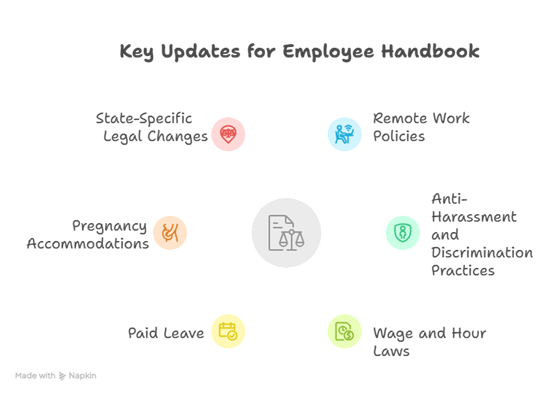
Remote Work Policies With remote and hybrid work becoming more common, updating policies to clearly define expectations, eligibility, and equipment use is essential.
The EEOC is focusing on discrimination claims related to hair texture and style, so grooming and dress code policies should be reviewed and updated accordingly .
Use inclusive language throughout the handbook, such as gender-neutral pronouns (they/them), to foster inclusivity
Employee Classifications and Wage Laws
Review classifications under the Fair Labor Standards Act (FLSA) to ensure proper exemption status.
Stay current with state-specific wage and hour laws, including paid time off and leave policies
Paid Family and Medical Leave
Be aware of state-specific changes, such as Maryland delaying its Paid Family and Medical Leave program contributions until July 1, 2025, with benefits starting July 1, 2026
Pregnancy Accommodations
Update policies to comply with evolving pregnancy accommodation laws and ensure clear procedures for requesting accommodations.
State-Specific Legal Changes
California employers should note changes affecting non-discrimination, leave, and vacation policies effective January 2025.
New York and New Jersey employers must incorporate recent federal and state legal developments into their handbooks .
Company Culture and Compliance Balance
While compliance is critical, also ensure the handbook reflects your organization’s culture and values to engage employees effectively
General Policy Reviews
Regularly review key policies such as leave, attendance, workplace conduct, and disciplinary procedures to maintain compliance and clarity.
New York State Handbook Review & Update Considerations
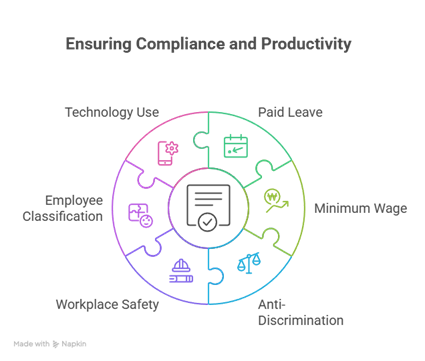
Paid Family Leave and Paid Sick Leave: New York State has been expanding its paid family leave and paid sick leave laws. Ensure your handbook reflects the latest eligibility, benefits, and procedures for requesting leave under these laws.
Minimum Wage and Overtime Rules: New York State and many localities (e.g., NYC, Long Island) have scheduled minimum wage increases. Confirm that wage policies and overtime eligibility align with the current rates and thresholds effective in 2025-2026.
Anti-Discrimination and Harassment Policies: Updates to reflect any new protected classes or changes in reporting procedures under New York State Human Rights Law and recent case law. Training requirements for harassment prevention may also have changed.
Workplace Safety and COVID-19 Policies: While COVID-19 emergency rules have relaxed, some employers maintain policies on vaccination, testing, or remote work. Review any state or local health guidance that might affect workplace safety protocols.
Employee Classification and Wage Transparency: New York has laws addressing gig workers, independent contractors, and wage transparency. Ensure handbook language clarifies employee status and complies with disclosure requirements.
Leave for Voting, Jury Duty, and Military Service: Confirm that leave policies comply with New York State laws protecting these rights.
Use of Technology and Social Media: Update policies on acceptable use of company devices, data privacy, and social media conduct, reflecting evolving norms and legal standards.
This is a shortlist of potential sections to review and revise in most employee handbooks. Continue to review local and state changes as well, when reviewing and updating employee handbooks. Communication, training and setting the expectations is necessary with any organizational change, including employee handbooks.
“Many states, counties, cities, and towns have their own laws prohibiting discrimination, as well as agencies responsible for enforcing those laws. We call these state and local agencies “Fair Employment Practices Agencies” (FEPAs). Usually the laws enforced by these agencies are similar to those enforced by EEOC.”[i] States and cities (including New York State and New York City) have entered into a work sharing agreement with the EEOC. What does this mean for our organizations? Does it have an impact on how we should operate or how we manage workplace allegations and investigations?
Work Sharing Agreements:
Under these terms, both the EEOC and state authority (NYS Division of Human Rights) or City (NYC) can designate the other as its agent for receipt of charges.
What does this mean? If a charge is received by one partner under the agreement, it is deemed received by the other.
“Moreover, these agreements typically proved that the state entity can waive its rights to process such a charge referred to it by the EEOC, which as the effect of permitting the federal agency to process the charge without waiting for the 60-day period to expire.
Many such agreements have an automatic waiver provision, which means that as soon as the charge is filed with the EEOC, the EEOC can begin processing it without going through the motions of referring it back to the state authority.
It also means that the grievant need not file with the state agency within 240 days of the unlawful practice, but, instead, has a full 300 days within which to take the initial step of filing a charge with the federal agency.”[i]
“You can file your charge with either the EEOC or with a Fair Employment Practices Agency. If the charge is initially filed with EEOC and the charge is also covered by state or local law, EEOC dual files the charge with the state or local FEPA (meaning the FEPA will receive a copy of the charge), but ordinarily retains the charge for processing.
If a FEPA has a contract with EEOC, a Charging Party may request that the EEOC review the determination of the FEPA. EEOC will conduct a review only if the request is submitted in writing within fifteen (15) days of receipt of the FEPA’s determination.”[ii]
Confused yet? To summarize, New York State and New York City have a working agreement with the EEOC, if a charge is filed, it is sent with the state or city, it is sent to the EEOC as well, if it falls within the 300-day requirement, under current federal law. “The EEOC contracts with approximately 90 FEPAs nationwide to process more than 48,000 discrimination charges annually.”[iii]
In summary, New York State and New York City have a working agreement with the EEOC. If a charge is filed, it is shared with both the state or city agency and the EEOC, provided it falls within the 300-day requirement under current federal law. The EEOC contracts with approximately 90 FEPAs nationwide to process more than 48,000 discrimination charges annually.
Implications for Organizations
So, what does all of this mean for organizations operating in areas with work sharing agreements? Here are some key implications:
Awareness of Extended Filing Deadlines: Organizations must be aware that employees have 300 days to file a charge with the EEOC, even if the state or local filing deadline is shorter. This extended timeframe can impact internal investigation timelines and record retention policies.
Potential for Dual Investigations: While the EEOC typically retains the charge for processing, organizations should be prepared for the possibility of parallel investigations by both the EEOC and the relevant FEPA. Coordination with legal counsel is crucial in such situations.
Importance of Thorough Internal Investigations: Given the potential for charges to be filed with either the EEOC or a FEPA, organizations should conduct thorough and impartial internal investigations of any workplace allegations of discrimination or harassment. A well-documented investigation can be a valuable defense in the event of a formal charge.
Review of Policies and Procedures: Organizations should review their anti-discrimination and harassment policies and procedures to ensure they are up-to-date and compliant with both federal and state/local laws. This includes ensuring that employees are aware of their rights and responsibilities under these laws.
Training for Managers and Employees: Regular training for managers and employees on anti-discrimination and harassment laws is essential. This training should cover topics such as recognizing and preventing discrimination, handling complaints, and conducting investigations.
Consistent Application of Policies: It is crucial to apply policies and procedures consistently across the organization. Inconsistent application can lead to claims of discrimination and undermine the organization’s defense in the event of a charge.
Documentation: Maintain thorough and accurate records of all complaints, investigations, and disciplinary actions. This documentation can be critical in defending against discrimination charges.
Legal Counsel: Consult with legal counsel experienced in employment law to ensure compliance with all applicable federal, state, and local laws. Legal counsel can also provide guidance on handling specific charges and investigations.
[i] Joel Wm. Friedman, Examples & Explanations: Employment Discrimination. Third Edition (Wolters Kluwer 2017).