Workplace Dating, Leadership Ethics & Love Contracts, Oh My!

In light of recent unfortunate events at a Coldplay Concert, when a CEO and HR Director were caught on a camera moment, ducking and hiding away from the media.  Dating in the workplace is common, every organization should have parameters in place to ensure expectation is set, consequences and clear ethical guidelines are in place.  We have all seen the fallout from the recent events at the Coldplay Concert, the CEO resigns, the HR Director is under investigation and internal workplace ethical credibility is gone.  Ethics starts at the top of the organization, if we don’t follow the mission, vision, values and code of ethics in the organization, why should we expect the workforce to follow anything?  Setting the tone at the top helps drive, culture, communication, internal equity, transparency, trust and open communication throughout the organization. 
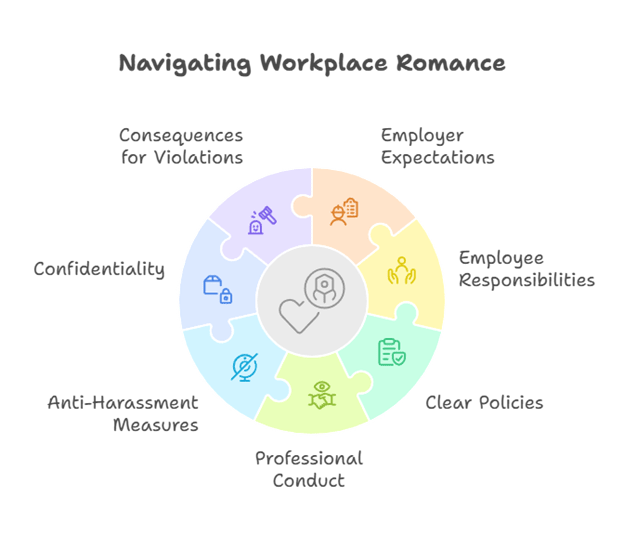
Dating in the workplace is a common occurrence, given how much time employees spend together. However, it brings unique challenges and risks that employers must address to maintain a professional, safe, and productive environment.

1. Clear Policies and Guidelines
Employers are increasingly expected to have clear, written policies regarding workplace relationships. These policies typically outline:

  • Disclosure Requirements: Many employers require employees to disclose romantic relationships, especially if there is a reporting relationship or potential conflict of interest. Disclosure allows the employer to manage risks, such as favoritism or conflicts, and to make adjustments if necessary (e.g., changing reporting lines).
  • Prohibited Relationships: Most policies explicitly prohibit relationships between managers and their direct reports to avoid power imbalances and perceptions of favoritism or coercion.
  • Consensual Relationships: Employers emphasize that all relationships must be consensual and free from any form of harassment or coercion. Some require both parties to sign a consensual relationship agreement.

2. Professional Conduct
Employers expect employees to maintain professionalism at all times, which includes:

  • No Public Displays of Affection (PDA): Employees are expected to refrain from PDA or any behavior that could make colleagues uncomfortable.
  • No Favoritism: Employees should avoid any actions that could be perceived as favoritism or bias due to their relationship.
  • Maintaining Boundaries: Personal issues should not spill over into the workplace. If a relationship ends, both parties are expected to remain professional and not disrupt the work environment.

3. Anti-Harassment and Complaint Procedures
Employers are required to have robust anti-harassment policies and complaint procedures:

  • Sexual Harassment Training: Regular training is expected, especially for supervisors, to ensure everyone understands what constitutes harassment and how to report it.
  • Multiple Reporting Channels: Employees should have several avenues to report inappropriate conduct, not just through their direct supervisor.
  • Prompt Investigation: Employers are expected to investigate complaints thoroughly and impartially, taking corrective action if necessary.

4. Confidentiality and Non-Retaliation

  • Confidentiality: Employers stress the importance of keeping personal relationships and related information confidential to protect privacy and prevent gossip.
  • Non-Retaliation: Employees must be protected from retaliation if they report concerns or end a relationship.

5. Consequences for Policy Violations
Violating workplace dating policies can result in disciplinary action, including reassignment or termination, depending on the severity of the infraction.

Key Takeaways for Employees

  • Know Your Company’s Policy: Always check your employee handbook or consult HR before starting a workplace relationship.
  • Disclose When Required: If your company requires disclosure, do so promptly to avoid potential disciplinary action.
  • Maintain Professionalism: Keep your relationship separate from your work life, avoid PDA, and treat your partner and colleagues equally.
  • Understand the Risks: Be aware that workplace relationships can lead to gossip, perceptions of favoritism, and complications if the relationship ends.
  • Seek Support if Needed: If you experience harassment or retaliation, use the reporting channels provided by your employer.

What Are Love Contracts?
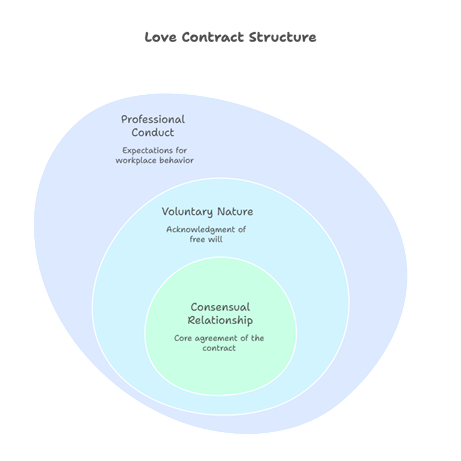
love contract—also known as a consensual relationship agreement—is a voluntary document signed by two employees who are in a romantic relationship at work. The contract typically acknowledges that the relationship is voluntary and consensual, and it often outlines expectations for professional conduct in the workplace 

Why Employers Use Love Contracts

  • Legal Protection: Love contracts are primarily used to protect employers from potential legal claims, especially those related to sexual harassment or favoritism. By having both parties acknowledge the consensual nature of the relationship, employers can reduce the risk of later claims that the relationship was unwelcome or coerced 
  • Clarifying Boundaries: These agreements help clarify how the romantic relationship will (and will not) affect the working relationship, which can be especially important if one party supervises the other 
  • Managing Breakups: In the event of a breakup, a love contract can help smooth the transition and set expectations for continued professionalism 

When Are Love Contracts Used?
Love contracts are most commonly used when a workplace romance involves a manager and a subordinate, as this dynamic poses the greatest risk for claims of harassment or favoritism. Most companies do not require love contracts for relationships between employees at the same level.

Ethics in the Workplace
Leadership ethics in the workplace refers to the practice of leaders making decisions and guiding their teams based on moral principles and values, rather than just focusing on profits or personal gain. Ethical leadership is about doing the right thing for the common good, considering the needs of employees, customers, communities, and the organization as a whole.
Core Principles of Ethical Leadership
Ethical leadership is built on several foundational principles:

  • Respect: Ethical leaders value the skills and contributions of others, fostering mutual respect rather than demanding it one-way. This creates healthier workplace relationships and a positive environment 
  • Accountability: Leaders hold themselves responsible for their actions, lead by example, and communicate openly about challenges without shifting blame 
  • Service: Ethical leaders prioritize the well-being of employees, customers, and the community, often engaging in charitable activities and encouraging their teams to do the same 
  • Honesty and Transparency: Open and honest communication builds trust within the organization and with customers, even when addressing difficult or unpopular issues 
  • Justice and Fairness: Ethical leaders ensure fair treatment for everyone, striving for equity and inclusion in decision-making 
  • Community: They view the organization as a community, considering the impact of decisions on all stakeholders and promoting collaboration 

A helpful framework for remembering these principles is the acronym FATHER: Fairness, Accountability, Trust, Honesty, Equality, and Respect.

Why Leadership Ethics Matter

Ethical leadership has significant benefits for organizations:

  • Improved Workplace Culture: Ethical leaders inspire trust, psychological safety, and a sense of belonging, leading to higher employee morale and engagement 
  • Attracting and Retaining Talent: Employees, especially younger generations like Gen Z, are drawn to organizations with strong ethical values and are more likely to stay with such companies 
  • Customer Loyalty: Consumers increasingly prefer to support businesses that demonstrate ethical practices and social responsibility 
  • Risk Reduction: Ethical decision-making minimizes legal issues, fines, and reputational damage 
  • Long-Term Success: Ethical leadership helps prevent scandals and fosters sustainable growth by building loyal partnerships, customers, and employees 

What Should Employers Consider?

  • Reporting Requirements: Love contracts usually require employees to report their relationship to HR, and also to notify HR if the relationship ends 
  • Favoritism Concerns: Even with a love contract, employers must be vigilant about potential claims of favoritism or discrimination from other employees.
  • Policy Integration: Love contracts should be part of a broader workplace romance policy that addresses reporting, confidentiality, and professional conduct.

7 Avenues for Improved Workplace Communication

Original post date: December 16, 2024

Organizations large and small are challenged with the right approach for how best to communicate within their workforce.  How personal do we make the communication?  How do we communicate important information timely to a large group of individuals?  Do we send a mass email?  Do we have all hands meetings?  The answer to these along with many other questions regarding workplace communication is that it depends; it depends on the workforce, the information, the timing and the culture of the organization. 

All leaders will have a different approach to communication, whether the organization is 5 people for 50,000 people.  The worst thing any of us can do is not communicate with the workforce, delivering less than positive news is not always easy but for an employee to learn about it on social media or through another channel of communication is not acceptable. 

Below are 7 avenues for improved workplace communication:

  1. Know Your Organization: How communication has and has not worked in the past within the organization.  If you were an employee of the organization, how would you want to hear about good and/or bad news?  If you are unsure of what avenue of communication to use, ask the workforce.  Can you please everyone?  Probably not, but it will make it easier and much more efficient to communicate with people knowing this information.
  • All Hands Meetings: This is a great approach to deliver information to a large group of employees.  They hear the same message from the same person, there is no second or third hand information delivery.  We found success with all hand’s meetings quarterly; we developed an agenda and each department leader presented on metrics.  The downfall to this approach is employee’s not asking questions in front of peers or a larger group.  Be open to suggestion or questions ahead of time to help prepare the information.   
  • Bulletin Boards or Intranet Communication Walls:  Bulletin boards have existed in organizations for decades.  Keeping a bulletin board updated in a breakroom or near a timeclock is a great way to communicate information, if you consistently update the bulletin board with new information.  If you have a memo that has not been changed in 1 year, employees will stop looking at the bulletin board.  Remember the labor posters as well!  The intranet is a new trend in organizations, a great place to update information and communicate, if all employees have access to the intranet.  If you do use the intranet and it is updated, there should be a mechanism that alerts all employees of the update via email, text message, etc. so they know to review the new information. 
  • Newsletter or Paychecks:  Organization have had tremendous success with newsletters, we wrote a newsletter monthly, printed it and sent it out via email throughout the organization.  Newsletters work if you are consistent, add a personal touch and have relevant information within the publication.  I always added birthdays, new births, pictures of the shop and any upcoming meetings with 401k, health insurance etc.  I also asked for input from employees within the organization.  If someone wanted to write an article I was happy to add it, if the article was appropriate.  Many organizations are now adding workplace communication memos on paycheck or direct deposit stubs.  This is a great idea to communicate small amounts of information to the employees or the employee’s spouse. 
  • Crew Meetings and Roundtable Discussions:  Managers and supervisors will meet with a team prior to the start of a shift.  The benefit to crew meetings or shop huddles is the manager/supervisor is familiar with the workforce and the group might be more comfortable asking questions in a smaller setting.  Roundtable discussions are discussions held by managers and leaders of the organization with small groups of employees.  Organization might choose to ask the employees questions or they might leave it as an open ended discussion.  I have seen this work, if it is done consistently and if organizational leaders follow-up on questions or concerns with employee’s directly.  Do not say “let me get back to you” and never get back to the employee.    
  • Memos or Suggestion Box:  Memos will work for small amounts of information, this is usually communicated by a manager or supervisor in a crew meeting, sent via email, posted on a bulletin board or updated on the intranet.  Memos will work if they are short, relevant and timely.  In past organizations we have found success with a suggestion box program, where other organizations have not had success.  Is your organization ready for a suggestion box?  Do you need a suggestion box?  Is there value to adding a suggestion box?  Will you or the leadership team follow-up individually with each employee on the suggestion good or bad to close the loop?  Implementing a suggestion box program will take time and resources, research options prior to rolling out a program and ask the workforce if it would be valuable. 
  • Decision Making Trees:

These are just a few of the many avenue’s organizations use to communicate within their respected organizations; email, memos home, safety meetings, safety councils, workplace communication teams, phone calls, text messages, training sessions, policies and procedures are other avenues of workplace communication.  Knowing your organization and the workforce will help you as a leader develop a communication process and communicate information consistently and timely.  As mentioned earlier, the last thing you want is for an employee to find out good and/or bad news through social media, on the internet or through the gossip mill.  This is a negative for employee morale.  If you do need assistance developing a communication plan or process, ask for help.  Communication is critical to the success of any organization, large or small.  If you commit to following up on a question or concern, ensure that you follow-up. 

10 Thoughts on Working through an ADA Accommodation

The Americans with Disabilities Act (ADA) was originally published in 1991, with revisions and updates in the mid-2000’s.  The legislation prohibits discrimination against people with disabilities in the workplace.  This article will focus on disability and accommodation during the application and employment relationship.  How does this impact our organizations?  What should we consider if an applicant or employee requires reasonable accommodation?  The steps below will assist our organizations in working through the complexity of accommodations.

Below are the 10 thoughts on ADA accommodations:

  1. Are you covered by the ADA? All employers with 15 or more employees are covered under the ADA at the federal level.  Review state regulations and legislation, to verify if there are stricter requirements at the state or local level. 
  1. Policies and Procedures in Place: Ensure your organization has handbook language, a policy, process and/or procedures in place to work through disability accommodations. This includes reviewing job descriptions; physical, standing, sitting or lifting requirements.  The more accuracy in the job descriptions, the better we can assess accommodations and determine the reasonableness of the accommodation request.
  1. Is the applicant qualified? The individual needs to satisfy the definitions under the ADA.  Applicants must meet the skill, experience, education and other job-related requirements.  They must be able to perform the essential functions of the position.
  1. The Interactive Process: Employers should engage in the interactive process in which the employee, health care provider and employer share relevant and important information on the position, the disability, accommodations and limitations of the applicant. This should be a good faith communication process between the parties.
  1. Employee Disability Under the ADA:
  • The ADA defines a disability as one of the following: a) a physical or mental impairment that substantially limits a major life activity; b) a record of a physical or mental impairment that substantially limited a major life activity; or c) being regarded as having such an impairment.
  • According to the Equal Employment Opportunity Commission (EEOC), the ADA Amendments Act (ADAAA) includes impairments that would automatically be considered disabilities. They include deafness, blindness, intellectual disability, completely or partially missing limbs, mobility impairments that require the use of a wheelchair, autism, cancer, cerebral palsy, diabetes, epilepsy, HIV or AIDS, multiple sclerosis and muscular dystrophy, major depression, bipolar disorder, post-traumatic stress disorder, obsessive-compulsive disorder, and schizophrenia.
  • The definition of major life activities includes caring for oneself, performing manual tasks, seeing, hearing, eating, sleeping, walking, standing, lifting, bending, speaking, breathing, learning, reading, concentrating, thinking, communicating and working. Major bodily functions include functions of the immune system; normal cell growth; and digestive, bowel, bladder, neurological, brain, respiratory, circulatory, endocrine and reproductive functions.
  • The definition of a disability also includes situations in which an employer takes an action prohibited by the ADA based on an actual or perceived impairment—for example, removing from customer contact a bank teller who has severe facial scars because customers may feel uncomfortable working with this employee or may perceive the employee as having an impairment when, in fact, he or she does not.
  • The ADAAA directs that if a “mitigating measure,” such as medication, medical equipment, devices, prosthetic limbs or low vision devices eliminates or reduces the symptoms or impact of the impairment, that fact cannot be used in determining if a person meets the definition of having a disability. Instead, the determination of disability should focus on whether the individual would be substantially limited in performing a major life activity without the mitigating measure. This rule, however, does not apply to people who wear ordinary eye glasses or contact lenses.
  • The following are not disabilities under the ADA: transvestism, transsexualism, pedophilia, exhibitionism, voyeurism, gender identity disorders not resulting from physical impairments, other sexual behavior disorders, compulsive gambling, kleptomania, pyromania, and psychoactive substance use disorders resulting from current illegal use of drugs.”[i]
  1. Reasonableness of the Accommodation: The accommodation can be a modification in the workplace. The price of reasonable accommodation will vary, case by case.  Determination of the accommodation should be an open process between the three parties and should be consistent throughout the organization with employees and applicants.
  1. Reasonable Accommodation versus Undue Hardship:
  • “The EEOC, when determining if the employee request creates an undue hardship to the employer, looks not only at the cost of the particular accommodation but also at the financial stability of a company. If the company is making significant profits or has a sizable net worth, the employer may not be able to prove that the requested accommodation would have a significant financial impact, therefore creating an undue hardship. For example, it may be an undue hardship for a nonprofit organization with limited funds to provide a special chair that costs $1,000 as an accommodation to an employee. However, the same request by an employee working in a for-profit organization that made sizable profits may not be seen as an undue hardship for that employer.
  • Accommodations that could result in an undue hardship include modifications that are “unduly extensive or disruptive, or those that would fundamentally alter the nature or operation of the job or business,” according to the EEOC. For example, small employers that require their employees to be able to perform a number of different jobs and tasks may not find it feasible or cost-effective to provide job restructuring as a “reasonable accommodation,” whereas in larger organizations, this may be a free or low-cost option.
  • The EEOC does not see impact on employee morale as a reasonable undue hardship defense.”[ii]
  1. Communication is Critical: The organization should notify the employee in writing if the accommodation has been approved or denied.  Details of the anticipated accommodation start date or reason for the denial should be included.  Copies of all material should be included in the employee files.  Make copies of all information.
  1. Review, Modify and Evolve: Just as we manage PFL and FMLA claims, we need to continue to review open accommodation cases, in the event accommodation requirements change, we need to be aware of these changes. Work with the employee and health care provider to ensure the communication channels remain open.
  1. Job Accommodation Network (JAN): “The Job Accommodation Network (JAN) is the leading source of free, expert, and confidential guidance on workplace accommodations and disability employment issues. Working toward practical solutions that benefit both employer and employee, JAN helps people with disabilities enhance their employability, and shows employers how to capitalize on the value and talent that people with disabilities add to the workplace.”[iii] This is a great resource with helpful information.  The forms, templates and accommodation recommendations are useful for all organizations.  Be proactive and strategic in your approach to accommodations.

Job Accommodation Network

Below are the links for upcoming training’s both in person and online webinars:

Upcoming Compliance Key Trainings

Elmira College: SHRM Certification Exam Prep Course- Fall 2018 & Spring 2019

Upcoming Compliance Online Training

Compliance IQ Webinar

– Matthew Burr, HR Consultant

[i] https://www.shrm.org/resourcesandtools/tools-and-samples/how-to-guides/pages/requestreasonableaccommodation.aspx

[ii] https://www.shrm.org/resourcesandtools/tools-and-samples/how-to-guides/pages/requestreasonableaccommodation.aspx

[iii] https://askjan.org/about-us/index.cfm

7 Reasons to Implement Stay Interviews in Your Organization

What is a stay interview?  “A stay interview is a structured discussion a leader conducts with an individual employee to learn specific actions the leader can take strengthen the employee’s engagement and retention with the organization.”[i]  What is the value of the stay interview?  The organization hears directly from the employee in a one-on-one discussion (not related to performance), with any issues, concerns and opportunities leadership improvement.  This provides us as leaders the opportunity to engage, communicate and retain the workforce.  The stay interviews should be conducted by the leader of the organization, with HR’s support.  I have used effectively used stay interviews.

Below are the thoughts on implementing stay interviews:

  1. Start at the Top: The leader at the top of the organization should set the tone for the organization and conduct stay interviews with their direct reports.  The process should cascade down throughout the rest of the organization to front-line supervisors and employees.  Employees at every level should take part in a stay interview, to ensure an effective and successful process.
  1. In Person: Stay interviews should not be conducted over the phone or via a video conferencing system, if possible. Remote workers should have the opportunity to sit one-on-one with their supervisor and have a discussion.
  1. Expectations of the Stay Interview: Ensure the employee understands the reason for the stay interview and how these interviews will focus on area’s that the manager can influence.  Not all of us can change company policy, mission statements and strategic goals.  However, if a trend in these interviews is consistent, we might have more say in strategic objectives.
  1. Schedule Time: “Most stay interviews take 20 minutes or less to conduct, but some will carry on longer. Leaders should consider telling employees to allow 20 minutes for their meeting, but even then, leaders should allow thirty minutes on their calendars.”[ii] Treat the employee as you want to be treated during the stay interview.
  1. Leave Performance Out of It: There is a time and place to discuss performance expectations. Stay interviews should remain focused on engagement, retention feedback, communication and concerns.  Scripted open ended questions are necessary.
  1. No Advanced Questions: This can limit the conversation to a list of memorized demands and responses. Open ended discussion with note taking, listening and probing for additional information will add tremendous value to the stay interview.
  1. Opening Script: The pre-drafted script is a great way to open the meeting. This will provide additional information to the employee on what the process will look like and the direction of the interview.  The messages will be consistent throughout the organization.

The Why of Stay Interviews:

  • “Employees hear directly from their supervisor that they care and want them to stay and grow with the company.
  • Supervisors further accept retention and engagement within their sphere of responsibility.
  • Employees are more likely to accept responsibility for staying.
  • Stay interviews build trust.”[iii]

Stay Interview Draft Template:

To open the stay interview, a manager may use the following (or similar) statements:

  • I would like to talk with you about the reasons you stay with ____, so I understand what I might be able to do to make this a great place to work.
  • I’d like to have an informal talk with you to find out how the job is going, how the job will change, so I can do my best to support you as your manager, particularly with issues within my control.
  • I will be taking notes throughout our discussion and might ask you to repeat yourself if I do not capture everything.
  • Do you have any questions before we get started?

Review Job Description and Changing Expectations

  • These are the current changes to the job description
  • These will be the changes to the position and current expectations/accountabilities
  • Discuss the reporting structure
  • Communication expectations
  • System reporting expectations
  • Do you have any questions or concerns?

Questions

The following are questions you may ask during a stay interview. You should have several open-ended questions on hand. It’s important to listen and gather ideas from the employee about how you and your organization can retain him or her.

  • Tell me specifically, what factors cause you to enjoy your current job and work situation (including people, job, rewards, job content, coworkers, management etc.), and as a result, they contribute to your staying at our firm as long as you have?
  • What gets your excited to come to work here every day?
  • What do you look forward to when you come to work each day?
  • What do you like most or least about working here?
  • What keeps you working here?
  • If you could change something about your job, what would that be?
  • What would make your job more satisfying?
  • How do you like to be recognized?
  • What talents are not being used in your current role?
  • What would you like to learn here?
  • What motivates (or demotivates) you?
  • What can I do to best support you?
  • What can I do more of or less of as your manager?
  • What can we be doing differently as a management team?  Communication, meetings, etc.
  •  If you “managed yourself,” what would you do differently (in relation to managing “you”), that I, as your current manager, don’t currently do?
  • What might tempt you to leave?

Below are the links for upcoming training’s both in person and online webinars:

Upcoming Compliance Key Trainings

Elmira College: SHRM Certification Exam Prep Course- Fall 2018 & Spring 2019

Upcoming Compliance Online Training

Compliance IQ Webinar

– Matthew Burr, HR Consultant

[i] https://www.shrm.org/resourcesandtools/hr-topics/employee-relations/pages/stay-interview-how-to-core-features-and-advantages.aspx

[ii] https://www.shrm.org/resourcesandtools/hr-topics/employee-relations/pages/stay-interview-how-to-core-features-and-advantages.aspx

[iii] https://www.shrm.org/resourcesandtools/hr-topics/employee-relations/pages/stay-interview-how-to-core-features-and-advantages.aspx

6 Final Guidance Updates to the New York State Sexual Harassment Prevention Laws

As we are all aware, in August 2018, the state published drafts of guidance materials concerning the new legislation, including a model sexual harassment prevention policy, a model complaint form, and model training materials. The state accepted public comments on these materials and, in the October 1, 2018 final guidance, made several changes as a result. On October 1, 2018, New York State released final guidance on the state’s new sexual harassment prevention laws. The new legislation requires all employers in New York State to publish policies concerning sexual harassment, adopt a sexual harassment complaint form, and conduct sexual harassment training.

 Below are final guidance updates:

  1. Employers have additional time to ensure all employees receive the required sexual harassment training. Training must now be completed by October 9, 2019, rather than the original January 1, 2019 deadline.
  1. New hires must be trained “as soon as possible.” Previously, the draft guidance specified new hires should be trained within 30 days of their start date.
  1. The model sexual harassment prevention policy was modified in several respects, including:
    1. The definition of harassment was amended to include harassment based on “self-identified or perceived sex” and “gender expression.”
    2. “Sex stereotyping” was added as an example of sexual harassment.
    3. The language concerning investigations was softened, with the policy now noting the investigation process “may vary from case to case.”
  1. The model complaint form was shortened to omit questions concerning whether the employee filed an external complaint or retained an attorney
  1. The training, which may be presented to employees individually or in groups; in person, via phone or online; via webinar or recorded presentation, should include as many of the following elements as possible:
  • Ask questions of employees as part of the program;
  • Accommodate questions asked by employees, with answers provided in a timely manner;
  • Require feedback from employees about the training and the materials presented.
  1. The training must:
  • Be interactive;
  • Include an explanation of sexual harassment consistent with guidance issued by the Department of Labor in consultation with the Division of Human Rights;
  • Include examples of unlawful sexual harassment;
  • Include information concerning the federal and state statutory provisions concerning sexual harassment and remedies available to targets of sexual harassment;
  • Include information concerning employees’ rights of redress and all available forums for adjudicating complaints; and
  • Include information addressing conduct by supervisors and additional responsibilities for supervisors.

The tools and resources that were released on October 1 include:

  • Updated website with resources for employers, employees, state contractors and targets of sexual harassment
  • Updated model sexual harassment prevention policy
  • Updated model sexual harassment complaint form
  • Updated model training (script book and PowerPoint presentation)
  • Updated minimum standards for sexual harassment prevention policies and trainings
  • Updated FAQs
  • Toolkits for employers and employees and a sexual harassment prevention policy poster are also being made available.

Sexual Harassment in the Workplace 

Employer Resource Link

Frequently Asked Questions Link

Below are the links for upcoming training’s both in person and online webinars:

Upcoming Compliance Key Trainings

Elmira College: SHRM Certification Exam Prep Course- Fall 2018 & Spring 2019

Upcoming Compliance Online Training

Compliance IQ Webinar

-Matthew W. Burr

5 Considerations When Giving a Reference

As we all know, when an employee leaves an organization, it isn’t always on a positive note.  Through a resignation or termination, the employment relationship ends, positive or negative, good or bad.  As previous employer’s we are conflicted on what information to provide about the current or former employee during the reference or background checking processes.  Should we tell the new organization the employee was terminated or a poor performer?  Should we tell the new organization that the employee caused conflict and drama or didn’t show up for work on time, missed days, quality issues, etc.?  What if there was a workplace violence issue?  The standard answer for most organizations is; date hired, last position held and last day worked.  What if the new organization questions you, the old employer if the person is eligible for rehire or if you would hire them again?  What do we do then?  In many situations, these are not easy questions to answer.

The five considerations when giving an employment reference:

  1. Applicable state legislation: Many states now have legislation that gives employers “qualified immunity” when we as former employers are providing reference information. “That means you’re protected from civil liability if you’re responding in good faith-in other words, without knowingly providing false or misleading information or acting with malicious intent.”[i]  What does that mean for us in New York State?  “Currently (2005 article), New York employers have a qualified privilege defense available to them when they provide information regarding an employee or former employee’s character…New York has not adopted a reference check immunity law…reference check immunity laws do not protect employers against claims that negative job references were given in retaliation for protected activity under discrimination laws.”[ii]  As of 2005, there were thirty states that had adopted reference check immunity laws, which vary widely throughout the country.  If you have former employees moving to another state, know the state laws prior to providing reference checks or additional information about the employment relationship.


  1. Control the Information: The Society of Human Resource Management recommends that we as employer’s limit who can and cannot give references and what information can be provided. It should be the responsibility of the HR professional, manager, general manager, office manager, business owner, etc.  Someone designated with authority that can speak to the employment relationship.  This will ensure consistency in the process throughout the organization.


  1. Consistency in the Process: Reference requests should follow the same process for all current or previous employee’s.  “All disclosures should be made only in writing and only upon written request from the prospective employer and with written permission from the employee.”[iii]  Companies are now outsourcing the reference check processes, which ensures consistency.  However, this provides limited information for the future employer.


  1. Relevant Facts: Do not give opinions about the employee’s suitability for a prospective job or new position. Even if the employee was an underperformer at your organization, they could be a great fit for the new position.  Use only documented evidence on job performance, when sharing with the prospective employer.  Less said, better defended!


  1. Employee Permission: It is recommended that all job candidates complete an application form that includes a release for employers from which they have added as a reference. This form should be consistent across the organization, to ensure equity and avoid discrimination charges.  I recommend obtaining this prior to releasing any information about the current or former employee.


As leaders, we need to ensure we are consistent when providing references for all our employee’s; past, current and future workforce.  Updating policies, procedures and processes will provide the foundation on which we can build a consistent process for reference checking and verification.  Documenting work performance and accurate performance reviews will help in providing accurate and relevant work-related information.  Remember that state laws will vary on qualified immunity legislation and these laws like most other’s will continue to evolve through court decisions and the legislative process.  Seek guidance if you are confused or need assistance developing or revising a process.  Be consistent, equitable, stick to the facts and control the information your organization provides during a reference check.

-Matthew W. Burr

[i] https://www.shrm.org/hr-today/news/hr-magazine/0418/Pages/when-giving-references-how-truthful-can-you-be.aspx

[ii] https://nys.shrm.org/sites/nys.shrm.org/files/ReferenceChecking.pdf

[iii] https://www.shrm.org/hr-today/news/hr-magazine/0418/Pages/when-giving-references-how-truthful-can-you-be.aspx

11 Changes to New York State Sexual Harassment Laws

Yes, that does read correctly, 11 upcoming changes.  New York State legislators have passed multiple regulations related to sexual harassment in the workplace; training, policies, reporting, etc.  Many of these new regulations and rules are in the wake of the #MeToo movement and the many issues we have seen with sexual harassment in the workplace in a variety of industries, organizations and professions.  As leader’s we cannot tolerate harassment of any kind.  The new law(s) require employers to provide sexual-harassment training to all workers and much more.

The 11 changes to sexual harassment legislation (for now):

  1. October 9, 2018: As of now, and by October 9, 2018, employers in New York State must implement annual sexual-harassment training. The state is developing a model program, which can be used by employers.  Any training implemented must meet or exceed the minimal state requirements.  More to come on this area of change.

Training Requirements:

  1. “An explanation of sexual harassment and specific examples of inappropriate conduct.
  2. Detailed information concerning federal, state and local laws and the remedies available to victims of harassment.
  3. An explanation of employees’ external rights of redress and the available administrative and judicial forums for bringing complaints.”[i]

Sexual-Harassment Prevention Policy

The state is requiring organizations to adopt a sexual-harassment prevention policy and distribute to employees (yes now you must have a handbook of sorts), the expectations of the new requirements could vary from what your organization is currently using.  The state has strict requirements for organizations policies and procedures.  Be aware of expectations and implement accordingly.  The policy is required to include (for now):

  1. “A statement prohibiting sexual harassment and providing examples of what constitutes sexual harassment.
  2. Information about federal and state sexual-harassment laws and the remedies that are available to victims—and a statement that there may be additional local laws on the matter.
  3. A standard complaint form.
  4. Procedures for a timely and confidential investigation of complaints that ensures due process for all parties.
  5. An explanation of employees’ external rights of redress and the available administrative and judicial forums for bringing complaints.
  6. A statement that sexual harassment is a form of employee misconduct and that sanctions will be enforced against those who engage in sexual harassment and against supervisors who knowingly allow such behavior to continue.
  7. A statement that it is unlawful to retaliate against employees who report sexual harassment or who testify or assist in related proceedings.”[ii]

Senate Passes Comprehensive Strengthening of New York’s Sexual Harassment Laws

The Senate Bill

Guidance on Sexual Harassment for All Employers in New York State

These changes are significant across the state.  As leaders, we need to begin planning for training needs throughout the organization and updating policies and procedures.  The training should have a sign in and sign out sheet to ensure employees did attend and stayed to complete the training.  Recording the training to verify all were in attendance was a suggestion I recently heard at a training, but to also show new employees during the new hire orientation process.  Remember this is an annual training.  However, new hires need training as well.  Policies that are modified need to have signatures and witness signatures to verify receipt and understanding.  We are all learning about these changes together.  We need to be proactive and seek guidance, as these laws continue to change and evolve.  New York City has laws above and beyond state requirements (more to be written on this).  Continue to monitor for new updates coming out of Albany.  There are many legal seminars throughout the state on this topic, which will be helpful to organizations of all sizes.  More to be written on these new requirements in upcoming articles!


– Matthew Burr, HR Consultant

[i] https://www.shrm.org/resourcesandtools/legal-and-compliance/state-and-local-updates/pages/new-york-sexual-harassment-training.aspx

[ii] https://www.shrm.org/resourcesandtools/legal-and-compliance/state-and-local-updates/pages/new-york-sexual-harassment-training.aspx

5 Definitions for Alternative Dispute Resolution

Alternative dispute resolution (ADR), is an umbrella term used for methods to resolve disputes internal to the organization and outside the court system.  Many organizations use one or all of the ADR techniques, with the techniques continuing to grow in popularity.  Union and nonunion organizations use ADR techniques to resolve disputes, large and small.  Dispute resolution is a necessity for any organization, resolution can impact organizational culture, engagement and turnover rates.  The techniques defined below can be used to resolve disputes outside of the workforce as well, we have mediation services in our communities that assist families, neighbors, etc. resolve disputes through proactive channels of communication.

The 5 Definitions of Alternative Dispute Resolution:

  1. “Arbitration: an ad judicatory process in which a neutral third party imposes a final, binding decision to resolve a dispute.
  2. Mediation: an informal process in which a neutral third party assists opposing parties to reach a voluntary, negotiated, non-binding resolution of a dispute; may be conducted internally or externally.
  3. Ombudsman: a neutral third party who is designated to confidentially investigate and propose settlement of complaints brought by employees; may be an insider or outsider.
  4. Open-door policy: a process in which employees are encouraged to discuss problems with their immediate supervisors or others in the chain of command.
  5. Peer review an internal process in which a panel of employees works together to resolve employment complaints.”[i]

Arbitrators, mediators and ombudsman are trained in dispute resolution techniques.  They know how to fact-find, draft agreements and issues decisions.  An open-door policy is an easy way to resolve disputes.  We listen to the issue (not listen to respond) and address any concerns.  Peer review is another process that can be implemented, this also needs to be managed proactively to ensure it’s legal.   All of the ADR techniques work, the effectiveness will vary by organization.  Select a process that works for your organization and be consistent with dispute resolution.

New York State Paid Family Leave Update:

Recent changes to NYS PFL confirmed that employers do not need to cap the weekly employee payroll deduction for PFL at .126% of the NYS Average Weekly Wage ($1.65 per week in 2018).  Employers can deduct .126% of an employee’s weekly wage until the employee hits the annual cap of $85.56, which is .126% of the annualized weekly wage.  This is a significant change, which better positions employers to collect the full PFL premium from each employee.

Work with your payroll companies and NYS PFL providers to ensure the calculations are accurate and deducted under current legislation.  If you are confused, seek guidance.  Like many laws, we continue to see changes to NYS Paid Family Leave. 


– Matthew Burr, HR Consultant

[i] American Arbitration Association, U.S. EEOC & SHRM Magazine

Are You Due for a Sabbatical?

Introduction Contributed by Kara Whittaker, Ghergich & Co. https://ghergich.com/   Kara@Ghergich.com

There’s a crisis in the American workplace, but it’s probably not what you think it is. We’re not taking our vacation time, and it’s leading to all sorts of unproductive, cranky, stressed-out employees. And that, we all know, isn’t good for business.
Employees not taking vacation time is not a small problem, either. In fact, the trend keeps going up—we keep taking less and less of what we’re owed—to the tune of over 660 million days left on the table, every year. If you’re one of those employees that keeps ignoring your vacation (or even if you’re not), then you might want to consider a radical approach to hitting that reset button: a sabbatical.
Many people are familiar with a sabbatical in the academic world; it’s a chance for academics to pursue a rigorous research idea and do so without having to teach class. But the same notion can be used in the workplace, even if it’s just for a few weeks or months. Here’s what to know about it – https://www.discover.com/personal-loans/resources/major-expenses/sabbatical/

you_may_be_due_for_a_sabbatical_and_not_even_know_it

2018 W-4 Form, W-4 Requirements Annually, and changes to NYC Legislation

In late February, the IRS released the updated 2018 Form W-4 and an updated tax withholding calculator.  The calculator provides an opportunity for employees to check their 2018 tax withholding after the passage of the Tax Cuts and Jobs Act, prior to filling out a new Form W-4.

2018 Form W-4

IRS Withholding Calculator

Do employee’s need to complete a new Form W-4 annually:

“Not necessarily. A W-4 form remains in effect until an employee submits a new one except when an employee claims to be exempt from income tax withholding.”

Employers should ensure they have new W-4s for:

  1. New employees. Employers should keep copies of the most current W-4s on hand.
  2. Employees who had a change in withholding events during the year.
  3. Employees claiming exemption from withholding. To continue to be exempt from withholding in the next year, employees must give employers a new W-4 claiming exempt status by Feb. 15 of that year. If an employee doesn’t give you a new Form W-4, employers must withhold tax based on the last valid Form W-4 for the employee that doesn’t claim exemption from withholding or, if one doesn’t exist, as if he or she is single with zero withholding allowances.”[i]


IRS Publication 15 provides guidelines for employers to remind employees before December 1 of each year to submit a new W-4 form if the withholding allowances changed or will be changing in the next year; due to added dependents, new tax legislation, etc.  As employers, we need to ensure all of our new hire paperwork is up-to-date.  This recent change should be noted as part of your organizations onboarding/new hire process.


NYC Evolving Legislative Changes:

NYC Mandates Temporary Schedule Changes 7/18/18

The new law provides employees with additional rights to demand changes to their schedule.  The law permits employees to demand two temporary schedule changes per calendar year for personal events.  The definition of personal events is broad, which leaves room for interpretation.  There are guidelines and certain exemptions to the new rule.  However, it is broad and will cover many organizations.

NYC Mandates “Cooperative Dialogue” 10/15/2018

This law codifies the organizations obligation to engage in a cooperative dialogue with any employee who may be entitled to reasonable accommodation.  “Specifically, you will need to engage in a good faith written or oral “cooperative dialogue” with the employee addressing:

  1. The employee’s accommodation needs.
  2. Potential accommodations that may address the needs, including alternatives to an employee’s requested accommodation.
  3. The difficulties that such potential accommodations may pose for your business.

After a final determination is made at the conclusion of the “cooperative dialogue,” you must provide the employee requesting the accommodation with a final written determination as to whether or not the accommodation is granted.”[v]

The  legislative changes in New York City will not impact employers in the Southern Tier, unless you have employees in the city.  However, as we have seen in the past, changes in NYC make their way to Albany, which result in statewide sweeping legislative changes, which can and do impact organizations in the Southern Tier.  Continue to watch for legal updates at the federal, state and local level.  If you are confused, seek guidance.  Legislative change is a continuous process and it can be complex.  As society evolves, so do our laws and regulations.  Asking questions, attending trainings, working with consultants and attorneys will provide you with a clearer picture of the evolving legislation.

Interested in learning more from me? Check out the options shared here: 

Upcoming Compliance Key Trainings

Elmira College: SHRM Certification Exam Prep Course- Coming in Spring 2019

Upcoming Corning Community College Training’s

[i] https://www.shrm.org/resourcesandtools/tools-and-samples/hr-qa/pages/cms_015244.aspx

[ii] https://www.shrm.org/resourcesandtools/hr-topics/compensation/pages/daylight-saving-time-wage-hour-problems.aspx

[iii] https://www.shrm.org/resourcesandtools/hr-topics/compensation/pages/daylight-saving-time-wage-hour-problems.aspx

[iv] Burr Consulting, LLC, “3 Daylight Savings Time Wage & Hour Considerations”, Burrconsultingllc.com, November 6, 2017

[v] https://www.shrm.org/resourcesandtools/legal-and-compliance/state-and-local-updates/pages/new-york-city-employers-reasonable-accommodations.aspx

-Matthew W. Burr