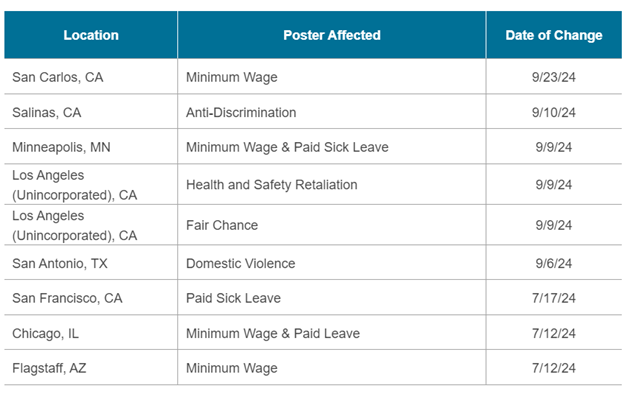
2024 Labor Law and Regulations Poster Compliance Requirements

Original Posting Date: 11/11/2024

Federal Labor Poster Website

New York State Labor Poster Website

Pennsylvania Labor Poster Website

The DOL’s recent increase of maximum fines for noncompliance may also prompt employers to take a closer look.

The maximum fine amounts for noncompliance with certain federal notice and posting requirements, to include the following:

  • Family and Medical Leave Act (FMLA): $189 (from $178)
  •  “Job Safety and Health: It’s the Law” (Occupational Safety and Health Act): $14,502 (from $13,653)
  • Employee Polygraph Protection Act (EPPA): $23,011 (from $21,663)

The DOL’s annual increase in maximum fines illustrates that posting requirements remain on its radar. As such, employers may want to be mindful of more specific posting requirements including the following:

  • Notably, the FMLA poster, Equal Employment Opportunity poster, and Employee Polygraph Protection Act poster must be displayed and visible to applicants.
  • While the applicable DOL regulations precede the internet’s ubiquity in the employment space, according to guidance issued by the DOL, a prominent notice on an employer’s website with a link to the applicable posters, in most cases, is a necessary supplement but not a substitute for the physical posting required by certain federal statutes.
  • Large combination posters are also available for employers that are required to post all posters contained in the DOL’s “six-in-one” poster.
  • The Occupational Safety and Health Administration’s (OSHA) poster and the Executive Order 13496: Notification of Employee Rights Under Federal Labor Laws poster (a required notice for federal contractors and subcontractors) have specific size requirements.

Other Thoughts on Posting Requirements:

  1. “Fair Labor Standards Act (FLSA) regulations, for example, to physically display posters “in conspicuous places in every establishment where such employees are employed so as to permit them to observe readily a copy” (29 C.F.R. §516.4). Required posters must be displayed so they are easily visible to the intended audience, according to the U.S. Department of Labor.
  2. Executive Order No. 11246, which governs affirmative action by federal contractors, indicates that required posters must be displayed in “conspicuous places accessible to all employees, job applicants and union representatives”(41 C.F.R. §60-1.42).
  3. The Family and Medical Leave Act (FMLA) regulations, which apply to employers with 50 or more employees, do state that “electronic posting is sufficient to meet this posting requirement as long as it otherwise meets the requirements of this section.” However, the act also requires covered employers to post a notice “prominently where it can be readily seen by employees and applicants for employment” (29 C.F.R. §825.300).”[i]
  4. “With a few exceptions (FMLA, MSPA and Executive Order 13496), the U.S. Department of Labor’s regulations do not require posting of notices in Spanish or other languages…
    1. The federal Family and Medical Leave Act (FMLA) regulations state, “Where an employer’s workforce is comprised of a significant portion of workers who are not literate in English, the employer shall provide the general notice in a language in which the employees are literate.” See FMLA regulation 825.300, (4).
    1. While no similar regulation exists for the Fair Labor Standards Act (FLSA) poster, the Department of Labor (DOL) advises, “Although there is no size requirement for the poster, employees must be able to readily read it” and goes on to list the languages the poster is provided in, adding, “There is no requirement to post the poster in languages other than English.” See The Fair Labor Standards Act
    1. OSHA regulations do not specify or require employers to display the OSHA poster in a foreign language. However, OSHA encourages employers with Spanish-speaking workers to also display the Spanish version of the poster…
    1. State laws and agencies make similar requirements and recommendations. Some states and localities, including but not limited to Arizona, California, Connecticut, Washington, D.C., Illinois, New Jersey, New Mexico, New York and Tennessee, include regulatory requirements for posters to be posted in Spanish when a certain percentage of the workforce uses English as a second language.”[ii]
  5. “There are three federal employment law posters that must be available to applicants: the FMLA poster, the Equal Employment Opportunity (EEO) poster and the Employee Polygraph Protection Act (EPPA) poster…
    1. Most of our poster regulations were written before the Internet was used for job postings. Until the regulations are revised, please place a prominent notice on the website where the job postings are listed stating that “Applicants have rights under Federal Employment Laws” and link to the three posters: Family and Medical Leave Act (FMLA) Poster (FMLA regulations were revised to allow for electronic posting as long as such posting otherwise meets the requirements of the regulations.); Equal Employment Opportunity (EEO) Poster; and Employee Polygraph Protection Act (EPPA) Poster. Please note, however, that posting the notice on the employer’s website in this manner is not a substitute for posting these EEO posters in conspicuous places on the employer’s premises where otherwise required.”[iii]
  6. “Old employment law posters should be saved to help prove past compliance, even though retaining old posters isn’t required, management attorneys say. Employers also should take pictures of old posters with time-and-date stamps to have a physical record that they were displayed…
    1. “From a best-practices perspective, retaining old posters makes sense to help prove past compliance,” said Aaron Warshaw, an attorney with Ogletree Deakins in New York City. “For example, in the context of employment litigation, posters can sometimes be relevant evidence to show that employees were informed of their applicable rights.”
    1. He recommended that employers retain old posters in paper or electronic format, “as long as they are clearly marked and not accidentally put back into circulation.” Save them for the applicable time employees have to sue under the law—the “statute of limitations”—such as three years for federal wage and hour posters, he said.””[iv]

State Posting Changes

City & County Posting Changes


[i] https://www.shrm.org/resourcesandtools/tools-and-samples/hr-qa/pages/determinetheirpostingrequirements.aspx

[ii] https://www.shrm.org/resourcesandtools/tools-and-samples/hr-qa/pages/laborlawposterrequirementsforthemultilingualworkplace.aspx

[iii] https://www.shrm.org/ResourcesAndTools/tools-and-samples/hr-qa/Pages/postingrequirementsapplicantswhichfederalemploymentpostersmustbeseenbyapplicants,andhowshouldanemployercomplywiththisrequir.aspx

[iv] https://www.shrm.org/resourcesandtools/legal-and-compliance/employment-law/pages/save-and-photograph-old-posters.aspx

2018 OSHA 300-A Posting Timeline

As many of us know; all employers are required to keep OSHA Form 300 (Injury and Illness Log) records throughout the year and must post Form 300A.  This annual summary of job-related illness and injuries, must be posted in the workplace by February 1, 2018.  The OSHA 300-A from should be posted in common areas, comparable to locations of labor and employment posters, workers compensation certification and paid family leave certification (break rooms, meeting rooms, kitchens, etc.).  The summary must include the total number of job-related injuries and illnesses that occurred in 2017.

Areas to remember:

  1. Posting Period: The posting period starts on February 1, 2018 and ends on April 30, 2018.
  2. What is a Form 300A: The form reports a business’s total number of fatalities, missed workdays, job transfers or restrictions, and injuries and illnesses as recorded on the OSHA Form 300.  The information posted should also include the number of employees and the hours they worked for the year.  No recordable illnesses or injuries?    However, an organization must still post the form, with zeroes on the appropriate lines.
  3. Helpful Links:

OSHA Injury and Illness Recordkeeping and Reporting Requirements

Injury & Illness Recordkeeping Forms

OSHA Recordkeeping Advisor

Partially Exempt Industries List

“The Trump administration continues to look for ways to lessen the regulatory burden on employers. As a result, the Occupational Safety and Health Administration’s (OSHA) electronic recordkeeping regulation continues to be whittled down. OSHA’s latest Regulatory Agenda sets out new changes to the already beleaguered rule. Specifically, OSHA intends to propose to amend the Electronic Recordkeeping rule to eliminate the requirement that establishments with 250 or more employees submit OSHA 300 Logs and 301 forms. Instead, two types of establishments would continue to submit 300A summary forms: (1) establishments of 250 or more employees; and (2) establishments with between 20 and 249 employees in the high-hazard industries listed in Appendix A to the regulation. Employers with establishments meeting these criteria electronically submitted OSHA 300A summaries with 2016 data on or before December 31, 2017 and will submit their calendar year 2017 summaries by July 1, 2018. Beginning in 2019, and every year thereafter, covered establishments must submit the information by March 2.”[i]

As we see with many of the HR laws and regulations, OSHA is continuing to evolve and change under the new administration.  Ensure that you are monitoring for recent or upcoming changes and posting as required under the federal and state law.  Public sector rules will vary as well.  If you have questions, seek guidance.  Safety rules and regulations can be complex, just as HR laws and regulations are.

[i] https://ogletree.com/shared-content/content/blog/2018/january/osha-anticipates-more-changes-to-the-electronic-recordkeeping-rule


2018 Employee Handbook Changes, IRS Mileage Rate and Labor Poster Updates

A new year brings new changes to our organizations, employment relationships, laws, regulations, handbooks and policies.  As more states continue to pass state specific legislation, we need to ensure that our handbooks and labor posters are updated accordingly.

 Below are 5 areas to watch related to employee handbooks:

  1. Workplace Conduct and Social Media: Under the new administration, we could see more flexibility in social media policies (pro-employer).  Social media is a concern in many organizations, ensure that your policy is legal, up-to-date and not overreaching.
  2. Arbitration Agreements: There are multiple lawsuits in federal courts related to employer arbitration agreements.  These decisions can impact our organizations.  I have not implemented arbitration agreements.  However, they are growing in popularity.
  3. Sexual Harassment/Harassment Policies: This speaks for itself.  California and Maine have modified their current laws related to sexual harassment, we could see significant changes in New York State, as stated by the Governor recently.  Ensure that there is a zero-tolerance and retaliation policies in place, and all employees are trained on current policies and procedures.  Organizations need to be proactive and not reactive to issues.
  4. Parental Leave: Paid Family Leave was effective January 1, 2018. Ensure that you have updated policies and handbook language to reflect this significant legislative change.  The state has a website full of information to utilize as we move forward in 2018.

PFL Resource Page

Model Language for Employer Material

  1. Disability and Other Accommodations: Review language related to the ADA, FMLA and medical marijuana.  Medical marijuana law(s) continues to evolve.  “In 2017, several courts ruled that registered medical marijuana users who were fired or passed over for jobs because of their medicinal use could bring claims under state disability laws.”[i]

As laws continue to evolve, now is the time to review handbooks, policies and procedures.  If you are unclear on a path-forward or what to look for, seek guidance.  Do not assume a Google search will provide legal and accurate information, draft handbook language or valid training material.

2018 IRS Mileage Rate:

“Beginning on Jan. 1, 2018, the standard mileage rates for the use of a car (also a van, pickup or panel truck) will be:

  • 5 cents for every mile of business travel driven, up 1 cent from the rate for 2017.
  • 18 cents per mile driven for medical or moving purposes, up 1 cent from the rate for 2017.
  • 14 cents per mile driven in service of charitable organizations, unchanged from 2017.”[ii]

Notice 2018-03

Mandatory State Labor Law Poster Changes Effective January 2018:

  • Alaska— Minimum Wage, effective Jan. 1, 2018
  • Arizona— Minimum Wage, effective Jan. 1, 2018
  • California— Transgender Rights, effective Jan. 1, 2018, Discrimination, Jan. 1, 2018
  • Colorado— Minimum Wage, effective Jan. 1, 2018
  • Florida — Minimum Wage, effective Jan. 1, 2018
  • Hawaii — Wage and Hour Laws, effective July 10, 2017, OSHA, effective Jan. 1, 2018
  • Maine — Minimum Wage, effective Jan. 1, 2018
  • Minnesota– Minimum Wage, effective Jan. 1, 2018
  • Missouri— Minimum Wage, effective Jan. 1, 2018
  • Montana— Minimum Wage, effective Jan. 1, 2018
  • Nevada — Rules to Observed by Employers, effective July 1, 2017
  • New Jersey— Minimum Wage, effective Jan. 1, 2018
  • New York— Minimum Wage, effective Dec. 31, 2017
  • North Carolina — Wage and Hour Notice to Employees, effective Dec. 31, 2017
  • Ohio— Minimum Wage, effective Jan. 1, 2018
  • Rhode Island — Minimum Wage, effective Jan. 1, 2018
  • South Dakota — Minimum Wage, effective Jan. 1, 2018
  • Vermont— Reasonable Accommodations for Pregnancy, effective Jan. 1, 2018
  • Washington— Minimum Wage, effective Jan. 1, 2018, Your Rights as a Worker, Jan. 1,2018

[i] https://www.shrm.org/ResourcesAndTools/legal-and-compliance/employment-law/Pages/5-Employee-Handbook-Issues-to-Watch-in-2018.aspx

[ii] https://www.shrm.org/ResourcesAndTools/hr-topics/benefits/Pages/2018-standard-mileage-rate.aspx

As always-if you feel uncertain or want an extra set of eyes, finding a consultant or strategic legal partner is a good idea. For more information about these subjects, click on the links here or reach out to schedule a meeting and consultation.

-Matthew W. Burr

7 Updates for New York State Paid Family Leave

New York State has communicated new forms that pertain to the upcoming January 1, 2018 roll-out of the Paid Family Leave, which will impact most employers throughout the state.  Below are links to the six forms that have recently been released from the state and more information on PFL tax withholding’s for employees.

Form Overview Page

  1. Employee Paid Family Leave Opt-Out: If an employee does not expect to work long enough to qualify for Paid Family Leave (a seasonal worker, for example), the employee may opt out of Paid Family Leave by completing the Waiver of Benefits Form.
  2. Bond with a Newborn, a Newly Adopted or Fostered Child: Employee is requesting Paid Family Leave to take time off to bond with a newly born, adopted or fostered child.
  3. Care for a Family Member with Serious Health Condition: Employee is requesting Paid Family Leave to take time off to care for a family member with a serious health condition.
  4. Assist Families in Connection with a Military Deployment: Employee is requesting Paid Family Leave to help relieve family pressures when someone is called to active military service abroad.
  5. Employer’s Application for Voluntary Coverage (No Employee Contribution): Employers exempt from providing mandatory Paid Family Leave may provide voluntary Paid Family Leave by completing PFL-135 (if no employee contribution is required).
  6. Employer’s Application for Voluntary Coverage (Employee Contribution Required): Employers exempt from providing mandatory Paid Family Leave may provide voluntary Paid Family Leave by completing PFL-136 (if they will be requiring an employee contribution).
  7. Tax Information: Benefits paid to employees will be taxable non-wage income that must be included in federal gross income, taxes will not automatically be withheld from benefits; employees can request tax withholding, premiums will be deducted from employees’’ after-tax wages, employers should report employee contributions on Form W-2 using Box 14 – State disability insurance taxes withheld and benefits should be reported by the State Insurance Fund on form 1099-G and by all other payers on Form 1099-MISC.

We will continue to see updates from the state on forms and potential policy changes to Paid Family Leave as the year comes to a close.  Continue to monitor for changes in policy and statewide communications.  Work with your payroll and disability providers to ensure that deductions start on or before January 1, 2018.  Be proactive in your communications with employees and ensure that policy, handbook and labor posters are up-to-date for the new year.  If you have questions regarding New York State Paid Family Leave, seek guidance on the processes and procedures.  This is a significant change at the state level, and it will impact most employers and employees in 2018.


Personnel Records Request in New York State & Paid Family Leave Letter Correction

Occasionally, an employee will request access to their personnel file during the employment relationship or after departing from the organization.  What are our legal obligations in providing this information to current or former employees?  There is currently, “no federal law that requires private employers to provide employees access to their personnel files, but there are many state laws that do grant access.”[i]  The answer varies, based on state specific laws and regulations.  What does that mean for employers in New York State?  Currently there is no law in New York State which permits an employee to examine his or her personnel file.  There is currently an amendment in the New York State Senate to provide public and private employees the right to review personnel files, the bill is in Committee and was proposed initially 2013-2014 and is now being proposed again in 2017-2018.  However, Pennsylvania allows an employee to inspect certain information from their own personnel files maintained by an employer.  Below are websites for New York State, Pennsylvania and the Society of Human Resources Management:

NY State Worker’s Rights Frequently Asked Questions

Senate Bill S2191: NYS Right to Review Personnel File

PA Inspection of Employment Records Law

SHRM Article: Personnel Records Access Legal Obligation Federal Laws & Policies

Again, laws vary state by state.  If you are a multi-state employer, research the specific laws and regulations and be consistent with employees.  Remember to look for (.Gov) or credible website sources, when searching for current state laws and regulations.  If you are required to provide access to employees on all or certain personnel file information, ensure you have a policy in place that is fair and consistent to all employees.

Below is a correction to the draft communication letter, when communicating NYSPFL information throughout the organization.  Correction underlined as regulation has changed, from $1.65 weekly maximum contribution to $85.56 annually:

The cost of Paid Family Leave benefits is paid for by the employee via payroll deductions.  The Company will be deducting a percentage of your average weekly wages (determined by New York State) to fund Paid Family Leave benefits.  The deduction rate, which is set by New York State and is the same for everyone, is 0.126% of each employee’s weekly wage with a weekly wage cap of $1,305.92.  The maximum contribution is currently $85.56 annually.  For example, if the employee’s weekly wage amounts to $1,000.00, the maximum payroll deduction for Paid Family Leave would be $1.26 for that week.  For employees who make more than the state’s average weekly wage of $1,305.92, the Paid Family Leave deduction will be capped at $1.65 per week (0.126% of $1,305.92).  We will be designing and communicating a more detailed Paid Family Leave policy in the future to be effective in 2018.  If you have any questions please contact ____.”


– Matthew Burr, HR Consultant

Burr Consulting, LLC


[i] https://www.shrm.org/resourcesandtools/tools-and-samples/hr-qa/pages/copypersonnelfiles.aspx


New York State Paid Family Leave Communication Letter

In late July, I wrote a brief article regarding “6 Need to Knows About the New York State Paid Family Leave (NYSPF) Legislation” and will more than likely write a few more articles about the legislation as we approach deadlines and implementation in 2018.  We are still patiently waiting for final rules and regulations to be issued from the New York State Workers’ Compensation Board, which continue to be communicated slowly.  Continue to monitor for any changes that can and will impact your organization.  As we approach 2018, we should begin communicating with employees about NYSPFL and the upcoming payroll deductions (if you haven’t started the deductions yet).

Below is a draft communication letter to consider when communicating NYSPFL information throughout the organization, which can also be used as a memo for a bulletin board or intranet/email message:

“Effective January 1, 2018, employees could be eligible for Paid Family Leave, as permitted under the New York Paid Family Leave Benefits Laws and Regulations.  After this date, eligible part-time and full-time employees may take Paid Family Leave under certain conditions, including: (1) to care for a family member with a serious health condition, (2) to bond with a child after birth or placement for adoption or foster care within the first 12 months after the birth or placement, or (3) because of any qualifying exigency arising from the fact that an employee’s spouse, domestic partner, child or parent is on active duty (or has been notified of an impending call or order to active duty) in the armed forces of the United States.

Paid Family Leave will phase in over 4 years with a gradually increasing benefit amount and duration, as shown below:

The cost of Paid Family Leave benefits is paid for by the employee via payroll deductions.  The Company will be deducting a percentage of your average weekly wages (determined by New York State) to fund Paid Family Leave benefits.  The deduction rate, which is set by New York State and is the same for everyone, is 0.126% of each employee’s weekly wage with a weekly wage cap of $1,305.92.  The maximum contribution is currently $1.65 each week.  For example, if the employee’s weekly wage amounts to $1,000.00, the maximum payroll deduction for Paid Family Leave would be $1.26 for that week.  For employees who make more than the state’s average weekly wage of $1,305.92, the Paid Family Leave deduction will be capped at $1.65 per week (0.126% of $1,305.92).  We will be designing and communicating a more detailed Paid Family Leave policy in the future to be effective in 2018.  If you have any questions please contact ____.”

Other considerations for NYSPFL Communication Letter and/or Policy:

  • Dates for deductions and payroll processing
  • Concurrent use with Family Medical Leave (remember FMLA varies in coverage)
  • Concurrent use of vacation and/or other paid time off
  • Eligibility, job protection and benefits protection regulations
  • Provider information, certification forms and submission processes
  • Approval and denial information

Additional organizational considerations for NYSPFL:

  • FMLA policy updates
  • Handbook updates
  • Labor and employment law posters/legal communication

The letter is designed for proactive communications.  As laws and regulations evolve, the letter/communication tools will also change.  Organizations should consider developing a frequently asked questions list, to assist employees in better understanding NYSPFL laws.  


– Matthew Burr, HR Consultant

6 Need to Knows About New York State Paid Family Leave

I have written about New York State Paid Family Leave three or four times over the past 8 months, and will more than likely write a few more articles about the legislation as we approach deadlines and implementation in 2018.  We are still patiently waiting for final rules and regulations to be issued from the New York State Workers’ Compensation Board, which continue to be communicated slowly to employers and insurance companies.  Continue to monitor for any changes that can and will impact your organization.

Below are 6 Need to Knows about NYSPFL as we approach 1/1/2018:

  1. Employer Eligibility: Qualifying reasons for leave under current PFL include; bonding with a new child (birth, adoption or placement in foster care), employee providing care for a child, parent, grandparent, grandchild, spouse or domestic partner with a serious health condition and qualifying exigencies arising from military services of the employee’s spouse, domestic partner, child, or parent.  Serious health condition or qualifying exigencies, follow the same guidelines that we see under the Family Medical Leave Act (FMLA)
  2. New York State’s Average Weekly Wage: The current average weekly wage is $1,305.92.  On March 31st of each calendar year, the rate is recalculated by the New York State Department of Labor.  More than likely, we will see this rate continue to increase year over year.
  3. Employer’s Obligation to Fund Paid Family Leave: “Although employers are required to provide PFL benefits to eligible employees, employers are not required to pay anything towards the cost of those benefits. Paid family leave is intended to be 100% employee-funded.”[i]  The Worker’s Compensation Board has yes to publish all rules in this area, continue to monitor for additional updates and new guidelines.
  4. Maximum Deductions: The most that can be deducted is 0.126% of the New York State average weekly wage.  This will be for an employee’s weekly wage.
  5. Insurance or Self-Insure: The employer can forego obtaining insurance and has the option to self-insure. Currently, the employer must elect to do so and file the required paperwork with New York State, no later than September 30, 2017.
  6. Employer’s Offering Benefits That Exceed NYSPFL: If an employer is already offering paid family leave that exceed the legal requirements and pay full salary during leave, the employer may request reimbursement from the insurance carrier for advance payment of benefits.  The employee is not entitled to add-on or double dip NYSPFL or short-term disability.  Benefits are limited to a total of 26-weeks; paid family leave and disability.   


As we approach January 1, 2018, continue to watch for updated rules and regulations from the New York State Worker’s Compensation Board.  There are still unanswered questions and areas of the legislation that need to be clarified.  Organizations should now be working with insurance companies or determining if they would like to be self-insured.  Do not wait until the last minute to begin implementing, taking deductions or communicating with the workforce.  The law is complex, seek guidance if you are confused.

New York State Paid Family Leave Resource Website

FMLA & NYPFL – Key Differences

PFLvsFMLA

[ii]

– Matthew Burr, HR Consultant

[i] https://www.bsk.com/media-center/3746-labor-employment-faqs-mdash-things-you-want-and-need-know-about#.WWfMyYVh068.linkedin


[ii] Guardian NYSPFL Presentation

3 Updates to the New York Paid Family Leave Law

As we move closer to 2018, the regulations on the New York State Paid Family Leave Law will continue to be communicated from the state.  On June 1, 2017, the state released the maximum employee contributions.  This will be the average deduction that will be taken out of the employee’s paycheck.

Below are the 3 updates:

  1. Clarification on the payroll deductions and employer portions. This clarification is not new.  However, I have been asked about the employer portion many times.  The paid family leave “is intended to be funded entirely through employee payroll deductions and employers are not required to fund any portion of this benefit.”[i]
  2. The maximum employee contribution was set at 0.126% on June 1, 2017, of an employee’s weekly wage, up to and not to exceed 0.126% of the NY statewide average weekly wage. The current statewide wage is $1,305.92.  “So, for example, if an employee’s weekly wage amounts to $1,000.00, the maximum payroll deduction for PFL would be $1.26 for that week.”[ii]  If any employee makes more than $1,305.92, the weekly amount will be capped at $1.65.  Multiply the 0.126% by the wage to calculate the deduction.
  3. The statewide average weekly wage is calculated annually on March 31st and will be based on the previous calendar year’s average weekly wage. As wages increase across the state, so will the paid family leave contribution deductions, out of the employee’s paycheck.        

As new information is released, I will send a breakdown of the regulations.  Now is the time to begin reviewing, drafting, updating and revising policies and procedures related to FMLA and Paid Family Leave.  January 1, 2018 is only six short months away.  If you are confused, ask questions and do not assume.  This law is very complex, it continues to change as new regulations are slowly released.

New York State Paid Family Leave Website

Premium Rate for Family Leave Maximum Employee Benefit Contribution Website


Reminder of Previous Information: 

[iii]


Want to learn more? Check out the upcoming trainings I will be conducting at Elmira College, Corning Community College (CCC), 24/7 Compliance and Compliance Online  in July & August:

Elmira College: SHRM Certification Exam Prep Course- September through November

Upcoming Corning Community College Training’s

247 Compliance: Performance of Dashboard Using KPIs and Designing


– Matthew Burr, HR Consultant


[i] https://www.bsk.com/media-center/3723-labor-employment-new-york-sets-maximum-employee-contribution-paid-family


[ii] https://www.bsk.com/media-center/3723-labor-employment-new-york-sets-maximum-employee-contribution-paid-family


[iii] Guardian PPT Training Slides

5 Proposed Regulations to the New York Paid Family Leave Law

The New York State Worker’s Compensation Board issued five proposed regulations on May 24, 2017, for organizations to incorporate, when implementing the New York Paid Family Leave requirements on January 1, 2018.  The initial regulations were published on February 22, 2017 and included a comment period.  The new regulations released on May 24, 2017 will have a 30-day comment period.

Below are 5 proposed regulation changes:

  1. An employee using intermittent leave must give the employer separate notice each day of use of the Paid Family Leave. Previous language stated that employees only needed to provide notice once to employers when using intermittent leave, which was inconsistent with the FMLA rules.


  1. Collective bargaining language must provide benefits as favorable as the Paid Family Leave law, including the length of leave and amount of pay. This section is still evolving and negotiated language can include the union responsibility for time records and pay deductions.  This has not been finalized and more changes will come to this section.


  1. Paid Family Leave language has been clarified that the eligibility of employees working 20-hours or more per week is measured based on the number of weeks in employment, which must be at least 26-weeks. Employees who work less than 20-hours per week is measured in days, which must be at least 175 working days.      


  1. The Worker’s Compensation Board clarified the July 1, 2017 deductions language. The employer can start taking payroll deductions on July 1, 2017, but cannot take deductions more than the maximum weekly contribution to retroactively cover the cost of providing Paid Family Leave.  The reason for early deductions is to offset the cost of acquiring the mandated insurance policy.


  1. The Worker’s Compensation Board issued additional guidance on accrued leave running concurrently with Paid Family Leave. The complexity of this language and requirements is related to accrued leave is still being drafted.  Further clarification is needed from the Board on the concurrent and accrued requirements, which include; FMLA, worker’s comp, and disability.  More updates to come on this proposed language.

Now is the time to begin reviewing, drafting, updating and revising policies and procedures related to FMLA and Paid Family Leave.  January 1, 2018 is only six short months away.  Continue to monitor for updates and changes to the proposed language.  If you are confused, ask questions and do not assume.  This law is very complex, it continues to change as concerns arise and the implementation will impact most organizations throughout New York State.


New York State Paid Family Leave Website


Additional Information:

[i]


Employers Providing Pawternity Leave to Employee’s (End on a Positive)


– Matthew Burr, HR Consultant

[i] Guardian PPT Training Slides