New Form I-9 Issued in July 2017

It seems like we just had a new Form I-9 issued in November 2016, effective in January 2017.  We did.  The U.S. Citizenship and Immigration Services (USCIS) published an updated version of the I-9 Form on July 17, 2017.  This new form will be mandatory to verify employment eligibility on September 18, 2017.  The revised form issued on November 14, 2016 can be used through September 17, 2017.  The current storage and retention rules remain the same.  “The new version brings very subtle changes to the form’s instructions and list of acceptable documents, which were created with the theoretical goal of making the form easier to navigate,” said Davis Bae, managing partner of the Seattle office of law firm Fisher Phillips. “Besides changing the wording on the form in almost imperceptible ways, the new version renumbers all List C documents except the Social Security card, and streamlines the certification process for certain foreign nationals.”[i]

Download the new here: Form I-9: July 17, 2017

Below are six, common I-9 Questions:

  1. Returning Summer Employees: If you rehire an employee within three years of the date that a previous Form I-9 was completed, you may either complete a new Form I-9 for your employee or complete Section 3 of the previously completed Form I-9, as long as the original I-9 shows current work authorization.”[ii]
  2. Re-verify a Female Employee Upon Getting Married: There is no requirement to re-verify a female employee or any employee who has a name change, currently.  “One other interesting point about transgender employees: The “Other Names Used field in the form has been changed to Other Last Names Used” to avoid potential discrimination issues and provide increased privacy for transgender individuals and others who have changed their first names.”[iii]
  3. Scan I-9s and Store Electronically: Due to the complexity of the rules and regulations regarding electronic scanning of I-9 Forms, the Society of Human Resource Management (SHRM) recommends using a qualified vendor to store I-9 Forms electronically.
  4. End of Retention Period: Shred I-9 Forms at the end of the required retention period.  However, verify the retention period requirements prior to shredding any documents.
  5. Completion Date of I-9 Form: The form can be completed as soon as you offer an individual the job and the job is accepted. It is best practice to have the offer and acceptance in writing.  Remind employees to bring the required documentation on the first day of work, if you do not require completion prior to the first day.
  6. Expired Driver’s License with a Receipt for Extension:  This is not legal.  “You may accept a receipt for a driver’s license that was requested to replace a license that was lost, stolen or damaged.”[iv]

We have seen multiple revisions to the I-9 Form over the past 10-months.  Remember to use the correct form on the dates required.  Switching the form now will save you time in September 2017.  Review the latest identification requirements and know what is acceptable when you are filling out the form.  Remember to fill out the form completely and ensure that the employee fills in their sections completely, signs and dates.  If you are confused seek guidance, I-9 Forms have grown in complexity and length since 1986.


Looking for more fast, up-to-date HR advice?

Check out our new podcast, Upstate HR  Recruitment in the Modern Age

Download an iTunes subscription and it will update you whenever we post a new podcast!

 – Matthew Burr, HR Consultant

[i] https://www.shrm.org/ResourcesAndTools/hr-topics/talent-acquisition/Pages/USCIS-Issues-Revised-New-Form-I9.aspx

[ii] https://www.shrm.org/resourcesandtools/legal-and-compliance/employment-law/pages/tough-i-9-issues.aspx
[iii] https://www.shrm.org/resourcesandtools/legal-and-compliance/employment-law/pages/tough-i-9-issues.aspx

[iv] https://www.shrm.org/resourcesandtools/legal-and-compliance/employment-law/pages/tough-i-9-issues.aspx


5 Updates on Job Description

Job descriptions are an important part of the employment relationship.  Once we complete, modify or update the job description, we might assume that the work is done.  However; essential functions, duties, technology, responsibilities, etc. can and change throughout the employment relationship.  As leaders, we need to review job descriptions and ensure these documents are up-to-date with accurate responsibilities and essential functions.  The link at the end of the article provides additional information on legal cases in which a job description protected the employer and one that harmed the employer.

Below are 5 thoughts on job descriptions:

  1. Current and Accurate: Keep all job descriptions current and accurate.  These descriptions can be reviewed during the annual review process or throughout the year.  Ask the employee for input on duties and responsibilities.  They should know the job!
  2. Essential Job Functions: Ensure that the essential job functions section is accurate and up-to-date.  Physical skills should be included in the essential functions or in another area of the job description.  Is prolonged walking or standing an essential function?  What about lifting material?  How many pounds and how often?  This should also be included in the job description.  Do not forget time spent at a desk.  If the job requires 6-8 hours on the computer, this should be included.  This section can be lengthy or detailed.
  3. FMLA Leave: “If the job description is out of date when an employee seeks FMLA leave, create a current and accurate list of essential job functions, indicate in the designation notice that the employee will be required to submit a fitness for duty certification addressing his or her ability to perform his or her specific job, and provide the list of essential job functions with the notice.”[i]
  4. Approval and Signature: My recommendation is to have more than one individual review and approve the job description prior to finalizing the draft.  There should be a signoff/approval process to ensure we have not missed anything.  Once the description is approved, the employee should review and signoff on the job description.
  5. Internet Search: It is easy to search the internet and find thousands of job descriptions.  However, this does not mean the information is legal, up-to-date or fits the job within your organization.  O’net and SHRM are great resources when drafting or updating job descriptions.  These can be used as templates and resources, to help lay the foundation of a job description that fits the needs of your organization.

As jobs and responsibilities change, so too should job descriptions.  As leaders, we should ask for input when modifying and updating job descriptions, to ensure accuracy and employee engagement.  If you are unsure on where to begin or how to draft a job description, ask for assistance.  Do not assume an internet search will provide legal and accurate information.  The case below is an example of when an inaccurate job description harmed an employer and references a case in which a job description helped an employer.

SHRM Saved – Or Sunk – By the Job Description?


– Matthew Burr, HR Consultant


[i] https://www.shrm.org/ResourcesAndTools/hr-topics/talent-acquisition/Pages/Saved-Sunk-Job-Description.aspx


4 Updates on the 2016 Overtime Rule

On June 30, 2017, the Department of Justice released a brief to the 5th U.S. Circuit Court of Appeals, “that the Department of Labor (DOL) intends to revisit the $47,476 ($913 per-week) salary limit set by the rule through new rule-making.”[i]  Recall from the November 2016 district court ruling, which blocked the overtime rule.  The court blocked the rule based on the lack of authority by the Department of Labor to set any salary-level threshold for the exemptions.  The court case has been delayed since March 2017.  The new administration could set a new direction for the Department of Labor, overtime rule, and salary threshold.

Below are 4 thoughts updates on the 2016 overtime rule:

  1. 3-Part Test: This process to determine exemption has not changed in 75 years.  To be exempt, a worker must satisfy the following; be paid on a salary basis, earn a specified salary and satisfy a duties test.  Reminder the exempt levels for Executive and Administrative professionals in New York State will rise again at the end of 2017.
  2. Potential Changes: During his confirmation hearing, Secretary of Labor Alexander Acosta wants to raise the $23,600 threshold to “somewhere around $33,000.”[ii]
  3. New Rule-making: The Department of Labor will revisit the salary level(s) through the rule-making process.  Under the new administration we could see no need for any courts to evaluate the 2016 rule, blocking the overtime rule and new salary threshold.
  4. Appeals Court: The 2016 case has not been decided yet.  We could still see a ruling from the court system on the salary thresholds blocked in November 2016.  Continue to monitor for any potential updates on this case.

Under the new administration we can expect to see changes to the Department of Labor and potential salary threshold increases.  However, this is a federal threshold.  Remember that state thresholds can be higher than federal thresholds, based on exemption status and the duties tests.  This is comparable to what we see with minimum wage increases, state versus federal.  If you are confused about job classifications, duties tests and threshold levels, ask for guidance.  This legislation will could evolve in the court system or under the new administration.

[i] https://www.shrm.org/resourcesandtools/legal-and-compliance/employment-law/pages/dol-right-to-set-salary-threshold.aspx

[ii] https://www.shrm.org/resourcesandtools/legal-and-compliance/employment-law/pages/dol-right-to-set-salary-threshold.aspx

-Matthew W. Burr 

6 Thoughts for Non-HR Professionals

We recently completed an HR training in Dallas, Texas, for Non-HR MBA students.  The training focused on the key areas that HR can and does impact in any organization.  Throughout the training we discussed the importance of aligning the HR department with the needs of the employees and organization; not an easy task, but necessary to move forward and progress.  I know the group of 100 MBA students have a new respect for the many hats that HR professionals continue to wear.

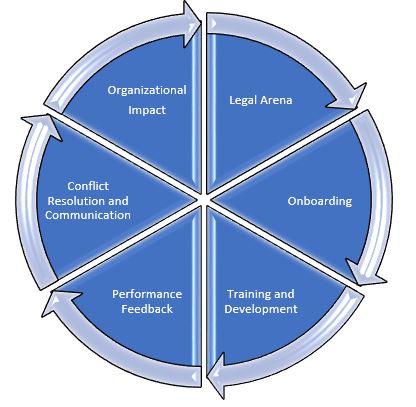
Below are 6 thoughts for non-HR professionals:

  1. Organizational Impact: HR can and does have an impact on the direction and strategy of the organization.  The HR function is as important as any other function within the organization.  Know the impact HR can have on the organizations mission, vision, culture, goals and objectives.
  2. Legal Arena: Labor and employment laws evolve and they change rapidly.  Interpreting and implementing legal change, continues to grow in complexity.  Federal, state and local laws can have an impact on the organization.  Ask questions and never assume you have the answer, legislation is one piece.  Remember the case law and amendments.
  3. Onboarding: Onboarding begins when an applicant applies for a job.  This process is critical to recruit and retain top talent.  Managers, coworkers and direct reports have ownership in ensuring the onboarding processes are organized and aligned with the organizations mission, vision and values.  If you were a new hire, what would you expect from recruiting to hire?  Put yourself in their shoes and reverse engineer a great experience.
  4. Training and Development: Training and development are extremely important pieces of the employment experiences.  Have we asked what training is important to the organization?  To the employee?  What can we afford?  Is there grant money available?  What about leadership development training?  Look for local and national opportunities for industry and profession specific training and development.
  5. Performance Feedback: Yes, employees want feedback!  In fact, continuous coaching and feedback, more than once per year will probably be an effective model.  Goals should be aligned with organizations goals and department goals.  These goals should also include training and development opportunities; degree, certification, leadership development, computer system training, financial, stretch assignments, etc.
  6. Conflict Resolution and Communication: The final thought can be the most difficult.  Resolving conflict and ensuring effective communication.  Never easy, but necessary.  As leader’s we will be in situations that require us to have that “difficult” conversation.  Practicing these conversations is never enjoyable, at times necessary to ensure we are prepared.  Communication is essential.  Know your organization and which communication tools are effective for your workforce.


6ThoughtsforNonHrProfessionals

These six thoughts are just a few of the important pieces of HR that do and will impact your organization.  As leader’s we need to recognize how these pieces effect our mission, vision, values, culture and employees.  Turnover is costly.  Recruiting is costly.  Training and retraining is costly.  Understanding these six areas’ will take work, but being an effective leader takes work.  Ask for help if you need it, people spend their careers specializing in each of the six areas.  Strategic HR can shape the mission statement, vision, culture, employee engagement and values of any of our organizations.

– Matthew Burr, HR Consultant

5 Considerations for Effective Workplace Investigations

We recently completed a successful training on effective and legal workplace investigations.  During the recording of our next podcast for Upstate HR, we also discussed workplace investigations and the importance of proactive investigatory processes.  Throughout my career, many of my experiences have provided valuable insight into the importance of effective and efficient workplace investigations.  As leaders, we need to take complaints and investigations seriously, as these issues can escalate into additional problems in the workplace, on social media,  and create stress outside of work.

Below are 5 considerations for effective workplace investigations:

  1. Don’t ignore the issue/complaint. If any employee approaches the organization with a complaint or allegation, we need to take this seriously.  Ignoring or hoping the issue goes away or resolves itself is not the right approach; we need to address the underlying issues.  Ask questions and ensure you understand the details of the issues/allegations.
  2. Never assume: Remember, there are two-sides to every story.  Do not assume that one party is guilty, because we only hear one-side of the story.  In most cases, fact-finding means understanding the entire allegation/situation before making a decision.
  3. Prepare, Prepare, Prepare: Preparing for the investigation interviews and fact-finding is challenging.  What questions do we ask?  What information do we need?  Who should we talk too?  The answer to this is that it depends on the situation.  Creating a template or checklist to ensure consistency and accuracy will help in working through the process efficiently and proactively.  Ask leading questions that force individuals to answer questions with more information, versus “yes” or “no” answers.  The more prepared you are, the more efficient the process will become.  Investigations are not easy and questions that are asked will not always be enjoyable for people to answer.  I have asked many of these questions throughout my career.  Be prepared, and know laws, policies, procedures, contract language, etc. that may be involved or impacted by the investigation.
  4. Neutrality: This consideration defaults back to consideration #2.  Remain neutral throughout the investigation and recommendation process.  This takes practice and is not easy in small organizations.  If you as a leader feel that neutrality is not practical internally, it is not always a bad idea to bring in a third-party to conduct the investigation and draft a finding of facts.  Using a third party all but ensures neutrality throughout the process.
  5. Closure/Conclusion/Recommendation: Throughout my career, I have seen this final step as the biggest hurdle for many organizations.  The investigation is conducted, information is gathered and then nothing happens.  Regardless of the outcome or recommended outcomes, the investigation needs to be closed.  I’m not suggesting revealing confidential information, but we do need to close the loop of communication with the parties involved.  Without proactive communication, we could see increased employee relations issues, decreased employee morale, and potential retaliation issues.  This is one of the most important pieces of the investigation process.

We closed out the podcast yesterday on a positive note.  Not all workplace investigations are negative or lead to discipline.  Workplace investigations are great for process improvement, addressing safety concerns, Six Sigma change, employee engagement, and efficiency.  Regardless, we need to take the investigation process seriously and manage it proactively, by reinforcing rules and policies throughout.  If you are unclear on how to investigate, ask for assistance or hire a third-party neutral to manage the process for the organization.

– Matthew Burr, HR Consultant


Below are the for upcoming training’s I will be conducting at Elmira College, Corning Community College (CCC), 247 Compliance and Compliance Online (July & August):

Elmira College: SHRM Certification Exam Prep Course- September through November

Upcoming Corning Community College Training’s

247 Compliance: Performance of Dashboard Using KPIs and Designing


Below is a link to our new Podcast Upstate HR:

Recruitment in the Modern Age

iTunes subscription will update you whenever we post a new podcast.

New podcast recently updated.


5 Proposed Regulations to the New York Paid Family Leave Law

The New York State Worker’s Compensation Board issued five proposed regulations on May 24, 2017, for organizations to incorporate, when implementing the New York Paid Family Leave requirements on January 1, 2018.  The initial regulations were published on February 22, 2017 and included a comment period.  The new regulations released on May 24, 2017 will have a 30-day comment period.

Below are 5 proposed regulation changes:

  1. An employee using intermittent leave must give the employer separate notice each day of use of the Paid Family Leave. Previous language stated that employees only needed to provide notice once to employers when using intermittent leave, which was inconsistent with the FMLA rules.


  1. Collective bargaining language must provide benefits as favorable as the Paid Family Leave law, including the length of leave and amount of pay. This section is still evolving and negotiated language can include the union responsibility for time records and pay deductions.  This has not been finalized and more changes will come to this section.


  1. Paid Family Leave language has been clarified that the eligibility of employees working 20-hours or more per week is measured based on the number of weeks in employment, which must be at least 26-weeks. Employees who work less than 20-hours per week is measured in days, which must be at least 175 working days.      


  1. The Worker’s Compensation Board clarified the July 1, 2017 deductions language. The employer can start taking payroll deductions on July 1, 2017, but cannot take deductions more than the maximum weekly contribution to retroactively cover the cost of providing Paid Family Leave.  The reason for early deductions is to offset the cost of acquiring the mandated insurance policy.


  1. The Worker’s Compensation Board issued additional guidance on accrued leave running concurrently with Paid Family Leave. The complexity of this language and requirements is related to accrued leave is still being drafted.  Further clarification is needed from the Board on the concurrent and accrued requirements, which include; FMLA, worker’s comp, and disability.  More updates to come on this proposed language.

Now is the time to begin reviewing, drafting, updating and revising policies and procedures related to FMLA and Paid Family Leave.  January 1, 2018 is only six short months away.  Continue to monitor for updates and changes to the proposed language.  If you are confused, ask questions and do not assume.  This law is very complex, it continues to change as concerns arise and the implementation will impact most organizations throughout New York State.


New York State Paid Family Leave Website


Additional Information:

[i]


Employers Providing Pawternity Leave to Employee’s (End on a Positive)


– Matthew Burr, HR Consultant

[i] Guardian PPT Training Slides

4 Updates on The Strengthening Career and Technical Education for the 21st Century Act

Progress is being made.  On May 17, 2017, the House Education and the Workforce Committee voted unanimously to move The Strengthening Career and Technical Education for the 21st Century Act forward.  This new act “would provide federal funds to increase access to career and technical education (CTE) and, in particular, to extend such access to more students from disadvantaged communities.”[i]  As businesses needs have evolved, so too must the skills of our employees.  Skilled workers are needed in many industries throughout the country; manufacturing, construction, carpentry, healthcare, computer programming, engineering, auto mechanics, transportation, HVAC, plumbing, electric and welding.  The bill is designed for U.S. workers compete in a global economy.

Below are 4 updates on expectations and path-forward:

  1. Employers need to be involved in the training and education processes for current or prospective workers. “Organizations must ensure that state and local governments know what their skill needs are so that officials can create programs under this legislation.”[ii]  Do not be afraid to provide feedback on both the positives and negatives of a program.


  1. State and local governments would be responsible for crafting and designing programs that best fit the needs of employers in the local communities. Upon approval and implementation, state and federal governments would also have to submit results of the effectiveness of the CTE trainings to federal agencies. 


  1. In 2016, a similar bill went to the Senate, but ran out of time when it was delayed by debates over the education secretary’s role in deciding how states can potentially spend money under the 2016 proposed law. The role of the Senate debates or education secretary is yet to be determined on progressing the new bill forward and spending.   


  1. The legislation is focused on post-secondary training for trade jobs in the U.S., that do not require a four-year degree. The impact of this bill, if passed will be significant as there is a need throughout the country to have trained and skilled workers in many industries. 

The value of The Strengthening Career and Technical Education for the 21st Century Act, could have great potential for additional training’s in our area.  Remember, this is federal legislation and does not include any training funding from New York State.  The key to any legislation such as this is the effectiveness of the training.  As employer’s we need to offer feedback and input into these programs, while holding state and local government entities accountable.  Developing training takes a tremendous amount of resources, resources that we are paying for.  You get out what you put in.  The employees and/or potential employees do have responsibility in ensuring that the training is effective and successful as well.  We will continue to monitor the act as it progress through the different branches of government for any amendments or updates.    

– Matthew Burr, HR Consultant


[i] https://www.shrm.org/resourcesandtools/hr-topics/talent-acquisition/pages/bill-upskill-us-workers-carl-perkins-act.aspx


[ii] https://www.shrm.org/resourcesandtools/hr-topics/talent-acquisition/pages/bill-upskill-us-workers-carl-perkins-act.aspx


Open Enrollment Success Tips

As most organizations are now approaching the open enrollment season, we need to be cognizant of confusing and frustrating open enrollment processes.  A poll “was conducted in April among 2,105 employees currently receiving health care through their employer. Among those whose company offers health insurance:  Half of employees (49 percent) say making health insurance decisions is always “very stressful” for them.  41 percent feel the open enrollment process at their company is “extremely confusing.  20 percent often regret the benefits choices they make.”[1]

As leaders we need to educate our employees on making the right choice for themselves and their family.  Healthcare enrollment can be a confusing process for any employee, education and communication are crucial to ensure a successful open enrollment season.  None of our organizations want to be a statistic as mentioned above.

Below are 7 open enrollment tips to assist your organization in a successful open enrollment season:


  1. Develop a roadmap from start to finish for the open enrollment outcomes. This should include what you want covered by the plans and how you want to get there.  Do you want 100% participation in open enrollment?  Are you analyzing the data every day?
  2. Keep it simple. Do not assume that every person that works for you has a thorough understanding of how open enrollment works or what to choose during the open enrollment process.  Use examples that everyone can understand. Benefit enrollment is complex enough; do not make it more complex.
  3. Develop a training for the open enrollment process. Everyone learns differently, so try to develop a training system that encompasses all aspects of different learning styles.  Presenting/lecturing on benefits for 2-hours would be a challenge for me (or anyone else!) to sit through.
  4. Design checklists and handouts. Develop checklists or cheat sheets for employees to use during the process.  Handout the packet of information during the training.  Material should be basic and easily readable for a variety of literacy levels.
  5. Offer family sessions. Offer enrollment sessions that include a spouse or significant other. This can relieve some anxiety and allow for better decision making by employees for their family’s needs.
  6. Determine Frequently Asked Questions. Design a frequently asked questions handout or implement into the training.   I have found this to work well in the past.
  7. Open enrollment office hours and follow-up meetings. Establish 30-minutes to 1-hour every other day or daily dedicated to open enrollment and open enrollment questions.  If employees need to enroll online, assist them with this process during these time slots.  Follow-up throughout the process to ensure you reach the pre-established goal for the organization.


Open enrollment timing and processes vary by organization.  At times, this process can be confusing and frustrating to your employees.  Proactive planning and simplification wherever possible will help to ensure a successful open enrollment season.  If you have a third party or consultant scheduled to work through the open enrollment process, walk through the training with them.  Human Resources needs to understand what information is being communicated and how it will be communicated.  Ask employees before the process begins if they have any questions or concerns.  As the cost of healthcare and other benefits continues to rise, as does the complexities of the laws and regulations.  Seek guidance or help if you are unclear on the right approach.


– Matthew Burr, HR Consultant

[1] https://www.shrm.org/resourcesandtools/hr-topics/benefits/pages/open-enroll-benefits-confusion.aspx