2025 Updated Wage Transparency Laws and Regulations

2025 State Changes

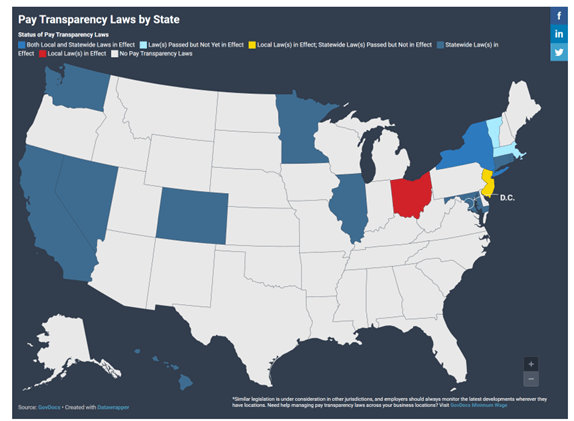
States with Wage Transparency Laws:

  • California: Requires employers to include salary ranges in job postings. 
  • Colorado: Enacted the Equal Pay for Equal Work Act, which includes pay transparency requirements. 
  • Connecticut: Requires employers to disclose wage ranges in job postings and prohibits seeking salary history. 
  • Hawaii: Requires employers to disclose salary ranges in job postings. 
  • Illinois: Has pay transparency requirements, with some guidance rolling out in 2025. 
  • Maryland: Requires employers to disclose wage ranges in job postings. 
  • Massachusetts: Requires employers with 100+ employees to submit wage data reports annually. 
  • Minnesota: Has pay transparency requirements, including disclosure of salary ranges. 
  • Nevada: Requires employers to disclose wage or salary ranges. 
  • New Jersey: Has pay transparency requirements. 
  • New York: Requires employers to disclose salary ranges in job postings. 
  • Rhode Island: Requires employers to provide the wage range prior to discussing compensation and upon request. 
  • Vermont: Requires employers to disclose hourly wage or salary, or range, in job postings. 
  • Washington: Requires employers to include salary ranges in job postings. 
  • Washington D.C.: Requires employers to disclose wage ranges in job postings. 

Pay Transparency Laws by State: Effective Dates

Below is an at-a-glance list of the states and corresponding effective dates that require disclosure of pay range under certain circumstances. Each law is different, so employers should review each specific jurisdiction’s requirements to ensure compliance:

  • California – effective Jan. 1, 2023
  • Colorado – effective Jan. 1, 2021
  • Connecticut – effective Oct. 1, 2021
  • District of Columbia – effective June 30, 2024
  • Hawaii – effective Jan. 1, 2024
  • Illinois – effective Jan. 1, 2025
  • Maryland – effective Oct. 1, 2020
  • Massachusetts – effective Oct. 29, 2025
  • Minnesota – effective Jan. 1, 2025
  • New Jersey – statewide law effective June 1, 2025
  • New York – effective Sept. 17, 2023
  • Nevada – effective Oct. 1, 2021
  • Rhode Island – effective Jan. 1, 2023
  • Vermont – effective July 31, 2025
  • Washington – effective Jan. 1, 2023

As of this writing, several jurisdictions in the U.S. have some form of a pay transparency law. But more could be on the horizon.

Of course, as with all aspects of employment law, each jurisdiction handles these requirements differently.

Starting at a high level, some states have laws that require employers to disclose the pay range for a position if the applicant asks for it:

  • California
  • Colorado
  • Connecticut
  • Maryland
  • Massachusetts – effective as of Oct. 29, 2025
  • Minnesota
  • Nevada
  • Rhode Island

Even among these states, there is some variation in how they implement their pay transparency laws.

Salary History Bans in the United States

Salary history bans are adjacent to pay transparency laws and generally prohibit employers from asking job applicants about their past or current pay.

These laws preclude employers from relying on pay history to set compensation, part of the growing employment law sector related to the #MeToo movement.

Employers can usually ask for pay expectations but not actual pay history.

What states have salary history bans?

States, or jurisdictions within them, that have salary history bans include:

  • Alabama
  • California
  • Colorado
  • Connecticut
  • Delaware
  • District of Columbia
  • Hawaii
  • Illinois
  • Maine
  • Maryland
  • Massachusetts
  • Minnesota
  • Missouri
  • Nevada
  • New Jersey
  • New York State
  • Ohio (only Toledo and Cincinnati)
  • Oregon
  • Pennsylvania (Philadelphia only)
  • Rhode Island
  • Vermont
  • Washington

https://www.govdocs.com/pay-transparency-laws/

Additional Consideration

Best Practices for Employers

1. Regularly Review and Update Compensation Policies

  • Conduct regular audits of pay practices to ensure compliance and identify any unjustified pay disparities 
  • Establish clear, documented guidelines for setting and communicating pay ranges.

2. Standardize Job Postings

  • Include required salary ranges and compensation details in all job postings, especially for roles that could be performed in states with transparency laws.
  • For multistate employers, consider adopting the strictest applicable standard to streamline compliance 

3. Train Managers and HR Staff

  • Ensure those involved in hiring and compensation decisions understand the requirements and are prepared to answer questions about pay transparency 

4. Prepare for Employee Inquiries

  • Be ready to provide pay scale information to current employees and applicants upon request, as required by law 

 5. Monitor Legal Developments

  • Stay informed about new and evolving wage transparency laws, as more states and localities are expected to adopt similar requirements in the coming years 

Strategic Opportunities

1. Building Trust and Employer Brand

  • Transparent pay practices can enhance employee trust, improve retention, and make the organization more attractive to top talent 

2. Promoting Pay Equity

  • Wage transparency helps identify and address pay gaps, supporting diversity, equity, and inclusion goals 

2023 New York State Wage Transparency September 17, 2023

“As a reminder, the pay transparency law, which is codified at Section 194-b of the New York Labor Law, will require employers with four or more employees to include the following whenever they “advertise” for a job, promotion, or transfer opportunity:

  • The compensation or “range of compensation” for the job, promotion, or transfer opportunity. 
  • The job description for the job, promotion, or transfer opportunity, if one exists.

The original legislation did not define the term “advertise.” The amendment adds the following definition:

“[A]dvertise” shall mean to make available to a pool of potential applicants for internal or public viewing, including electronically, a written description of an employment opportunity.

This is a broad definition and will likely encompass internal postings on an intranet or job board, postings in newspapers and “want ads,” as well as electronic postings on the employer’s website or job posting sites such as Indeed.com or ZipRecruiter.” (https://www.hodgsonruss.com/newsroom-publications-14258.html)

“On Dec. 21, 2022, Gov. Kathy Hochul signed the long-anticipated New York State pay transparency bill into law. The bill amends New York State Labor Law by adding a new section 194-b, which takes effect on Sept. 17, 2023. Labor Law § 194-b continues a recent trend toward pay transparency both nationally and locally, including similar laws in New York City, Albany County, Westchester County and Ithaca.

Employers subject to the law are broadly defined to include nearly every entity with four or more employees, as well as agents and recruiters. Only temporary help firms, as defined under New York State Labor Law § 916(5), are exempt.[1]

Similar to other pay transparency laws, Labor Law § 194-b requires employers to disclose an amount or a range of compensation for any open job, promotion or transfer opportunity that can or will be performed, at least in part, in New York State. The law defines “range of compensation” as “the minimum and maximum annual salary or hourly range of compensation . . . that the employer in good faith believes to be accurate at the time of the posting of an advertisement” for the job, promotion or transfer opportunity. Advertisements for jobs, promotions or transfer opportunities that are paid solely on commission must disclose that in writing. Additionally, the law requires employers to post a job description if one exists.

Labor Law § 194-b does not define “advertisement,” so the breadth of the law’s application to activities such as direct recruitment and internal promotion is unclear. Presumably, the Commissioner of Labor will clarify the scope of coverage by regulations, which the law directs the Commissioner to promulgate. 

Employers are required to keep and maintain records in connection to the law, including the history of compensation ranges for each job, promotion or transfer opportunity and the job descriptions for these positions, if such job descriptions exist.

Any person claiming to be aggrieved under Labor Law § 194-b may file a complaint with the Department of Labor, which has the authority to impose civil penalties of up to three thousand dollars for violations of the law or forthcoming regulations. Employers are prohibited from refusing to interview, hire, promote, employ or otherwise retaliate against an applicant or current employee for exercising any rights under this new law.

Finally, Labor Law § 194-b contains a provision stating that it shall not be construed or interpreted to supersede or preempt any local law, rules, or regulation. Most of the existing local pay transparency laws in New York failed to predict a parallel state law (despite the fact that one had already passed in the legislature), so employers subject to these laws will have to comply with overlapping obligations unless the local jurisdictions yield. The Westchester County Salary Transparency Law is the outlier and expressly gives way to “substantially similar” state legislation.” (Bond)

May 12, 2022, the Salary Transparency Law was enacted in New York City, which was postponed to the effective date of November 1, 2022. 

“In addition to employers, 134-A specifies that employment agencies, and employees or agents thereof, must also include a salary range or hourly wage range in each advertised position, promotion, or transfer opportunity. Job advertisements for “temporary employment at temporary help firms” are still exempted from the law. Temporary help firms are defined as businesses that recruit and hire their own employees and assign those employees to perform work at or perform services for other organizations or businesses.” (Littler)

  1. “The civil penalty for the first violation will be $0 if the employer cures the violation within 30 days of receipt of a complaint. The proof of cure may be submitted either electronically or in person and is deemed an admission of liability by the employer.
  2. In line with the recent CCHR guidance (which has now been updated), the law would apply to job listings for both salaried and hourly positions, and would not apply to any position “that cannot or will not be performed, at least in part, in the city of New York.”
  3. While an individual may only file a lawsuit based on a violation arising from an advertisement by their current employer, any aggrieved person may file a complaint with the Commission, regardless of whether the alleged violator is the grievant’s current employer.” (Bond)

New York Wage Transparency Law

As assumed, on June 3, 2022, New York State passed a similar law on wage transparency. 

“The new law would require covered employers to disclose compensation or a range of compensation to applicants and employees upon issuing an employment opportunity for internal or public viewing, or upon employee request. The Bill is intended to enhance transparency around compensation and reducing any existing wage disparities among employees.

The Bill defines a covered employer as: (i) “any person, corporation, limited liability company, association, labor organization or entity employing four or more employees in any occupation, industry, trade, business or service, or any agent thereof;” and (ii) “any person, corporation, limited liability company, association or entity acting as an employment agent or recruiter, or otherwise connecting applicants with employers, provided that “employer” shall not include a temporary help firm” as the term is defined under New York Labor Law Section 916 (5).

The Bill requires covered employers to disclose the following information in job postings, including for promotions and transfer opportunities, that can or will be performed at least in part in the State of New York:

  1. The compensation or a range of compensation for such job, promotion, or transfer opportunity; and
  2. The job description for such job, promotion, or transfer opportunity, if such description exists.

For positions that are paid solely on commission, compliance with the law’s compensation disclosure requirements can be achieved by providing a written general statement that compensation shall be based on commission.

Additionally, the new law would prohibit employers from refusing to interview, hire, promote, employ or otherwise retaliating against an applicant or current employee for exercising their rights under new Section 194-b. The law would allow individuals aggrieved by a violation to file a complaint with the NYS Department of Labor (NYSDOL). Violations of the any of the requirements of the new law or any subsequently published regulations could result in a civil penalty pursuant to NY Labor Law Section 218 which generally provides civil monetary penalties for non-wage related violations ranging from $1,000 to $3,000, to be assessed by the NYSDOL.

Under the new law, covered employers would also be required to maintain records of compliance, including but not limited to the history of compensation ranges for each job, promotion or transfer opportunity as well as the job descriptions for such positions (if applicable).” (Bond)

If enacted, the proposed bill would take effect 270 days after it becomes law.

These are simple changes to make when posting for openings and recruiting.  Ensure that you are communicating the anticipated changes throughout your organization.  Continue to monitor for any upcoming changes or modifications to the proposed legislation.  These changes are a trend nationally.

Ithaca New York Pay Transparency Law Effective September 1, 2022:
“The City of Ithaca will require employers to disclose the minimum and maximum pay in every job posting, starting September 1. The new city ordinance applies to any employer with more than three permanent workers based in Ithaca. That could also include employers of certain Ithaca-based remote workers.”

10 Thoughts on Working through an ADA Accommodation

The Americans with Disabilities Act (ADA) was originally published in 1991, with revisions and updates in the mid-2000’s.  The legislation prohibits discrimination against people with disabilities in the workplace.  This article will focus on disability and accommodation during the application and employment relationship.  How does this impact our organizations?  What should we consider if an applicant or employee requires reasonable accommodation?  The steps below will assist our organizations in working through the complexity of accommodations.

Below are the 10 thoughts on ADA accommodations:

  1. Are you covered by the ADA? All employers with 15 or more employees are covered under the ADA at the federal level.  Review state regulations and legislation, to verify if there are stricter requirements at the state or local level. 
  1. Policies and Procedures in Place: Ensure your organization has handbook language, a policy, process and/or procedures in place to work through disability accommodations. This includes reviewing job descriptions; physical, standing, sitting or lifting requirements.  The more accuracy in the job descriptions, the better we can assess accommodations and determine the reasonableness of the accommodation request.
  1. Is the applicant qualified? The individual needs to satisfy the definitions under the ADA.  Applicants must meet the skill, experience, education and other job-related requirements.  They must be able to perform the essential functions of the position.
  1. The Interactive Process: Employers should engage in the interactive process in which the employee, health care provider and employer share relevant and important information on the position, the disability, accommodations and limitations of the applicant. This should be a good faith communication process between the parties.
  1. Employee Disability Under the ADA:
  • The ADA defines a disability as one of the following: a) a physical or mental impairment that substantially limits a major life activity; b) a record of a physical or mental impairment that substantially limited a major life activity; or c) being regarded as having such an impairment.
  • According to the Equal Employment Opportunity Commission (EEOC), the ADA Amendments Act (ADAAA) includes impairments that would automatically be considered disabilities. They include deafness, blindness, intellectual disability, completely or partially missing limbs, mobility impairments that require the use of a wheelchair, autism, cancer, cerebral palsy, diabetes, epilepsy, HIV or AIDS, multiple sclerosis and muscular dystrophy, major depression, bipolar disorder, post-traumatic stress disorder, obsessive-compulsive disorder, and schizophrenia.
  • The definition of major life activities includes caring for oneself, performing manual tasks, seeing, hearing, eating, sleeping, walking, standing, lifting, bending, speaking, breathing, learning, reading, concentrating, thinking, communicating and working. Major bodily functions include functions of the immune system; normal cell growth; and digestive, bowel, bladder, neurological, brain, respiratory, circulatory, endocrine and reproductive functions.
  • The definition of a disability also includes situations in which an employer takes an action prohibited by the ADA based on an actual or perceived impairment—for example, removing from customer contact a bank teller who has severe facial scars because customers may feel uncomfortable working with this employee or may perceive the employee as having an impairment when, in fact, he or she does not.
  • The ADAAA directs that if a “mitigating measure,” such as medication, medical equipment, devices, prosthetic limbs or low vision devices eliminates or reduces the symptoms or impact of the impairment, that fact cannot be used in determining if a person meets the definition of having a disability. Instead, the determination of disability should focus on whether the individual would be substantially limited in performing a major life activity without the mitigating measure. This rule, however, does not apply to people who wear ordinary eye glasses or contact lenses.
  • The following are not disabilities under the ADA: transvestism, transsexualism, pedophilia, exhibitionism, voyeurism, gender identity disorders not resulting from physical impairments, other sexual behavior disorders, compulsive gambling, kleptomania, pyromania, and psychoactive substance use disorders resulting from current illegal use of drugs.”[i]
  1. Reasonableness of the Accommodation: The accommodation can be a modification in the workplace. The price of reasonable accommodation will vary, case by case.  Determination of the accommodation should be an open process between the three parties and should be consistent throughout the organization with employees and applicants.
  1. Reasonable Accommodation versus Undue Hardship:
  • “The EEOC, when determining if the employee request creates an undue hardship to the employer, looks not only at the cost of the particular accommodation but also at the financial stability of a company. If the company is making significant profits or has a sizable net worth, the employer may not be able to prove that the requested accommodation would have a significant financial impact, therefore creating an undue hardship. For example, it may be an undue hardship for a nonprofit organization with limited funds to provide a special chair that costs $1,000 as an accommodation to an employee. However, the same request by an employee working in a for-profit organization that made sizable profits may not be seen as an undue hardship for that employer.
  • Accommodations that could result in an undue hardship include modifications that are “unduly extensive or disruptive, or those that would fundamentally alter the nature or operation of the job or business,” according to the EEOC. For example, small employers that require their employees to be able to perform a number of different jobs and tasks may not find it feasible or cost-effective to provide job restructuring as a “reasonable accommodation,” whereas in larger organizations, this may be a free or low-cost option.
  • The EEOC does not see impact on employee morale as a reasonable undue hardship defense.”[ii]
  1. Communication is Critical: The organization should notify the employee in writing if the accommodation has been approved or denied.  Details of the anticipated accommodation start date or reason for the denial should be included.  Copies of all material should be included in the employee files.  Make copies of all information.
  1. Review, Modify and Evolve: Just as we manage PFL and FMLA claims, we need to continue to review open accommodation cases, in the event accommodation requirements change, we need to be aware of these changes. Work with the employee and health care provider to ensure the communication channels remain open.
  1. Job Accommodation Network (JAN): “The Job Accommodation Network (JAN) is the leading source of free, expert, and confidential guidance on workplace accommodations and disability employment issues. Working toward practical solutions that benefit both employer and employee, JAN helps people with disabilities enhance their employability, and shows employers how to capitalize on the value and talent that people with disabilities add to the workplace.”[iii] This is a great resource with helpful information.  The forms, templates and accommodation recommendations are useful for all organizations.  Be proactive and strategic in your approach to accommodations.

Job Accommodation Network

Below are the links for upcoming training’s both in person and online webinars:

Upcoming Compliance Key Trainings

Elmira College: SHRM Certification Exam Prep Course- Fall 2018 & Spring 2019

Upcoming Compliance Online Training

Compliance IQ Webinar

– Matthew Burr, HR Consultant

[i] https://www.shrm.org/resourcesandtools/tools-and-samples/how-to-guides/pages/requestreasonableaccommodation.aspx

[ii] https://www.shrm.org/resourcesandtools/tools-and-samples/how-to-guides/pages/requestreasonableaccommodation.aspx

[iii] https://askjan.org/about-us/index.cfm

6 Final Guidance Updates to the New York State Sexual Harassment Prevention Laws

As we are all aware, in August 2018, the state published drafts of guidance materials concerning the new legislation, including a model sexual harassment prevention policy, a model complaint form, and model training materials. The state accepted public comments on these materials and, in the October 1, 2018 final guidance, made several changes as a result. On October 1, 2018, New York State released final guidance on the state’s new sexual harassment prevention laws. The new legislation requires all employers in New York State to publish policies concerning sexual harassment, adopt a sexual harassment complaint form, and conduct sexual harassment training.

 Below are final guidance updates:

  1. Employers have additional time to ensure all employees receive the required sexual harassment training. Training must now be completed by October 9, 2019, rather than the original January 1, 2019 deadline.
  1. New hires must be trained “as soon as possible.” Previously, the draft guidance specified new hires should be trained within 30 days of their start date.
  1. The model sexual harassment prevention policy was modified in several respects, including:
    1. The definition of harassment was amended to include harassment based on “self-identified or perceived sex” and “gender expression.”
    2. “Sex stereotyping” was added as an example of sexual harassment.
    3. The language concerning investigations was softened, with the policy now noting the investigation process “may vary from case to case.”
  1. The model complaint form was shortened to omit questions concerning whether the employee filed an external complaint or retained an attorney
  1. The training, which may be presented to employees individually or in groups; in person, via phone or online; via webinar or recorded presentation, should include as many of the following elements as possible:
  • Ask questions of employees as part of the program;
  • Accommodate questions asked by employees, with answers provided in a timely manner;
  • Require feedback from employees about the training and the materials presented.
  1. The training must:
  • Be interactive;
  • Include an explanation of sexual harassment consistent with guidance issued by the Department of Labor in consultation with the Division of Human Rights;
  • Include examples of unlawful sexual harassment;
  • Include information concerning the federal and state statutory provisions concerning sexual harassment and remedies available to targets of sexual harassment;
  • Include information concerning employees’ rights of redress and all available forums for adjudicating complaints; and
  • Include information addressing conduct by supervisors and additional responsibilities for supervisors.

The tools and resources that were released on October 1 include:

  • Updated website with resources for employers, employees, state contractors and targets of sexual harassment
  • Updated model sexual harassment prevention policy
  • Updated model sexual harassment complaint form
  • Updated model training (script book and PowerPoint presentation)
  • Updated minimum standards for sexual harassment prevention policies and trainings
  • Updated FAQs
  • Toolkits for employers and employees and a sexual harassment prevention policy poster are also being made available.

Sexual Harassment in the Workplace 

Employer Resource Link

Frequently Asked Questions Link

Below are the links for upcoming training’s both in person and online webinars:

Upcoming Compliance Key Trainings

Elmira College: SHRM Certification Exam Prep Course- Fall 2018 & Spring 2019

Upcoming Compliance Online Training

Compliance IQ Webinar

-Matthew W. Burr

5 Definitions for Alternative Dispute Resolution

Alternative dispute resolution (ADR), is an umbrella term used for methods to resolve disputes internal to the organization and outside the court system.  Many organizations use one or all of the ADR techniques, with the techniques continuing to grow in popularity.  Union and nonunion organizations use ADR techniques to resolve disputes, large and small.  Dispute resolution is a necessity for any organization, resolution can impact organizational culture, engagement and turnover rates.  The techniques defined below can be used to resolve disputes outside of the workforce as well, we have mediation services in our communities that assist families, neighbors, etc. resolve disputes through proactive channels of communication.

The 5 Definitions of Alternative Dispute Resolution:

  1. “Arbitration: an ad judicatory process in which a neutral third party imposes a final, binding decision to resolve a dispute.
  2. Mediation: an informal process in which a neutral third party assists opposing parties to reach a voluntary, negotiated, non-binding resolution of a dispute; may be conducted internally or externally.
  3. Ombudsman: a neutral third party who is designated to confidentially investigate and propose settlement of complaints brought by employees; may be an insider or outsider.
  4. Open-door policy: a process in which employees are encouraged to discuss problems with their immediate supervisors or others in the chain of command.
  5. Peer review an internal process in which a panel of employees works together to resolve employment complaints.”[i]

Arbitrators, mediators and ombudsman are trained in dispute resolution techniques.  They know how to fact-find, draft agreements and issues decisions.  An open-door policy is an easy way to resolve disputes.  We listen to the issue (not listen to respond) and address any concerns.  Peer review is another process that can be implemented, this also needs to be managed proactively to ensure it’s legal.   All of the ADR techniques work, the effectiveness will vary by organization.  Select a process that works for your organization and be consistent with dispute resolution.

New York State Paid Family Leave Update:

Recent changes to NYS PFL confirmed that employers do not need to cap the weekly employee payroll deduction for PFL at .126% of the NYS Average Weekly Wage ($1.65 per week in 2018).  Employers can deduct .126% of an employee’s weekly wage until the employee hits the annual cap of $85.56, which is .126% of the annualized weekly wage.  This is a significant change, which better positions employers to collect the full PFL premium from each employee.

Work with your payroll companies and NYS PFL providers to ensure the calculations are accurate and deducted under current legislation.  If you are confused, seek guidance.  Like many laws, we continue to see changes to NYS Paid Family Leave. 


– Matthew Burr, HR Consultant

[i] American Arbitration Association, U.S. EEOC & SHRM Magazine

3 Thoughts on What Should and Should Not Be Included in the Personnel Files

In a March 2015 article written by the Society of Human Resource Management, the article provided guidance on separating employee files for relevancy and confidentiality.  Employee records can be separated into three types of files.  “A general personnel file, a confidential employee file and a common file.”[i]  Organizations should always consider and be aware of sensitive information (date of birth, marital status, Social Security numbers, HIPAA protected information, criminal history, court orders, financial history, etc.), that can be included in any of the three separated files.  Other considerations should include relevancy to the supervisor or management of the workforce.  “Is it related to the employee’s performance, knowledge skills, abilities or behavior?”[ii]  This should also be a determining factor, when separating information and organizing new files.  Does the supervisor or manager need access to all the information?

The Basic Personnel File (supervisor and manager relevant):

  • Recruiting information, resumes, job application and academic transcripts
  • Job descriptions (signed)
  • Job offer, promotion, rates of pay, compensation information, training records
  • Handbook and policy acknowledgements (including revised policies)
  • Recognition
  • Disciplinary information, warnings, coaching and counseling
  • Performance evaluations
  • Termination records, exit interview, closure of the file (goes without writing)

The Confidential Personnel File:

  • EEO records
  • Reference and background checks
  • Drug test results
  • Medical and insurance records
  • Child support and garnishments
  • Legal documents
  • Workers compensation and short-term disability claims
  • Investigation notes
  • Form I-9*

The Common File:

  • Form I-9 Audits
  • Form I-9’s* (my recommendation is to put active employee’s I-9’s in a binder that is accessible, confidential and locked in a cabinet, for auditing and reviews).

Regardless of the filing process(s) your organization has implemented, the information contained in any of the employee files needs to be kept confidential and locked in secure filing cabinets.  During trainings with supervisors and managers, my statement is simple, treat your employee’s information as it is your own confidential information.  The last thing we want is open personnel files on desks, doctor’s notes attached to calendars and unlocked filing cabinets.  When an employee exits the organization, I consolidate all files and information into one folder and store in a terminated employee file section, with the exit interview (if applicable).  “Maintaining records in separate files as discussed above allows managers, employees and outside auditors to see the information they need to make decisions, yet does not allow inappropriate access.”[iii]  Filing and organizing paperwork is not always fun, but it is necessary to ensure legality and confidentiality.  If you are confused on employee files and appropriate storage, seek guidance.  Electronic files and legal requirements related to electronic filing can vary by state, a thorough understanding of these laws is necessary prior to implementing an electronic filing system.  We should be proactive and take all precautions, related to employee records and record retention.

[iv]

[i] https://www.shrm.org/resourcesandtools/tools-and-samples/hr-qa/pages/includedinpersonnelfile.aspx

[ii] https://www.shrm.org/resourcesandtools/tools-and-samples/hr-qa/pages/includedinpersonnelfile.aspx

[iii] https://www.shrm.org/resourcesandtools/tools-and-samples/hr-qa/pages/includedinpersonnelfile.aspx

[iv] http://cyquesthr.com/access-personnel-files-laws-50-states/

4 New Hire Forms Needed in New York State

As we have now entered the second month in 2018, some of our organizations will be hiring new employees for continued operation and some for the upcoming seasonal summer months.  Hiring new employees into the workforce is great, we have a tremendous opportunity to set the new hire up for success with a great onboarding process and introduction to the organization.  With new hires, comes legal paperwork.  State and federal forms get updated and posted on government websites for all of us to use.  As leaders and business owners, we need to ensure our forms are updated and legal.

Below are the new hire forms needed in New York State:

  1. Form I-9, Eligibility to work in the United States: This form is required in every state for new hires and needs to be reviewed for expired ID’s; driver’s license, passport, etc. Organizations must verify that each new employee is legally eligible to work in the United States.  Ensure the form is filled out correctly and signed by the right person in the organization.  This form changed in late 2017.
  2. Form W-4, wage Withholding Allowance Certificate: This form is necessary for federal withholdings. All employees should complete and sign a Form W-4 prior to starting work.  Currently, the 2017 form is still being used.  Watch for any updates or changes in 2018, related to the new tax legislation.
  3. Form IT-2104, Employer Allowance Certificate (NYS): This is the New York State withholding form required to be completed in full prior to an employee starts working for the organization. Ensure you are using the 2018 version of the form.
  4. Wage Forms Required by New York Labor Laws: Organizations are required to provide wage notification forms to all employees. The forms vary by hourly, salary, salaried nonexempt, etc.  The link above provides a definition on which form to use based on the classification of the employee.  Reminder, these forms were updated in 2017 as well.

These are the legally required forms that employees are required to complete prior to starting work (I-9 the first three working days).  Other forms will vary by organization; direct deposit, safety rules and regulations, handbooks and policies, IT and login information, safety and security, vehicle registration, cellphone policy, tour of the facility, labor and employment posters, payroll deductions, payroll processing, etc.  Remember, state forms will vary.  Pennsylvania uses a different withholding form from that used in New York.  Consultants should be providing a signed an updated (revised 11.2017) federal Form W-9.

Develop a checklist for your organization to ensure we consistently cover information for all new hires.  The onboarding process is an important part of the employment relationship and many people will decide during this process how long they will potentially stay with an organization.  As leaders, we need to ensure all employees feel welcome and engaged on day 1, while covering the legalities of the employment relationship.  If you need assistance developing a new hire orientation checklist, seek guidance, the last thing we want is to place a new hire in a conference room and have the individual read policies and sign paperwork alone all day.  I have been part of process like this and it does not work!

4 EEOC Guidelines on Workplace Harassment Prevention and Cadillac Healthcare Tax Updates

The U.S. Equal Employment Opportunity Commission recently released the “Promising Practices for Preventing Harassment.”  This is a guidance document for employers, that contains harassment prevention recommendations for all employers in four categories.  As leaders we have a responsibility to take all harassment claims serious and need to ensure a proactive approach to investigations, communication and accountability as it related to workplace harassment claims, sexual harassment, retaliation, bullying, workplace violence concerns, etc.

The Four Categories:

  1. Leadership and Accountability: “The cornerstone of a successful harassment prevention strategy is the consistent and demonstrated commitment of senior leaders to create and maintain a culture in which harassment is not tolerated.”[i]
  2. Comprehensive and Effective Harassment Policy: “A comprehensive, clear harassment policy that is regularly communicated to all employees is an essential element of an effective harassment prevention strategy.”[ii]
  3. Effective and Accessible Harassment Complaint System: “An effective harassment complaint system welcomes questions, concerns, and complaints; encourages employees to report potentially problematic conduct early; treats alleged victims, complainants, witnesses, alleged harassers, and others with respect; operates promptly, thoroughly, and impartially; and imposes appropriate consequences for harassment or related misconduct, such as retaliation.”[iii]
  4. Effective Harassment Training: “Leadership, accountability, and strong harassment policies and complaint systems are essential components of a successful harassment prevention strategy, but only if employees are aware of them. Regular, interactive, comprehensive training of all employees may help ensure that the workforce understands organizational rules, policies, procedures, and expectations, as well as the consequences of misconduct.”[iv]

For additional information on the Promising Practices for Preventing Harassment guidance (each of the four have additional recommendations on the website) for your organization and workforce, the link is below:

Promising Practices for Preventing Harassment

Cadillac Tax Updates

Congress passed a law on January 22 to delay the affordable Car Act’s 40 percent excise tax on high-value healthcare plan for two years.  The Cadillac tax was set to take effect in 2020, under the new law, the tax will be delayed until 2022.

What to expect in 2022:

  • $10,200 for individual coverage ($11,850 for qualified retirees and those in high-risk professions).
  • $27,500 for family coverage ($30,950 for qualified retirees and those in high-risk professions).[v]

Under the new administration we could see significant changes to the Affordable Care Act and healthcare in general.  Continue to monitor for updates and changes, that can and will impact your workforce.  If you are confused seek guidance, healthcare law continues to evolve in complexity at the federal and state levels.

[i] https://www.eeoc.gov/eeoc/publications/promising-practices.cfm

[ii] https://www.eeoc.gov/eeoc/publications/promising-practices.cfm

[iii] https://www.eeoc.gov/eeoc/publications/promising-practices.cfm

[iv] https://www.eeoc.gov/eeoc/publications/promising-practices.cfm

[v] https://www.shrm.org/resourcesandtools/hr-topics/benefits/pages/congress-delays-cadillac-tax-until-2022.aspx


2018 OSHA 300-A Posting Timeline

As many of us know; all employers are required to keep OSHA Form 300 (Injury and Illness Log) records throughout the year and must post Form 300A.  This annual summary of job-related illness and injuries, must be posted in the workplace by February 1, 2018.  The OSHA 300-A from should be posted in common areas, comparable to locations of labor and employment posters, workers compensation certification and paid family leave certification (break rooms, meeting rooms, kitchens, etc.).  The summary must include the total number of job-related injuries and illnesses that occurred in 2017.

Areas to remember:

  1. Posting Period: The posting period starts on February 1, 2018 and ends on April 30, 2018.
  2. What is a Form 300A: The form reports a business’s total number of fatalities, missed workdays, job transfers or restrictions, and injuries and illnesses as recorded on the OSHA Form 300.  The information posted should also include the number of employees and the hours they worked for the year.  No recordable illnesses or injuries?    However, an organization must still post the form, with zeroes on the appropriate lines.
  3. Helpful Links:

OSHA Injury and Illness Recordkeeping and Reporting Requirements

Injury & Illness Recordkeeping Forms

OSHA Recordkeeping Advisor

Partially Exempt Industries List

“The Trump administration continues to look for ways to lessen the regulatory burden on employers. As a result, the Occupational Safety and Health Administration’s (OSHA) electronic recordkeeping regulation continues to be whittled down. OSHA’s latest Regulatory Agenda sets out new changes to the already beleaguered rule. Specifically, OSHA intends to propose to amend the Electronic Recordkeeping rule to eliminate the requirement that establishments with 250 or more employees submit OSHA 300 Logs and 301 forms. Instead, two types of establishments would continue to submit 300A summary forms: (1) establishments of 250 or more employees; and (2) establishments with between 20 and 249 employees in the high-hazard industries listed in Appendix A to the regulation. Employers with establishments meeting these criteria electronically submitted OSHA 300A summaries with 2016 data on or before December 31, 2017 and will submit their calendar year 2017 summaries by July 1, 2018. Beginning in 2019, and every year thereafter, covered establishments must submit the information by March 2.”[i]

As we see with many of the HR laws and regulations, OSHA is continuing to evolve and change under the new administration.  Ensure that you are monitoring for recent or upcoming changes and posting as required under the federal and state law.  Public sector rules will vary as well.  If you have questions, seek guidance.  Safety rules and regulations can be complex, just as HR laws and regulations are.

[i] https://ogletree.com/shared-content/content/blog/2018/january/osha-anticipates-more-changes-to-the-electronic-recordkeeping-rule


2018 Employee Handbook Changes, IRS Mileage Rate and Labor Poster Updates

A new year brings new changes to our organizations, employment relationships, laws, regulations, handbooks and policies.  As more states continue to pass state specific legislation, we need to ensure that our handbooks and labor posters are updated accordingly.

 Below are 5 areas to watch related to employee handbooks:

  1. Workplace Conduct and Social Media: Under the new administration, we could see more flexibility in social media policies (pro-employer).  Social media is a concern in many organizations, ensure that your policy is legal, up-to-date and not overreaching.
  2. Arbitration Agreements: There are multiple lawsuits in federal courts related to employer arbitration agreements.  These decisions can impact our organizations.  I have not implemented arbitration agreements.  However, they are growing in popularity.
  3. Sexual Harassment/Harassment Policies: This speaks for itself.  California and Maine have modified their current laws related to sexual harassment, we could see significant changes in New York State, as stated by the Governor recently.  Ensure that there is a zero-tolerance and retaliation policies in place, and all employees are trained on current policies and procedures.  Organizations need to be proactive and not reactive to issues.
  4. Parental Leave: Paid Family Leave was effective January 1, 2018. Ensure that you have updated policies and handbook language to reflect this significant legislative change.  The state has a website full of information to utilize as we move forward in 2018.

PFL Resource Page

Model Language for Employer Material

  1. Disability and Other Accommodations: Review language related to the ADA, FMLA and medical marijuana.  Medical marijuana law(s) continues to evolve.  “In 2017, several courts ruled that registered medical marijuana users who were fired or passed over for jobs because of their medicinal use could bring claims under state disability laws.”[i]

As laws continue to evolve, now is the time to review handbooks, policies and procedures.  If you are unclear on a path-forward or what to look for, seek guidance.  Do not assume a Google search will provide legal and accurate information, draft handbook language or valid training material.

2018 IRS Mileage Rate:

“Beginning on Jan. 1, 2018, the standard mileage rates for the use of a car (also a van, pickup or panel truck) will be:

  • 5 cents for every mile of business travel driven, up 1 cent from the rate for 2017.
  • 18 cents per mile driven for medical or moving purposes, up 1 cent from the rate for 2017.
  • 14 cents per mile driven in service of charitable organizations, unchanged from 2017.”[ii]

Notice 2018-03

Mandatory State Labor Law Poster Changes Effective January 2018:

  • Alaska— Minimum Wage, effective Jan. 1, 2018
  • Arizona— Minimum Wage, effective Jan. 1, 2018
  • California— Transgender Rights, effective Jan. 1, 2018, Discrimination, Jan. 1, 2018
  • Colorado— Minimum Wage, effective Jan. 1, 2018
  • Florida — Minimum Wage, effective Jan. 1, 2018
  • Hawaii — Wage and Hour Laws, effective July 10, 2017, OSHA, effective Jan. 1, 2018
  • Maine — Minimum Wage, effective Jan. 1, 2018
  • Minnesota– Minimum Wage, effective Jan. 1, 2018
  • Missouri— Minimum Wage, effective Jan. 1, 2018
  • Montana— Minimum Wage, effective Jan. 1, 2018
  • Nevada — Rules to Observed by Employers, effective July 1, 2017
  • New Jersey— Minimum Wage, effective Jan. 1, 2018
  • New York— Minimum Wage, effective Dec. 31, 2017
  • North Carolina — Wage and Hour Notice to Employees, effective Dec. 31, 2017
  • Ohio— Minimum Wage, effective Jan. 1, 2018
  • Rhode Island — Minimum Wage, effective Jan. 1, 2018
  • South Dakota — Minimum Wage, effective Jan. 1, 2018
  • Vermont— Reasonable Accommodations for Pregnancy, effective Jan. 1, 2018
  • Washington— Minimum Wage, effective Jan. 1, 2018, Your Rights as a Worker, Jan. 1,2018

[i] https://www.shrm.org/ResourcesAndTools/legal-and-compliance/employment-law/Pages/5-Employee-Handbook-Issues-to-Watch-in-2018.aspx

[ii] https://www.shrm.org/ResourcesAndTools/hr-topics/benefits/Pages/2018-standard-mileage-rate.aspx

As always-if you feel uncertain or want an extra set of eyes, finding a consultant or strategic legal partner is a good idea. For more information about these subjects, click on the links here or reach out to schedule a meeting and consultation.

-Matthew W. Burr

4 Updates IRS Deadline to Supply ACA Forms to Employees

In late December 2017, the IRS announced an extension for employer’s providing Affordable Care Act forms to employee’s.  As the future of the Affordable Care Act is still undecided, employers should be proactive in distributing and communicating information to the workforce.

Below are 4 updates for the ACA:

  1. Extension: The IRS extended the date to March 2, 2018 to distribute the 2017 forms to employees.  This is a 30-day extension to the regularly scheduled date of late January 2018.
  2. Penalty: “The IRS, which announced the extension December 22 in Notice 2018-06, also said it will not impose penalties on employers that can show that they made good-faith efforts to comply with the Affordable Car Act’s (ACA’s) information reporting requirements for plan year 2017.”[1]

Notice 2018-06

Information Reporting Requirements for Plan Year 2017

  1. IRS Filing Deadline: The due dates for filing 2017 returns with the IRS is not extended.  The due dates to file information returns with the IRS remain; February 28 paper filers and April 2 electronic filers.
  2. The Future and Beyond: “Although this is the third year that the IRS has granted transition relief for reporting, the notice states significantly that the IRS does not anticipate granting transition relief for 2018 or future years,” Jost pointed out. “This statement highlights the fact that, although the individual mandate penalty is repealed as of 2019, the reporting requirements that support it, as well as the employer mandate, remain in effect.”[2]

Affordable Care Act (ACA) Tax Provisions

Form 1095-B

Form 1095-C

As leader’s, we must be proactive in approaching the Affordable Care Act’s current and future legislation.  As the individual mandate penalty is repealed, the healthcare law is still the law of the land, for now.  Continue to watch for more changes in 2018 and 2019.  The ACA is complex, seek guidance if you are unclear on a path-forward.

Below is a link to the NYS Paid Family Leave Resources:

NYS Paid Family Leave Employer Webinar

PFL Resource Page

Model Language for Employer Material

[1] https://www.shrm.org/resourcesandtools/hr-topics/benefits/pages/irs-extends-aca-form-distribution-deadline.aspx

[2] https://www.shrm.org/resourcesandtools/hr-topics/benefits/pages/irs-extends-aca-form-distribution-deadline.aspx