New York State Paid Family Leave Communication Letter

In late July, I wrote a brief article regarding “6 Need to Knows About the New York State Paid Family Leave (NYSPF) Legislation” and will more than likely write a few more articles about the legislation as we approach deadlines and implementation in 2018.  We are still patiently waiting for final rules and regulations to be issued from the New York State Workers’ Compensation Board, which continue to be communicated slowly.  Continue to monitor for any changes that can and will impact your organization.  As we approach 2018, we should begin communicating with employees about NYSPFL and the upcoming payroll deductions (if you haven’t started the deductions yet).

Below is a draft communication letter to consider when communicating NYSPFL information throughout the organization, which can also be used as a memo for a bulletin board or intranet/email message:

“Effective January 1, 2018, employees could be eligible for Paid Family Leave, as permitted under the New York Paid Family Leave Benefits Laws and Regulations.  After this date, eligible part-time and full-time employees may take Paid Family Leave under certain conditions, including: (1) to care for a family member with a serious health condition, (2) to bond with a child after birth or placement for adoption or foster care within the first 12 months after the birth or placement, or (3) because of any qualifying exigency arising from the fact that an employee’s spouse, domestic partner, child or parent is on active duty (or has been notified of an impending call or order to active duty) in the armed forces of the United States.

Paid Family Leave will phase in over 4 years with a gradually increasing benefit amount and duration, as shown below:

The cost of Paid Family Leave benefits is paid for by the employee via payroll deductions.  The Company will be deducting a percentage of your average weekly wages (determined by New York State) to fund Paid Family Leave benefits.  The deduction rate, which is set by New York State and is the same for everyone, is 0.126% of each employee’s weekly wage with a weekly wage cap of $1,305.92.  The maximum contribution is currently $1.65 each week.  For example, if the employee’s weekly wage amounts to $1,000.00, the maximum payroll deduction for Paid Family Leave would be $1.26 for that week.  For employees who make more than the state’s average weekly wage of $1,305.92, the Paid Family Leave deduction will be capped at $1.65 per week (0.126% of $1,305.92).  We will be designing and communicating a more detailed Paid Family Leave policy in the future to be effective in 2018.  If you have any questions please contact ____.”

Other considerations for NYSPFL Communication Letter and/or Policy:

  • Dates for deductions and payroll processing
  • Concurrent use with Family Medical Leave (remember FMLA varies in coverage)
  • Concurrent use of vacation and/or other paid time off
  • Eligibility, job protection and benefits protection regulations
  • Provider information, certification forms and submission processes
  • Approval and denial information

Additional organizational considerations for NYSPFL:

  • FMLA policy updates
  • Handbook updates
  • Labor and employment law posters/legal communication

The letter is designed for proactive communications.  As laws and regulations evolve, the letter/communication tools will also change.  Organizations should consider developing a frequently asked questions list, to assist employees in better understanding NYSPFL laws.  


– Matthew Burr, HR Consultant
6 Need to Knows About New York State Paid Family Leave

I have written about New York State Paid Family Leave three or four times over the past 8 months, and will more than likely write a few more articles about the legislation as we approach deadlines and implementation in 2018.  We are still patiently waiting for final rules and regulations to be issued from the New York State Workers’ Compensation Board, which continue to be communicated slowly to employers and insurance companies.  Continue to monitor for any changes that can and will impact your organization.

Below are 6 Need to Knows about NYSPFL as we approach 1/1/2018:

  1. Employer Eligibility: Qualifying reasons for leave under current PFL include; bonding with a new child (birth, adoption or placement in foster care), employee providing care for a child, parent, grandparent, grandchild, spouse or domestic partner with a serious health condition and qualifying exigencies arising from military services of the employee’s spouse, domestic partner, child, or parent.  Serious health condition or qualifying exigencies, follow the same guidelines that we see under the Family Medical Leave Act (FMLA)
  2. New York State’s Average Weekly Wage: The current average weekly wage is $1,305.92.  On March 31st of each calendar year, the rate is recalculated by the New York State Department of Labor.  More than likely, we will see this rate continue to increase year over year.
  3. Employer’s Obligation to Fund Paid Family Leave: “Although employers are required to provide PFL benefits to eligible employees, employers are not required to pay anything towards the cost of those benefits. Paid family leave is intended to be 100% employee-funded.”[i]  The Worker’s Compensation Board has yes to publish all rules in this area, continue to monitor for additional updates and new guidelines.
  4. Maximum Deductions: The most that can be deducted is 0.126% of the New York State average weekly wage.  This will be for an employee’s weekly wage.
  5. Insurance or Self-Insure: The employer can forego obtaining insurance and has the option to self-insure. Currently, the employer must elect to do so and file the required paperwork with New York State, no later than September 30, 2017.
  6. Employer’s Offering Benefits That Exceed NYSPFL: If an employer is already offering paid family leave that exceed the legal requirements and pay full salary during leave, the employer may request reimbursement from the insurance carrier for advance payment of benefits.  The employee is not entitled to add-on or double dip NYSPFL or short-term disability.  Benefits are limited to a total of 26-weeks; paid family leave and disability.   


As we approach January 1, 2018, continue to watch for updated rules and regulations from the New York State Worker’s Compensation Board.  There are still unanswered questions and areas of the legislation that need to be clarified.  Organizations should now be working with insurance companies or determining if they would like to be self-insured.  Do not wait until the last minute to begin implementing, taking deductions or communicating with the workforce.  The law is complex, seek guidance if you are confused.

New York State Paid Family Leave Resource Website

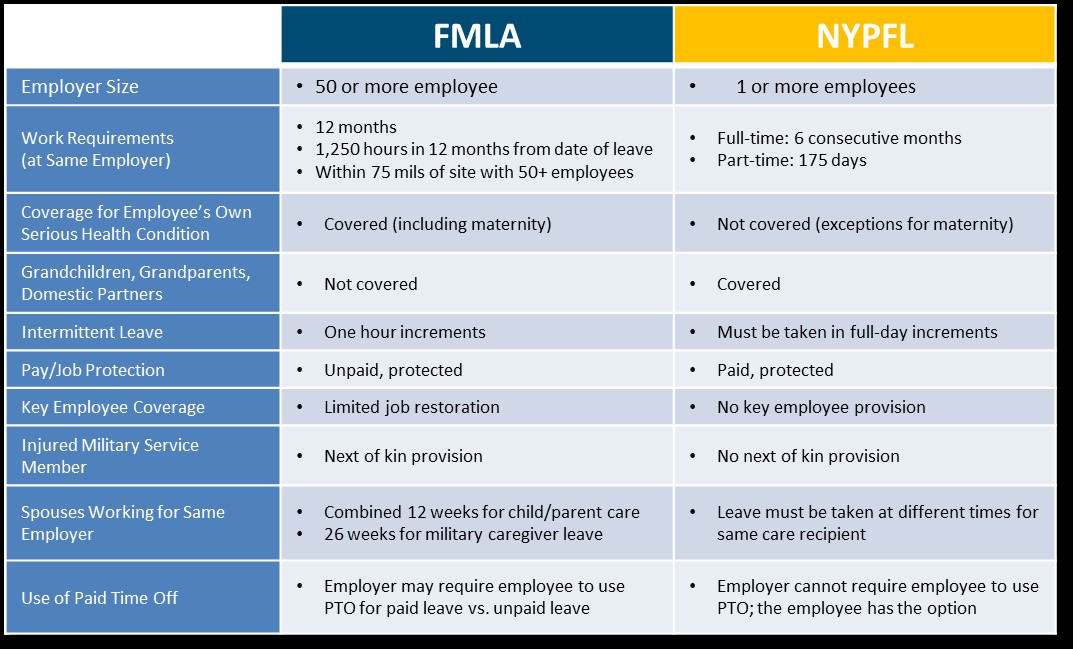
FMLA & NYPFL – Key Differences

PFLvsFMLA

[ii]

– Matthew Burr, HR Consultant

[i] https://www.bsk.com/media-center/3746-labor-employment-faqs-mdash-things-you-want-and-need-know-about#.WWfMyYVh068.linkedin


[ii] Guardian NYSPFL Presentation

4 Updates on the DOL Overtime Rule

I first want to highlight the background of the overtime rule, from 2016 through current day.  In November 2016, a district court in Texas blocked the overtime rule put forth under the Obama administration.  It was scheduled to raise the salary threshold from $23,600 to $47,476 on December 1, 2016.  Moving to current day, under the Trump administration, the decision was appealed, to better understand and determine the Department of Labor’s authority in setting salary thresholds.  The 2016 ruling is currently moving (slowly) through the litigation process.  However, the Department of Labor has suggested new and more complex alternatives to the salary threshold and overtime rule(s).

Below 4 on the DOL’s Overtime Suggestions:

  1. Request for Information: On July 26, 2017, the Department of Labor issued a request for information (RFI) during the overtime rule making process.  “The use of an RFI in the rule making process is optional but the DOL chose this option rather than immediately publishing a proposed rule in light of pending litigation over the 2016 overtime rule.”[i]  The RFI was published in the Federal Register and comments will be public record.

https://s3.amazonaws.com/public-inspection.federalregister.gov/2017-15666.pdf

  1. Cost-of-Living-Based Salary Test: This is comparable to what we have seen with minimum wage levels and exempt/non-exempt weekly rates, throughout New York City and New York State.  The suggested rates would vary based location and cost of living, a varying scale of exempt and non-exempt rates.  Living in Washington D.C. costs more than living in the rural south.  There will be significant challenges with this option, employees that travel, working in more than one location in different areas of the country.
  2. Litigation and Other Threshold Proposals: Continue to watch for any rulings in the current court proceedings on the Department of Labor’s authority in setting salary thresholds. Also, we could see multiple proposals throughout this process on overtime and salary thresholds, under the new administration.
  3. New York State Regulations: Regardless of changes made at the federal level, we will see changes in the minimum wage rate and exempt/non-exempt rates on January 1, 2018.  Exempt and non-exempt for the specific executive and administrative classifications.  Both increases/changes will vary by region, throughout the state.


The laws, regulations and salary thresholds will continue to evolve, through the litigation process by the Department of Labor, request for information proposal and rule making process under the new administration.  Ensure that your organization is compliant with state and federal laws regarding exempt, non-exempt and salaried non-exempt statuses.  There are duties tests to assist employers in determining overtime eligibility, published by the federal government.  If you are confused, seek guidance.  Certain positions can be confusing and determinations are complex.


– Matthew Burr, HR Consultant


[i] https://www.shrm.org/resourcesandtools/legal-and-compliance/employment-law/pages/ot-rfi-multiple-salary-levels.aspx


4 Updates on the 2016 Overtime Rule

On June 30, 2017, the Department of Justice released a brief to the 5th U.S. Circuit Court of Appeals, “that the Department of Labor (DOL) intends to revisit the $47,476 ($913 per-week) salary limit set by the rule through new rule-making.”[i]  Recall from the November 2016 district court ruling, which blocked the overtime rule.  The court blocked the rule based on the lack of authority by the Department of Labor to set any salary-level threshold for the exemptions.  The court case has been delayed since March 2017.  The new administration could set a new direction for the Department of Labor, overtime rule, and salary threshold.

Below are 4 thoughts updates on the 2016 overtime rule:

  1. 3-Part Test: This process to determine exemption has not changed in 75 years.  To be exempt, a worker must satisfy the following; be paid on a salary basis, earn a specified salary and satisfy a duties test.  Reminder the exempt levels for Executive and Administrative professionals in New York State will rise again at the end of 2017.
  2. Potential Changes: During his confirmation hearing, Secretary of Labor Alexander Acosta wants to raise the $23,600 threshold to “somewhere around $33,000.”[ii]
  3. New Rule-making: The Department of Labor will revisit the salary level(s) through the rule-making process.  Under the new administration we could see no need for any courts to evaluate the 2016 rule, blocking the overtime rule and new salary threshold.
  4. Appeals Court: The 2016 case has not been decided yet.  We could still see a ruling from the court system on the salary thresholds blocked in November 2016.  Continue to monitor for any potential updates on this case.

Under the new administration we can expect to see changes to the Department of Labor and potential salary threshold increases.  However, this is a federal threshold.  Remember that state thresholds can be higher than federal thresholds, based on exemption status and the duties tests.  This is comparable to what we see with minimum wage increases, state versus federal.  If you are confused about job classifications, duties tests and threshold levels, ask for guidance.  This legislation will could evolve in the court system or under the new administration.

[i] https://www.shrm.org/resourcesandtools/legal-and-compliance/employment-law/pages/dol-right-to-set-salary-threshold.aspx

[ii] https://www.shrm.org/resourcesandtools/legal-and-compliance/employment-law/pages/dol-right-to-set-salary-threshold.aspx

-Matthew W. Burr 

3 Updates to the New York Paid Family Leave Law

As we move closer to 2018, the regulations on the New York State Paid Family Leave Law will continue to be communicated from the state.  On June 1, 2017, the state released the maximum employee contributions.  This will be the average deduction that will be taken out of the employee’s paycheck.

Below are the 3 updates:

  1. Clarification on the payroll deductions and employer portions. This clarification is not new.  However, I have been asked about the employer portion many times.  The paid family leave “is intended to be funded entirely through employee payroll deductions and employers are not required to fund any portion of this benefit.”[i]
  2. The maximum employee contribution was set at 0.126% on June 1, 2017, of an employee’s weekly wage, up to and not to exceed 0.126% of the NY statewide average weekly wage. The current statewide wage is $1,305.92.  “So, for example, if an employee’s weekly wage amounts to $1,000.00, the maximum payroll deduction for PFL would be $1.26 for that week.”[ii]  If any employee makes more than $1,305.92, the weekly amount will be capped at $1.65.  Multiply the 0.126% by the wage to calculate the deduction.
  3. The statewide average weekly wage is calculated annually on March 31st and will be based on the previous calendar year’s average weekly wage. As wages increase across the state, so will the paid family leave contribution deductions, out of the employee’s paycheck.        

As new information is released, I will send a breakdown of the regulations.  Now is the time to begin reviewing, drafting, updating and revising policies and procedures related to FMLA and Paid Family Leave.  January 1, 2018 is only six short months away.  If you are confused, ask questions and do not assume.  This law is very complex, it continues to change as new regulations are slowly released.

New York State Paid Family Leave Website

Premium Rate for Family Leave Maximum Employee Benefit Contribution Website


Reminder of Previous Information: 

[iii]


Want to learn more? Check out the upcoming trainings I will be conducting at Elmira College, Corning Community College (CCC), 24/7 Compliance and Compliance Online  in July & August:

Elmira College: SHRM Certification Exam Prep Course- September through November

Upcoming Corning Community College Training’s

247 Compliance: Performance of Dashboard Using KPIs and Designing


– Matthew Burr, HR Consultant


[i] https://www.bsk.com/media-center/3723-labor-employment-new-york-sets-maximum-employee-contribution-paid-family


[ii] https://www.bsk.com/media-center/3723-labor-employment-new-york-sets-maximum-employee-contribution-paid-family


[iii] Guardian PPT Training Slides

5 Proposed Regulations to the New York Paid Family Leave Law

The New York State Worker’s Compensation Board issued five proposed regulations on May 24, 2017, for organizations to incorporate, when implementing the New York Paid Family Leave requirements on January 1, 2018.  The initial regulations were published on February 22, 2017 and included a comment period.  The new regulations released on May 24, 2017 will have a 30-day comment period.

Below are 5 proposed regulation changes:

  1. An employee using intermittent leave must give the employer separate notice each day of use of the Paid Family Leave. Previous language stated that employees only needed to provide notice once to employers when using intermittent leave, which was inconsistent with the FMLA rules.


  1. Collective bargaining language must provide benefits as favorable as the Paid Family Leave law, including the length of leave and amount of pay. This section is still evolving and negotiated language can include the union responsibility for time records and pay deductions.  This has not been finalized and more changes will come to this section.


  1. Paid Family Leave language has been clarified that the eligibility of employees working 20-hours or more per week is measured based on the number of weeks in employment, which must be at least 26-weeks. Employees who work less than 20-hours per week is measured in days, which must be at least 175 working days.      


  1. The Worker’s Compensation Board clarified the July 1, 2017 deductions language. The employer can start taking payroll deductions on July 1, 2017, but cannot take deductions more than the maximum weekly contribution to retroactively cover the cost of providing Paid Family Leave.  The reason for early deductions is to offset the cost of acquiring the mandated insurance policy.


  1. The Worker’s Compensation Board issued additional guidance on accrued leave running concurrently with Paid Family Leave. The complexity of this language and requirements is related to accrued leave is still being drafted.  Further clarification is needed from the Board on the concurrent and accrued requirements, which include; FMLA, worker’s comp, and disability.  More updates to come on this proposed language.

Now is the time to begin reviewing, drafting, updating and revising policies and procedures related to FMLA and Paid Family Leave.  January 1, 2018 is only six short months away.  Continue to monitor for updates and changes to the proposed language.  If you are confused, ask questions and do not assume.  This law is very complex, it continues to change as concerns arise and the implementation will impact most organizations throughout New York State.


New York State Paid Family Leave Website


Additional Information:

[i]


Employers Providing Pawternity Leave to Employee’s (End on a Positive)


– Matthew Burr, HR Consultant

[i] Guardian PPT Training Slides

Open Enrollment Success Tips

As most organizations are now approaching the open enrollment season, we need to be cognizant of confusing and frustrating open enrollment processes.  A poll “was conducted in April among 2,105 employees currently receiving health care through their employer. Among those whose company offers health insurance:  Half of employees (49 percent) say making health insurance decisions is always “very stressful” for them.  41 percent feel the open enrollment process at their company is “extremely confusing.  20 percent often regret the benefits choices they make.”[1]

As leaders we need to educate our employees on making the right choice for themselves and their family.  Healthcare enrollment can be a confusing process for any employee, education and communication are crucial to ensure a successful open enrollment season.  None of our organizations want to be a statistic as mentioned above.

Below are 7 open enrollment tips to assist your organization in a successful open enrollment season:


  1. Develop a roadmap from start to finish for the open enrollment outcomes. This should include what you want covered by the plans and how you want to get there.  Do you want 100% participation in open enrollment?  Are you analyzing the data every day?
  2. Keep it simple. Do not assume that every person that works for you has a thorough understanding of how open enrollment works or what to choose during the open enrollment process.  Use examples that everyone can understand. Benefit enrollment is complex enough; do not make it more complex.
  3. Develop a training for the open enrollment process. Everyone learns differently, so try to develop a training system that encompasses all aspects of different learning styles.  Presenting/lecturing on benefits for 2-hours would be a challenge for me (or anyone else!) to sit through.
  4. Design checklists and handouts. Develop checklists or cheat sheets for employees to use during the process.  Handout the packet of information during the training.  Material should be basic and easily readable for a variety of literacy levels.
  5. Offer family sessions. Offer enrollment sessions that include a spouse or significant other. This can relieve some anxiety and allow for better decision making by employees for their family’s needs.
  6. Determine Frequently Asked Questions. Design a frequently asked questions handout or implement into the training.   I have found this to work well in the past.
  7. Open enrollment office hours and follow-up meetings. Establish 30-minutes to 1-hour every other day or daily dedicated to open enrollment and open enrollment questions.  If employees need to enroll online, assist them with this process during these time slots.  Follow-up throughout the process to ensure you reach the pre-established goal for the organization.


Open enrollment timing and processes vary by organization.  At times, this process can be confusing and frustrating to your employees.  Proactive planning and simplification wherever possible will help to ensure a successful open enrollment season.  If you have a third party or consultant scheduled to work through the open enrollment process, walk through the training with them.  Human Resources needs to understand what information is being communicated and how it will be communicated.  Ask employees before the process begins if they have any questions or concerns.  As the cost of healthcare and other benefits continues to rise, as does the complexities of the laws and regulations.  Seek guidance or help if you are unclear on the right approach.


– Matthew Burr, HR Consultant

[1] https://www.shrm.org/resourcesandtools/hr-topics/benefits/pages/open-enroll-benefits-confusion.aspx