
The clocks will be set back one hour at 2 a.m. on Sunday, November 2, 2025, causing confusion and challenges for employers with nonexempt employees who were working during the time the clocks turned forward. How do we pay employees during this time? What is our legal obligation related to hours worked and paid?
On November 2, 2025, Daylight Saving Time ends in the U.S. and clocks will “fall back” one hour at 2 a.m. local time, which is a requirement under the Fair Labor Standards Act (FLSA) for employers to pay employees for all hours worked. This means employees working an overnight shift that includes this change will work one hour longer than usual and must be compensated for that extra hour, with potential overtime implications if the extra hour puts them over 40 hours for the week.
Daylight Saving Time Change
- Date and time: Clocks will be set back one hour at 2 a.m. local time on Sunday, November 2, 2025.
- Effect: This will result in one additional hour being worked for those on overnight shifts, and an earlier sunrise.
FLSA and Payroll Considerations
- Guaranteed hours: Under the FLSA, employees must be paid for all hours they actually work.
- Overnight shifts: Employees on overnight shifts that cross the time change will work an extra hour. This hour must be paid.
- Overtime pay: If the extra hour pushes an employee’s total hours for the week over 40, they must be paid overtime for that hour as well.
- Employer responsibility: Employers must ensure their payroll systems accurately account for this change and that employees are compensated correctly.
The AI Answer
What Employers Should Do for Daylight Saving Time in November 2025
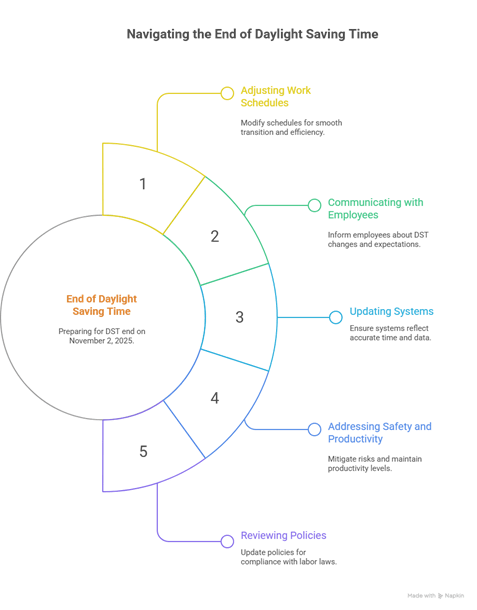
Employer Considerations:
- Adjust Work Schedules:
- Since clocks fall back one hour at 2 a.m. on November 2, employees working overnight shifts that span this time will effectively work an extra hour.
- Employers should decide how to handle this extra hour—whether to pay for it, treat it as overtime, or adjust schedules accordingly.
- Communicate Clearly:
- Notify employees ahead of time about the time change and how it affects their work hours.
- Remind employees to set their clocks back before going to bed on Saturday, November 1, 2025, to avoid confusion.
- Update Systems and Devices:
- Many digital devices update automatically, but analog clocks, ovens, and some machinery may need manual adjustment.
- Employers should ensure all timekeeping systems, security systems, and scheduling software reflect the time change accurately.
- Consider Safety and Productivity:
- The time change can affect sleep patterns and alertness. Employers might want to be mindful of potential impacts on employee safety and productivity immediately following the time change
- Review Policies:
- Check company policies regarding pay and hours worked during DST changes to ensure compliance with labor laws and fairness.
Below are three wage and hour answers, for daylight saving time change(s):
Pay and Hours Worked: Employers are required to pay employees for all hours worked. Nonexempt employees working last night at 2:00 a.m. must be paid one additional hour of pay, unless the start/end times of their shifts are adjusted in anticipation of the time change. In essence, such an employee will have worked the hour from 1:00 a.m. to 2:00 a.m. twice.”[i]
Overtime: The one additional hour must be considered into the overtime compensation/calculation for the entire week. If the nonexempt employee is scheduled for 40-hours this week, the additional hour would put the employee at 41-hours, one hour of overtime, at least time and one-half the normal hourly rate.
Overtime Rate: “In addition, employers must take this additional hour of work into account when computing the employee’s regular rate of pay for purposes of calculating the employee’s overtime rate.”[ii]
Additionally, ensure that your payroll systems fall back during the time change on Sunday. I have seen issues with timekeeping and payroll systems not resetting for the one-hour time change, which will cause additional issues when processing payroll.
“Previously, employment law experts told HR Dive that managers should be mindful of giving employees proper break times if shifts encompass daylight saving transitions. So, for example, if supervisors typically rely on computers to automate break times, this would be an instance where manual timekeeping is encouraged.
Additionally, HR should look into whether there are any wage and hour provisions in their workers’ collective bargaining agreement that addresses the daylight-saving time change.
Employers should ensure that they are following any provisions in a collective bargaining agreement that addresses wage and hour provisions for time change. Ultimately, the employment attorney who spoke to HR Dive reaffirmed the DOL’s guidance: Timekeeping is about “staying true” to the hours worked.
Another compliance consideration is workplace safety: A 2018 National Safety Council study found that post-daylight saving transition fatigue leads to an annual uptick in accidents, due to “circadian misalignment” or talent fighting to stay awake.” (HR Dive)
FLSA Hours Worked Advisor
Daylight Saving Time
Most states participate in daylight saving time. Those employees working the graveyard shift when Daylight Saving Time begins work one hour less because the clocks are set ahead one hour. Those employees working the graveyard shift when Daylight Saving Time ends work an extra hour because the clocks are set back one hour at 2:00 a.m.
For example:
The scheduled shift starts at 11:00 p.m. and ends at 7:30 a.m. The next day, your employee works an eight- hour shift and receives a 30-minute lunch break.
- On Sunday Daylight Saving Time starts at 2:00 a.m., the employee does not work the hours from 2:00 a.m. to 3:00 a.m. because at 2:00 a.m. all of the clocks are turned forward to 3:00 a.m. Thus, on this day the employee only worked 7 hours, even though the schedule was for 8 hours.
- On the Sunday that Daylight Saving Time ends at 2:00 a.m., the employee works the hour from 1:00 a.m. to 2:00 a.m. twice because at 2:00 a.m. all of the clocks are turned back to 1:00 a.m. Thus, on this day the employee worked 9 hours, even though the schedule only reflected 8 hours.
The FLSA requires that employees must be credited with all of the hours actually worked. Therefore, if the employee is in a work situation similar to that described in the above example, he or she worked 7 hours on the day that Daylight Saving Time begins and 9 hours on the day that Daylight Saving Time ends. This assumes, of course, that the employee actually worked the scheduled shift as in our example.
https://webapps.dol.gov/elaws/whd/flsa/hoursworked/screener11.asp
“Unanticipated challenges”
That extra hour of work can present several unanticipated challenges, in addition to an unpaid hour:
- Breaks. In states requiring that employees take breaks at a certain point in their shifts, workers may not automatically get that time, says Caroline Brown, of counsel at Fisher Phillips. “For that day, back off of relying on the time keeping computer so much,” Brown suggests, and figure out the time manually.
- Overtime. If that additional hour puts an employee at more than 40 hours during that workweek, the Fair Labor Standards Act requires the employee be paid overtime. Employees who fall under the “8 and 80” system — or in states that require daily overtime — may be eligible for overtime for that day.
- Collective Bargaining Agreements. Employers should ensure that they are following any provisions in a collective bargaining agreement that addresses wage and hour provisions for time change.
Making Adjustments
Although appropriate tracking for the seasonal time change is frequently forgotten, it can be easily remedied, says Green.
The best approach is to go back to basics, Brown suggests. “There is a tendency for employers to focus on days and shifts when it comes to wage and hour requirements, when it’s really about staying true to the time of how many hours someone did the work.”
Whether timekeeping is manual or automatic, grab a pen and paper if necessary, and figure out the actual hours for that day, Brown says; “Give that payroll a glance to make sure everything lines up.” The same goes when spring rolls around: an employee working 11 p.m. to 7 a.m. when we turn the clocks forward must be paid for only seven hours of work.
It’s worth noting that not all states and regions observe Daylight Saving Time, but if yours is one that does, be prepared so you — and your employees — can avoid any unpleasant wage and hour surprises.” (HR Dive)
States That Deviate from the Daylight Saving Standard
Note that Arizona (with the exception of the Navajo Nation) and Hawaii do not observe daylight saving time. Not to be outdone, Florida and Nevada have passed bills that would ensure that daylight saving time is observed year-round. Though their respective state legislatures approved these bills, and their governors signed them, they are still awaiting federal approval. And, of course, there’s California, which just a few days after the end of daylight-saving time will vote on a proposition to move the state to year-round daylight-saving time as well. Even if that proposition passes, it will require congressional approval for the change to become permanent.” (JDSUPRA)
Additional Considerations
- Ensure timeclocks adjusted.
- Camera’s need to align with timeclock.
- The payroll smartphone app time alignment
- Computer system time updates
- Communication on pay and policies.
- Smart phones, computers, etc.
Additional Legislative Information:
Introduced in House (01/03/2025)
Sunshine Protection Act of 2025
This bill makes daylight saving time the new, permanent standard time.
States with areas exempt from daylight saving time may choose the standard time for those areas.
https://www.congress.gov/bill/119th-congress/house-bill/139
Eighteen states have enacted legislation or passed resolutions to provide for year-round daylight-saving time if Congress were to allow such a change. Will that eventually happen? Only time will tell.
Daylight-saving State Legislation Link
[i] https://www.shrm.org/resourcesandtools/hr-topics/compensation/pages/daylight-saving-time-wage-hour-problems.aspx
[ii] https://www.shrm.org/resourcesandtools/hr-topics/compensation/pages/daylight-saving-time-wage-hour-problems.aspx

 BURR CONSULTING, LLC