What is a stay interview? “A stay interview is a structured discussion a leader conducts with an individual employee to learn specific actions the leader can take strengthen the employee’s engagement and retention with the organization.”[i] What is the value of the stay interview? The organization hears directly from the employee in a one-on-one discussion (not related to performance), with any issues, concerns and opportunities for leadership improvement. This provides us as leaders with the opportunity to engage, communicate and retain the workforce. The stay interviews should be conducted by the leader of the organization, with HR’s support. I have effectively used stay interviews.
Below are the thoughts on implementing stay interviews:
Start at the Top: The leader at the top of the organization should set the tone for the organization and conduct stay interviews with their direct reports. The process should cascade down throughout the rest of the organization to front-line supervisors and employees. Employees at every level should take part in a stay interview, to ensure an effective and successful process.
In Person: Stay interviews should not be conducted over the phone or via a video conferencing system, if possible. Remote workers should have the opportunity to sit one-on-one with their supervisor and have a discussion.
Expectations of the Stay Interview: Ensure the employee understands the reason for the stay interview and how these interviews will focus on areas that the manager can influence. Not all of us can change company policy, mission statements and strategic goals. However, if a trend in these interviews is consistent, we might have more say in strategic objectives.
Schedule Time: “Most stay interviews take 20 minutes or less to conduct, but some will carry on longer. Leaders should consider telling employees to allow 20 minutes for their meeting, but even then, leaders should allow thirty minutes on their calendars.”[ii] Treat the employee as you want to be treated during the stay interview.
Leave Performance Out of It: There is a time and place to discuss performance expectations. Stay interviews should remain focused on engagement, retention feedback, communication and concerns. Scripted open-ended questions are necessary.
No Advanced Questions: This can limit the conversation to a list of memorized demands and responses. Open-ended discussion with note taking, listening and probing for additional information will add tremendous value to the stay interview.
Opening Script: The pre-drafted script is a great way to open the meeting. This will provide additional information to the employee on what the process will look like and the direction of the interview. The messages will be consistent throughout the organization.
The Why of Stay Interviews:
“Employees hear directly from their supervisor that they care and want them to stay and grow with the company.
Supervisors further accept retention and engagement within their sphere of responsibility.
Employees are more likely to accept responsibility for staying.
Stay Interview Draft Template: To open the stay interview, a manager may use the following (or similar) statements:
I would like to talk with you about the reasons you stay with ____, so I understand what I might be able to do to make this a great place to work.
I’d like to have an informal talk with you to find out how the job is going, how the job will change, so I can do my best to support you as your manager, particularly with issues within my control.
I will be taking notes throughout our discussion and might ask you to repeat yourself if I do not capture everything.
Do you have any questions before we get started?
Review Job Description and Changing Expectations
These are the current changes to the job description
These will be the changes to the position and current expectations/accountabilities
Discuss the reporting structure
Communication expectations
System reporting expectations
Do you have any questions or concerns?
Questions The following are questions you may ask during a stay interview. You should have several open-ended questions on hand. It’s important to listen and gather ideas from the employee about how you and your organization can retain him or her.
Tell me specifically, what factors cause you to enjoy your current job and work situation (including people, job, rewards, job content, coworkers, management etc.), and as a result, they contribute to your staying at our firm as long as you have?
What gets your excited to come to work here every day?
What do you look forward to when you come to work each day?
What do you like most or least about working here?
What keeps you working here?
If you could change something about your job, what would that be?
What would make your job more satisfying?
How do you like to be recognized?
What talents are not being used in your current role?
What would you like to learn here?
What motivates (or demotivates) you?
What can I do to best support you?
What can I do more of or less of as your manager?
What can we be doing differently as a management team? Communication, meetings, etc.
If you “managed yourself,” what would you do differently (in relation to managing “you”), that I, as your current manager, don’t currently do?
What might tempt you to leave?
Stay Interview Template We would appreciate you taking 8-10 minutes to answer the following questions as honestly as possible. Your individual responses are treated as confidential and will not become part of your personnel file. We believe that the information is of vital importance and will assist in analyzing and improving our employee satisfaction and culture. Thank you for your participation!
Employee Name (Last, First, & Middle)
Employee ID Number
Date of Hire
Job Title
Supervisor/Manager Name
Department
Select the top 3 reasons you remain in your position.
☐ Type of Work ☐ Compensation ☐ Benefits ☐ Company Culture
☐ Business/Product Direction ☐ Quality of Supervision ☐ Support from Team Members
☐ Work-Life Balance ☐ Career Advancement Opportunity ☐ Other: __________________
What do you think of your supervision in regard to the following?
Excellent
Good
Fair
Needs Improvement
Demonstrates fair and equal treatment
☐
☐
☐
☐
Comments
Provides recognition on the job
☐
☐
☐
☐
Comments
Encourages cooperation and teamwork
☐
☐
☐
☐
Comments
Requests feedback and listens to suggestions
☐
☐
☐
☐
Comments
How would you rate the following in relation to your job?
Excellent
Good
Fair
Needs Improvement
Collaboration within your department
☐
☐
☐
☐
Comments
Collaboration with other departments
☐
☐
☐
☐
Comments
Communication in your department
☐
☐
☐
☐
Comments
Communication within the company as a whole
☐
☐
☐
☐
Comments
Communication between you and your manager
☐
☐
☐
☐
Comments
Morale in your department
☐
☐
☐
☐
Comments
Job satisfaction
☐
☐
☐
☐
Comments
Training opportunities
☐
☐
☐
☐
Comments
Growth potential
☐
☐
☐
☐
Comments
What do you think makes us standout as a good place to work?
What are the challenges with working here? Any suggestions for improvements?
What keeps you working here? What do you most look forward to coming into work each day?
If you could change something about your job to make it more satisfying, what would that be?
What would you like to learn here? What can the company do to best support you?
What motivates you?
What might tempt you to leave?
Please include any additional comments about your job or the company:
The WARN Act protects workers, families and communities if an organization has a foreseen or unforeseen plant closure or mass layoff. The goal for all of our organizations is to never be in a position for mass layoffs however, understanding the difference in Federal vs. New York State specific laws is necessary, to ensure legal compliance. New York State is one of the few states that has a “Mini-WARN” Act with stricter regulations than federal law.
Federal: Requiring employers with 100 or more employees (generally not counting those who have worked less than six months in the last 12 months and those who work an average of less than 20 hours a week) to provide at least 60 calendar days advance written notice of a plant closing and mass layoff affecting 50 or more employees at a single site of employment. WARN makes certain exceptions to the requirements when layoffs occur due to unforeseeable business circumstances, faltering companies, and natural disasters. Advance notice gives workers and their families some transition time to adjust to the prospective loss of employment, to seek and obtain other jobs, and if necessary, to enter skill training or retraining that will allow these workers to compete successfully in the job market. Regular federal, state, local, and federally recognized Indian Tribal government entities that provide public services are not covered. (DOL)
State: The WARN Act applies to private businesses with 50 or more full time workers in New York State. It covers:
Closings affecting 25 or more workers
Mass layoffs involving 25 or more full-time workers (if the 25 or more workers make up at least 33% of all the workers at the site)
Mass layoffs involving 250 or more full-time workers
Certain other relocations and covered reductions in work hours
This means that covered businesses must provide all employees with notice 90 days prior to a:
Plant closing
Mass layoff
Relocation
Other covered reduction in work hours
Businesses that do not provide notice may be required to:
Pay back wages and benefits to workers
Pay a civil penalty
Early warning gives the DOL and the LWIB the chance to work with the business early on and provide employees with information about:
Unemployment Insurance (UI)
Workforce Programs
Resources designed to get employees back to work quickly
Early warning also benefits the business. It can shorten the time that workers are on UI. It therefore may lower the UI charges associated with the layoff or closing. (NYS DOL)
As of late 2025/early 2026, the New York State (NYS) WARN Act mandates stricter compliance, requiring 90 days’ notice for layoffs/closures. Recent updates include incorporating remote workers into site counts, requiring disclosure of AI usage in selection decisions, and adding notifications to local officials, school districts, and emergency services.
Key NYS WARN Act Changes & Requirements
AI/Algorithmic Disclosure (New): The DOL submission form now asks if AI or algorithmic tools were used to determine layoffs, requiring a yes/no answer and explanation.
Remote Worker Inclusion: Employees working remotely are now considered based at the site to which they report for calculating whether the threshold is met.
Expanded Notification Recipients: Notices must now be sent to the chief elected official of the local government, school districts, and local emergency service providers (police/fire), in addition to the DOL and union representatives.
Increased Notice Period: Employers must provide 90 days’ advance notice (compared to 60 days under federal law).
Thresholds: Applies to private employers with 50+ full-time employees in NY, covering closings affecting 25+ employees, or mass layoffs of 25+ (if 1/3 of staff) or 250+ employees.
Sale of Business: Updated rules now apply to notice requirements during a sale of a business.
On June 21, 2023, the New York Department of Labor’s amendments to the NY WARN Act.
Employer Coverage Under the amended regulations, the definition of a covered employer is expanded to count not just employees at a single site of employment in the state, but also employees who work remotely but are “based at the employment site.”
New Notice Content Requirements On top of NY WARN’s already long list of notice content requirements, the amended regulations add that the notice to the New York Commissioner of Labor must include:
business addresses and email addresses for the employer’s and employees’ agents;
the personal telephone numbers, personal email addresses (if known), work locations, part-time/full-time status, method of payment (i.e., hourly, salary, or commission basis), and union affiliation for each affected employee;
the total number of full-time employees in New York State and at each affected site, as well as the number of affected employees at each affected site; and
the total number of part-time employees in New York State and at each affected site, as well as the number of affected employees at each affected site.
Notice to affected employees must now also include relevant information known at the time of the notice, such as information on severance packages or financial incentives if the employee remains and works until the effective date of the layoff, available dislocated worker assistance, and, if the planned action is expected to be temporary, the estimated duration.
Revisions to the Sale of Business Provision and NY WARN Exceptions NY WARN’s sale of business provision was amended to clarify that sellers will not have an obligation to give WARN notice if the transfer of employees in the sale is a good-faith condition of the purchase agreement, and the purchasing employer does not uphold that condition. In that scenario, the purchasing employer would need to provide notice.
Additionally, NY WARN’s exceptions, which permit an employer in some cases to give less than the full 90-days’ notice to affected employees, remain in place with some tweaks:
The faltering company exception is now applicable only to plant closings (mirroring the federal WARN Act).
The unforeseeable business circumstances exception was amended to include public health emergencies, such as a pandemic, that result in a sudden and unexpected closure, and a terrorist attack directly affecting operations as new examples of circumstances that would qualify for this exception.
“An amendment to the Age Discrimination in Employment Act (ADEA), the OWBPA is a federal law that requires employers to offer older workers (those who are at least 40 years old) benefits that are equal to or, in some cases, cost the employer as much as, the benefits it offers to younger workers. The OWBPA also sets minimum standards for an employee waiver of the right to sue for age discrimination, designed to ensure that the waiver is knowing and voluntary.” (Cornell Legal Information Institute)
The purposes of the Older Workers Benefit Protection Act (OWBPA) are to make it illegal for an employer to:
use an employee’s age as the basis for discrimination in benefits
target older workers for their staff-cutting programs, and
require older workers to waive their rights without observing certain safeguards.
“California’s WARN Act (Cal WARN) takes an approach to counting employees and layoffs that differs from the federal WARN Act, Hathaway noted. Cal WARN applies to “facilities” that have employed 75 or more people within the past 12 months. If 50 employees—employed for at least six months—are let go within a 30-day period, Cal WARN is triggered. Also, any closing of a covered facility triggers Cal WARN, even if fewer than 50 employees are let go, he explained.
The Iowa, New Hampshire, New York and Wisconsin WARN laws apply to layoffs involving as few as 25 employees, Hathaway said.
“New York requires 90 days’ notice, and New Jersey has a revision to its WARN law that has not yet gone into effect that also requires 90 days’ notice, plus separation pay equal to one week of pay per year of service,” he noted.
The mini-WARN Act in Illinois applies to employers with 75 or more full-time employees when: 1) 25 or more full-time employees are laid off if they constitute one-third or more of the full-time employees at the site or 2) 250 or more full-time employees are laid off, Hollis said.
Wisconsin’s mini-WARN Act applies to employers with at least 50 employees, he added.
“States continue to pass WARN-like requirements,” Hathaway said. “Be sure to know which states have done so.”
A city also can have a mini-WARN law. “As an example, Philadelphia has such a law, which can be surprising to employers.” (SHRM)
Key State-Specific WARN Act Provisions (as of 2026)
California (Cal-WARN): Covers employers with 75+ employees. Requires 60 days’ notice for layoffs, relocations, or terminations of 50+ employees within 30 days.
New York (NY-WARN): Covers employers with 50+ employees. Requires 90 days’ notice for plant closings, and lower thresholds for mass layoffs (33% of workforce or at least 25 employees).
New Jersey (NJ-WARN): Requires 90 days’ notice for employers with 100+ employees when laying off 50+ workers, and mandates severance pay for certain layoffs.
Illinois: Applies to employers with 75+ full-time employees, requiring 60 days’ notice for layoffs of 25+ employees (if they constitute 33% of the workforce) or 250+ employees.
Other States: Additional states with specific mini-WARN laws include Delaware, Iowa, Maine, Maryland, New Hampshire, Ohio, Tennessee, and Vermont.
Severance Legal Requirements
Federal Law Review and Revocation Periods
Under the federal Age Discrimination in Employment Act (ADEA) and the Older Workers Benefit Protection Act (OWBPA), review periods depend on the employee’s age and the nature of the termination:
Individual Termination (Age 40+): Minimum 21 days to review the agreement.
Group Layoff / Reduction in Force (Age 40+): Minimum 45 days to review if two or more employees are laid off.
Federal Revocation Period: Mandatory 7 days to revoke the signature after signing an age discrimination waiver.
On March 4, 2025, the New York state Senate passed S.372, the “No Severance Ultimatums Act” a first of its kind legislation which, if enacted, will require New York employers to:
Provide a minimum 21 business days for employees to review severance agreements (which is waivable by the employee), and a nonwaivable seven-day revocation period after signing, and notify employees of their right to consult with an attorney before signing the agreement.
California: SB 331 (passed in 2022) requires employers to provide all employees at least five business days to review a severance agreement and notify employees of their right to consult with an attorney. California however does not require employers to require a revocation period after signing.
Minnesota: Under the Minnesota Human Rights Act (MHRA), prospective claims of the MHRA cannot be released in a severance agreement. Additionally, if a severance agreement includes a release of claims existing at the time of execution related to workplace discrimination, harassment or retaliation, employees have the right to rescind the release of MHRA claims within 15 days (written agreements) or 45 days (for electronic agreements) after signing.
New York: Existing New York law already requires a 21-day (waivable) review period and a mandatory seven-day revocation period for settlement agreements resolving discrimination, harassment or retaliation claims, when the employer includes a non-disclosure provision (at the employee’s choice) regarding the facts of the claim. Employers must provide this in a separate agreement for review and signature before signing the full settlement agreement.
No Severance Ultimatum Act- NYS
The Act adds a new Section 215-d to the New York Labor Law (“NYLL”) and prohibits so-called “coercive severance ultimatums.” Specifically, the Act requires that employers provide separating employees additional time and information before such employees release waivable claims. The Act would apply to all New York employees. Notably, the Act expressly includes governmental agencies in its definition of “employer.”
Under the Act, any employer offering a “severance agreement,” defined as an agreement offered upon separation of employment that requires the employee to release waivable claims against the employer, must notify the employee that:
The employee has a right to consult an attorney about the agreement;
The employee has at least twenty-one (21) calendar days to consider the agreement;
The employee may revoke the agreement within seven (7) calendar days of signing;
The agreement does not become effective and enforceable until after the revocation period expires; and
The employee may make a knowing and voluntary choice to sign the agreement prior to the end of the consideration period, provided such decision is not induced by the employer through fraud, misrepresentation, a threat to withdraw or alter the consideration period, or by providing different terms if the employee signs early.
The firm’s 2014 Guide to Severance and Workforce Transition reflects the results of a survey of over 250 HR professionals across a wide range of company sizes and industries in the U.S. For those organizations not offering severance to all employees in cases of involuntary separation, the following positions were eligible for severance payments:
• Officers (C-suite)—76 percent of respondents.
• All senior executives—84 percent.
• Managers—84 percent.
• Professionals—73 percent.
• Administrative/clerical employees—56 percent.
• No policy—12 percent.
• Don’t know—5 percent.
“Because reductions in force or organizational restructuring events often affect many more employees below the professional level than above it, not offering severance may have an effect on how a large number of employees choose to respond with legal action or speak about or represent the company in the media, within their social networks, and in online reviews, where their opinions may create a ripple effect,” the report points out.
Calculating Severance
Of the 48 percent of organizations that offered severance for all eligible employees, the top three factors in calculating severance payouts were:
• Years of service.
• Job level or title.
• Base salary.
When asked for the average amount of equivalent salary offered to employees of those organizations, the top three responses were:
• 3 months.
• 2 months.
• 1 month.
“Factors such as employee level or tenure have often factored into severance calculations in the past; however, as the business landscape changes and the conversation in human resources includes more perspectives on fairness in compensation and reward, it will be interesting to see if severance [trends toward] standard calculations” for all employees, the report states.
Continuing Benefits
Employers with 20 or more employees are usually required to offer departing employees COBRA health insurance coverage and to notify their employees of the availability of such coverage. Among surveyed companies, 70 percent have a standard policy for COBRA health plan continuation for all employees in the event of a reduction in force. These companies indicated that they:
• Provide COBRA benefits continuance as required—35 percent of respondents.
• Pay COBRA/insurance premium payments directly to an insurance company—29 percent.
• Give employees a lump sum to fully cover COBRA/insurance premiums—9 percent.
• Give employees a lump sum to partially cover COBRA/insurance premiums—6 percent.
When paying severance on an ad hoc basis, employers should be careful to clearly establish that they retain discretion over whether to grant severance pay and that it is not automatic or a vested job right. Some of the more common administrative issues that should be addressed include the following:
Will severance benefits cease if a former employee obtains alternative employment during the severance pay period?
How will any benefit payments be handled?
Will former employees continue to be considered “employees” of the organization during severance pay periods with all the same rights and privileges as active employees?
Will individuals still considered to be employees be eligible for routine salary increases or adjustment during the severance period?
What approval process will be required for authorizing severance payments?
Will there be an appeal process?
How will severance payments be calculated, and what will be the basis used for calculating benefits?
Will benefits be paid in the form of a lump sum payment, or over time?
Will changes in policy have any impact on past and current recipients of severance pay benefits?
What funding mechanisms are to be used to fund severance benefits?
Can severance benefits be transferred, assigned or pledged to a third party?
Will employees be required to sign a waiver or release of claims prior to receiving severance benefits?
What impact will the employee’s receipt of severance pay have on unemployment insurance benefits for the employee and on the future premiums of the employer? (SHRM)
What to include
Having a clearly written and communicated policy regarding termination and severance pay benefits is highly advisable. However, unless governed by a collective bargaining agreement or state law, what an employer chooses to include in a severance pay policy is at its discretion. The amount and type of compensation in any given severance agreement varies according to specific circumstances, but the amount of severance pay is typically based on a number of factors, including:
Length of the employee’s tenure with the employer.
Circumstances under which the employment relationship ended (e.g., employer downsizing, employee conduct or layoff).
The employer’s financial solvency or particular circumstances (e.g., filing for bankruptcy, experiencing economic growth).
A well-structured policy should reflect the employer’s organizational culture and philosophy. In drafting the policy, employers should consider incorporating provisions that:
Cover a range of common situations, such as downsizing resulting from changes to internal organizational structures or business reorganizations.
Specify that severance pay benefits will be paid only to employees who are actually laid off as a result of transfers in business ownership due to a merger or acquisition.
Specify whether periodic severance payments cease when former employees obtain alternative employment.
Require employees to sign a waiver or release absolving the employer from employment-related liability prior to remittance of any severance pay.
Stipulate that any waiver or release should comply with the detailed requirements of the OWBPA, which applies when a discharged employee is age 40 or older and is waiving or releasing ADEA claims.
Clearly spell out the purpose of severance pay benefits. Generally, the purpose defines the group or groups of employees who are eligible under the plan as well as the benefits and constraints of the plan.
Specifically state that the organization reserves the right to alter or terminate the policy at its discretion. (SHRM)
Severance Pay Policy Purpose The purpose of this policy is to outline the severance pay benefit of [Company Name].
Eligibility This policy applies to all exempt and nonexempt, full-time and part-time employees. Part-time employees will receive severance pay on a pro-rated basis in accordance with their scheduled hours.
Triggering Events In the event of an involuntary termination due to a reduction in force/downsizing, change in company direction, job elimination or termination for performance, [Company Name] provides a severance benefit for the affected employees. This does not apply to terminations for cause, refusal to be reassigned or refusal to be relocated.
Payment Amount The rate of severance is based on length of service with [Company Name] (or as adjusted through acquisition).
Length of Service Number of Weeks Less than one year 2 One year – less than two 3 Two years – less than three 4 Three years – less than four 5 Four years – less than five 6 Five years – less than six 7 Six years or more 8
The maximum allowed severance is eight weeks. Severance is calculated on base pay only. Employees may choose to receive severance pay as a salary continuation benefit (continue payments on scheduled paydays) or in a lump sum. Federal, state and local tax withholding will apply.
Vacation Accrued but unused vacation will be paid out to the employee. Vacation will stop accruing as of the effective date of termination.
Commissions Any commissions earned as of the date of the termination will be paid out.
Insurance Benefits Health and dental insurance coverage, if applicable, end on the last day of the month in which the employee receives the severance benefit. Upon termination of coverage, COBRA notification will be forwarded.
Reduction in Force Policy – Selection and Severance Pay
A reduction in force (RIF) occurs when changing priorities, budgetary constraints or other business conditions require [Company Name] to eliminate positions.
Selection for RIF
A RIF decision requires an evaluation of the need for particular positions and the relative value of work performed by specific employees so that [Company Name] can continue to provide the highest level of service possible with a reduced work force. Determining the retention or separation of an employee includes an evaluation of the relative skills, knowledge and productivity of the employee in comparison to necessary services. Length of service and other factors are also considered but receive less weight in the determination. [Company Name] determines priority for RIF within the following guidelines:
Temporary employees performing the same work must be terminated before any regular employee, provided that a regular employee can perform the temporary employee’s tasks.
Reduction in force of regular employees is based on the following factors:
Which positions are most critical to the department in the delivery of goods or services.
Relative skills, knowledge and productivity of employees.
Length of service of employees.
Consideration of equal employment factors to avoid adverse impact on [Company Name]’s affirmative action goals.
Severance Pay Severance pay is available for eligible employees in accordance with [Company Name]’s RIF determination process.
Severance pay calculation The amount of an eligible employee’s severance payment is based on length of service and salary at separation. Payment is made in the same number of months as the number of months of pay. Payment is discontinued once re-employment is obtained.
Years of Service
Payment
Less than 1 year
2 weeks’ base salary
1 but less than 5 years
1 month base salary
5 but less than 10 years
2 months’ base salary
10 but less than 20 years
3 months’ base salary
20 or more years
4 months’ base salary
[Optional section, where allowable under state law:]
Age Adjustment An employee qualifies for an age adjustment factor at 40 years of age. To compute the amount of the adjustment, 2.5 percent of the annual base salary at separation is added for each full year of age over 39 years of age. The total age adjustment factor cannot exceed the total service payment.
Example: Age 47, salary – $48,000/year, 9 years’ service
Factor
Computation
Amount of Severance Pay
Service
$4,000/month for 2 months
$8,000
Age adjustment
$48,000 x .025 x (47-39) = $9,600 Age adjustment factor cannot exceed the service factor, so the age factor is limited to $8,000.
$8,000
Total
$16,000 distributed over 2 months
Deductions from severance pay The following deductions must be withheld from severance payments.
Deduction
Amount
Federal withholding
Based on an employee’s current withholding status on W-4
Garnishments, support orders, levies
All based on directive provided
Negative leave balances, where allowable
Based on leave balances
The following deductions will not be withheld from severance payments:
State income withholding tax (if permitted by the employee’s state).
Medical insurance, including health, dental and vision.
401(k) and deferred compensation.
401(k) loan payments.
Life insurance.
Direct deposit Severance payments, as well as any leave payout due, will continue to be directly deposited into the bank account currently set up. To change to a different account, contact the payroll office.
Other RIF Benefits Unemployment insurance Employees separated due to RIF are eligible to collect unemployment insurance provided they otherwise meet the state eligibility requirements. Contact the local unemployment office to file a claim for unemployment compensation.
Vacation balance Vacation leave is paid for a maximum of [insert amount] hours.
What is Outplacement Service?
Outplacement services offer a multitude of benefits for both the employee and the employer.
For the Employee:
Career Counseling and Guidance: Outplacement provides access to experienced career counselors who can help employees assess their skills, interests, and career goals. Counselors offer personalized guidance on career paths, job search strategies, and professional development.
Resume and Cover Letter Assistance: Crafting a compelling resume and cover letter is crucial for a successful job search. Outplacement services offer expert assistance in developing these documents, highlighting the employees’ strengths and accomplishments in a way that resonates with potential employers.
Interview Skills Training: Many people find interviewing stressful. Outplacement programs include interview skills training, equipping employees with the techniques and confidence to excel in job interviews. This may include mock interviews, feedback on communication style, and strategies for answering common interview questions.
Job Search Resources and Networking: Outplacement services provide access to a wealth of job search resources, including job boards, company directories, and networking opportunities. Counselors can help employees identify potential employers and connect with industry contacts.
Emotional Support: Losing a job can be emotionally challenging. Outplacement services offer emotional support and guidance to help employees cope with the stress and uncertainty of job loss. Counselors can provide a safe space to process emotions and develop coping strategies.
Negotiation Skills: Outplacement services can assist employees in negotiating salary and benefits with potential employers.
For the Employer:
Improved Employee Morale: Offering outplacement services demonstrates that the employer cares about the well-being of its employees, even after they leave the company. This can help maintain morale among remaining employees and reduce the risk of negative publicity.
Reduced Legal Risk: Providing outplacement services can help mitigate the risk of legal action from departing employees. By offering support and resources, employers can demonstrate that they are treating employees fairly and respectfully.
Enhanced Reputation: Companies that offer outplacement services are often viewed as more socially responsible and ethical. This can enhance the company’s reputation and attract top talent in the future.
Smoother Transition: Outplacement services can help ensure a smoother transition for both the departing employees and the remaining team. By providing support and resources, employers can minimize disruption and maintain productivity.
Positive Brand Image: Treating departing employees with respect and dignity can positively impact the company’s brand image. This can be particularly important in today’s social media-driven world, where negative experiences can quickly go viral.
Key Components of Outplacement Services Outplacement services typically include a range of components designed to support the employee’s job search. These components may include:
Assessment: An initial assessment to identify the employee’s skills, interests, and career goals.
Career Counseling: One-on-one counseling sessions with an experienced career coach.
Resume and Cover Letter Development: Assistance in creating professional and effective resumes and cover letters.
Interview Skills Training: Workshops and practice sessions to improve interview performance.
Job Search Strategy Development: Guidance on developing a targeted job search strategy.
Networking Opportunities: Access to networking events and industry contacts.
Online Resources: Access to online job boards, company directories, and other resources.
Administrative Support: Assistance with administrative tasks such as scheduling interviews and preparing documents.
Negotiation Support: Assistance with negotiating salary and benefits.
Types of Outplacement Services Outplacement services are not one-size-fits-all. They can be tailored to meet the specific needs of the employee and the employer. Common types of outplacement services include:
Individual Outplacement: This is the most common type of outplacement service, providing personalized support to individual employees.
Group Outplacement: This type of service is offered to groups of employees who are being laid off at the same time. It typically includes workshops and group counseling sessions.
Executive Outplacement: This type of service is designed for senior-level executives and typically includes more intensive coaching and support.
Virtual Outplacement: This type of service is delivered online, providing employees with access to resources and support from anywhere in the world.
Talentscape’s Outplacement Services Talentscape’s outplacement services are designed to empower departing employees and equip them with the tools and support they need to successfully navigate their career transitions. Here’s how:
Personalized Career Coaching: Every individual’s situation is unique. Talentscape provides one-on-one coaching sessions with experienced career consultants who take the time to understand each participant’s skills, experience, goals, and challenges. This personalized approach ensures that the advice and guidance provided are relevant and effective. Coaches help participants identify their strengths, explore career options, and develop a tailored job search strategy.
Resume and Cover Letter Optimization: A strong resume and compelling cover letter are essential for making a positive first impression on potential employers. Talentscape’s experts work with participants to craft professional, ATS-friendly resumes and targeted cover letters that highlight their accomplishments and showcase their value.
Interview Skills Training: Mastering the art of interviewing is crucial for landing a job. Talentscape offers comprehensive interview skills training, including mock interviews, feedback on communication style, and guidance on how to answer common interview questions effectively. Participants learn how to confidently present themselves and articulate their qualifications.
Networking Opportunities: Networking is a powerful tool for job seekers. Talentscape helps participants expand their professional networks by providing access to industry contacts, alumni networks, and online communities. Coaches also provide guidance on how to effectively network and build relationships.
Job Search Resources and Technology: Talentscape provides access to a wealth of job search resources, including online job boards, company directories, and industry research tools. Participants also benefit from access to cutting-edge technology platforms that streamline the job search process and help them track their progress.
Emotional Support and Guidance: Job loss can be a stressful and emotional experience. Talentscape provides a supportive and understanding environment where participants can process their emotions, build their confidence, and stay motivated throughout their job search. Coaches offer encouragement, guidance, and practical advice to help participants overcome challenges and stay focused on their goals.
Benefits for Employers Offering outplacement services is not just a compassionate gesture; it’s a strategic investment that can benefit employers in numerous ways:
Enhanced Employer Brand: Providing outplacement services demonstrates a commitment to employee well-being and reinforces a positive employer brand. This can improve employee morale, attract top talent, and enhance the company’s reputation in the marketplace.
Reduced Legal Risks: Outplacement services can help mitigate the risk of legal claims related to terminations. By providing departing employees with support and resources, companies can reduce the likelihood of wrongful termination lawsuits and other legal challenges.
Improved Employee Morale and Productivity: When employees see that their company cares about their future, even after they leave, it can boost morale and productivity among remaining employees. This can lead to a more engaged and motivated workforce.
Smoother Transitions: Outplacement services can help ensure a smoother transition for both departing employees and the company. By providing support and guidance, companies can minimize disruption and maintain productivity during periods of change.
Cost Savings: While outplacement services involve an initial investment, they can ultimately lead to cost savings by reducing legal risks, improving employee morale, and minimizing disruption.
Positive Public Relations: Offering outplacement services can generate positive public relations and enhance the company’s image as a responsible and caring employer.
Why Talentscape Stands Out Talentscape distinguishes itself from other outplacement providers through its:
Customized Approach: We understand that every organization and every employee has unique needs. Our programs are tailored to meet those specific requirements.
Experienced and Dedicated Coaches: Our team of career coaches comprises seasoned professionals with extensive experience in various industries. They are passionate about helping individuals achieve their career goals.
Cutting-Edge Technology: We leverage the latest technology to provide participants with access to a comprehensive suite of job search tools and resources.
Proven Track Record: We have a proven track record of helping individuals successfully transition to new roles.
Commitment to Client Satisfaction: We are committed to providing exceptional service and exceeding our clients’ expectations.
New York has the most restrictive law, prohibiting discipline for legally protected absences (like FMLA, disability, religious needs) under “no-fault” policies, making it the closest to having a “no-fault ban” for those crucial leaves. Other states, like California, also have strong laws (CFRA, PDL) protecting specific leaves, meaning employers must always account for these protected reasons, even in general point systems.
Key State Examples
New York (NY): Since February 2023, NY Labor Law § 215 prohibits employers from disciplining or retaliating against employees for lawful absences protected by federal, state, or local law, effectively restricting traditional no-fault systems for such leaves.
California (CA): State laws like the California Family Rights Act (CFRA) and Pregnancy Disability Leave (PDL) require employers to allow protected leave, meaning any attendance policy must exclude these absences from points or penalties.
What These Policies Mean
No-Fault Policies: These systems track absences (tardies, no-shows) and assign points regardless of the reason, leading to discipline if a threshold is met.
Legally Protected Absences: Even in states without explicit bans, federal and state laws (like FMLA, ADA, state sick leave laws) mandate certain leaves (e.g., serious health conditions, disability accommodations, family needs) that cannot be penalized under a standard no-fault system.
What are No-Fault Attendance Policies?
No-fault attendance policies, also known as point-based or occurrence-based attendance policies, are disciplinary systems that address employee absenteeism and tardiness regardless of the reason for the absence. Unlike traditional attendance policies that distinguish between excused and unexcused absences, no-fault policies treat all absences the same, with certain exceptions.
The core principle is that consistent attendance is essential for business operations, and excessive absenteeism, regardless of the cause, disrupts productivity and imposes costs on the employer. These policies aim to create a clear, objective, and consistently applied system for managing attendance.
Key Features of No-Fault Attendance Policies
Several key features characterize no-fault attendance policies:
Point System: Employees accrue points for each absence or instance of tardiness. The number of points assigned may vary depending on the duration of the absence or the lateness.
Progressive Discipline: As an employee accumulates points, they progress through a series of disciplinary actions, such as verbal warnings, written warnings, suspensions, and ultimately, termination.
Point Decay or Restoration: Some policies include a mechanism for points to decay or be restored over time if the employee maintains good attendance. This incentivizes improved attendance behavior.
Specific Point Thresholds: The policy clearly defines the point thresholds for each disciplinary action, ensuring transparency and consistency.
Limited Exceptions: While the policy is generally “no-fault,” most policies include exceptions for absences protected by law, such as those covered by the Family and Medical Leave Act (FMLA), Americans with Disabilities Act (ADA), or workers’ compensation laws.
Clear Communication: The policy is clearly communicated to all employees, outlining the rules, point system, disciplinary actions, and exceptions.
Legal Considerations
While no-fault attendance policies offer administrative simplicity, employers must be mindful of several legal considerations:
FMLA: The Family and Medical Leave Act (FMLA) provides eligible employees with up to 12 weeks of unpaid, job-protected leave for specified family and medical reasons. Employers cannot penalize employees for taking FMLA-protected leave under a no-fault attendance policy.
ADA: The Americans with Disabilities Act (ADA) requires employers to provide reasonable accommodations to qualified individuals with disabilities. This may include modifying attendance policies to accommodate disability-related absences. Employers must engage in an interactive process with employees to determine if a reasonable accommodation is possible.
Workers’ Compensation: Employees who are absent due to work-related injuries or illnesses are typically protected under workers’ compensation laws. Employers cannot penalize employees for absences related to compensable injuries or illnesses.
Discrimination: Employers must ensure that no-fault attendance policies are applied consistently and do not disproportionately impact protected groups, such as employees based on race, gender, religion, or age.
State and Local Laws: Some states and localities have laws that provide additional protections for employees regarding sick leave or other types of leave. Employers must comply with these laws when implementing and administering no-fault attendance policies.
Contractual Obligations: Collective bargaining agreements or employment contracts may contain provisions related to attendance policies. Employers must adhere to these contractual obligations.
Advantages of No-Fault Attendance Policies
Simplicity and Objectivity: No-fault policies are relatively simple to administer and provide a clear, objective standard for evaluating attendance.
Consistency: The consistent application of the policy can reduce claims of favoritism or discrimination.
Reduced Administrative Burden: Eliminating the need to evaluate the reasons for absences can save time and resources for HR and management.
Improved Attendance: The policy can incentivize employees to improve their attendance by creating a clear consequence for absences.
Focus on Performance: By addressing absenteeism, the policy can help improve overall employee performance and productivity.
Disadvantages of No-Fault Attendance Policies
Potential for Inequity: The policy may penalize employees for legitimate absences, such as those due to illness or family emergencies, which can lead to resentment and morale issues.
Risk of Legal Challenges: Failure to properly account for legally protected absences can result in legal challenges under the FMLA, ADA, or other laws.
Negative Impact on Employee Morale: Employees may feel that the policy is unfair or insensitive to their personal circumstances, which can negatively impact morale and engagement.
Presenteeism: Employees may come to work sick to avoid accruing points, which can spread illness and reduce productivity.
Difficulty in Addressing Underlying Issues: The policy may not address the underlying reasons for absenteeism, such as job dissatisfaction, stress, or health problems.
Potential for Abuse: Employees may strategically use their allowed absences, leading to predictable disruptions in workflow.
Best Practices for Implementing No-Fault Attendance Policies To mitigate the potential disadvantages and ensure legal compliance, employers should consider the following best practices:
Clearly Define the Policy: The policy should be written in clear, concise language and easily accessible to all employees.
Provide Adequate Training: Managers and supervisors should be trained on how to administer the policy consistently and fairly.
Make Exceptions for Legally Protected Absences: The policy should clearly state that absences covered by the FMLA, ADA, workers’ compensation, and other applicable laws will not be counted against employees.
Consider a “Good Faith” Exception: Include a provision that allows for exceptions in extraordinary circumstances, such as natural disasters or family emergencies.
Offer Employee Assistance Programs (EAPs): Provide resources to help employees address underlying issues that may be contributing to absenteeism, such as stress, mental health problems, or substance abuse.
Regularly Review and Update the Policy: The policy should be reviewed and updated periodically to ensure compliance with changing laws and regulations and to address any unintended consequences.
Communicate Openly with Employees: Be transparent about the purpose of the policy and address any concerns or questions that employees may have.
Track Attendance Data: Monitor attendance data to identify trends and patterns and to evaluate the effectiveness of the policy.
Focus on Employee Well-being: Promote a culture of employee well-being and provide resources to help employees stay healthy and productive.
Many of our organizations have dealt with absenteeism, both chronic and occasional. These absences do have an impact on all of our organizations from productivity to organizational culture and employee conflict/retaliation, turnover, etc. “Each year, “US workers are absent from work for more than ½ billion work days…according to a 2016 report published by the CDC, productivity losses from missed work cost employers $225.8 billion, or $1,685 per employee, each year…absenteeism causes financial issues, loss of productivity and a decrease in workplace morale.”[i]
The yearly cost of employee absenteeism is 225.8 billion dollars.
There’s no doubt about it: $225.8 billion is a lot of money…that comes out to $1,685 per employee, per year. Why is absenteeism so costly? Absenteeism not only reduces productivity, but can also lead to increased spending on hiring and onboarding new employees, paying overtime for employees covering open shifts, and unplanned downtime. https://www.teamsense.com/blog/absenteeism-workplace-statistics
Chronic Absenteeism Definitions to Remember:
Employee absences fall within two broad categories:
“Innocent”: Absences related to legitimate medical and/or personal issues and are out of the employee’s control
“Culpable”: Absences that occur without genuine cause and are within the employee’s control
What about Statutory Interplay (laws and regulations that impact absenteeism)?
*These regulations and statutory interplay are specific to New York State, review your local and state laws and regulations, to ensure compliance, while ensuring a thorough understanding of the regulations prior to writing and enforcing attendance policies.
Thoughts on Chronic Absenteeism:
Design, implement and communicate a legally compliant and effective attendance policy.
Ensure your managers, supervisors and the rest of the organization is consistently enforcing the attendance policy. Questions to consider:
Are call-in procedures being followed? Are we allowing text messages, Facebook messages, emails, etc.?
Are we tracking call-ins?
Are documentation procedures being followed?
What about the aforementioned protected leave interplay? Have we checked on this?
Track attendance and review metrics on a regular basis. We reviewed attendance metrics monthly as part of the Key Performance Indicators (KPI’s) at past organizations, during monthly operation review meetings.
Conduct necessary follow-up when vague absence explanations that are being offered. Ask for new FMLA paperwork or ADA paperwork. Follow-up, but follow-up consistently. Accountability from the organization and employees is necessary.
Recognize and reward for good attendance records. Ensure this is spelled out in the policy and implemented consistently throughout the organization.
What about pattern absenteeism?
Training and communication on the policy and handbook language?
Rolling 12-month calendar?
These are just a few thoughts, definitions and recommendations on chronic absenteeism and attendance policies for all organizations. I have written many of these policies for organizations and implemented attendance tracking metrics. I’m happy to work with any organization in reviewing, revising, drafting, implementing and communicating attendance policies. Consistency is the key to a successful attendance policy. Ensure you review laws and regulations at the local, state and federal level prior to finalizing the attendance policy.
Example Attendance Policy (Review Local & State Considerations)
Objective The purpose of this policy is to set forth for the Organization policy and procedures for handling employee absences and tardiness to promote the efficient operation of the company and minimize unscheduled absences.
Policy Punctual and regular attendance is an essential responsibility of each employee at the Organization. Employees are expected to report to work as scheduled, on time and prepared to start working. Employees are also expected to remain at work for their entire work schedule. Late arrival, early departure or other absences from scheduled hours are disruptive and must be avoided.
This policy does not apply to absences covered by the Family and Medical Leave Act (FMLA) or leave provided as a reasonable accommodation under the Americans with Disabilities Act (ADA), New York State Paid Family Leave (PFL), New York State Paid Sick Leave (PSL), Workers Compensation, Paid COVID-19 Sick Leave (as applicable), Pregnancy Leave (PDA & PWFA), Religious Holidays, Jury Duty, Time Off to Vote, Bereavement Leave and any other protected leave as defined at the local, state, and federal level. These exceptions are described in separate policies.
Absence “Absence” is defined as the failure of an employee to report for work when he or she is scheduled to work. The two types of absences are defined below:
Excused absence occurs when all the following conditions are met:
The employee provides to his or her supervisor sufficient notice advance of the absence.
The absence request is approved by the Human Resources Department or Supervisor.
Unexcused absence occurs when any of the above conditions are not met. If it is necessary for an employee to be absent or late for work because of an illness or an emergency, the employee must notify his or her supervisor no later than the employee’s scheduled starting time on that same day. If the employee is unable to call, he or she must have someone make the call. An unexcused absence counts as one occurrence for the purposes of discipline under this policy.
Employees with three or more consecutive days of excused absences because of illness or injury must give the Organization proof of physician’s care and a fitness for duty release prior to returning to work.
Employees must take earned PTO and/or PSL for every absence unless otherwise allowed by company policy (e.g., leave of absence, FMLA, bereavement, jury duty) if paid leave is available.
Call-In Procedure: Employees are expected to call in, text or email prior to any scheduled shift as soon as possible. Sick, Personal, Leave, PTO, etc. must be approved prior to using any leave. Approval must be submitted to the President. If you plan to take vacation time 5-10 days, please schedule 2-weeks in advance. Call-in includes intermittent FMLA, PFL leave, sick leave, etc. reserves the right to deny any leave if standards are not followed, employees not following procedures will be disciplined up to and including dismissal.
Tardiness and Early Departures Employees are expected to report to work and return from scheduled breaks on time. If employees cannot report to work as scheduled, they must notify their supervisor no later than their regular starting time. This notification does not excuse the tardiness but simply notifies the supervisor that a schedule change may be necessary. Employees who must leave work before the end of their scheduled shift must notify a supervisor immediately. Tardiness and early departures are each one-half an occurrence for the purpose of discipline under this policy.
Chronic Absence or Tardiness Employees receiving corrective action under this policy are expected to improve their attendance and punctuality. Failure to improve and sustain improvement may result in the employee’s receiving additional correction, up to and including termination.
Pattern Absenteeism Is defined as late arrivals or missing scheduled days during a workweek, (showing up late on Monday morning or calling in sick on Monday).
Disciplinary Action Excessive absenteeism is defined as two or more occurrences of unexcused absence in a 30-day period and will result in disciplinary action. Eight occurrences of unexcused absence in a 12-month period are considered grounds for dismissal.
Job Abandonment Any employee who fails to report to work for a period of three days or more without notifying his or her supervisor will be considered to have (AWOL) abandoned the job and voluntarily resigned from the employment relationship.
Attendance Point System for Nonexempt Employees
Attendance and Punctuality An unauthorized absence occurs when the employee’s supervisor/department has not been properly notified that an employee will be late or absent. Points will be assessed for unauthorized absences, tardiness or late arrivals as described below. Absent – missing one or more consecutive scheduled workdays for a single reason or arriving more than two hours after the scheduled starting time. Tardy – arriving up to 15 minutes after the scheduled starting time. Late – arriving between 15 minutes and two hours after the scheduled starting time.
Absence
Points
Explanation
1-14 minutes
1
Tardy
15 minutes-2 hours
3
Late
More than 2 hours
5
Unauthorized absence
Disciplinary Action Employees will be subject to disciplinary action when the total points accumulated from unauthorized absences and tardiness reach the following levels during any rolling 12-month period.
Points
Corrective Action
10
Verbal warning
15
Written warning
20
Termination
Perfect Attendance Objective The Organization values employees with perfect attendance and recognizes nonexempt employees semiannually for perfect attendance on January 1 and July 1.
Eligibility To receive an attendance award, the employee must have been a full-time employee during the previous six-month period and have used no sick leave, taken no time off without pay, had no unscheduled late arrivals or early departures that were not made up within the same workweek, and had no unscheduled PTO (without advanced notice). Absences covered by the Family and Medical Leave Act (FMLA) or leave provided as a reasonable accommodation under the Americans with Disabilities Act (ADA), New York State Paid Family Leave (PFL), New York State Paid Sick Leave (PSL), Workers Compensation, Paid COVID-19 Sick Leave (as applicable), Pregnancy Leave (PDA & PWFA) are not counted.
Perfect Attendance Award The perfect-attendance award is $100 cash. This cash award is considered taxable income to the employee but will be “grossed up” to cover taxes so that the actual amount the employee realizes is $100. It will be included in the employee’s paycheck the first regularly scheduled payday following January 1 and July 1.
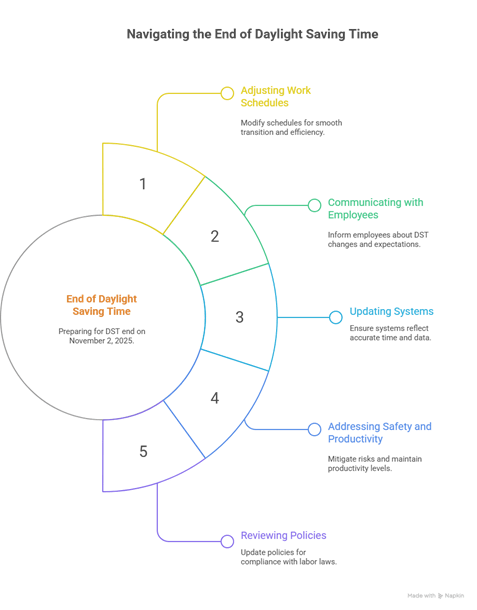
The clocks will be set back one hour at 2 a.m. on Sunday, November 2, 2025, causing confusion and challenges for employers with nonexempt employees who were working during the time the clocks turned forward. How do we pay employees during this time? What is our legal obligation related to hours worked and paid?
On November 2, 2025, Daylight Saving Time ends in the U.S. and clocks will “fall back” one hour at 2 a.m. local time, which is a requirement under the Fair Labor Standards Act (FLSA) for employers to pay employees for all hours worked. This means employees working an overnight shift that includes this change will work one hour longer than usual and must be compensated for that extra hour, with potential overtime implications if the extra hour puts them over 40 hours for the week.
Daylight Saving Time Change
Date and time: Clocks will be set back one hour at 2 a.m. local time on Sunday, November 2, 2025.
Effect: This will result in one additional hour being worked for those on overnight shifts, and an earlier sunrise.
FLSA and Payroll Considerations
Guaranteed hours: Under the FLSA, employees must be paid for all hours they actually work.
Overnight shifts: Employees on overnight shifts that cross the time change will work an extra hour. This hour must be paid.
Overtime pay: If the extra hour pushes an employee’s total hours for the week over 40, they must be paid overtime for that hour as well.
Employer responsibility: Employers must ensure their payroll systems accurately account for this change and that employees are compensated correctly.
The AI Answer
What Employers Should Do for Daylight Saving Time in November 2025
Employer Considerations:
Adjust Work Schedules:
Since clocks fall back one hour at 2 a.m. on November 2, employees working overnight shifts that span this time will effectively work an extra hour.
Employers should decide how to handle this extra hour—whether to pay for it, treat it as overtime, or adjust schedules accordingly.
Communicate Clearly:
Notify employees ahead of time about the time change and how it affects their work hours.
Remind employees to set their clocks back before going to bed on Saturday, November 1, 2025, to avoid confusion.
Update Systems and Devices:
Many digital devices update automatically, but analog clocks, ovens, and some machinery may need manual adjustment.
Employers should ensure all timekeeping systems, security systems, and scheduling software reflect the time change accurately.
Consider Safety and Productivity:
The time change can affect sleep patterns and alertness. Employers might want to be mindful of potential impacts on employee safety and productivity immediately following the time change
Review Policies:
Check company policies regarding pay and hours worked during DST changes to ensure compliance with labor laws and fairness.
Below are three wage and hour answers, for daylight saving time change(s): Pay and Hours Worked: Employers are required to pay employees for all hours worked. Nonexempt employees working last night at 2:00 a.m. must be paid one additional hour of pay, unless the start/end times of their shifts are adjusted in anticipation of the time change. In essence, such an employee will have worked the hour from 1:00 a.m. to 2:00 a.m. twice.”[i]
Overtime: The one additional hour must be considered into the overtime compensation/calculation for the entire week. If the nonexempt employee is scheduled for 40-hours this week, the additional hour would put the employee at 41-hours, one hour of overtime, at least time and one-half the normal hourly rate.
Overtime Rate: “In addition, employers must take this additional hour of work into account when computing the employee’s regular rate of pay for purposes of calculating the employee’s overtime rate.”[ii]
Additionally, ensure that your payroll systems fall back during the time change on Sunday. I have seen issues with timekeeping and payroll systems not resetting for the one-hour time change, which will cause additional issues when processing payroll.
“Previously, employment law experts told HR Dive that managers should be mindful of giving employees proper break times if shifts encompass daylight saving transitions. So, for example, if supervisors typically rely on computers to automate break times, this would be an instance where manual timekeeping is encouraged. Additionally, HR should look into whether there are any wage and hour provisions in their workers’ collective bargaining agreement that addresses the daylight-saving time change.
Employers should ensure that they are following any provisions in a collective bargaining agreement that addresses wage and hour provisions for time change. Ultimately, the employment attorney who spoke to HR Dive reaffirmed the DOL’s guidance: Timekeeping is about “staying true” to the hours worked.
Another compliance consideration is workplace safety: A 2018 National Safety Council study found that post-daylight saving transition fatigue leads to an annual uptick in accidents, due to “circadian misalignment” or talent fighting to stay awake.” (HR Dive)
FLSA Hours Worked Advisor Daylight Saving Time Most states participate in daylight saving time. Those employees working the graveyard shift when Daylight Saving Time begins work one hour less because the clocks are set ahead one hour. Those employees working the graveyard shift when Daylight Saving Time ends work an extra hour because the clocks are set back one hour at 2:00 a.m.
For example: The scheduled shift starts at 11:00 p.m. and ends at 7:30 a.m. The next day, your employee works an eight- hour shift and receives a 30-minute lunch break.
On Sunday Daylight Saving Time starts at 2:00 a.m., the employee does not work the hours from 2:00 a.m. to 3:00 a.m. because at 2:00 a.m. all of the clocks are turned forward to 3:00 a.m. Thus, on this day the employee only worked 7 hours, even though the schedule was for 8 hours.
On the Sunday that Daylight Saving Time ends at 2:00 a.m., the employee works the hour from 1:00 a.m. to 2:00 a.m. twice because at 2:00 a.m. all of the clocks are turned back to 1:00 a.m. Thus, on this day the employee worked 9 hours, even though the schedule only reflected 8 hours.
The FLSA requires that employees must be credited with all of the hours actually worked. Therefore, if the employee is in a work situation similar to that described in the above example, he or she worked 7 hours on the day that Daylight Saving Time begins and 9 hours on the day that Daylight Saving Time ends. This assumes, of course, that the employee actually worked the scheduled shift as in our example.
That extra hour of work can present several unanticipated challenges, in addition to an unpaid hour:
Breaks. In states requiring that employees take breaks at a certain point in their shifts, workers may not automatically get that time, says Caroline Brown, of counsel at Fisher Phillips. “For that day, back off of relying on the time keeping computer so much,” Brown suggests, and figure out the time manually.
Overtime. If that additional hour puts an employee at more than 40 hours during that workweek, the Fair Labor Standards Act requires the employee be paid overtime. Employees who fall under the “8 and 80” system — or in states that require daily overtime — may be eligible for overtime for that day.
Collective Bargaining Agreements. Employers should ensure that they are following any provisions in a collective bargaining agreement that addresses wage and hour provisions for time change.
Making Adjustments Although appropriate tracking for the seasonal time change is frequently forgotten, it can be easily remedied, says Green.
The best approach is to go back to basics, Brown suggests. “There is a tendency for employers to focus on days and shifts when it comes to wage and hour requirements, when it’s really about staying true to the time of how many hours someone did the work.”
Whether timekeeping is manual or automatic, grab a pen and paper if necessary, and figure out the actual hours for that day, Brown says; “Give that payroll a glance to make sure everything lines up.” The same goes when spring rolls around: an employee working 11 p.m. to 7 a.m. when we turn the clocks forward must be paid for only seven hours of work.
It’s worth noting that not all states and regions observe Daylight Saving Time, but if yours is one that does, be prepared so you — and your employees — can avoid any unpleasant wage and hour surprises.” (HR Dive)
States That Deviate from the Daylight Saving Standard Note that Arizona (with the exception of the Navajo Nation) and Hawaii do not observe daylight saving time. Not to be outdone, Florida and Nevada have passed bills that would ensure that daylight saving time is observed year-round. Though their respective state legislatures approved these bills, and their governors signed them, they are still awaiting federal approval. And, of course, there’s California, which just a few days after the end of daylight-saving time will vote on a proposition to move the state to year-round daylight-saving time as well. Even if that proposition passes, it will require congressional approval for the change to become permanent.” (JDSUPRA)
Additional Considerations
Ensure timeclocks adjusted.
Camera’s need to align with timeclock.
The payroll smartphone app time alignment
Computer system time updates
Communication on pay and policies.
Smart phones, computers, etc.
Additional Legislative Information:
Introduced in House (01/03/2025) Sunshine Protection Act of 2025 This bill makes daylight saving time the new, permanent standard time. States with areas exempt from daylight saving time may choose the standard time for those areas.
In light of recent unfortunate events at a Coldplay Concert, when a CEO and HR Director were caught on a camera moment, ducking and hiding away from the media. Dating in the workplace is common, every organization should have parameters in place to ensure expectation is set, consequences and clear ethical guidelines are in place. We have all seen the fallout from the recent events at the Coldplay Concert, the CEO resigns, the HR Director is under investigation and internal workplace ethical credibility is gone. Ethics starts at the top of the organization, if we don’t follow the mission, vision, values and code of ethics in the organization, why should we expect the workforce to follow anything? Setting the tone at the top helps drive, culture, communication, internal equity, transparency, trust and open communication throughout the organization.
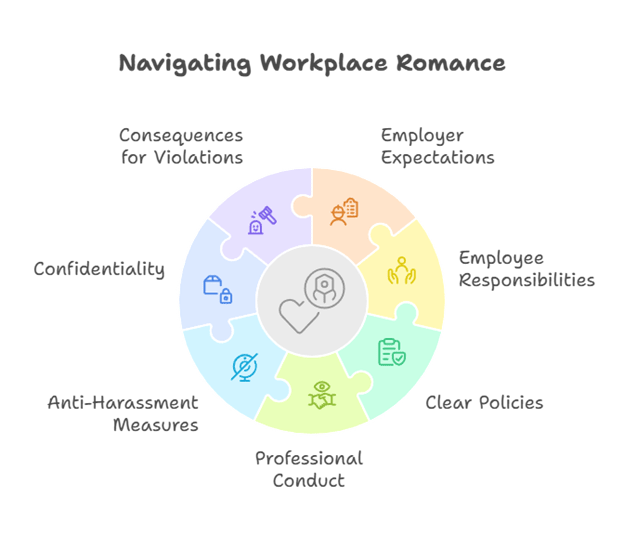
Dating in the workplace is a common occurrence, given how much time employees spend together. However, it brings unique challenges and risks that employers must address to maintain a professional, safe, and productive environment.
1. Clear Policies and Guidelines Employers are increasingly expected to have clear, written policies regarding workplace relationships. These policies typically outline:
Disclosure Requirements: Many employers require employees to disclose romantic relationships, especially if there is a reporting relationship or potential conflict of interest. Disclosure allows the employer to manage risks, such as favoritism or conflicts, and to make adjustments if necessary (e.g., changing reporting lines).
Prohibited Relationships: Most policies explicitly prohibit relationships between managers and their direct reports to avoid power imbalances and perceptions of favoritism or coercion.
Consensual Relationships: Employers emphasize that all relationships must be consensual and free from any form of harassment or coercion. Some require both parties to sign a consensual relationship agreement.
2. Professional Conduct Employers expect employees to maintain professionalism at all times, which includes:
No Public Displays of Affection (PDA): Employees are expected to refrain from PDA or any behavior that could make colleagues uncomfortable.
No Favoritism: Employees should avoid any actions that could be perceived as favoritism or bias due to their relationship.
Maintaining Boundaries: Personal issues should not spill over into the workplace. If a relationship ends, both parties are expected to remain professional and not disrupt the work environment.
3. Anti-Harassment and Complaint Procedures Employers are required to have robust anti-harassment policies and complaint procedures:
Sexual Harassment Training: Regular training is expected, especially for supervisors, to ensure everyone understands what constitutes harassment and how to report it.
Multiple Reporting Channels: Employees should have several avenues to report inappropriate conduct, not just through their direct supervisor.
Prompt Investigation: Employers are expected to investigate complaints thoroughly and impartially, taking corrective action if necessary.
4. Confidentiality and Non-Retaliation
Confidentiality: Employers stress the importance of keeping personal relationships and related information confidential to protect privacy and prevent gossip.
Non-Retaliation: Employees must be protected from retaliation if they report concerns or end a relationship.
5. Consequences for Policy Violations Violating workplace dating policies can result in disciplinary action, including reassignment or termination, depending on the severity of the infraction.
Key Takeaways for Employees
Know Your Company’s Policy: Always check your employee handbook or consult HR before starting a workplace relationship.
Disclose When Required: If your company requires disclosure, do so promptly to avoid potential disciplinary action.
Maintain Professionalism: Keep your relationship separate from your work life, avoid PDA, and treat your partner and colleagues equally.
Understand the Risks: Be aware that workplace relationships can lead to gossip, perceptions of favoritism, and complications if the relationship ends.
Seek Support if Needed: If you experience harassment or retaliation, use the reporting channels provided by your employer.
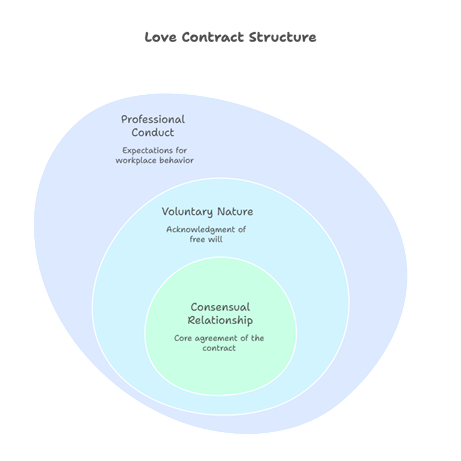
What Are Love Contracts? A love contract—also known as a consensual relationship agreement—is a voluntary document signed by two employees who are in a romantic relationship at work. The contract typically acknowledges that the relationship is voluntary and consensual, and it often outlines expectations for professional conduct in the workplace
Why Employers Use Love Contracts
Legal Protection: Love contracts are primarily used to protect employers from potential legal claims, especially those related to sexual harassment or favoritism. By having both parties acknowledge the consensual nature of the relationship, employers can reduce the risk of later claims that the relationship was unwelcome or coerced
Clarifying Boundaries: These agreements help clarify how the romantic relationship will (and will not) affect the working relationship, which can be especially important if one party supervises the other
Managing Breakups: In the event of a breakup, a love contract can help smooth the transition and set expectations for continued professionalism
When Are Love Contracts Used? Love contracts are most commonly used when a workplace romance involves a manager and a subordinate, as this dynamic poses the greatest risk for claims of harassment or favoritism. Most companies do not require love contracts for relationships between employees at the same level.
Ethics in the Workplace Leadership ethics in the workplace refers to the practice of leaders making decisions and guiding their teams based on moral principles and values, rather than just focusing on profits or personal gain. Ethical leadership is about doing the right thing for the common good, considering the needs of employees, customers, communities, and the organization as a whole.
Core Principles of Ethical Leadership Ethical leadership is built on several foundational principles:
Respect: Ethical leaders value the skills and contributions of others, fostering mutual respect rather than demanding it one-way. This creates healthier workplace relationships and a positive environment
Accountability: Leaders hold themselves responsible for their actions, lead by example, and communicate openly about challenges without shifting blame
Service: Ethical leaders prioritize the well-being of employees, customers, and the community, often engaging in charitable activities and encouraging their teams to do the same
Honesty and Transparency: Open and honest communication builds trust within the organization and with customers, even when addressing difficult or unpopular issues
Justice and Fairness: Ethical leaders ensure fair treatment for everyone, striving for equity and inclusion in decision-making
Community: They view the organization as a community, considering the impact of decisions on all stakeholders and promoting collaboration
A helpful framework for remembering these principles is the acronym FATHER: Fairness, Accountability, Trust, Honesty, Equality, and Respect.
Why Leadership Ethics Matter
Ethical leadership has significant benefits for organizations:
Improved Workplace Culture: Ethical leaders inspire trust, psychological safety, and a sense of belonging, leading to higher employee morale and engagement
Attracting and Retaining Talent: Employees, especially younger generations like Gen Z, are drawn to organizations with strong ethical values and are more likely to stay with such companies
Customer Loyalty: Consumers increasingly prefer to support businesses that demonstrate ethical practices and social responsibility
Long-Term Success: Ethical leadership helps prevent scandals and fosters sustainable growth by building loyal partnerships, customers, and employees
What Should Employers Consider?
Reporting Requirements: Love contracts usually require employees to report their relationship to HR, and also to notify HR if the relationship ends
Favoritism Concerns: Even with a love contract, employers must be vigilant about potential claims of favoritism or discrimination from other employees.
Policy Integration: Love contracts should be part of a broader workplace romance policy that addresses reporting, confidentiality, and professional conduct.
As we all know and understand, workplace burnout can be a significant issue in any of our organizations and throughout the workforce. How do we help solve this common problem? What opportunities can we offer to employees to reduce workplace burnout? Lead by example and set the tone at the top of the organization to counter workplace burnout, while ensuring employee commitment and engagement.
My 6 recommendations on countering workplace burnout:
Prioritize Your Health: This is a challenge for all of us, with long workdays and challenging work schedules (electronic responses late night). Look for opportunities to reduce stress and recognize when it is time to turn it off. Eat healthy, exercise regularly (I work out at 5am most mornings, it is a great way to start the day), get a full night’s sleep (turn the TV off and other technology early) and meditate or find alternatives to reduce stress. Developing disciplined and healthy habits will help you develop a routine; health should be a priority for all of us; I learned this the hard way.
Compassion: We all have different workstyles and how we personally handle stress and burnout. Recognize your own signs when work and life are too much, know that it is okay to take a break and rejuvenate for a few days. Know when employees in the organization are burning out and ask them to take a break. Burnout isn’t a personal failure, its simply time for a break. Make the break a priority.
Set the Tone at the Top: Some of you have seen emails from me at 3am (or earlier), this is an area where I need to heed my own advice. Set a good example as leaders in the organization and know when a break is needed and when to turn off the technology. Encourage employees to take downtime and focus on life, not work.
The Why: Have a true understanding of the reasons your organization or you personally are having workplace burnout. Is there anything we need to change as an organization? Is there anything I need to change? Can we do 4-day work weeks in the summer? Ask for feedback from the workforce and actively listen. Make the necessary changes to avoid burnout within yourself and your workforce.
Vacation & PTO Days: We have vacation and PTO days as a benefit in most organizations for a reason. Use the days granted by the organization and understand the value of using vacation and PTO days. Encourage subordinates to use these days as well and enforce the no technology usage on vacation policy. It is necessary to unplug, I still have not learned this.
Learn to Unplug: I will call myself a hypocrite with this recommendation. I have not learned how to unplug as of yet, but I am working on it! Technology controls the way we communicate and how we run our organizations. We have the ability to have instant access to information and need it to make effective and sound decisions. Turning off the technology is not a bad thing; it provides the break we all need. Learn how to unplug, even if it is only checking messages once a day on vacation (let’s see how well I am following my own advice). I was in Yellowstone National Park, so cellphone service was sporadic at best, which helped me turn off the technology for a while.
These are a just a few thoughts I have had as I reflect back on a busy first half of 2025 and recognize areas I need to personally improve on work-life balance, while learning to unplug. We all work differently, find the balance between life and work that is effective for you and your organizations. Taking a break is not failing, it is recognizing your mind, body and spirit need to do something different or do nothing at all for a few days. Enjoy the summer.
Strategies to Address and Prevent Burnout
Foster a Culture of Wellbeing:
Make employee wellbeing a core part of organizational culture, not just an HR initiative.
Encourage work-life balance by promoting reasonable hours, flexible schedules, and the use of vacation time
Equip Managers to Support Employees:
Train managers to set clear expectations, provide regular feedback, and remove barriers to success.
Encourage open communication and regular check-ins to identify stressors early
Promote Mental Health Awareness:
Offer mental health resources, such as confidential counseling or workshops on stress management.
Normalize discussions about mental health to reduce stigma
Recognize and Reward Employees:
Provide rewards that show appreciation for employees as individuals, not just for their performance. This could include gift cards, extra time off, or public recognition
Improve Workload Management:
Use tools to optimize scheduling and ensure adequate staffing levels.
Avoid last-minute changes that create unnecessary stress
Leverage Technology for Insights:
Tools like Deloitte’s “Vitals” dashboard can help monitor employee workloads and identify early signs of burnout. Such systems enable proactive interventions
Create a Positive Work Environment:
Encourage collaboration, fairness, and respect among team members.
Adjust environmental factors like noise levels, lighting, and seating arrangements to enhance comfort (You.com)
NYC ESSTA Rules Incorporating Prenatal Leave
The New York City Department of Consumer and Worker Protection issued amended rules on May 30, 2025, formally incorporating the state prenatal leave requirement into ESSTA. Changes and obligations related to prenatal leave, which are effective July 2, 2025, include:
Policy Requirements
The obligation to promulgate and distribute a policy related to ESSTA is expanded to require that such policy address paid prenatal leave entitlements. Under the rules, employers must distribute their written safe and sick time and paid prenatal leave policies to employees personally upon hire and within 14 days of the effective date of any policy changes and upon an employee’s request.
In essence, all NYC employers have an obligation to modify their current policy and reissue the revised policy to current employees.
Employee Notice of Rights, Posting
The Department also issued an updated Notice of Employee Rights that includes paid prenatal leave. The updated notice must be provided to new hires and to current employees when rights change (which is the case here), and employers must maintain a record of receipt by the employee. The notice also must be posted.
All NYC employers have an obligation to modify the notice required for new hires and reissue the notice to current employees.
Paystub Requirement
For each pay period in which an employee uses prenatal leave, the following information must be clearly documented on pay stubs or other documentation provided to the employee, such as a pay statement:
The amount of paid prenatal leave used during the pay period; and
Total balance of remaining paid prenatal leave available for use in the 52-week period.
Takeaways
Changes to NYC’s paid prenatal leave requirement take effect 07.02.25.
They incorporate and enhance NYS prenatal leave protections that went into effect at the beginning of this year.
NYC employers should understand their obligations and implement the changes to policies, notices, and recordkeeping.
Since Jan. 1, 2025, all private-sector employers in New York have been required to provide up to 20 hours of paid prenatal leave in a 52-week period to eligible employees, regardless of company size. The 52-week leave period starts on the first day the prenatal leave is used.
The prenatal leave entitlement is in addition to the statutory sick leave entitlement and other paid time off benefits provided by company policy or applicable law, and it applies only to employees receiving prenatal healthcare services, such as medical exams, fertility treatments, and end-of-pregnancy appointments. Spouses, partners, or support persons are not eligible to use prenatal leave.
“For the first time in decades, the New York State Legislature and governor amended Sections 519 and 521 of the Judiciary Law, to increase the daily rate of pay for trial and grand jurors serving in New York State, from $40 to $72. This amendment was enacted through the New York State Budget for fiscal year 2025-2026, which was signed into law on May 9, 2025. Accordingly, as of June 8, 2025, most employers with 11 or more employees must pay their employees who are absent for jury duty at a daily rate of $72 for the first three days of jury duty…As a reminder, employers are also required to comply with Section 519 of the Judiciary Law, which provides that “any person who is summoned to serve as a juror [] and who notifies their employer to that effect prior to the commencement of a term of service shall not, on account of absence from employment by reason of such jury service, be subject to discharge or penalty.”
Pursuant to Section 750 of the Judiciary Law, an employer may be “punish[ed] for a criminal contempt” if they are found guilty of “subjection of an employee to discharge or penalty on account of his absence from employment by reason of jury or subpoenaed witness service.” Section 751 of the Judiciary Law provides that such punishment may be by fine, up to $1,000, or by imprisonment for up to 30 days, or both….If an employer has questions about its obligations to an employee when it receives notice that its employee has been summoned to serve as a juror or witness, please contact counsel.” https://www.jdsupra.com/legalnews/nys-legislature-increases-daily-jury-1498682/
And now social media…
Social media in the workplace and outside of the workplace can be a complicated area for employers to manage, if we see certain posts by employees. Is an employee protected if the post disparaging content about an employer or another employee on social media? It depends on the post. Employees are free to complain about terms and conditions of employment under Section 7 of the National Labor Relations Act (Wagner Act). Under the Trump Administration and National Labor Relations Board (NLRB), some of the broad Section 7 social media content is being reduced, pro-employer rules on social media content. However, the employee still has a protected right to complain or discuss terms and conditions of employment (wages, benefits, working conditions, hours of work, seniority, safety issues, grievance and arbitration process, leave of absence, performance reviews, respect, integrity and culture issues) on social media, “water cooler talk.” With the NLRB turnover, expect changes to current policy expectations and rules at the federal level, which can and will vary from state or local level.
Creating a Workplace Culture:
Eliminate the Need to Complain on social media: Create a culture that there is an open channel of communication and employees have the opportunity to ask questions and discuss concerns with leadership.
Social Media Compliance Policy: The policy needs to clearly communicate anti-harassment, anti-discrimination, anti-bullying, sexual harassment, retaliation, etc. The policy should also include a social media use policy in the workplace. The policy cannot be overly broad; this can impact employee’s Section 7 rights. As social media evolves, so should our policies. I’m happy to work on a policy for any organization.
Create a Culture: A safe and open workplace that encourages employees to speak about any aspect of the work environment. Not only a safe and open workplace, but a workplace that closes the loop on communication and concerns are addressed with follow-up back to the employee. Internal complaint procedures (required in New York State for sexual harassment), whistleblower hotlines/policy, supervisor training and an active HR department are suggestions to build a culture such as this.
Training & Awareness: Writing policies is great, I see misses on setting the expectation, training and being consistent with expectations throughout the organization. What does leadership need to understand and what do the employees need to understand? Are we consistent? Have we communicated the policies, rules and expectations? Do we need an annual training or reminder?
These are a few suggestions for improving an organization and being consistent with a social media policy in the workplace. Have the social media policy reviewed prior to implementation in the workplace, once it is implemented, communicate and train employees on the new policy.
New York Labor Law Section 201-d:
This labor law prohibits employers from refusing to hire individuals because of lawful; off-duty recreational activities. What does this mean for our organizations? If you review social media or conduct Google searches on applicants prior to the making an offer, be aware of this law. Social media reviews or research can lead to bias decision making.
“What to Include
Alexiou recommends that social media policies include the following elements:
Roles. Identify the two main roles of employees on social media: official and unofficial. Make it clear that only the former can speak on behalf of the company.
Acceptable conduct and content. What can and can’t your employees post online? For example, employees must be respectful of others, be honest and transparent about their role, maintain workplace confidentiality, and so on. Prohibit online spats about the company and inflammatory or disrespectful language.
Regulations, legal restrictions and sensitive information. Make sure your employees are fully aware of the kinds of content they can and cannot post per industry regulations.
Procedure for conflict or crisis. Make it clear what your employees should do in these situations, including who they should reach out to for guidance and under what circumstances.
Call to action for participation. Explain that their participation in social media can help them build their personal brand, help the company recruit top talent, and drive the company’s sales and marketing activities. Encourage your employees to share why they enjoy working for you, how they feel supported by their manager or mentor, and customer testimonies about how your product or service impacted their life.
Arkansas: Prohibits employers from suggesting that an employee should disclose his or her social media username and password, add the employer as a social media contact, or change his or her social media privacy settings (2013).
California: Prohibits employers from requiring or requesting employees or applicants to disclose their username or password for their social media account and also prohibits employers from requiring the employee or applicant access his or her social media account in the presence of the employer. However, employers may make a reasonable request that an employee divulge personal social media account information, as is relevant to an investigation of employee misconduct (2012).
Colorado: Prohibits employers from requiring an employee or applicant to disclose a username, password or other means of accessing a personal account, unless an employer is conducting an investigation for legal compliance purposes (2013).
Connecticut: Prohibits an employer from requiring or requesting an employee or applicant to provide it with a username and password or to access a personal online account in the presence of the employer (effective Oct. 1, 2015).
Illinois: Bars employers from demanding employees or applicants reveal their usernames or passwords linked to social networking sites; also prohibits employers from forcing employees to display their social networking profiles for review (2012).
Louisiana: Employers cannot require prospective or current employees to disclose their username, password, or other login information that allows access to or observation of personal social media accounts (2014).
Maryland: Prohibits employers from requesting or requiring the disclosure of usernames or passwords to personal social media accounts and prohibits employers from taking or threatening to take any disciplinary action against employees or applicants who refuse to disclose such information (2012).
Michigan: Prohibits employers from asking for an employee’s or applicant’s personal Internet account information; does not prohibit an employer from conducting a work-related investigation into activity on an employee’s personal Internet account (2012).
Montana: Prohibits an employer from requiring or requesting an employee or applicant to disclose a username or password, access social media in the presence of the employer, or divulge information in a social media account as a condition of employment (2015).
Nevada: Prohibits employers from requiring access to an employee’s social media account as a condition of employment (2013).
New Hampshire: Employers cannot require prospective or current employees to disclose their username, password or other login information for personal social media accounts (2014).
New Jersey: Employers cannot require prospective or current employees to disclose their username, password or other means for accessing an electronic account or service (2013).
New Mexico: Employers are prohibited from requesting or requiring that prospective employees provide passwords or access to their social networking accounts (2013).
Oklahoma: Employers cannot require prospective or current employees to disclose their username, password or other login information to personal social media accounts or require prospective or current employees to log in to personal social media accounts in the presence of the employer (2014).
Oregon: It is unlawful for an employer to request that an employee or applicant disclose his or her username and password or add the employer to his or her list of contacts (2013).
Rhode Island: Employers cannot require or request prospective or current employees to disclose personal social media account information (2014).
Tennessee: Employers cannot require or request prospective or current employees to disclose login information to personal social media accounts or require prospective or current employees to log in to personal social media accounts in the presence of the employer (2015).
Utah: Generally prohibits employers from requesting information related to personal Internet accounts, including usernames and passwords; allows employers to investigate specific information on the employee’s personal Internet account to ensure compliance with certain laws (2013).
Virginia: Prohibits employers from requiring prospective or current employees to disclose the username and password to their social media accounts (effective July 1, 2015).
Washington: Prohibits employers from requesting personal social networking account login information from employees or applicants; allows employers to require disclosure of employees’ social media content in situations where necessary to comply with a federal law (2013).
Wisconsin: Employers cannot require or request prospective or current employees to disclose login information to personal social media accounts, or require prospective or current employees to allow employers to observe their personal social media account in the employer’s presence (2014).” (SHRM)