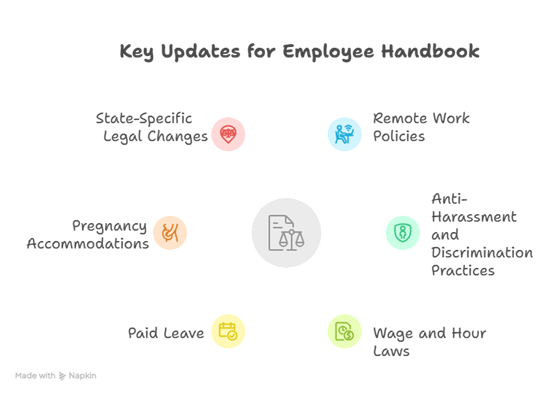
Remote Work Policies With remote and hybrid work becoming more common, updating policies to clearly define expectations, eligibility, and equipment use is essential.
The EEOC is focusing on discrimination claims related to hair texture and style, so grooming and dress code policies should be reviewed and updated accordingly .
Use inclusive language throughout the handbook, such as gender-neutral pronouns (they/them), to foster inclusivity
Employee Classifications and Wage Laws
Review classifications under the Fair Labor Standards Act (FLSA) to ensure proper exemption status.
Stay current with state-specific wage and hour laws, including paid time off and leave policies
Paid Family and Medical Leave
Be aware of state-specific changes, such as Maryland delaying its Paid Family and Medical Leave program contributions until July 1, 2025, with benefits starting July 1, 2026
Pregnancy Accommodations
Update policies to comply with evolving pregnancy accommodation laws and ensure clear procedures for requesting accommodations.
State-Specific Legal Changes
California employers should note changes affecting non-discrimination, leave, and vacation policies effective January 2025.
New York and New Jersey employers must incorporate recent federal and state legal developments into their handbooks .
Company Culture and Compliance Balance
While compliance is critical, also ensure the handbook reflects your organization’s culture and values to engage employees effectively
General Policy Reviews
Regularly review key policies such as leave, attendance, workplace conduct, and disciplinary procedures to maintain compliance and clarity.
New York State Handbook Review & Update Considerations
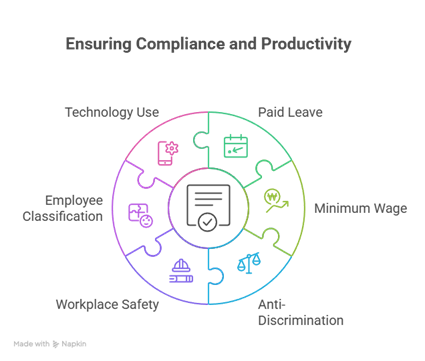
Paid Family Leave and Paid Sick Leave: New York State has been expanding its paid family leave and paid sick leave laws. Ensure your handbook reflects the latest eligibility, benefits, and procedures for requesting leave under these laws.
Minimum Wage and Overtime Rules: New York State and many localities (e.g., NYC, Long Island) have scheduled minimum wage increases. Confirm that wage policies and overtime eligibility align with the current rates and thresholds effective in 2025-2026.
Anti-Discrimination and Harassment Policies: Updates to reflect any new protected classes or changes in reporting procedures under New York State Human Rights Law and recent case law. Training requirements for harassment prevention may also have changed.
Workplace Safety and COVID-19 Policies: While COVID-19 emergency rules have relaxed, some employers maintain policies on vaccination, testing, or remote work. Review any state or local health guidance that might affect workplace safety protocols.
Employee Classification and Wage Transparency: New York has laws addressing gig workers, independent contractors, and wage transparency. Ensure handbook language clarifies employee status and complies with disclosure requirements.
Leave for Voting, Jury Duty, and Military Service: Confirm that leave policies comply with New York State laws protecting these rights.
Use of Technology and Social Media: Update policies on acceptable use of company devices, data privacy, and social media conduct, reflecting evolving norms and legal standards.
This is a shortlist of potential sections to review and revise in most employee handbooks. Continue to review local and state changes as well, when reviewing and updating employee handbooks. Communication, training and setting the expectations is necessary with any organizational change, including employee handbooks.
Published by Mathew W. Burr, MJ-LEL, MBA, MHRIR, GPHR, SHRM-SCP, SPHR, CPHR-INT, Chartered CIPD
Mathew W. Burr, MJ-LEL, MBA, MHRIR, GPHR, SHRM-SCP, SPHR, CPHR-INT, Chartered MCIPD
Lean Six Sigma Black Belt
ABOUT:
Matthew Burr has over 18-years of experience working in the human resources field, starting his career as an Industrial Relations Intern at Kennedy Valve Manufacturing to most recently founding and managing a human resource consulting company; Burr Consulting, LLC, Talentscape, LLC and Co-Owner of Labor Love, a Labor, and Employment Law poster printing company. Prior to founding the consulting firm, the majority of his career was heavy industry manufacturing and healthcare. He specializes in compliance auditing, training labor and employment law, conflict resolution, performance management, labor, and employment relations. Matthew has a generalist background in HR and operations, while providing strategic HR and operational solutions to his clients, focusing on small and medium sized organizations. He works as an Adjunct at Alfred State University, Tompkins Cortland Community College, and Montgomery Community College. He successfully designed an HR Concentration in the business management major that aligned with both SHRM and HRCI certifications, providing opportunities for students to sit for both the SHRM-CP and aPHR certifications upon completion of the degree, concentration, and internship hours as an Assistant Professor of Management at Elmira College (Retired January 2022). Matthew is also the SHRM Certification Exam Instructor, with a current pass rate of 92% on the SHRM-SCP and 83% pass rate on the SHRM-CP and a combined 88% on both exams over a 7-year period of instructing the course (Elmira College, Collin College & The College of St. Rose). Matthew works as a trainer at Tompkins Cortland Community College, Corning Community College, Broome Community College, and HR Instructor for Certification Preparation for the Human Resource Certification Institute (HRCI). He also acts as an On-Call Mediator and Factfinder through the Public Employment Relations Board in New York State, working with public sector employers and labor unions.
PUBLICATIONS:
Matthew has over 70+ publications including, American Bar Association (ABA) Experience Magazine, Cornell HR Review, Business Insider, New York State Bar Association (NYSBA), PayScale, Society of Human Resource Management (SHRM), and Expert 360 (in Australia). In early 2017, he published his first book, “$74,000 in 24 Months: How I killed my student loans (and you can too!),” proceeded by his second book, which was published in January 2021, “Slay the Student Loan Dragon: Tips and Tricks on How to Conquer the Student Loan Game” and his most recent book, “Unbox Your HR Career” in July 2023.
VOLUNTEER WORK:
Matthew is currently the New York State Society of Human Resource Management (NYSSHRM) District-Director.
EDUCATION & TRAINING:
Additional Training & Development:
SHRM Workplace Coaching and Mentoring Recertification Program, 2020
SHRM Foundation Employing Abilities @Work Certificate, 2020
SHRM Foundation Veterans at Work Certificate Program, 2018
Delta County Chamber of Commerce: Delta Force Leadership Program, 2013
FEATURED IN & ON:
Matthew was featured on CNN Money, Fast Company, Fits Small Business, Fox News, Magnify Money, Monster.com, My Twin Tiers, Namely, Student Loan Hero, Smart Sheet and CEO Blog Nation, Human Resource Certification Institute (HRCI), Society of Human Resource Management (SHRM).
Burr Consulting, LLC Capabilities Statement
General Information:
Burr Consulting, LLC
Owner: Matthew W. Burr
Mission Statement:
“Strategically Aligning HR as a Partner for the Success of Your Business”
Contact Information:
Burr Consulting, LLC
What's New in HR Blog
Talentscape, LLC
Labor Love, LLC (Labor Posters)
The HR Support Center
The Upstate HR Podcast
(607)227-4386
Matthew@Burrconsultingllc.com
Facebook: Burr Consulting, LLC
LinkedIn: Burr Consulting, LLC
Twitter: @Burrconsulting
Online Certification Verification: Credibly
Dun & Bradstreet (D&B) Number: 080776443
NAICS Codes: 541612, 923130, 54161, 541611,
541613, 611430, 541618, 561312, 561311
SIC: 8742, 8748, 9441, 8748001, 8748026
Our Services
HR MANAGEMENT
New Hire Orientation; Temporary HR Support; Recruiting and Application Tracking; HR Compliance (ADA, FMLA); Employee Handbook; Policy and Procedure; HRIS; HR Audits; Job Profile Design and Revision; HR Key Performance Indicators; EEO Reporting and Classification; State Unemployment Insurance Services
TRAINING & TRAINING DEVELOPMENT
Organizational Development; Employee Relations; Workplace Violence; Harassment & Sexual Harassment; Union Awareness; Managerial
EMPLOYEE & LABOR RELATIONS
Employee Relations Training; Conflict Resolution; Mentoring; Workplace Investigations; Labor Contract Costing; Mediation & Arbitration Prep; Fact-Finding; Workplace Investigations; Coaching & Counseling; Performance Reviews; Contingency Plan Development; Contingency Plan Training; State of New York Public Employment Relations Board (PERB)PERB Mediation and Fact-Finding Panels (Albany, NY covering the Elmira, NY Area)
HIRING & RECRUITMENT
Applicant Tracking Systems; Metric Development; Interview Training; Workforce Planning; Recruitment; Interviews; Job Offers; New Hire Process
POLICY & COMPENSATION
Group Plans – Healthcare, Dental, Vision, Group Life, Short- and Long-Term Disability; Retirement – 401(k), Profit Sharing, Roth; Workers Compensation; Total Compensation Design and Strategy; Deferred Compensation Plans; Salary Surveys; Reward Systems; Online Payroll; Customized Payroll Processing; Employee Self Service; Customized Reporting
HR COMPLIANCE MATERIALS
Burr Consulting, LLC is excited to announce a new partnership with Labor Love LLC, expanding our services to include HR printed materials compliant with industry standards.
View all posts by Mathew W. Burr, MJ-LEL, MBA, MHRIR, GPHR, SHRM-SCP, SPHR, CPHR-INT, Chartered CIPD


 BURR CONSULTING, LLC