Many businesses handle HR internally with 54% of small businesses dealing with employment processes. If you’re doing it alone, you’re likely wasting time that could go toward core business activities that help your company grow. Find out how all companies, even small startups, can benefit from using HR consultants.
Streamline Recruitment
The average time to fill a position is 36 days with screening taking an average of seven days, interviews taking eight days, and making a hiring decision taking an average of five days, according to the Society for Human Resource Management. HR consultants can help you refine your recruitment process to make it more efficient. They can help you attract more candidates, handle applicant tracking, improve interviewing, and other recruitment activities.
They can help you explore various recruitment methods, such as using internships. According to Zenbusiness, hiring interns gives you a chance to train potential full-time employees while testing them out to see if they’re a good fit for the company.
Amplify Employee Performance
HR consultants can evaluate your overall employee management practices to identify issues and suggest improvements. Many options can improve productivity and employee performance. Examples include:
Time tracking and attendance
Performance reviews
Employee development
Mentoring and coaching
Focus on Retention
High employee retention saves you money and keeps productivity high. Calculating your retention rate gives you a baseline, so you can determine if employee turnover is an issue. An HR consultant can help you evaluate your rate and give you strategies for improving it.
Meet Compliance
Employment law includes lots of regulations that you must follow to stay compliant. For example, employers are required to display certain workplace posters regarding specific regulations, such as the minimum wage and the Family and Medical Leave Act. Specific requirements can vary based on the size, industry, and other factors of your business. You also face compliance issues for payroll. Hiring Burr Consulting makes it easier to understand those requirements so you can stay in compliance.
Improve Training
Training ensures your employees have the skills and knowledge to perform well. HR consultants can provide tailored training programs that fit your company’s needs. Outsourcing your training planning saves you significant time and ensures the training is valuable with the right topics. The training can cover workplace basics that everyone needs, such as workplace violence and harassment, or specific topics, such as managerial training.
Help With Benefits
Creating a competitive benefits package is crucial for attracting and keeping talent. Designing your benefits program can be difficult, especially if you have a tight budget. It can be difficult to know which benefits offer the most value and appeal to employees. An HR consultant can help you maximize your benefits budget and choose the perks that your employees really want.
Get a Fresh Perspective
If you’re not an HR professional, you might not know the best practices. It’s difficult to stay current on HR trends when you’re dealing with other aspects of running your business. Using a professional HR service gives you instant access to expertise, which can give you a different perspective and fresh ideas.
Consider HR Consultants
Using an HR consultant can streamline and improve all of your employment tasks and free up your time. Explore the HR services from Burr Consulting, LLC.
Again, laws vary state by state. If you are a multi-state employer, research the specific laws and regulations and be consistent with employees. Remember to look for (.Gov) or credible website sources, when searching for current state laws and regulations. If you are required to provide access to employees on all or certain personnel file information, ensure you have a policy in place that is fair and consistent to all employees.
Texas Law:
Texas law does not require an employer to allow an employee to access his or her personnel file (exception: public employees may request copies of their personnel file documents under the Public Information Act) – however, most companies allow supervised access and copying of contents at the employee’s cost – a company should never place anything in a personnel file that it would be ashamed to show other people (such as 12 average jurors) – remember, anything in any file relating to an employee is discoverable in a claim or lawsuit filed by or on behalf of that employee!
“In some states, an employee’s request to see his or her file must be in writing: California, Connecticut, Maine, Massachusetts, Michigan, Minnesota and Rhode Island. In other states, the employer may create a policy requiring written requests: Delaware, Illinois, Pennsylvania and Wisconsin.
State laws also vary as to whether employees are allowed to make copies of their records and who must bear the cost of making copies. In Colorado, for example, employees may request copies of their records and employers may require workers to pay reasonable expenses. Pennsylvania employers, however, don’t have to allow copying, but employees are permitted to take notes when viewing their files.
Some state laws set a minimum number of times individuals must be allowed to inspect their files. For instance, in Colorado, current employees are allowed to view their files at least once a year and former employees may take a look at their files once after termination. Minnesota employees can inspect their files once every six months, but former employees can only do so one time within the first year after separation.” (SHRM)
Draft Organizational Policy:
Employee personnel records are maintained in our human resources department. As required by law, some records pertaining to employees are maintained in separate files relating to medical issues and internal investigations. Employees, or their representative, may request access to their basic personnel file. Depending upon the circumstances, employees may be provided access to records pertaining to internal investigations, with appropriate redactions to protect the rights of others.
All requests for access to your personnel file must be provided in writing to human resources. Upon receipt of your written request, human resources will schedule an appointment for you to view your file during normal office hours. For purposes of this policy, your personnel file includes records related to performance and training as well as other records used for hiring, promotion and disciplinary decisions. It will not include any reference checks, medical records or investigation files. Employees are not permitted to remove any documents from the personnel file but may provide a written response to any document in the personnel file. Written responses will be attached to the original document in the personnel file.
Employees may request copies of documents in their personnel file. Requests for copies must also be made in writing to human resources.
Under OSHA’s recordkeeping regulation, certain covered employers are required to prepare and maintain records of serious occupational injuries and illnesses using the OSHA 300 Log. This information is important for employers, workers and OSHA in evaluating the safety of a workplace, understanding industry hazards, and implementing worker protections to reduce and eliminate hazards.
Did You Know? Employers must electronically submit 2022 injury and illness data from OSHA Form 300A by March 2 if they have: 250 or more employees and are currently required to keep OSHA injury and illness records. 20-249 employees classified in specific industries with historically high rates of occupational injuries and illnesses. Visit OSHA’s Injury Tracking Application webpage for more information and to submit data online. When electronically submitting OSHA Form 300A, you must provide your Employer Identification Number.
Is your organization required to prepare and maintain records under current rules?
To find out if you are required to prepare and maintain records under the updated rule, first determine your NAICS code by:
Using the search feature at the U.S. Census Bureau NAICS main webpage. In the search box for the most recent NAICS, enter a keyword that describes your business. Choose the primary business activity that most closely corresponds to you, or refine your search to get more choices.
Viewing the most recent complete NAICS tables on the U.S. Census Bureau NAICS main webpage. Select the two-digit sector code and choose a six-digit industry code to read its definition.
NOTE: Establishments in companies with 10 or fewer employees at all times in the previous year continue to be exempt from keeping OSHA records, regardless of their industry classification. The partial exemption for size is based on the number of employees in the entire company.
the Log of Work-Related Injuries and Illnesses (OSHA Form 300),
the Summary of Work-Related Injuries and Illnesses (OSHA Form 300A), and
the Injury and Illness Incident Report (OSHA Form 301).
Employers must fill out the Log and the Incident Report only if a recordable work-related injury or illness has occurred. Employers must fill out and post the Summary annually, even if no recordable work-related injuries or illnesses occurred during the year.
In place of the OSHA forms, employers may also use equivalent forms (forms that have the same information, are as readable and understandable, and are completed using the same instructions as the OSHA forms they replace). Many employers use an insurance form instead of the Incident Report, or supplement an insurance form by adding information required by OSHA.
A Form 300 log is required for each physical establishment location that is expected to be in operation for at least one year. For employees who work from home, OSHA does not consider the worker’s home to be an establishment for record-keeping purposes. OSHA considers the worker’s establishment to be the office to which he or she reports, from which he or she receives direction or supervision, collects pay, and otherwise stays in contact with the employer. It is at this establishment that the log is kept.
Step 2: Identify Required Recordings
Work-related injuries and illnesses that result in the following must be recorded:
Death.
Loss of consciousness.
Days away from work.
Restricted work activity or job transfer.
Medical treatment beyond first aid.
Any work-related case involving cancer, chronic irreversible disease, a fractured or cracked bone, or a punctured eardrum.
In addition to the above cases, employers must record the following conditions when work-related:
Any needle-stick injury or cut from a sharp object that is contaminated with another person’s blood or other potentially infectious material.
Any case requiring an employee to be medically removed under the requirements of an OSHA health standard.
Tuberculosis (TB) infection as evidenced by a positive skin test or diagnosis by a licensed health care professional after exposure to a known case of active TB.
An employee’s hearing test result that the employee has experienced a standard threshold shift in hearing in one or both ears.
The OSHA Regulation 29 C.F.R. §1904.7 contains an in-depth overview of recordable injuries and illnesses. Additional information on determining medical treatment and first aid can be located at 29 C.F.R. §1904.7(b)(5).
Step 3: Determine Work-Relatedness
When an accident occurs, an employer must document a recordable injury or illness on the OSHA Form 300 log within seven days. An injury or illness is considered work-related and must be recorded on the log unless an exception applies. Some exceptions include:
At the time of the injury or illness, the employee was at work as a member of the general public and not as an employee. For example, if an employee returns to work after the end of his or her shift to pick up an item the employee forgot to take home and is injured during this visit.
The injury or illness surfaces while at work, but results solely from a nonwork-related event or exposure. For example, an employee suffers a heart attack while at work but has a history of heart disease.
The injury or illness results solely from voluntary participation in a wellness program. For example, an employee is injured while working out in the company gym.
The injury or illness is the result of eating or drinking or preparing food or drink for personal consumption. For example, an employee chokes while eating a sandwich for lunch.
The injury is the result of an employee doing personal tasks outside of work hours. For example, the employee sustains an injury while visiting with co-workers after his or her work shift.
Step 4: Complete the OSHA Form 300
Employers must take the following steps to fill out the OSHA Form 300:
Fill in the year, establishment name, city and state.
Assign each event an employer-created case number on the OSHA log. This can be as simple as number 1, 2, 3, 4 and so on. The only requirement is that each case number for a given year is unique.
Identify the employee, the employee’s job title, the date of the injury or onset of the illness and the exact location where the event occurred.
Specifically describe the case, along with the parts of the body affected and the object/substance that directly injured or made the employee ill, using more than one line if necessary.
Classify the case by choosing only one of the categories. The most serious outcome will need to be recorded; the employer should revise the log if the injury or illness progresses or the outcome is more serious than was originally recorded. The original entry must be crossed out, deleted or concealed with correctional fluid.
Enter the number of days the employee was on restricted work or job transfer, the number of days away from work, or both.
Indicate whether the case is an injury or an illness.
Total all columns at the end of the year.
The Form 300 will contain information related to an employee’s health and must be kept confidential to the extent possible while using the information for occupational safety and health purposes. OSHA provides guidance that includes the forms needed for maintaining occupational injury and illness records along with step-by-step instructions.
Step 5: Complete and Post the OSHA 300A Annual Summary
The information from the OSHA Form 300 Log is transferred onto the 300A Summary by matching the corresponding lettered column on the log with the lettered blank space on the summary.
The employer must complete the establishment information section and have the summary signed by an authorized executive of the company.
Employers must complete the 300A summary form and post the summary in the workplace from February 1 to April 30 of the year following the year covered by the form at each job site in a conspicuous area where notices to employees are customarily placed. For example, accidents occurring in 2022 will be summarized on the Form 300A and posted from February through April 2023. Copies of the 300A summary should be provided to any employees who may not see the posted summary because they do not regularly report to a fixed location.
Step 6: Submit Electronic Reports to OSHA
Employers with 20 or more employees that are subject to OSHA’s recordkeeping regulation must electronically submit to OSHA information from Form 300A (Summary of Work-Related Injuries and Illnesses) by March 2.
Employers with fewer than 20 employees at all times during the year do not have to submit information electronically to OSHA.
The requirement to electronically submit information from OSHA Form 300 (Log of Work-Related Injuries and Illnesses), and OSHA Form 301 (Injury and Illness Incident Report) was eliminated in 2019. However, OSHA issued a proposed rule in 2022 that could, if finalized, require establishments with 100 or more employees in the highest-hazard industries to submit the Form 300 and the Form 301 information once a year to OSHA. SeeImprove Tracking of Workplace Injuries and Illnesses.
Step 7: Retain the Log and Summary
The OSHA Form 300 Log and the OSHA 300A Summary must be kept for five years following the year that the log and summary pertain to. (SHRM)
How to Calculate OSHA Case Rates and Day Rates
The typical injury and illness rates monitored by OSHA include case rates such as:
Recordable case rate (RCR)—also called total recordable case rate (TRCR) or total recordable incident rate (TRIR)
Days away, restricted, or transferred rate (DART)
Lost time case rate (LTCR)
Days away case rate (DACR)
The basic equation for these rates is:
Number of cases x 200,000
Case Rate TRIR or DART = ____________________________________
Number of hours worked
Some safety rating groups will use day rates as well as case rates to prescreen companies bidding for jobs. Using data on logs and 300A forms, calculate the day rate by using the sum of days of lost time or days of job transfer instead of the count of cases with lost days or job transfer.
Days lost or days of restricted duty x 200,000
Day Rate = ___________________________________________
Number of hours worked
To keep all these rates low, employers should, of course, seek to prevent injuries and keep non-OSHA recordable cases off the logs. In addition, they should also actively monitor and manage cases to minimize the number of cases that end up triggering recordability and accumulating unnecessary days away from work or job transfer (modified duty) days.
Six Steps to Reduce OSHA Injury and Illness Rates
The methods discussed below are commonly used as workers’ compensation controls, but they are also central to lowering OSHA rates.
1. Determining Recordability
The first and most important question is whether the injury or illness in question is work-related. If it is not work-related, the case is not recordable and those keeping the log can simply stop here. We cover more about determining if the injury or illness is work-related in another article in this series.
2. Ensuring Prompt Return to Work and Normal Duties
Returning employees to work and normal duties as quickly as possible after an injury helps decrease the number of cases and days that accumulate toward the rates outlined above. In a limited number of cases, the only thing that makes a case OSHA recordable can be the loss of days itself. Some employers unintentionally make a case recordable and accumulate days because they take an employee off work or assign them modified duty when the medical professional treating them does not prescribe it. OSHA considers that case and those days as recordable.
To keep rates legitimately low, have an expedited process to ensure the employee is brought back to work and returned to their regular job duties as quickly as possible. Work with medical providers who are familiar with your company and your employees’ roles to streamline this process:
Ensure medical providers know you offer modified duty
Send an accurate job description to the clinic with the employee
Get to know the occupational medical providers in your area
Provide them with job descriptions ahead of time
Have them visit your sites or workplace
3. Using Nurse Triage and First Aid When Possible
Cases that do not result in medical treatment are non-recordable, barring any other triggers. For injuries and illnesses that are not severe, consider using nurse triage and or first aid treatment to help prevent unnecessary trips to a medical provider—this can potentially keep some cases off your logs. Remember that OSHA has a prescriptive list of first aid treatments, and any treatment that falls outside of that list is considered medical treatment. It’s also important to remember that if treatments are on that list but are administered by a medical doctor or other medical professional, it’s still counted as first aid. Knowing what counts as first aid versus medical treatment will help you ensure you don’t over-record (or under-record). Getting your employees the most appropriate and best care after an injury is the first priority. Having a nurse triage service help you make that call and help you know when first aid treatment is best is a solid strategy. For more information on this topic, see our article, OSHA 300 Logs: How to Determine Whether to Record an Injury or Illness.
4. Reporting Claims Quickly
While it may sound counterintuitive, if first aid is not appropriate, reporting claims quickly and getting an adjuster involved is another way to help shorten case length, limit days lost, decrease days of modified duty, and expedite good medical outcomes. Delaying reporting and access to medical care tends to lengthen off-work and modified duty periods in the long run.
Workers’ compensation case acceptance and payment are not the same as OSHA recordability decision-making. Each has its own criteria, so ensure you are using OSHA’s criteria for recordkeeping rather than assuming a WC case acceptance merits automatic OSHA reporting.
Using a non-prescription medication at nonprescription strength (for medications available in both prescription and non-prescription form, a recommendation by a physician or other licensed health care professional to use a non-prescription medication at prescription strength is considered medical treatment for recordkeeping purposes);
Administering tetanus immunizations (other immunizations, such as Hepatitis B vaccine or rabies vaccine, are considered medical treatment); Cleaning, flushing or soaking wounds on the surface of the skin
Using wound coverings such as bandages, Band-Aids™, gauze pads, etc.; or using butterfly bandages or Steri-Strips™ (other wound closing devices such as sutures, staples, etc., are considered medical treatment);
Using hot or cold therapy;
Using any non-rigid means of support, such as elastic bandages, wraps, non-rigid back belts, etc. (devices with rigid stays or other systems designed to immobilize parts of the body are considered medical treatment for recordkeeping purposes);
Using temporary immobilization devices while transporting an accident victim (e.g., splints, slings, neck collars, back boards, etc.). Drilling of a fingernail or toenail to relieve pressure, or draining fluid from a blister;
Using eye patches;
Removing foreign bodies from the eye using only irrigation or a cotton swab;
Removing splinters or foreign material from areas other than the eye by irrigation, tweezers, cotton swabs or other simple means;
Using finger guards;
Using massages (physical therapy or chiropractic treatment are considered medical treatment for recordkeeping purposes); or
The governor recently signed a bill that prohibits employers from requesting or requiring an employee’s personal username, login information, passwords, or social media accounts as a condition of hiring, a condition of employment, or for use in a disciplinary action. This legislation mirrors enactments in many other jurisdictions.
The new law prohibits employers from requesting, requiring, or coercing employees and job applicants to:
Disclose their username, password, or other log-in information used to access their personal account through an electronic communications device.
Access their personal account in the employer’s presence.
Reproduce photos, videos, or other information contained in their personal account through means prohibited under the law.
A carve-out exists for employers to request or require employees to disclose log-in information for accounts that were provided by the employer and that are used for business purposes, so long as the employee was provided notice of the employer’s right to request such information. There is an exemption for employers that request or require an employee to disclose log-in information for an account known to the employer to be used for business purposes.
The new law permits employers to access an electronic communications device paid for, in whole or in part, by the employer and when payment for the device was conditioned on the employer retaining the right to access the device, and the employee was given prior notice to such conditions. However, this exception does not permit an employer to access an employee’s personal accounts on that device. (SHRM)
10 Tips for Social Media Recruiting and Applicant Screening
Social media use for recruiting and applicant screening continues to grow in popularity. “Sixty percent of employers use social networking sites to research job candidates, up from 52 percent last year and 11 percent in 2006.”[i] Organizations need to be aware of the risk and reward for utilizing social media during the recruiting and applicant screening process. “When surveyed in 2013 about why they decided not to use social networking sites for candidate screening, 74 percent of organizations said they were concerned with legal risks or discovering information about protected characteristics when perusing candidates’ social media profiles…. For example, from a candidate’s picture, an employer may learn his or her likely race, approximate age and more. People also commonly post personal information such as medical or family problems.”[ii] social media can be a great resource for additional recruiting efforts and applicant screening processes. “Forty-nine percent of hiring managers who screen candidates via social networks said they’ve found information that caused them not to hire a candidate – on par with last year 48 percent. The following are the top pieces of content that turned off these employers:
Provocative or inappropriate photographs, videos or information – 46 percent
Information about candidate drinking or using drugs – 43 percent
Discriminatory comments related to race, religion, gender, etc. – 33 percent
Candidate bad-mouthed previous company or fellow employee – 31 percent”[iii]
SHRM recommends the following seven tips for recruiters on social media:
“Use social media to project your company’s values and mission, highlight your best employees, and showcase organization-led volunteer opportunities that support the local community.
Be aware of what’s being said about your organization on social media and respond when necessary.
Partner with universities, colleges, and friends and families of workers to help get the word out about your company.
Tie social media messaging to your organization’s values, particularly if they are identified on your website. If diversity is prized, reflect that in the staff images on your social network pages.
Work with your public relations and marketing departments to create an appealing narrative around your organization.
Encourage workers to share creative photos that align with the company’s values and mission.
Be authentic. Don’t rely exclusively on the HR and PR departments to take and post photos.”[iv]
My three recommendations on applicant screenings through social media:
Know the law. Laws vary, at the state and federal level. These laws will continue to evolve through case law and newly created social media platforms. Know what you can and cannot do when asking for and reviewing applicant’s social media profiles.
Consistently, inconsistent. If your organization does review social media profiles for applicants, ensure that all applicant profiles are reviewed. Do not review one person and not another. This could be viewed as potential discrimination. Implement a policy for reviewing social media profiles on every applicant.
Fake profiles are inaccurate and full of false information. Social media is filled with thousands of fake profiles. If you do review applicant’s social media presence, ensure it is the correct profile with accurate information, good or bad.
With the explosion of social networking and changing dynamics of the workforce, obtaining additional information (the added puzzle-piece) on applicants is here to stay. “Today, Millennials account for 36 percent of the U.S. workforce, according to the Bureau of Labor Statistics, and they will account for 75 percent of the global workforce by 2025. Given that this group of employees have grown up actively communicating via myriad social media sites and devices, the use of social media is a workplace trend with staying power for the foreseeable future.”[v]
Alternative dispute resolution (ADR), is an umbrella term used for methods to resolve disputes internal to the organization and outside the court system. Many organizations use one or all of the ADR techniques, with the techniques continuing to grow in popularity. Union and nonunion organizations use ADR techniques to resolve disputes, large and small. Dispute resolution is a necessity for any organization, resolution can impact organizational culture, engagement and turnover rates. The techniques defined below can be used to resolve disputes outside of the workforce as well, we have mediation services in our communities that assist families, neighbors, etc. resolve disputes through proactive channels of communication.
The 5 Definitions of Alternative Dispute Resolution:
“Arbitration: an ad judicatory process in which a neutral third party imposes a final, binding decision to resolve a dispute.
Mediation: an informal process in which a neutral third party assists opposing parties to reach a voluntary, negotiated, non-binding resolution of a dispute; may be conducted internally or externally.
Ombudsman: a neutral third party who is designated to confidentially investigate and propose settlement of complaints brought by employees; may be an insider or outsider.
Open-door policy: a process in which employees are encouraged to discuss problems with their immediate supervisors or others in the chain of command.
Peer review an internal process in which a panel of employees works together to resolve employment complaints.”[i]
Arbitrators, mediators and ombudsmen are trained in dispute resolution techniques. They know how to fact-find, draft agreements and issues decisions. An open-door policy is an easy way to resolve disputes. We listen to the issue (not listen to respond) and address any concerns. Peer review is another process that can be implemented, this also needs to be managed proactively to ensure it’s legal. All of the ADR techniques work, the effectiveness will vary by organization. Select a process that works for your organization and be consistent with dispute resolution.
[i] American Arbitration Association, U.S. EEOC & SHRM Magazine
The LS59 for Exempt Employees was updated in May 2023. The law requires employers to give notice to employees of their wage rates at the time of hire. Now, the WTPA requires employers to give a written notice to each new hire. The notice must include:
Rate or rates of pay, including overtime rate of pay (if it applies).
How the employee is paid – by the hour, shift, day, week, commission, etc.
Regular payday.
Official name of the employer and any other names used for business (DBA).
Address and phone number of the employer’s main office or principal location.
Allowances taken as part of the minimum wage (tip, meal and lodging deductions).
In the past, the notices were in English; now, the notice must appear both in English and in the employee’s primary language (if the Department of Labor offers a translation).
Employers must have each employee sign and date the completed notice; employers must provide a copy to each employee.
Also, remember to use the correct Wage Theft Notification Form as well, found on the New York State websites. There are differences for exempt or nonexempt employees.
I am pleased to extend you an offer of employment with the Employer Name, Address and Phone Number. We are excited about the contribution you will make to our organization, working as a ______________.
Following is a summary of our employment offer:
Title:
Hire/Effective Date of Salary Change:
Manager:
Supervisor:
Employee’s rate of pay: $
Hours Per Week:
Weeks Per Year:
Allowances taken: None
Pay is: Bi-weekly (On Friday’s)
Overtime Pay Rate: $ per hour (This must be at least 1½ times the work)
Notice given at time of hire, promotion, demotion, salary change (Circle One)
This offer is contingent on the following (TBD by the Organization:
Receipt of your written acceptance, and we reserve the right to withdraw or modify this offer at any time before we receive your written acceptance.
Successful completion of a routine background investigation.
Proof of your identity and employment authorization, as required by the U.S. Department of Justice and the Immigration and Naturalization Act.
Your employment with us will be on an “at will” basis, which means that either you or the organization may terminate your employment at any time for any reason, with or without cause. No employee of the organization has authority to alter your at will employment relationship. Although the Organization does not have any current plans to change its benefits or compensation programs, it reserves the right to change or terminate these benefits, programs and plans at any time.
Employee Name, I believe this position can be an exciting and fulfilling opportunity for you, and we look forward to having you join the ________ team. Please feel free to let me know if you have any questions. I can be reached at XXXX
Sincerely,
To confirm your acceptance of this offer, and agreement of the above, please sign this original letter and return it to the main office within one week of receipt.
Employee Acknowledgement: On this day I have been notified of my pay rate, overtime rate (if eligible), allowances, and designated pay day on the date given below.
I have been given this pay notice/offer letter in English because it is my primary language.
The Executive Exemption: Primary duties include managing the enterprise, directing the work of at least two or more full-time employees and has the authority to hire and fire employees. The link(s) goes into specific duties tests on the exemptions. NY State Law
The Administrative Exemption: Primary duties must be the performance of office or non-manual work related to the management of the business and exercising discretion and independent judgement with respect to matters of significance. NY State Law
The Learned Professional Exemption: Primary duties must be the performance of work requiring advanced knowledge, which is predominantly intellectual in character and requires discretion and judgement.
Computer Employee Exemption: Primary duties consist of the application of systems analysis techniques, design development, documentation, analysis, creation, modification of computer systems and designing, testing or modifying computer programs. This exemption is complex, ensure you read through the FLSA definition prior to deciding and thoroughly understand the duties test.
The Outside Sales Exemption: Primary duties must include making sales, obtaining orders or contracts. The employee must be regularly engaged away from the employer’s place of business.
The Highly Compensated Employees Exemption: Perform office or non-manual work and paid total annual compensation of $100,000 or more. They regularly perform at least one of the duties of an exempt executive, administrative or learned professional identified in the standard tests of exemption.
Social media in the workplace and outside of the workplace can be a complicated area for employers to manage, if we see certain posts by employees. Is an employee protected if the post disparaging content about an employer or another employee on social media? It depends on the post. Employees are free to complain about terms and conditions of employment under Section 7 of the National Labor Relations Act (Wagner Act). Under the Trump Administration and National Labor Relations Board (NLRB), some of the broad Section 7 social media content is being reduced, pro-employer rules on social media content. However, the employee still has a protected right to complain or discuss terms and conditions of employment (wages, benefits, working conditions, hours of work, seniority, safety issues, grievance and arbitration process, leave of absence, performance reviews, respect, integrity and culture issues) on social media, “water cooler talk.”
Creating a Workplace Culture:
Eliminate the Need to Complain on Social Media: Create a culture that there is an open channel of communication and employees have the opportunity to ask questions and discuss concerns with leadership.
Social Media Compliance Policy: The policy needs to clearly communicate anti-harassment, anti-discrimination, anti-bullying, sexual harassment, retaliation, etc. The policy should also include a social media use policy in the workplace. The policy cannot be overly broad, this can impact employee’s Section 7 rights. As social media evolves, so to should our policies. I’m happy to work on a policy for any organization.
Create a Culture: A safe and open workplace that encourages employees to speak-out about any aspect in the work environment. Not only a safe and open workplace, but a workplace that closes the loop on communication and concerns are addressed with follow-up back to the employee. Internal complaint procedures (required in New York State for sexual harassment), whistleblower hotlines/policy, supervisor training and an active HR department are suggestions to build a culture such as this.
These are a few suggestions on improving an organization and being consistent with a social media policy in the workplace. Have the social media policy reviewed prior to implementing in the workplace, once it is implemented, communicate and train employees on the new policy.
New York Labor Law Section 201-d:
This labor law prohibits employers from refusing to hire individuals because of lawful; off-duty recreational activities. What does this mean for our organizations? If you review social media or conduct Google searches on applicants prior to the making an offer, be aware of this law. Social media reviews or searches can lead to bias decision making.
Upcoming New York State Minimum Wage, Executive & Administrative Exempt Salary Changes, Farm Overtime Threshold Reductions and Nationwide Changes
The NYS Department of Labor is proceeding with scheduled increases to the state’s minimum wage effective December 31, 2022. While there is no change for New York City employers, Long Island, or Westchester employers, the remainder of upstate New York will see increases. As you know, this will also impact the minimum salary levels to be paid to Executive and Administrative exempt employees. The new minimum wage and minimum salary levels can be found below. Things to keep in mind:
The updated poster. You will be required to post a new minimum wage poster. You will be able to find the new poster here. Remember, there could be corresponding increases in the tipped wage and wages paid for fast food employees in your area.
The minimum salary level to be considered exempt from overtime under NYS law for Executive and Administrative employees is tied to the minimum wage and may also be increasing for your industry and area. Remember, there is no NYS minimum salary level for Professional exemptions. For Professional employees you would be subject to the Federal minimum salary level.
Minimum Wage Increases
Once adopted, the FY2024 Budget would establish a new statutory minimum wage rate schedule in Section 652 of the Labor Law as follows:
Effective Date
New York City, Westchester, Nassau, Suffolk Counties
Upstate New York
January 1, 2023
$15.00
$14.20
January 1, 2024
$16.00
$15.00
January 1, 2025
$16.50
$15.50
January 1, 2026
$17.00
$16.00
January 1, 2027+
$17.00 + annual increase
$16.00 + annual increase
Indexing the Minimum Wage
Starting January 1, 2027, additional annual minimum wage increases would be implemented each year based on the Northeast region measure of consumer price increases for urban wage earners and clerical workers (CPI-W). There would be no increases to the minimum wage if over a period of the prior year, the calculations published by the United States Department of Labor show that:
The CPI-W for Northeast Region Urban Wage Earners is negative.
The statewide unemployment rate increases by one-half percentage point or more.
Total non-farm employment decreases (measured seasonally).
Adjusted minimum wages are required to be published by the State Department of Labor no later than October 1st of each year.
Adjustments to Salary Thresholds, Allowances, and Gratuities
It is worth noting that minimum wage orders in effect would remain in effect, including wage orders that address minimum salary levels for executive and administrative exemptions, gratuities, and allowances for meals, apparel, etc. As these minimum wage increases take effect, the State Department of Labor would amend the wage orders to increase all monetary amounts (i.e., salary levels and allowances) in the same proportion as the increase in the hourly minimum wage. The state is expected to publish the official amounts of these adjustments. We calculate the salary threshold in 2024 for downstate would rise to $1,200 weekly, and the upstate salary basis threshold would rise to $1,125 weekly.
The wage for food service workers who receive tips would remain lower than the regular minimum wage by one-third and rounded to the nearest five cents. While the state has not issued its official calculations, our unofficial calculations for tipped food service workers in the Hospitality Industry would be as follows:
TIPPED FOOD SERVICE WORKERS
Year
New York City, Westchester, Nassau, Suffolk Counties
Upstate New York
2024
$10.70
$10.00
2025
$11.00
$10.35
2026
$11.35
$10.70
2027+
$11.35 + annual increase
$10.70 + annual increase
Updated New York Salary Threshold (Reminder FLSA is still moving forward with $55,000 nationally.)
Employers should adjust their minimum exempt salary to $55,341 annually ($1,064.25 weekly) to reflect the increase that took effect December 31st, 2022, throughout the State.
There was no increase for NYC, Long Island, and Westchester which have their own minimum salary threshold. As a reminder to remain in compliance if you have employees working in those regions any exempt executives or administrative employees should be receiving a minimum weekly salary of $1,125.00 (Annual $58,500).
Expect the 2024 threshold to move to $1,125 per week, as of December 31, 2023, no state announcement as of yet.
NYS Reduces Overtime Threshold for Farm Workers to 40 hours Per Week
New York State Department of Labor (NYSDOL) Commissioner Roberta Reardon issued an order accepting the recommendation of the Farm Laborers Wage Board to lower the current 60-hour threshold for overtime pay to 40 hours per week by January 1, 2032, allowing 10 years to phase in the new threshold. NYSDOL will now be undergoing a rule making process which will include a 60-day public comment period. This applies to certain agricultural employers and employees only.
Under proposed language, an employer shall pay an employee for overtime at a wage rate of one- and one-half times the employee’s regular rate of pay for hours worked in excess of the following number of hours in one workweek:
(a) 60 hours on or after January 1, 2020; (b) 56 hours on or after January 1, 2024; (c) 52 hours on or after January 1, 2026; (d) 48 hours on or after January 1, 2028; (e) 44 hours on or after January 1, 2030; (f) 40 hours on or after January 1, 2032.
Minimum Wage for Fast Food Employees The minimum wage for fast food employees working outside of New York City will increase to $14.50 per hour. The final scheduled increase to $15.00 per hour will take effect on July 1, 2021.
District of Columbia: January 1, 2023, was supposed to be the date when the minimum cash wage for tip credit employees would increase to $6.00 per hour due to voter-approved changes that occurred at the November 8, 2022, election (including the gradual phasing out of the tip credit). However, as it had done previously with proposed changes to tipped employee standards, the District of Columbia enacted legislation that partially overrode the ballot measure and delayed the operative date of these changes from January 1 to May 1, 2023. As a result, D.C. employers are subject to two rate-related changes within, essentially, a two-month period, as the amended law also requires the minimum cash wage to increase to $8.00 per hour on July 1, 2023.
Maryland: With the signing of SB 555 on April 11, 2023, Maryland eliminated its current two-tier minimum wage effective January 1, 2024, at which point a $15.00 per hour minimum wage will apply to all employers (currently the rates are $13.25 and $12.80, depending on whether an employer has 15 or more, or 14 or fewer, employees). Additionally, the legislation removed annual adjustments to the minimum wage, meaning the $15.00 minimum wage will apply from January 1, 2024, until the legislature and governor decide to increase the rate.
Michigan: On January 26, 2023, a three-judge panel of the Michigan Court of Appeals issued a ruling that maintained the status quo concerning Michigan’s minimum wage and tip provisions and reversed a Court of Claims decision that found that the state legislature had violated the Michigan Constitution when it overhauled revisions to the law only months after it had adopted as law a proposed ballot measure covering these topics. The appellate court decision, in turn, has been appealed to the Michigan Supreme Court.
Although percentage changes to the consumer price index have been trending downward, comparatively speaking more current figures exceed those we saw before inflation began picking up steam around Spring 2021. For example, nationally the March 2021 figures increased around a percentage point compared to those in February 2021, from 1.7 to 2.6% (CPI-U) (Consumers) and from 1.9 to 3% (CPI-W) (Workers). We then saw a point-and-a-half increase when comparing figures in April and March 2021, with increases of 4.2% (CPI-U) and 4.7% (CPI-W). From there, inflation was off to the proverbial races, gradually increasing in 2021, peaking mid-2022, then beginning a gradual descent to where we find ourselves currently: 4.9% (CPI-U) and 4.6% (CPI-W) in April 2023.
This rollercoaster ride plays out in the minimum wage adjustments, with interesting outcomes when we compare 2023 to 2022 adjustments. For example:
Although some rate changes will occur on the same date for localities within close proximity of each other, the date a location uses to make the calculation adjustment matters. Consider, in California, the City of Los Angeles and the County of Los Angeles. Before July 2022, each location had a $15 minimum wage. For 2022 calculation purposes, inflation was increasing, so, because the county adjustment was based on November figures, its increase was less than the city’s adjustment based on December figures: $15.96 (County) and $16.04 (City). For 2023 calculation purposes, however, inflation had been decreasing, so the city’s later-in-the-year metric means its percentage change was less, which has allowed the county to leapfrog the city even though it started with a lower number to adjust: $16.90 (County) and $16.78 (City).
We also see CPI switcheroos within the same jurisdiction. Some locations that had comparatively modest rate adjustments in 2022 have more robust increases in 2023, e.g., this occurs under some local laws in California, Maryland, and New Mexico.
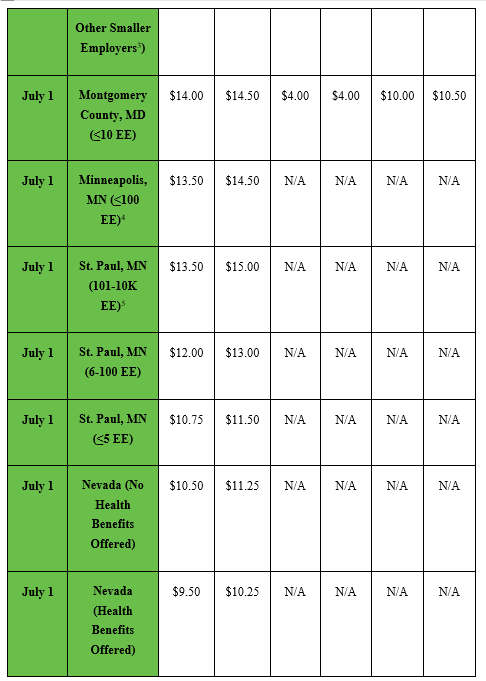
In the below chart (organized chronologically, then by jurisdiction) we include the generally applicable1 minimum wage (MW) and identify the date in 2023 when the change occurred or will occur. We list the rate that applied before the change (Pre) alongside the new rate (Post). In certain jurisdictions – excluding, e.g., California, Minnesota, Nevada, Oregon – employers may be able to count tips an employee receives toward the minimum wage. In those jurisdictions that permit a tip credit (TC), if the direct wage an employer pays (minimum cash wage or MCW) and tips an employee earns equals the minimum wage, an employer satisfies its minimum wage obligation, but, if the direct wage plus tips does not equal the minimum wage, an employer must pay the employee the difference.
White Collar Employees Covered by Minimum Wage: In various states, employees covered by the executive, administrative, professional, or outside sales exemptions are exempt from state overtime requirements, but not exempt from state minimum wage requirements. In these jurisdictions, such employees must earn at least the applicable minimum wage. In one such state, Nevada, on July 1 the minimum wage will increase to $11.25 or $10.25 per hour, depending on whether an employer offers health benefits. Note that, in Illinois, local minimum wage rates may apply (see above), which could affect executive, administrative, or professional employees.
Commissioned Employee Overtime Exemption: To qualify under the federal FLSA’s 7(i) overtime exception, the regular rate of pay for an employee of a retail or service establishment must exceed one-and-a-half times the federal minimum wage, and more than half the employee’s compensation for a representative period (not less than one month) must represent commissions on goods or services. In the following states with upcoming mid-year 2023 rate changes, the 7(i)-type exception requires – in part – an employee’s pay to either equal or exceed one-and-a-half times the state minimum wage: District of Columbia ($17.00); Nevada ($11.25 or $10.25); Oregon ($15.45, $14.20, or $13.20). Additionally, in Connecticut ($15.00), pay must exceeds two times the state minimum wage.
Nevada Daily Overtime Exception: Nevada law contains both weekly and daily overtime requirements. An exception to daily overtime standard exists, however, for employers whose hourly rate equals or exceeds one-and-a-half times the state minimum wage. For this exception to apply, effective July 1, 2023, the employee’s hourly rate must be at least $16.875 or $15.375 per hour, depending on whether an employer offers health benefits. Note, however, that weekly overtime standards still apply to these employees. (Littler)
2024 New York State Paid Family Leave and Workers Compensation Rates & 2023 PFL Reminders
On Wednesday, August 30, 2023, the New York Department of Financial Services (DFS) announced that in 2024, the maximum contribution rate for Paid Family Leave will go down from 0.455% to 0.373% of an employee’s gross annualized wages, capped at $89,343.80*, which is the updated annualized New York State Average Weekly Wage (learn more about the NYSAWW here). This translates to a maximum annual premium contribution of$333.25 per employee that an employer can withhold – down from $399.43 this year.
The New York Department of Labor released its New York State Average Weekly Wage (NYSAWW),used to calculate 2024 NY Paid Family Leave benefits. As of April 1, 2023, the NYSAWW increased to $1,718.15*. (Shelter Point)
Through Legislation S.2928-A/A.06098-A, the definition of “family members” expands to include siblings. This includes biological siblings, adopted siblings, step-siblings and half-siblings. These family members can live outside of New York State, and even outside of the country.
Here are some contribution and benefit examples at different income levels:
Employees earning $519 a week (about $27,000 a year) will pay about $2.65 per week: $519 x 0.511%. When taking the benefit, these employees will receive $347.73 per week, up to a maximum total benefit of $4,172.76.
Employees earning $1,000 a week ($52,000 a year) will pay $5.11 per week: $1,000 x 0.511 %. When taking the benefit, these employees will receive $670 per week, up to a maximum total benefit of $8,040.
Employees earning the SAWW of $1,594.57 (about $83,000 a year) or more will pay 0.511% x their gross wages each pay period until they reach the maximum of $423.71. When taking the benefit, these employees will receive $1,068.36 per week, up to a maximum total benefit of $12,820.32
Draft PFL Policy Language:
NEW YORK STATE PAID FAMILY LEAVE
New York Paid Family Leave provides job-protected, paid time off so employees can:
bond with a newly born, adopted, or fostered child.
care for a close relative with a serious health condition; or
Assist loved ones when a family member is deployed abroad on active military service.
By NYS PFL Definition:
spouse
domestic partner (including same and different gender couples; legal registration not required)
child/stepchild and anyone for whom you have legal custody
parent/stepparent
parent-in-law
grandparent
grandchild
sibling (starting in 2023) Workers should check with their employer’s Paid Family Leave insurer to learn when sibling care goes into effect for their policy. For employees who work for self-insured employers, coverage begins January 1, 2023.
Employees who believe they are eligible for Paid Family Leave should contact their _______ as soon as possible. More information can be found at www.ny.gov/programs/new-york-state-paid-family-leave. Organization will abide by all changes to NYSPFL and communicate such changes to the employees. For additional information please alert your President, or the Statement of Rights Posting on Paid Family Leave.
Legal Area’s and Changes to Remember and Communicate:
Employees have job protection, similar to FMLA.
Paid Sick Leave policies and procedures.
Right to keep their health insurance while on leave.
No retaliation or discrimination against those who take leave.
Citizenship is never a factor in eligibility for NYSPFL.
Review the language contained in your employee handbook, policy, or policy manual. Update FMLA and NYSPFL language to reflect changes and communicate the policy to the workforce.
Communicate PFL payroll deductions for 2020 to the workforce now or during open enrolment. My recommendation is to do this in writing via a template and obtain a signature. NYS has a PDF template referenced above.
Ensure the NYS PFL statement of rights for Paid Family Leave in 2023 is up-to-date and communicated to the workforce. This includes the postings; disability provider or state is providing these postings to employers. Watch the expiration dates on the postings, this is a common area in an audit that needs to be corrected.
A proper call-in procedure for intermittent leave is necessary. Do you accept text messages? What about emails? This should all be clearly communicated in a policy or procedure. How much notice?
New York State Paid Sick Leave
I am happy to work with any employer’s on ensuring policy, communication mechanisms, postings and other NYSPFL material is legal and up to date. Ensure you are reviewing this information annually and communicating changes to PFL rates annually. Work with your payroll provider to ensure and verify the percentage deductions are accurate and live in the payroll system. Remember interns and seasonal employees and communicate if they do or do not qualify for PFL. There are forms to fill out online if they do not qualify to ensure the deduction is not taken.
Frequently Asked Questions
How many weeks of Paid Family Leave are available to employees? Eligible employees can take up to 12 weeks of Paid Family Leave.
How much will employees get paid when taking Paid Family Leave? Employees taking Paid Family Leave in 2023 will get 67% of their average weekly wage, up to a cap of 67% of the current NYSAWW of $1,688.19.
What is the maximum weekly benefit? The maximum weekly benefit for 2023 is $1,131.08.
If I start my continuous leave in one year and it extends into the next, am I eligible for the benefits at the 2023 rate? You get the benefit rate in effect on the first day of your leave.
If I start my intermittent leave in 2022, and it extends into 2023, am I eligible for the benefits at the 2023 rate? You get the benefit rate in effect on the first day of a period of leave. When more than three months pass between days of Paid Family Leave, your next day or period of Paid Family Leave is considered a new claim under the law. This means you will need to file a new request for Paid Family Leave and that you may be eligible for the increased benefits available should that day or period of Paid Family Leave begin in 2023.
I am having a new baby in 2022; can I wait until 2023 to take Paid Family Leave? Yes, you can take (and must complete) Paid Family Leave for bonding with a new child at any time within the first 12 months of the child’s birth, adoption, or foster care placement, provided that you remain an eligible, covered employee.
I used all 12 weeks of Paid Family Leave in the last year; can I take more Paid Family Leave this year if I experience another qualifying event? You may take up to 12 weeks of Paid Family Leave in every 52-week period. This means that if you used the full 12 weeks of leave, the next time you would be eligible to take Paid Family Leave again is one year from your first day of leave.
What is the weekly employee contribution rate? If you are paid weekly, the payroll contribution is 0.455% of your gross weekly wages and is capped at an annual maximum of $399.43. If your gross weekly wages are less than the NYSAWW ($1,688.19 per week), you will have an annual contribution amount less than the annual cap of $399.43, consistent with your actual wages.
For example, if you earn about $27,000 a year ($519 a week), you will pay about $2.36 per week.
If you are not paid weekly, the payroll contribution will be 0.455% of your gross wages for the pay period.
What is the maximum amount employees will pay for Paid Family Leave? The maximum employee contribution for 2023 is $399.43.
On March 31, 2022, New York updated the NYSAWW. When does this NYSAWW take effect for Paid Family Leave deduction and benefit caps? The new NYSAWW only applies to the 2023 benefit and will not affect Paid Family Leave deductions or benefits until January 1, 2023, if leave was begun on or after that date. The new NYSAWW does not have any impact on Paid Family Leave benefits in 2022.
What is the NYSAWW that will be used for Paid Family Leave benefits in 2023? $1,688.19
Workers Comp Rates
The maximum weekly benefit rate for workers’ compensation claimants is two-thirds of the New York State average weekly wage for the previous calendar year, as determined by the New York State Department of Labor (Workers’ Compensation Law §§ 2[16] and 15[6]).
The Department of Labor reported to the Superintendent of the Department of Financial Services that the New York State average weekly wage for 2022 was $1,718.15. Accordingly, the maximum weekly benefit rate will be $1,145.43 for compensable lost time for workers’ compensation claims with dates of injury during the period from July 1, 2023, through June 30, 2024.
Schedule of Benefits
Date of Accident
Weekly Maximum Total / Partial
July 1, 2023 – June 30, 2024
$1,145.43 / $1,145.43
July 1, 2022 – June 30, 2023
$1,125.46 / $1,125.46
July 1, 2021 – June 30, 2022
$1,063.05 / $1,063.05
July 1, 2020 – June 30, 2021
$966.78 / $966.78
July 1, 2019 – June 30, 2020
$934.11 / $934.11
July 1, 2018 – June 30, 2019
$904.74 / $904.74
July 1, 2017 – June 30, 2018
$870.61 / $870.61
July 1, 2016 – June 30, 2017
$864.32 / $864.32
July 1, 2015 – June 30, 2016
$844.29 / $844.29
July 1, 2014 – June 30, 2015
$808.65 / $808.65
July 1, 2013 – June 30, 2014
$803.21 / $803.21
July 1, 2012 – June 30, 2013
$792.07 / $792.07
July 1, 2011 – June 30, 2012
$772.96 / $772.96
July 1, 2010 – June 30, 2011
$739.83 / $739.83
July 1, 2009 – June 30, 2010
$600 / $600
July 1, 2008 – June 30, 2009
$550 / $550
July 1, 2007 – June 30, 2008
$500 / $500
July 1, 1992 – June 30, 2007
$400 / $400
July 1, 1991 – June 30, 1992
$350 / $350
July 1, 1990 – June 30, 1991
$340 / $280
July 1, 1985 – June 30, 1990
$300 / $150
IRS Releases 2024 Cost-of-Living Adjusted Limits for Benefit Plans
The Internal Revenue Service recently announced 2024 dollar limits for qualified retirement plans (including 401(k) plans), deferred compensation plans, and health and welfare plans. Adjustments to certain limits are based on a cost-of-living index.
In addition, the Social Security taxable wage base, which affects qualified retirement plans “integrated” with Social Security, typically adjusts each year. For 2024, the taxable wage base increases to $160,200.
For 2024, most limits increased with the exception of catch-up contributions limits and limits fixed by statute, the latter of which do not adjust based on the cost of living. The increased limits for 2024 are highlighted in bold below.
Qualified Retirement Plan Limits
2024 Limit
2023 Limit
Annual Limit on 401(k)/403(b) Deferral Contributions
$23,000
$22,500
Annual Limit on Age 50 and Older 401(k)/403(b) Catch-up Contributions
$7,500
$7,500
Annual Compensation Limit
$345,000
$330,000
Annual Contribution Limit for Defined Contribution Plans
$69,000
$66,000
Annual Benefit Limit for Defined Benefit Plans
$275,000
$265,000
Prior Year Compensation Amount for Determining Highly Compensated Employees
$155,000
$150,000
Key Employee Compensation Limit
$220,000
$215,000
Annual Limit on SIMPLE Contributions
$16,000
$15,000
Annual Limit on Catch-up Contributions to SIMPLE Plans
$3,500
$3,500
ESOP Account Balance Limit Subject to 5-Year Distribution Period
$1,380,000
$1,330,000
Incremental Amount Adding Additional Year(s) to ESOP 5-Year Distribution Period
$275,000
$265,000
Earnings Threshold for SEP Contribution
$750
$750
Deferred Compensation Limits
2024 Limit
2023 Limit
Annual Limit on 457(b) Contributions
$23,000
$22,500
Annual Limit on Catch-up Contributions to 457(b) Plans
$7,500
$7,500
409A Specified Employee Compensation Threshold
$220,000
$215,000
409A Involuntary Separation Pay Limit
$690,000
$660,000
Health and Welfare Plan Limits
2024 Limit
2023 Limit
Annual Limit on Salary Reduction Contributions to Health FSA
$3,200
$3,050
Annual Limit on Health FSA Carryover
$640
$610
Annual Limit on Salary Reduction Contributions to Dependent Care FSA
$5,000 if married filing jointly or if single $2,500 if married filing separately
$5,000 if married filing jointly or if single $2,500 if married filing separately
Annual Limit on HSA Contributions
$4,150 (EE only)$8,300 (family)
$3,850 (EE only) $7,750 (family)
Annual Limit on Catch-up Contributions to HSA
$1,000
$1,000
Annual Minimum Deductible for High Deductible Health Plans
$1,600 (EE only)$3,200 (family)
$1,500 (EE only) $3,000 (family)
Annual Limit on High Deductible Health Plan Out-of-pocket Expenses
The clocks fell back one hour, causing confusion and challenges for employers with nonexempt employees who were working during the time the clocks fell back. How do we pay employees during this time? What is our legal obligation related to hours worked and paid?
Below are three wage and hour answers, for daylight savings time change(s):
Pay and Hours Worked: Employers are required to pay employees for all hours worked. Nonexempt employees working last night at 2:00 a.m., must be paid one additional hour of pay, “unless the start/end times of their shifts are adjusted in anticipation of the time change. In essence, such an employee will have worked the hour from 1:00 a.m. to 2:00 a.m. twice.”[i]
Overtime: The one additional hour must be considered into the overtime compensation/calculation for the entire week. If the nonexempt employee is scheduled for 40-hours this week, the additional hour would put the employee at 41-hours, one hour of overtime, at least time and one-half the normal hourly rate.
Overtime Rate: “In addition, employers must take this additional hour of work into account when computing the employee’s regular rate of pay for purposes of calculating the employee’s overtime rate.”[ii]
Additionally, ensure that your payroll systems fall back during the time change on Sunday. I have seen issues with timekeeping and payroll systems not resetting for the one-hour time change, which will cause additional issues when processing payroll.
“Does Double Pay Apply for 1:00 a.m. to 2:00 a.m.?
Employers whose nonexempt employees are in the midst of a shift at 2:00 a.m. on November 4, when that time becomes 1:00 a.m., may be required to pay these employees for one additional hour of work—if, in fact, the time change extends the number of hours actually worked. This is because federal law requires employers to pay employees for all hours worked, and these employees will have essentially worked the hour from 1:00 a.m. to 2:00 a.m. twice (and that “extra” hour will carry over throughout the remainder of the shift). To avoid this, employers could alter the start or end times of these nonexempt employees’ shifts on November 5.
Employers’ Overtime Obligations
If an employer in the above scenario does pay its nonexempt employees for an additional hour of work, it might be on the hook for overtime compensation as well. That is, the hour from 1:00 a.m. to 2:00 a.m. that equals two hours of work might result in a workweek of over 40 hours or a workday in excess of 8 hours. Employers may need to consider that additional hour of work in determining employees’ overtime compensation for the day and week.
Regular Rate of Pay
The Fair Labor Standards Act (FLSA) requires employers to pay employees one-and-one-half times their regular rate of pay for all overtime hours worked. For some employees—those paid on commission, tipped workers, and employees who receive bonuses, to name a few—this regular rate is a bit more difficult to determine. Under federal law, an employee’s regular rate of pay is the employee’s hourly rate for all of his or her non overtime hours worked in a single workweek. When calculating an employee’s regular rate, employers must consider all compensation that the employee received in one workweek, including the additional hour of compensation to which a nonexempt employee may be entitled if he or she is working during the time change. Thus, employers that have workers on the clock at 2:00 a.m. might need to take this into account when computing employees’ regular rate of pay for the week for purposes of calculating an employees’ overtime rate.
What About the Beginning of Daylight-Saving Time?
Forward-thinking employers may also want to take the start of daylight-saving time into account. Nonexempt employees who are working on Sunday, March 12, 2023, at 2:00 a.m.—when clocks will “spring forward” to 3:00 a.m.—may be entitled to one fewer hour of pay for their shifts because, essentially, they would not have worked from 2:00 a.m. to 3:00 a.m. For example, if an employee is scheduled to work a shift from 11:00 p.m. to 7:30 a.m., he or she will have worked only seven hours. Once again, employers may adjust their nonexempt employees’ schedules for that day to give them an additional hour of work.
Note, however, that the FLSA does not require employers that decide to pay a worker for a full eight-hour shift even if he or she worked only seven hours to include that extra hour of pay in calculating the employee’s regular rate of pay for overtime purposes. The FLSA also prohibits employers from crediting that extra “non worked” hour of pay toward any overtime compensation due to the employee.” (SHRM)
“Previously, employment law experts told HR Dive that managers should be mindful of giving employees proper break times if shifts encompass daylight saving transitions. So, for example, if supervisors typically rely on computers to automate break times, this would be an instance where manual timekeeping is encouraged.
Additionally, HR should look into whether there are any wage and hour provisions in their workers’ collective bargaining agreement that addresses the daylight-saving time change.
Employers should ensure that they are following any provisions in a collective bargaining agreement that addresses wage and hour provisions for time change. Ultimately, the employment attorney who spoke to HR Dive reaffirmed the DOL’s guidance: Timekeeping is about “staying true” to the hours worked.
Another compliance consideration is workplace safety: A 2018 National Safety Council study found that post-daylight saving transition fatigue leads to an annual uptick in accidents, due to “circadian misalignment” or talent fighting to stay awake.” (HR Dive)
States That Deviate from the Daylight Savings Standard
Note that Arizona (with the exception of the Navajo Nation) and Hawaii do not observe daylight saving time. Not to be outdone, Florida and Nevada have passed bills that would ensure that daylight saving time is observed year-round. Though their respective state legislatures approved these bills, and their governors signed them, they are still awaiting federal approval. And, of course, there’s California, which just a few days after the end of daylight-saving time will vote on a proposition to move the state to year-round daylight-saving time as well. Even if that proposition passes, it will require congressional approval for the change to become permanent.” (JDSUPRA)
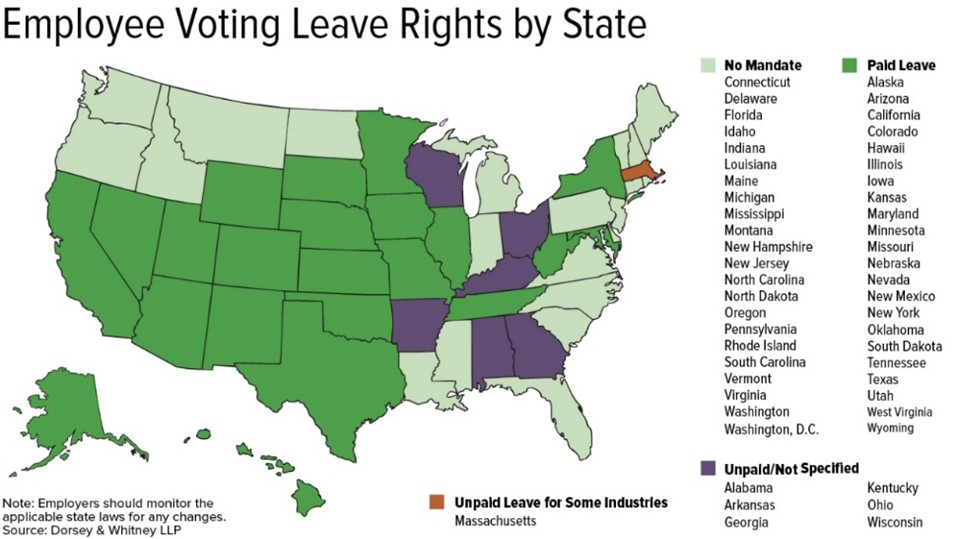
As we approach November 2023, it is necessary for all organizations to review laws and regulations regarding voting leave laws. I highly encourage all organizations to review current policies, procedures, and postings. New York State has specific regulations on when postings need to be up in the workplace, in a breakroom or virtual.
Example Policy:
“Employees will be considered to have sufficient time to vote outside their scheduled work hours if they have four consecutive hours between the polls opening and the beginning of their work shift, or four hours after the polls close. Employees who need time to vote need to communicate the request to HR or management prior to the day of voting, per New York State and federal law. PTO time can be used for time off to vote.”
New York State Time Off to Vote 2020 Legislation:
New York State Election Law (As amended by Chapter 56 of the Laws of 2020) § 3-110.
Time allowed employees to vote.
If a registered voter does not have sufficient time outside of his or her scheduled working hours, within which to vote on any day at which he or she may vote, at any election, he or she may, without loss of pay for up to two hours, take off so much working time as will, when added to his or her voting time outside his or her working hours, enable him or her to vote.
If an employee has four consecutive hours either between the opening of the polls and the beginning of his or her working shift, or between the end of his or her working shift and the closing of the polls, he or she shall be deemed to have sufficient time outside his or her working hours within which to vote. If he or she has less than four consecutive hours he or she may take off so much working time as will, when added to his or her voting time outside his or her working hours enable him or her to vote, but not more than two hours of which shall be without loss of pay, provided that he or she shall be allowed time off for voting only at the beginning or end of his or her working shift, as the employer may designate, unless otherwise mutually agreed.
If the employee requires working time off to vote the employee shall notify his or her employer not more than ten nor less than two working days before the day of the election that he or she requires time off to vote in accordance with the provisions of this section.
Not less than ten working days before every election, every employer shall post conspicuously in the place of work where it can be seen as employees come or go to their place of work, a notice setting forth the provisions of this section. Such notice shall be kept posted until the close of the polls on election day.
ATTENTION ALL EMPLOYEES Time allowed employees to vote on election day
N.Y. ELECTION LAW SECTION 3-110i states that:
IF YOU DO NOT HAVE 4 consecutive hours to vote, either from the opening of the Polls to the beginning of YOUR WORKING shift, or between the end of your working shift and the closing of the polls, YOU MAY TAKE OFF UP TO 2 HOURS, without loss of pay, TO ALLOW YOU TIME TO VOTE if you are a registered voter.
You may take time off at the beginning or end of your working shift, as your employer may designate, unless otherwise mutually agreed.
YOU MUST NOTIFY YOUR EMPLOYER Not less than 2 days, but not MORE THAN 10 days, before THE DAY OF THE ELECTION THAT YOU WILL TAKE TIME off to vote.
Revised 4.14.2020
i Employers: Not less than ten working days before any Election Day, every employer shall post conspicuously in the place of work where it can be seen as employees come or go to their place of work, a notice setting forth the provisions of this law. Such notice shall be kept posted until the close of the polls on Election Day
Current State of Pennsylvania Voting Leave Legislation:
“Time off Allotted: The statute does not provide for any period of leave. It is unlawful for a person to use force, violence, restraint, or to inflict or threaten to inflict injury, damage, harm or loss on a person to induce or compel such person to vote or refrain from voting.”[i]
State Laws
Here’s a list of jurisdictions that require time off for voting:
State of Pennsylvania Draft Organizational Policy (this is an example):
“Organization ________believes that it is the responsibility and duty of employees to exercise the privilege of voting in elections. In accordance with this philosophy, the company will grant its employees approved time off to vote if necessary due to work schedules.
Time Off for Voting:
All employees should be able to vote either before or after regularly assigned work hours. However, when this is not possible due to work schedules, managers are authorized to grant a reasonable period of time, up to three hours, during the workday to vote. Time off for voting should be reported and coded appropriately on timekeeping records.”[i][ii]





 BURR CONSULTING, LLC