Always opportunity to continue to build culture, strategy and partnerships.
Benefits for Employers
1. Harnessing AI to Revolutionize HR
AI Strategy: HR leaders are expected to craft and implement a clearly defined, HR-focused AI strategy. This includes leveraging AI for talent management, recruitment, and employee experience, while ensuring ethical and responsible use
AI’s Impact on Work: There is a strong emphasis on taking an enterprise-wide view of AI’s impact, not just on processes but also on how it changes leadership roles, employee expectations, and organizational culture
AI Agents: The adoption of AI agents is already transforming HR, making it crucial for HR consultants to guide organizations through this technological shift
2. Adapting to Shifting Talent Models
Agile, Multidisciplinary Teams: Organizations are moving away from traditional HR structures, forming agile pods that focus on priority areas such as onboarding redesign, retention improvement, and leadership pipeline development
Talent Flexibility: HR must help organizations adapt to new talent models, including gig work, remote/hybrid arrangements, and skills-based hiring
3. Driving Organizational Culture and Change
Culture Evolution: As AI and new talent models disrupt the workplace, evolving organizational culture to support performance, innovation, and adaptability is a top priority
Well-being, Fairness, and Trust: Employees expect organizations to prioritize well-being, fairness, and trust. HR consultants must help leaders balance innovation with a people-first approach
4. Building Alignment, Adaptability, and Trust
Strategic Alignment: HR must ensure that people strategies are tightly aligned with business goals, especially as organizations navigate rapid change
Adaptability: Helping organizations remain agile and responsive to market signals, regulatory changes, and workforce expectations is essential
Trust: Maintaining trust, especially as AI and automation increase is critical for employee engagement and retention
5. Supporting Leadership and Employee Experience
Leadership Development: There is a renewed focus on developing leaders who can manage change, inspire teams, and drive transformation
Employee Experience: HR must continue to enhance the employee experience, from onboarding to career development, ensuring that technology enhances rather than detracts from human connection
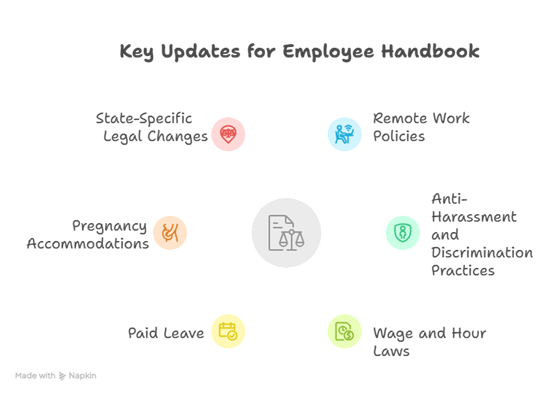
Remote Work Policies With remote and hybrid work becoming more common, updating policies to clearly define expectations, eligibility, and equipment use is essential.
The EEOC is focusing on discrimination claims related to hair texture and style, so grooming and dress code policies should be reviewed and updated accordingly .
Use inclusive language throughout the handbook, such as gender-neutral pronouns (they/them), to foster inclusivity
Employee Classifications and Wage Laws
Review classifications under the Fair Labor Standards Act (FLSA) to ensure proper exemption status.
Stay current with state-specific wage and hour laws, including paid time off and leave policies
Paid Family and Medical Leave
Be aware of state-specific changes, such as Maryland delaying its Paid Family and Medical Leave program contributions until July 1, 2025, with benefits starting July 1, 2026
Pregnancy Accommodations
Update policies to comply with evolving pregnancy accommodation laws and ensure clear procedures for requesting accommodations.
State-Specific Legal Changes
California employers should note changes affecting non-discrimination, leave, and vacation policies effective January 2025.
New York and New Jersey employers must incorporate recent federal and state legal developments into their handbooks .
Company Culture and Compliance Balance
While compliance is critical, also ensure the handbook reflects your organization’s culture and values to engage employees effectively
General Policy Reviews
Regularly review key policies such as leave, attendance, workplace conduct, and disciplinary procedures to maintain compliance and clarity.
New York State Handbook Review & Update Considerations
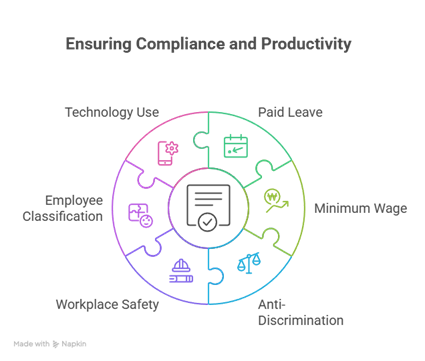
Paid Family Leave and Paid Sick Leave: New York State has been expanding its paid family leave and paid sick leave laws. Ensure your handbook reflects the latest eligibility, benefits, and procedures for requesting leave under these laws.
Minimum Wage and Overtime Rules: New York State and many localities (e.g., NYC, Long Island) have scheduled minimum wage increases. Confirm that wage policies and overtime eligibility align with the current rates and thresholds effective in 2025-2026.
Anti-Discrimination and Harassment Policies: Updates to reflect any new protected classes or changes in reporting procedures under New York State Human Rights Law and recent case law. Training requirements for harassment prevention may also have changed.
Workplace Safety and COVID-19 Policies: While COVID-19 emergency rules have relaxed, some employers maintain policies on vaccination, testing, or remote work. Review any state or local health guidance that might affect workplace safety protocols.
Employee Classification and Wage Transparency: New York has laws addressing gig workers, independent contractors, and wage transparency. Ensure handbook language clarifies employee status and complies with disclosure requirements.
Leave for Voting, Jury Duty, and Military Service: Confirm that leave policies comply with New York State laws protecting these rights.
Use of Technology and Social Media: Update policies on acceptable use of company devices, data privacy, and social media conduct, reflecting evolving norms and legal standards.
This is a shortlist of potential sections to review and revise in most employee handbooks. Continue to review local and state changes as well, when reviewing and updating employee handbooks. Communication, training and setting the expectations is necessary with any organizational change, including employee handbooks.
“Many states, counties, cities, and towns have their own laws prohibiting discrimination, as well as agencies responsible for enforcing those laws. We call these state and local agencies “Fair Employment Practices Agencies” (FEPAs). Usually the laws enforced by these agencies are similar to those enforced by EEOC.”[i] States and cities (including New York State and New York City) have entered into a work sharing agreement with the EEOC. What does this mean for our organizations? Does it have an impact on how we should operate or how we manage workplace allegations and investigations?
Work Sharing Agreements:
Under these terms, both the EEOC and state authority (NYS Division of Human Rights) or City (NYC) can designate the other as its agent for receipt of charges.
What does this mean? If a charge is received by one partner under the agreement, it is deemed received by the other.
“Moreover, these agreements typically proved that the state entity can waive its rights to process such a charge referred to it by the EEOC, which as the effect of permitting the federal agency to process the charge without waiting for the 60-day period to expire.
Many such agreements have an automatic waiver provision, which means that as soon as the charge is filed with the EEOC, the EEOC can begin processing it without going through the motions of referring it back to the state authority.
It also means that the grievant need not file with the state agency within 240 days of the unlawful practice, but, instead, has a full 300 days within which to take the initial step of filing a charge with the federal agency.”[i]
“You can file your charge with either the EEOC or with a Fair Employment Practices Agency. If the charge is initially filed with EEOC and the charge is also covered by state or local law, EEOC dual files the charge with the state or local FEPA (meaning the FEPA will receive a copy of the charge), but ordinarily retains the charge for processing.
If a FEPA has a contract with EEOC, a Charging Party may request that the EEOC review the determination of the FEPA. EEOC will conduct a review only if the request is submitted in writing within fifteen (15) days of receipt of the FEPA’s determination.”[ii]
Confused yet? To summarize, New York State and New York City have a working agreement with the EEOC, if a charge is filed, it is sent with the state or city, it is sent to the EEOC as well, if it falls within the 300-day requirement, under current federal law. “The EEOC contracts with approximately 90 FEPAs nationwide to process more than 48,000 discrimination charges annually.”[iii]
In summary, New York State and New York City have a working agreement with the EEOC. If a charge is filed, it is shared with both the state or city agency and the EEOC, provided it falls within the 300-day requirement under current federal law. The EEOC contracts with approximately 90 FEPAs nationwide to process more than 48,000 discrimination charges annually.
Implications for Organizations
So, what does all of this mean for organizations operating in areas with work sharing agreements? Here are some key implications:
Awareness of Extended Filing Deadlines: Organizations must be aware that employees have 300 days to file a charge with the EEOC, even if the state or local filing deadline is shorter. This extended timeframe can impact internal investigation timelines and record retention policies.
Potential for Dual Investigations: While the EEOC typically retains the charge for processing, organizations should be prepared for the possibility of parallel investigations by both the EEOC and the relevant FEPA. Coordination with legal counsel is crucial in such situations.
Importance of Thorough Internal Investigations: Given the potential for charges to be filed with either the EEOC or a FEPA, organizations should conduct thorough and impartial internal investigations of any workplace allegations of discrimination or harassment. A well-documented investigation can be a valuable defense in the event of a formal charge.
Review of Policies and Procedures: Organizations should review their anti-discrimination and harassment policies and procedures to ensure they are up-to-date and compliant with both federal and state/local laws. This includes ensuring that employees are aware of their rights and responsibilities under these laws.
Training for Managers and Employees: Regular training for managers and employees on anti-discrimination and harassment laws is essential. This training should cover topics such as recognizing and preventing discrimination, handling complaints, and conducting investigations.
Consistent Application of Policies: It is crucial to apply policies and procedures consistently across the organization. Inconsistent application can lead to claims of discrimination and undermine the organization’s defense in the event of a charge.
Documentation: Maintain thorough and accurate records of all complaints, investigations, and disciplinary actions. This documentation can be critical in defending against discrimination charges.
Legal Counsel: Consult with legal counsel experienced in employment law to ensure compliance with all applicable federal, state, and local laws. Legal counsel can also provide guidance on handling specific charges and investigations.
[i] Joel Wm. Friedman, Examples & Explanations: Employment Discrimination. Third Edition (Wolters Kluwer 2017).




 BURR CONSULTING, LLC