2026 Independent Contractor Considerations

Questions to Consider:
 
Behavioral control

  • Instructions: An employee is given instructions on how, when, and where to perform the work, while a contractor is not.
  • Training: The hiring entity does not train an independent contractor on how to do their job; the contractor uses their own methods.
  • Personal services: The contractor usually has the right to hire others to do the work, whereas an employee typically must perform the services personally. 

Financial control

  • Investment: An independent contractor often has a significant investment in tools, equipment, or a business, while an employee does not.
  • Expenses: An independent contractor may have unreimbursed business expenses, while an employee’s expenses are often reimbursed.
  • Opportunity for profit or loss: A contractor’s opportunity to earn a profit or incur a loss based on their managerial skill is a key indicator of independence.
  • Payment: Contractors are often paid a flat fee for a job, while employees are usually paid an hourly or salary wage. 

Type of relationship

  • Permanency: The relationship is typically less permanent for an independent contractor than for an employee.
  • Integration: The work performed by an independent contractor is often not an integral part of the hiring company’s main business activities.
  • Benefits: Independent contractors do not receive employee-type benefits like health insurance or vacation pay.
  • Written contract: A written agreement stating the worker is an independent contractor is considered, but it is not the only factor. 

https://www.dol.gov/agencies/whd/fact-sheets/13-flsa-employment-relationship

“Governor Hochul signed legislation on November 22, 2023, creating protections for independent contractors that are very similar to the requirements of New York City’s Freelance Isn’t Free Act.

The law creates a new section of the New York Labor Law, 191-D, and sets forth wage and job protections for freelance workers in New York State. The law defines “freelance worker” as any person or an organization composed of only one person (in other words, an individual contractor’s corporation) hired as an independent contractor for at least $800. It excludes construction contractors.

The law requires companies who enter into covered agreements with freelance workers to reduce the terms of the agreement to writing, provide a written copy of the contract to the freelance worker, and include the following minimum information in the contract:

  • The name and mailing address of both the hiring party and freelance worker
  • An itemization of all services to be provided by the freelance worker, the value of these services, and the rate and method of compensation
  • The date on which the hiring party must pay the contracted compensation or the mechanism by which such date will be determined (if this provision is not included, then payment must be made no later than 30 days after the completion of the freelance worker’s services)
  • The date by which the freelance worker must submit a list of all services rendered to meet any payment processing deadline of the hiring party

The hiring party is required to keep contracts for at least six years. The bill provides that the failure to produce a freelancer contract upon request by the NY DOL shall give rise to a presumption that the terms that the freelance worker has presented are the agreed upon terms. The law also requires the NY DOL to create template contracts, although companies would not be prohibited from creating or continuing to use their own.

Under the law, any freelance worker can file a confidential complaint with the NY DOL. The bill expressly provides that failure of a hiring party to keep adequate records can expose them to penalties and, in the absence of any records, “the hiring party…shall bear the burden of proving that the complaining employee was paid in accordance with this section.” The bill also gives freelance workers protection from intimidation, harassment, or discrimination for exercising their rights under the law.

Finally, the law provides a private right of action and six-year statute of limitations, except for claims regarding failure to provide a compliant written contract, which have a two-year statute of limitations and require a plaintiff to demonstrate they requested a written contract before the work began. Statutory damages for failing to provide a written contract are set at $250. Liquidated damages and attorney fees are available for a plaintiff who prevails on claims regarding failure to timely pay for services owed or retaliation.

The law takes effect on May 20, 2024, and applies only to contracts entered into on or after that date.” (Morgan Lewis)

https://www.morganlewis.com/pubs/2023/12/new-york-state-year-end-legislative-developments-for-employers-to-know

https://www.jdsupra.com/legalnews/new-york-state-2024-employment-law-6603981/

Additional Freelance Legal Protections by State & City

https://freelancerfiles.com/blogs/news/5-states-cities-are-now-regulating-freelance-work-in-the-us-here-s-what-you-need-to-know

Federal Updates:

The federal article below continues to evolve, expect more changes defining independent contractors at the FEDERAL DOL with the Trump Administration.

Trump DOL Pauses Biden Independent Contractor Rule Defense

The U.S. Department of Labor announced Tuesday a final rule revising its interpretation of the Fair Labor Standards Act’s classification provision to determine whether a worker may be considered an independent contractor.

The final rule largely tracks the agency’s October 2022 proposed rule. It retains the multifactor, “totality-of-the-circumstances” framework for analyzing independent contractors’ status included in that proposal.
Under this framework, DOL will consider six non exhaustive factors when examining the relationship between a worker and a potential employer:

  1. Worker’s opportunity for profit or loss.
  2. Investments made by the worker and the employer.
  3. Degree of permanence of the work relationship.
  4. Nature and degree of control over performance of the work.
  5. Extent to which the work performed is an integral part of the employer’s business.
  6. Use of the worker’s skill and initiative.

The rule will be published in the Federal Register on Wednesday, Jan. 10, and is slated to take effect March 11, officials said. (HR Dive)

Current Independent Factor Test

“An employment relationship under the FLSA must be distinguished from a strictly contractual one. Such a relationship must exist for any provision of the FLSA to apply to any person engaged in work which may otherwise be subject to the Act. In the application of the FLSA an employee, as distinguished from a person who is engaged in a business of his or her own, is one who, as a matter of economic reality, follows the usual path of an employee and is dependent on the business which he or she serves. The employer-employee relationship under the FLSA is tested by “economic reality” rather than “technical concepts.” It is not determined by the common law standards relating to master and servant.

The U.S. Supreme Court has on a number of occasions indicated that there is no single rule or test for determining whether an individual is an independent contractor or an employee for purposes of the FLSA. The Court has held that it is the total activity or situation which controls. Among the factors which the Court has considered significant are:

  1. The extent to which the services rendered are an integral part of the principal’s business.
  2. The permanency of the relationship.
  3. The amount of the alleged contractor’s investment in facilities and equipment.
  4. The nature and degree of control by the principal.
  5. The alleged contractor’s opportunities for profit and loss.
  6. The amount of initiative, judgment, or foresight in open market competition with others required for the success of the claimed independent contractor.
  7. The degree of independent business organization and operation.

There are certain factors which are immaterial in determining whether there is an employment relationship. Such facts as the place where work is performed, the absence of a formal employment agreement, or whether an alleged independent contractor is licensed by State/local government are not considered to have a bearing on determinations as to whether there is an employment relationship. Additionally, the Supreme Court has held that the time or mode of pay does not control the determination of employee status.

Exempt and nonexempt, hourly, salaried, and salaried nonexempt are definitions that most of us know and currently use to classify the positions in our organizations.  We know that we must classify individuals in an exempt or nonexempt (overtime eligible) position for payroll, overtime and reporting purposes.  There are numerous definitions to define exempt level positions under the current FLSA (federal) regulations. 

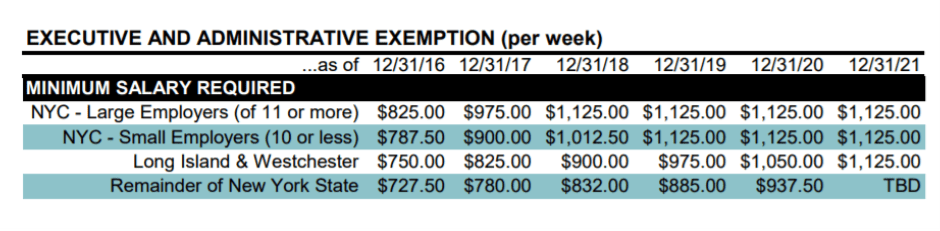
Remember that the salary threshold in New York State varies for executive and administrative professionals, when comparing with the federal law.  As leaders, we need to ensure our classifications for each position within our organizations are accurate and our workforce is paid correctly for work performed and hours worked.”

(https://www.dol.gov/agencies/whd/fact-sheets/13-flsa-employment-relationship)

https://www.dol.gov/agencies/whd/fact-sheets/13-flsa-employment-relationship

National Labor Relations Board June 2023 Ruling
“A new ruling from the National Labor Relations Board (NLRB) alters the standard employers must use to determine whether someone qualifies as an independent contractor.

In the June 13 ruling, the board concluded that the makeup artists, wig artists and hairstylists who work at the Atlanta Opera are employees, not independent contractors. The workers had filed an election petition with the board, seeking union representation.

The NLRB rejected the previous ruling in SuperShuttle that entrepreneurial opportunity for gain or loss should be the animating principle of the independent contractor test. Instead, it said entrepreneurial opportunity should be taken into account alongside a list of traditional common-law factors.

Those factors include:

  • The extent of control the employer exercises over the details of the work.
  • Whether the work is usually done under the direction of the employer or without supervision.
  • Whether the worker is engaged in a distinct occupation or business.
  • How much skill is required in the particular occupation.
  • Whether the employer supplies the tools and the place of work.
  • The length of time for which the worker is employed.
  • The method of payment, whether by the hour or by the job.
  • Whether the work is a part of the regular business of the employer.

“Applying this clear standard will ensure that workers who seek to organize or exercise their rights under the National Labor Relations Act (NLRA) are not improperly excluded from its protections,” said NLRB Chairman Lauren McFerran.

The SuperShuttle ruling “cannot be squared with board precedent, with the common law, or with Supreme Court precedent,” the NLRB wrote in its opinion.

In this case, the creative workers did not have true entrepreneurial opportunity because in reality there was no other opera across town that they could take their talents to, according to David Korn, an attorney with Phelps Dunbar in New Orleans.

“Hypothetical opportunity should not be considered,” said James Evans, an attorney with Alston Bird in Los Angeles.

The new ruling “is designed and intended to make it much more difficult for employers to classify workers as independent contractors and therefore avoid the potential for those workers to organize,” said Jason Reisman, an attorney with Blank Rome in Philadelphia. “This new decision will serve potentially as a solid deterrent for many employers and create doubt for others, or at least make them think twice and re-evaluate how and how often they utilize independent contractors.”

In light of the NLRB decision, “it might be time to reevaluate what our written agreement looks like” for independent contractors and how it’s working in practice, said David Pryzbylski, an attorney with Barnes & Thornburg in Indianapolis. “Anybody using independent contractors needs to take notice of this. The gig economy is top of mind.”

“Employers should know it is not enough to rely upon the method of payment or industry past practices and norms to classify and treat service providers as independent contractors,” said Michael Gotzler, an attorney with Littler in Madison, Wis. “The legal risks and attendant financial exposure are too great nowadays for any business to ignore this evolving area of law.”

However, Todd Lebowitz, an attorney with BakerHostetler in Cleveland said, “This is a low-impact decision. More than anything else, it just reflects that different board members have different perspectives when applying the same common-law test, just like different judges have different perspectives when applying the same test,”

How Employees Differ from Independent Contractors
Under federal law, employees may be entitled to union rights, minimum wage, overtime pay and other benefits. Independent contractors are not entitled to such benefits, but they generally have more flexibility to set their own schedules and work for multiple companies.

Contractors can’t form unions and can’t file unfair labor practice charges with the NLRB, Pryzbylski said.

SHRM filed a friend-of-the-court brief with the NLRB in favor of keeping the SuperShuttle standard. “In order to recruit and retain the best talent, especially during these challenging economic times, [businesses] must offer a myriad of work relationship options that provide the 21st-century worker the autonomy necessary to make the best decisions for them and their families. To that end, the availability of independent work is not only valuable to workers, but necessary for businesses to compete in today’s global marketplace,” SHRM stated, noting that almost 50 percent of Generation Z and 44 percent of Millennials engage in some form of independent work.” (SHRM)


What Is the Most Common Test for Independent Contractors?The ABC test is the most common test used for determining whether someone is an independent contractor. If an employee meets all three of these conditions, they are considered to be an independent contractor.

Conditions of the ABC test:

  • Condition A — The individual must be free from the direction and control of the hiring entity. This includes the execution of the work and how the employee is supervised.
  • Condition B — Second, the independent contractor has to perform work that is considered to be outside the scope of the hiring entity’s business. For example, a software company may hire someone to fix its plumbing system.
  • Condition C — Finally, the worker must be engaged in an independently established occupation, business, or trade that is the same as the work they are performing.

Condition B is particularly challenging for many contractors to meet and is often criticized as overly restrictive. For example, a self-employed freelance journalist hired by a magazine or website to write an article would be unable to meet Condition B because their line of work is the same as that of the hiring company: producing written content. The same would apply to many temporary workers, including a musician hired to fill in for an unavailable band member, a carpenter hired to help a construction firm build a house, or a baker hired to help a caterer with a particularly large event.

To alleviate for Condition B’s unintentional heavy-handedness, many states pass additional laws, such as California‘s AB 2257, giving certain professions exemptions from Condition B (or the ABC test as a whole).

Common Law Rules for independent contractors:

States that do not use the ABC test typically use the similar Common Law Rules as outlined by the US Internal Revenue Service (IRS). The answers to the common law questions help determine if a worker is considered an independent contractor or a full employee.

  1. Behavioral control: Does the hiring company control the worker and/or the methods they use to complete the work?
  2. Financial control: Does the hiring company control aspects of the worker’s compensation, such as how they are paid, if expenses are reimbursed, and who furnishes needed supplies?
  3. Relational control: Does the hiring company offer the worker benefits such as insurance or vacation pay? Is the work being done part of the hiring company’s main business? Is the working relationship ongoing?

What States Use the ABC Test?

There are several states that commonly use the ABC test to decide whether someone is an independent contractor. These include AlaskaArkansas, California, ConnecticutDelawareGeorgiaHawaiiIllinoisIndianaKansasLouisianaMaineMarylandMassachusettsNebraskaNevadaNew HampshireNew JerseyNew MexicoOhioOregonRhode IslandTennesseeUtahVermontWashington, and West Virginia. Anyone working as an independent contractor in these states must pass the ABC test if they want to be classified as such.

Any other states generally have requirements that are very similar, but there may be a few differences. For example, several states require the contractor to meet only conditions A and C of the ABC test or utilize Common Law Rules instead.

https://worldpopulationreview.com/state-rankings/independent-contractor-laws-by-state

Employee or Independent Contractor?
The most basic question about the employment relationship is whether a worker is, in fact, an employee or an independent contractor. As with so many employment law issues, the answer is it depends. In this case, it depends on who is asking: the Internal Revenue Service (IRS), the U.S. Department of Labor (DOL), a workers’ compensation hearing officer and so on. Even courts have admitted that the distinction is not always clear. Regardless of what the employer calls the worker; contractor, freelancer, consultant or gig worker, the same principles apply. SeeNavigating Employment Law in the Gig Economy.

Employee status triggers employer obligations under various federal and state laws that do not apply to independent contractors, and the responsibility for classifying a worker correctly falls squarely on the employer. HR professionals must understand the practical and legal differences between employees and independent contractors.

No bright-line test exists to determine when a worker should be classified as an employee rather than as an independent contractor. However, a wealth of information is readily available to help organizations make the necessary case-by-case determinations. Once the decision has been made to meet a staffing need through independent contractors, organizations can take several practical steps to manage independent contractors effectively.

SeeBLS: Contingent and Alternative Employment Arrangements Summary and Gigs Are the Future of Work: A Q&A with Sarah Kessler.

How to Classify Properly
No legal test applies in every situation when deciding to classify a worker as an independent contractor. For example, the IRS and DOL use different, although similar, analytical frameworks. In fact, the multiplicity of tests defining independent contractor status applied across federal and state laws makes it possible for a worker to be classified as an independent contractor under one law but as an employee under another.

To minimize legal risk, employers are well-advised to ensure that classification as an independent contractor would satisfy every test that may be applicable where the organization does business.

TESTS FOR INDEPENDENT CONTRACTOR STATUS
Various federal government agencies and some states have their own tests to determine independent contractor status.

DOL. According to the DOL’s Fact Sheet 13: Employment Relationship Under the Fair Labor Standards Act, “The U.S. Supreme Court has on a number of occasions indicated that there is no single rule or test for determining whether an individual is an independent contractor or an employee for purposes of the FLSA. The Court has held that it is the total activity or situation which controls.” The following factors have been considered significant in determining independent contractor classification:

  • The extent to which the services rendered are an integral part of the principal’s business.
  • The permanency of the relationship.
  • The amount of the alleged contractor’s investment in facilities and equipment.
  • The nature and degree of control by the principal.
  • The alleged contractor’s opportunities for profit and loss.
  • The amount of initiative, judgment, or foresight in open market competition with others required for the success of the claimed independent contractor.
  • The degree of independent business organization and operation.

SeeMisclassification of Employees as Independent Contractors and DOL Issues Guidance on Independent Contractors.

Additionally, some statutes enforced by the DOL, such as the federal Service Contract Act, contain their own definitions of what constitutes an employee for purposes of the statute. SeeEmployee coverage does not depend on form of employment contract.

IRS. As reflected in Section 2 of its Publication 15-A: Employer’s Supplemental Tax Guide, the IRS now looks at 11 factors (rather than the previous 20 factors) within three areas:

  • Behavioral: Does the company control or have the right to control what the worker does and how the worker does his or her job?
  • Financial: Are the business aspects of the worker’s job controlled by the payer? (These include such considerations as how the worker is paid, whether expenses are reimbursed, who provides tools/supplies, etc.)
  • Type of Relationship: Are there written contracts or employee-type benefits (e.g., pension plan, insurance, vacation pay, etc.)? Will the relationship continue, and is the work performed a key aspect of the business?

SeeIndependent Contractor (Self-Employed) or Employee?

Organizations or individuals can request an official determination of a worker’s status under the IRS test by filing IRS Form SS-8.

Workers’ compensation laws. The test for independent contractor status under workers’ compensation laws varies from state to state. To find out more about the workers’ compensation test in a given state, employers may contact the state department of industrial relations or the state labor department. See State Workers’ Compensation Officials.

State laws. Some states may have different or more-restrictive independent contractor classification rules. Several states, such as California, use their own three-factor test, also known as an “ABC” test, where three main criteria must be met. Each employer should check the laws in the states in which they wish to hire independent contractors to ensure compliance. SeeHow do I know if an individual is considered an employee or independent contractor in California?

Legal Ramifications of Misclassification
Classifying a gig worker as an independent contractor should always be an informed and bona fide business decision, not a subterfuge to avoid the employer’s obligations to employees. Misclassification of an individual as an independent contractor can give rise to a variety of liabilities. SeeIndependent-Contractor Classifications May Need to Be Reviewed.

If the purported independent contractor arrangement is between two organizations, that is, between the organization receiving the services and the organization that actually engages the workers, there is a risk of being found to be a joint employer—a legal relationship in which both client and contractor can be liable for violations of employment laws. SeeHow to Minimize Staffing Agency Snags.

TAX CONSEQUENCES
Employers are required to withhold income taxes based on information employees provide on IRS Form W-4. If an employer fails to withhold income taxes on behalf of a worker improperly classified as an independent contractor, and the individual has failed to pay the taxes, the employer may be liable for federal or state taxes that were required to be withheld but were not.

Furthermore, independent contractors are not eligible to receive tax-free benefits from the organization. If the company chooses to offer health care benefits to an independent contractor, the contractor must pay income taxes on the value of the benefit. If the company includes an independent contractor in its defined benefit pension plan, it risks losing the tax-exempt status of the plan. SeeWhat Benefits Can Companies Offer Gig Workers?

Additionally, beginning with tax year 2020, employers must use Form 1099-NEC to report nonemployee compensation rather than the 1099-MISC. SeeWhat is the difference between IRS Form 1099-NEC and Form 1099-MISC?

EMPLOYEE BENEFITS OBLIGATIONS
In Vizcaino v. Microsoft Corporation, the court found that Microsoft had mischaracterized certain workers as independent contractors and freelancers. Although the workers had been hired for specific projects, some continued to work on successive projects for several years. They were fully integrated into Microsoft’s workforce, and worked onsite and on work teams along with Microsoft’s regular employees. They also shared the same supervisors, performed identical functions and worked the same core hours as regular employees. Microsoft provided them with admittance card keys, office equipment and supplies. However, as independent contractors, these workers were not eligible for the same employee benefits that Microsoft’s regular employees received. Microsoft reached a settlement for $96.89 million and was subsequently assessed approximately $27.13 million in attorney fees and costs.

WORKERS’ COMPENSATION
A misclassified gig worker can result in the supposed employer being held liable for on-the-job injuries outside the protections of the workers’ compensation system, and for penalties as well.

UNEMPLOYMENT COMPENSATION
A worker may file a claim for unemployment compensation and be granted benefits if the unemployment agency believes that the worker was misclassified as an independent contractor. If the organization misclassified the worker, it may be liable for penalties and interest in addition to unpaid unemployment insurance premiums. SeeNew York Uber Drivers Can Collect Unemployment Benefits.

WAGE AND HOUR LIABILITY
The widespread use of gig workers invites the scrutiny of plaintiffs’ attorneys who may be eager to bring a class- or collective-action suit for unpaid overtime or minimum wage violations under the Fair Labor Standards Act (FLSA) or state wage and hour laws. SeeWage and Hour Class Actions Can Cost Employers Millions.

VICARIOUS LIABILITY
An employer may incur liability for wrongful acts of a worker who it has mistakenly classified as an independent contractor. Even when an individual has been correctly classified as an independent contractor, an employer may still be liable for work that is considered “inherently dangerous activity,” or if the employer exercises control over the work or the activity that caused harm to a third party. (SHRM)

Independent Contractor Tax Information
The 1099-MISC form has been used in the past to report certain payments, including nonemployee compensation (NEC), to the IRS. Beginning with tax year 2020, the 1099-MISC has been redesigned due to the creation of Form 1099-NEC. Employers will no longer report nonemployee compensation, such as payments to independent contractors, on Form 1099-MISC.

Form 1099-NEC
Beginning with tax year 2020, employers must use Form 1099-NEC to report nonemployee compensation. If the following four conditions are met, you must generally report a payment as nonemployee compensation:

  1. You made the payment to someone who is not your employee.
  2. You made the payment for services rendered in the course of your trade or business (including government agencies and nonprofit organizations).
  3. You made the payment to an individual, a partnership, an estate or, in some cases, a corporation.
  4. You made payments to the payee of at least $600 during the year.

Common examples of nonemployee compensation include payments to independent contractors, fees paid for professional services such as of attorneys and accountants, and commissions paid to nonemployee salespersons that are subject to repayment but not repaid during the calendar year.

Employers are required to furnish Form 1099-NEC to the payee and file with the IRS by January 31 (February 1 in 2021, since January 31 falls on a Sunday).

Form 1099-NEC example: 


Form 1099-MISC
According to the IRS, beginning with tax year 2020, you should file Form 1099-MISC for each person to whom you have paid the following in the course of your business during the year:

  • At least $10 in royalties or broker payments in lieu of dividends or tax-exempt interest.
  • At least $600 in the following:
    • Rents.
    • Prizes and awards.
    • Other income payments.
    • Generally, cash from a notional principal contract to an individual, a partnership or an estate.
    • Any fishing boat proceeds.
    • Medical and health care payments.
    • Crop insurance proceeds.
    • Payments to an attorney.
    • Section 409A deferrals.
    • Nonqualified deferred compensation.

Employers must furnish the Form 1099-MISC to the recipient by January 31 and file with the IRS by February 28 (March 31 if filing electronically). For 2021, the due dates are February 1 to the recipient and March 1 to the IRS.
 
For detailed instructions and examples for both forms, see Instructions for Forms 1099-MISC and 1099‑NEC.
 
IRS Independent Contractor Website
 
https://www.irs.gov/forms-pubs/about-form-w-9
 
Checklist: Utilizing Independent Contractors
Contract Development
☐ Review Department of Labor and IRS criteria to ensure an independent contractor relationship.
☐ Use Form SS-8 for IRS determination of independent contractor status if unclear and the determination cannot be made by the business.
☐ Develop a written agreement with an assigned specific scope of work for a specific duration.
☐ Do not have a contractor complete an employment application.
☐ Require the contractor to supply his or her own workers’ compensation and liability insurance.
☐ Require the contractor to supply his or her own equipment and tools.
☐ Establish invoicing requirements and payment dates.
☐ Do not pay contractor expenses; expenses should be built into the contract for the cost of the entire job.
☐ Do not provide continuing education training. The company may provide training specific to the assignment or company procedures.
☐ Do not have contractors perform similar work of employees or perform routine work.
☐ Contractor work should not be close to core business operations and therefore considered employee-type work.  
☐ Require documentation demonstrating an independent contractor relationship, such as a copy of business or professional license, copy of insurance certificates, copies of the independent contractor’s advertising, and copy of the contractor’s business card and stationery. 
 
Contract Signed; Contractor Work to Begin
☐ Require the contractor complete Form W-9, Request for Taxpayer Identification Number and Certification. This form can be used to request the correct name and taxpayer identification number, or TIN, of the worker. A TIN may be either a Social Security number (SSN) or an employer identification number (EIN).
☐ Do not complete an I-9 form.
☐ Do not pay contractors from a payroll account.
☐ Do not provide an employee handbook.
☐ Do not allow independent contractors to enroll in any company-sponsored benefit plans or offer other benefits.
☐ Do not invite or permit contractors to attend company parties or special events intended for employees.
☐ Do not issue company business cards or employee ID badges to contractors.
☐ Restrict contractor participation in projects or department meetings.
☐ Do not give independent contractors authority for hiring, disciplinary action or termination decisions.
☐ Do not require the contractor to work “full time” or have set hours. Contractors should control when and how they work.
☐ Do not conduct performance evaluations similar to employee evaluations. Companies should require deadlines and results and can require contractors to follow job and company rules.
 
Contract Work in Progress (1 month to end of contract)
☐ Periodically review the contract and assigned scope of work to ensure contractor is working within the contract scope and maintaining independent contractor status.
☐ Confirm with company contact(s) that the contractor has not been provided additional duties or benefits outside the scope of the contract or anything else that would jeopardize independent contractor status.
☐ Retain records of all transactions with the contractor, such as the contractor’s invoices for billing.

Ongoing
☐ Review IRS criteria to ensure company is maintaining an independent contractor relationship.
☐ Confirm W-9 is on record and retained for four years.
☐ Send form 1099-NEC each year for any contractor (e.g., attorney, accountant, consultant) paid $600 or more for services provided during the year.
☐ Review W-9 Record Retention Schedule to purge unneeded files.
 Retain W-9 for four years for future reference in case of any questions from the worker or the IRS. 
☐ Destroy records that have met the retention requirements unless employer is involved in a dispute that has not yet been resolved.
 
Draft Independent Contractor Agreement (Review State or Local Law)
This independent contractor agreement (Agreement) is entered into this ____ day of ______________, 20__, by and between ______________(Corporation), and _______________________________, an independent contractor (Contractor), in consideration of the mutual promises made herein, as follows:

Term of Agreement
This Agreement will become effective on the ______ day of _______________, 20__, and will continue in effect until: ________, 20__.

Services to be Rendered by Contractor
Contractor agrees to provide the following services:
____________________________________________________________________________
 
Method of Performing Services:
Contractor will determine the method, details, and means of performing the above-described services, including the determination of the need for and hiring of assistants at the Contractor’s own expense. The Corporation may not control, direct or otherwise supervise Contractor’s assistants or employees in the performance of those services.

Compensation:
In consideration for the services to be performed by Contractor, Corporation agrees to pay Contractor the sum of ________________________ dollars ($__________), upon completion of the work to be performed.

Tools and Instruments:
Contractor will supply all tools, equipment and supplies required to perform the services under this Agreement.

Workers Compensation:
Contractor agrees to provide workers’ compensation insurance for Contractor’s employees and agents and agrees to hold harmless and indemnify Corporation for any and all claims arising out of any injury, disability, or death of any of Contractor’s employees or agents.

Insurance:
Contractor agrees to maintain a policy of insurance in the minimum amount of _________________ Dollars ($__________) to cover any negligent acts committed by Contractor or Contractor’s employees or agents during the performance of any duties under this Agreement. Contractor further agrees to hold Corporation free and harmless from any and all claims arising from any such negligent act or omission.

Obligations of Corporation
Corporation agrees to meet the terms of all reasonable requests of Contractor necessary to the performance of Contractor’s duties under this Agreement.

Assignment:
Neither this Agreement nor any duties or obligations under this Agreement may be assigned by Corporation or Contractor without the prior written consent of Contractor and Corporation.

Termination of Agreement:
Notwithstanding any other provisions of this Agreement, either party hereto may terminate this Agreement at any time by giving ________ days written notice to the other party.

General Provisions
Notices:
Any notices to be given hereunder by either party to the other may be made either by personal delivery or by mail, registered or certified, postage prepaid with return receipt requested. Mailed notices shall be addressed to the parties at the following addresses:

Corporation: ______________________________________________________________
Contractor: _______________________________________________________________
Each party may change the above address by written notice in accordance with this paragraph. Notices delivered personally shall be deemed communicated as of the date of actual receipt; mailed notices shall be deemed communicated as of three (3) days after the date of mailing.

Entire Agreement:
This Agreement supersedes any and all other agreements, either oral or in writing, between the parties hereto with respect to the performance of services by Contractor for Corporation and contains all of the covenants and agreements between the parties with respect to the rendering of such services in any manner whatsoever. Each party to this Agreement acknowledges that no representations, inducements, promises or agreements, orally or otherwise, have been made by any party, or anyone acting on behalf of any party, which are not embodied herein, and that no other agreement, statement, or promise not contained in this Agreement shall be valid or binding. Any modification of this Agreement will be effective only if it is in writing signed by the party to be charged.

Partial Invalidity:
If any provision of this Agreement is held by a court of competent jurisdiction to be invalid, void or unenforceable, the remaining provisions shall nevertheless continue in full force without being impaired or invalidated in any way.

Governing Law:
This Agreement shall be governed by and construed in accordance with the laws of the State of ________________________________.
 
Corporation, by _____________________                Date______________________________
 
Contractor, by ______________________                Date ______________________________
 

Invoice Template
[ADD LOGO/IMAGE] HOURLY CONTRACTOR
INVOICE
 
DETAILS
DATE: 2/1/2025
INVOICE NO. [#]
FROM BILL TO
[COMPANY NAME] [COMPANY NAME]
[ATTN] [ATTN]
[STREET ADDRESS] [STREET ADDRESS]
[CITY, STATE, ZIP CODE] [CITY, STATE, ZIP CODE]
[PHONE] [PHONE]
[E-MAIL] [E-MAIL]
 
DESCRIPTION QUANTITY UNIT PRICE AMOUNT ($)
 
NOTES: ___________________________________________
__________________________________________________
__________________________________________________
 
SUBTOTAL
DISCOUNT
TAX / VAT
TOTAL
 
THANK YOU FOR YOUR BUSINESS

Labor and Employment Poster Compliance- Fines, Remote Worker Requirements & Additional Language Posting Requirements


In my 10 years conducting compliance audits, I find posting mistakes in almost every organization, regardless of size, location and type (government, for-profit, not-for-profit).  Compliance audits are necessary to ensure compliance, postering requirements change throughout the year.  Annual subscription will ensure compliance; I can help with an annual subscription for digital and posters!

Identify Required Posters: Create a comprehensive list of all federal, state, and local labor law posters required for each location. Utilize online resources, legal counsel, or labor law poster compliance services to ensure accuracy.Physical Inspection: Conduct a physical inspection of each workplace to verify that all required posters are displayed in conspicuous locations where employees can easily access and read them. Common locations include break rooms, employee entrances, and near-time clocks.Poster Content Review: Carefully examine each poster to ensure it is the most current version. Labor laws are subject to change, and outdated posters can lead to non-compliance. Check for revision dates or contact the relevant government agency to confirm the poster’s validity.Accessibility Assessment: Evaluate the accessibility of the posters for all employees, including those with disabilities. Ensure that posters are displayed at an appropriate height and are readable. Consider providing posters in multiple languages if a significant portion of the workforce speaks a language other than English.Documentation: Maintain detailed records of the audit, including the date of the audit, the locations inspected, the posters reviewed, and any identified deficiencies. This documentation will be valuable for demonstrating compliance and tracking progress in addressing any issues. 
Penalty ExamplesOccupational Safety and Health Act (OSHA): Up to a $16,550 maximum fine per violation.Employee Polygraph Protection Act (EPPA): Up to a $26,262 maximum fine per violation.Equal Employment Opportunity is the Law (EEOC): Up to $659 per violation.Family and Medical Leave Act (FMLA): Up to $216 per violation for employers with 50 or more employees. How to stay compliant

Display posters correctly: 
Post all required federal and state posters in a prominent and easily accessible location where employees can see them, such as a break room or time-clock area. 

Keep them updated: 
Replace posters whenever there is a mandatory change in the law. 

Provide for remote employees: 
If your employees work exclusively remotely, you may be able to provide digital copies. However, many federal statutes require both electronic and hard-copy postings, and you should not rely on electronic notices as a complete substitute unless all employees are remote and have easy access to the digital versions. 

Check specific requirements: 
Pay attention to specific requirements, such as the OSHA poster having a minimum paper size of 8.5 by 14 inches. 
 
NYS Requirements
“In addition to the increasing number of posters employers are required to physically display, effective December 16, 2022, New York employers must now furnish all employees with digital copies of all required posters via email or by posting them on the employer’s website.

Section 201 of New York’s Labor Law requires employers to furnish employees with “copies or abstracts” of laws, rules, and orders, that are designated by the New York State Department of Labor (NYDOL) as affecting employees.

Traditionally, this obligation was satisfied by an employer posting the copies and abstracts “in a conspicuous place on each floor of the premises.” Indeed, the NYDOL’s guidance has previously indicated that furnishing required notices electronically only may not be sufficient for employers to satisfy their obligations under Section 201. The physical requirement piece of Section 201 has now been confirmed with the latest amendment.

On December 16, 2022, Governor Kathy Hochul signed into law an amendment to Section 201 that expanded the posting requirements. Employers must now:Furnish digital versions of all copies and abstracts required under New York law or the NYDOL’s regulations to all employees through either the employer’s website or by email;Furnish digital versions of all other documents required to be physically posted in the workplace pursuant to any state or federal law or regulation to all employees through either the employer’s website or by email; andProvide notice to employees that all physically posted notices are available electronically.The amendment language indicates that these new requirements do not substitute an employer’s obligations under New York or federal law to physically display postings in a conspicuous place in the workplace. Instead, the electronic furnishing of postings is an additional requirement for employers to satisfy.

Failure to comply with these new requirements can result in monetary fines. Additionally, non-compliance may be used as evidence to support other alleged workplace violations by an employer. (Fox Rothchild)
As many of our organizations have been implementing and utilizing remote worker options, we cannot forget the requirements for labor and employment law posters.  Local, State and Federal laws have different requirements and definitions for remote workers.
 
Broad Definition of Remote Workers:Works at homeDoes not report to a physical job siteIs an employeeOther Considerations:Independent Contractors: Organization is not requiredDigital Nomads: Organization is not requiredGig Workers: Depends on payrolling of the individualTemporary Workers: Depends on payrollingWorkers on site at customer’s office: If the customer’s office has posters, more than likely no, but you do want to work with the customer to ensure compliance.General Posting Requirements:VisibleConspicuous LocationReadableNot DefacedPost Where Employees Report to Work Each DayRemote Workers with Internet Access:Internal website linkConspicuously Displayed: Ensure it is easy to find on your intranet portal and not buried in folders.Ensure workers are aware of how to accessMake remote workers aware of their rightsCan send them their own set of postersElectronic posters = best practiceStill need paper posters at main office and other locationsEEOC: In most cases, electronic posting supplements physical posting but does not itself fulfill the employer’s basic obligation to physically post the required information in its workplaces.
 
The majority of the agencies, laws and regulations were written prior to the remote work became a popular model for organizations to implement.  However, there are a few federal and state laws that have implemented electronic posting language.USERRA Notice: May be posted or distributed in other ways.FMLA Notice: May be distributed electronically if all other requirements are met.EEOC: employers are encouraged to post the electronic notice on their internal websites in a conspicuous locationColorado Paid Leave, Whistleblowing & PPE: Provide through electronic communication, or conspicuous posting in the web-based platformFFCRA: An employer may also directly mail the required notice to any employees who are not able to access information at the worksite, through email, or online.Pennsylvania Mandatory Requirements


The 15 Mandatory Federal Contractor Postings:“National Labor Relations Act (NLRA)Informs employees of their rights under the National Labor Relations Act to form, join, and support a union and to bargain collectively with their employerMust be posted in English and any language common to a significant portion of workers if they are not fluent in EnglishPosting requirement does not apply to contracts of less than $100,000Enforced by the U.S. Department of Labor – Office of Labor-Management Standards and Office of Federal Contract Compliance ProgramsThere has been some confusion recently on whether this is a required poster. The National Labor Relations Board previously required private employers to post a similar notice, but a recent case has put that requirement on hold until further notice. That decision has no impact on federal contractors who are still required to post this poster.Walsh-Healey Public Contracts Act/Service Contract ActNotifies employees of the minimum wage rate, overtime requirements and safety and health requirementsMust be posted by federal contractors and subcontractors with contracts in excess of $10,000 for the manufacturing or furnishing of materials, supplies, and equipment to the federal government or federal contractors who provide services to the federal government using service employees whose contract exceeds $2,500Enforced by the U.S. Department of Labor – Employment Standards Administration – Wage and Hour DivisionAmerican Recovery and Reinvestment Act (ARRA) Whistleblower RightsInforms employees of their whistleblower rights under the American Recovery and Reinvestment ActMust be posted by federal contractors who received funds under the ARRAEnforced by the Recovery Accountability and Transparency BoardDepartment of Defense (DOD) Fraud HotlineInforms employees of the Department of Defense Fraud Hotline number for reporting fraud, waste and abuseMust be posted by federal contractors who have contracts with the Department of Defense that exceed $5,000,000Enforced by the U.S. Department of DefenseDepartment of Defense (DOD) Whistleblower HotlineInforms employees of their whistleblower rightsMust be posted by federal contractors who have contracts with the Department of Defense that exceed $5,000,000Enforced by the U.S. Department of DefenseDepartment of Homeland Security (DHS) Fraud HotlineInforms employees of the Department of Homeland Security Hotline number for reporting suspected criminal violations, misconduct and wasteful activitiesMust be posted by federal contractors who have contracts with the Department of Defense that exceed $5,000,000 and if the DOD contract is funded, in whole or in part, by DHS disaster relief fundsEnforced by the U.S. Department of Homeland Security – Office of the Inspector GeneralNotice to Workers with Disabilities/Special Minimum WageInforms employees the conditions under which special minimum wages may be paidMust be posted by federal contractors who employ disabled employees paid at a special minimum wageEnforced by the U.S. Department of Labor – Employment Standards Administration – Wage and Hour DivisionE-VerifyNotifies applicant and employees of their rights under the E-Verify programMust be posted by federal contractors in English and Spanish and posted near entranceEnforced by the U.S. Department of Homeland SecurityRight to WorkNotifies applicants and employees of their discrimination rights under the E-Verify programMust be posted by federal contractors in English and Spanish and posted near entranceEnforced by the U.S. Department of Homeland Security 2Federal Contractor Minimum WageInforms employees of the federal minimum wage for contractorsMust be posted by federal contractors and subcontractors that have FLSA-covered workers performing work in connection with a covered Service Contract Act or Davis-Bacon Act contract, as well as those with concessions contracts or contracts offering services to federal employees or the public on federal propertyEnforced by the U.S. Department of Labor – Employment Standards Administration – Wage and Hour Division“EEO is the Law” SupplementInforms applicants and employees of federal nondiscrimination laws and procedures for filling complaints with the Office of Federal Contract Compliance ProgramsMust be posted by federal contractors and subcontractors with contracts in excess of $10,000Enforced by the U.S. Department of Labor – Office of Federal Contract Compliance ProgramsPay Transparency Policy StatementInforms applicants and employees of their pay transparency rightsMust be posted by federal contractors and subcontractors with contracts in excess of $10,000Enforced by the U.S. Department of Labor – Office of Federal Contractor Compliance ProgramsFederal Contractor Paid Sick LeaveInforms employees of their paid sick leave rightsMust be posted by federal contractors and subcontractors that have FLSA-covered workers performing work in connection with a covered Service Contract Act or Davis-Bacon Act contract, as well as those with concessions contracts or contracts offering services to federal employees or the public on federal propertyEnforced by the U.S. Department of Labor – Employment Standards AdministrationDavis-Bacon ActNotifies employees of prevailing wage requirements and overtime pay under the Davis-Bacon ActMust be posted by federal contractors and subcontractors performing on federally funded construction projects in excess of $2,000 for the actual construction, alteration/repair of public buildings or public worksEnforced by the U.S. Department of Labor – Employment Standards Administration – Wage and Hour DivisionDepartment of Transportation (DOT) Federal Highway ConstructionInforms employees to report any false statement, false reports or false claims made to the character, quality, quantity, or cost of any work performed on the contractMust be posted by federal contractors who work on federally funded highway construction projectsEnforced by the U.S. Department of Transportation” (Poster Guard)

November 2025 Voting Laws for Employer Reminders & Additional State Information

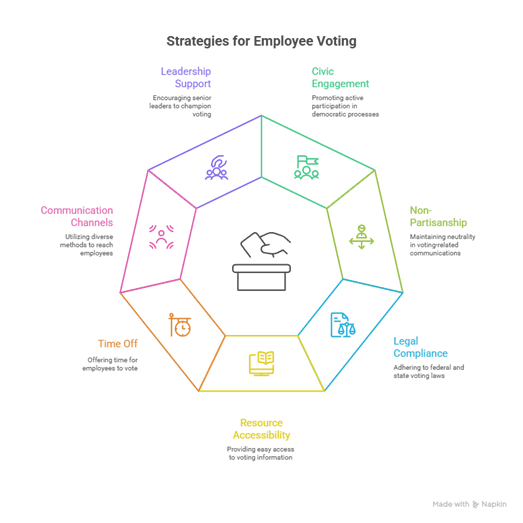
As we approach November 2025 NYS voting dates (see attached PDF for reminders), it is necessary for all organizations to review laws and regulations regarding voting leave laws.  I highly encourage all organizations to review current policies, procedures, and postings.  New York State has specific regulations on when postings need to be up in the workplace, in a breakroom or virtual.

Required Notices Across the U.S.:

“California, DC, and New York also require that employers post a notice about employees’ voting rights in a conspicuous location in the workplace. Employees who work from home or don’t report to the workplace regularly should be provided with these notices electronically.

California

California requires the notice to be posted at least 10 days before the November 5 election, which is October 26, a Saturday. If you’re closed on Saturdays, we recommend posting or sending this notice by Friday the 25th.

The District of Columbia

DC requires that employers post a voting leave notice created by the DC Board of Elections (DCBOE) at least 60 days before the November 5 election—which is September 6. If you provide this notice electronically for remote employees, you need to get their acknowledgment of receipt. This election’s notice can be found in English and in other languages here. The DCBOE has a web page with additional information.

New York

New York requires the notice to be posted at least 10 working days before the November 5 election (this would be October 22 for a Monday through Friday workplace). New York’s notice is available here.”  (Mineral)

Example Policy:

“Employees will be considered to have sufficient time to vote outside their scheduled work hours if they have four consecutive hours between the polls opening and the beginning of their work shift, or four hours after the polls close.  Employees who need time to vote need to communicate the request to HR or management prior to the day of voting, per New York State and federal law.  PTO time can be used for time off to vote.” 

New York State Time Off to Vote 2020 Legislation:

New York State Election Law (As amended by Chapter 56 of the Laws of 2020) § 3-110.

Time allowed employees to vote.

  1. If a registered voter does not have sufficient time outside of his or her scheduled working hours, within which to vote on any day at which he or she may vote, at any election, he or she may, without loss of pay for up to two hours, take off so much working time as will, when added to his or her voting time outside his or her working hours, enable him or her to vote.
  2. If an employee has four consecutive hours either between the opening of the polls and the beginning of his or her working shift, or between the end of his or her working shift and the closing of the polls, he or she shall be deemed to have sufficient time outside his or her working hours within which to vote. If he or she has less than four consecutive hours he or she may take off so much working time as will, when added to his or her voting time outside his or her working hours enable him or her to vote, but not more than two hours of which shall be without loss of pay, provided that he or she shall be allowed time off for voting only at the beginning or end of his or her working shift, as the employer may designate, unless otherwise mutually agreed.
  3. If the employee requires working time off to vote the employee shall notify his or her employer not more than ten nor less than two working days before the day of the election that he or she requires time off to vote in accordance with the provisions of this section.
  4. Not less than ten working days before every election, every employer shall post conspicuously in the place of work where it can be seen as employees come or go to their place of work, a notice setting forth the provisions of this section. Such notice shall be kept posted until the close of the polls on election day.
  5.  

ATTENTION ALL EMPLOYEES Time allowed employees to vote on election day

N.Y. ELECTION LAW SECTION 3-110i states that:

  • IF YOU DO NOT HAVE 4 consecutive hours to vote, either from the opening of the Polls to the beginning of YOUR WORKING shift, or between the end of your working shift and the closing of the polls, YOU MAY TAKE OFF UP TO 2 HOURS, without loss of pay, TO ALLOW YOU TIME TO VOTE if you are a registered voter.
  • You may take time off at the beginning or end of your working shift, as your employer may designate, unless otherwise mutually agreed.
  • YOU MUST NOTIFY YOUR EMPLOYER Not less than 2 days, but not MORE THAN 10 days, before THE DAY OF THE ELECTION THAT YOU WILL TAKE TIME off to vote.

Revised 4.14.2020

i Employers: Not less than ten working days before any Election Day, every employer shall post conspicuously in the place of work where it can be seen as employees come or go to their place of work, a notice setting forth the provisions of this law. Such notice shall be kept posted until the close of the polls on Election Day

New York State Employer Posting Link (10 Working Days)

Current State of Pennsylvania Voting Leave Legislation:

  1. “Time off Allotted: The statute does not provide for any period of leave. It is unlawful for a person to use force, violence, restraint, or to inflict or threaten to inflict injury, damage, harm or loss on a person to induce or compel such person to vote or refrain from voting.”[i]

[i] https://www.dorsey.com/~/media/files/newsresources/publications/2008/10/employee-time-off-on-election-day-a-statebystate__/files/election-guide/fileattachment/election-guide.pdf

State Laws

Here’s a list of jurisdictions that require time off for voting:

  • Alabama.
  • Alaska.
  • Arizona.
  • Arkansas.
  • California.
  • Colorado.
  • Connecticut.
  • District of Columbia.
  • Georgia.
  • Illinois.
  • Iowa.
  • Kansas.
  • Kentucky.
  • Maryland.
  • Massachusetts.
  • Minnesota.
  • Missouri.
  • Nebraska.
  • Nevada.
  • New Mexico.
  • New York.
  • North Dakota.
  • Ohio.
  • Oklahoma.
  • South Dakota.
  • Tennessee.
  • Texas.
  • Utah.
  • West Virginia.
  • Wisconsin.
  • Wyoming.

Additional Information

State of Pennsylvania Draft Organizational Policy (this is an example):

“Organization ________believes that it is the responsibility and duty of employees to exercise the privilege of voting in elections. In accordance with this philosophy, the company will grant its employees approved time off to vote if necessary due to work schedules.

Time Off for Voting:

All employees should be able to vote either before or after regularly assigned work hours. However, when this is not possible due to work schedules, managers are authorized to grant a reasonable period of time, up to three hours, during the workday to vote. Time off for voting should be reported and coded appropriately on timekeeping records.”[i][ii]

[Company Name] believes that it is the responsibility and duty of employees to exercise the privilege of voting in elections. In accordance with this philosophy, the company will grant its employees approved time off to vote if necessary due to work schedules and for periods of service as an election official.

Time Off for Voting

All employees should be able to vote either before or after regularly assigned work hours. However, when this is not possible due to work schedules, managers are authorized to grant a reasonable period of time, up to [insert number] hours, during the work day to vote. This time off will be [with/without] pay. Time off for voting should be reported and coded appropriately on timekeeping records.

Time Off for Election Service

Employees who are chosen to serve as election officials at polling sites will be permitted to take required time off to serve in this capacity. Employees who are chosen to act as election officials must notify their manager a minimum of [insert number] days in advance of their need for time off in order to accommodate the necessary rescheduling of work periods. Employees must report time engaged as an election official and code this time accordingly on timekeeping records. 

Purpose/Objective

[Company Name] encourages all employees to accept their civic responsibilities, and as a good corporate citizen, the company is pleased to assist employees in the performance of their civic duties. The company provides a reasonable amount of time off, including up to two hours of paid time off, to employees whose work schedules do not provide sufficient time on an election day to vote.

Eligibility

In circumstances where an employee’s work schedule does not provide sufficient time to vote on an election day, the company will provide a reasonable amount of time off during scheduled work time, including up to two hours of paid time off, for employees to vote. Employees who need time off to vote should notify [their supervisors/human resources/other job title] at least two days prior to election day. The company reserves the right in its sole discretion to specify a time period during which the polls are open for employees to leave work to vote.

Procedures

Employees requesting leave under this policy should comply with the following requirements:

  1. Notify [their supervisors/human resources/other job title] at least two days prior to election day of the need for time off to vote.
  2. Coordinate the time off with [their supervisors/human resources/other job title] prior to election day to ensure as little disruption as possible in the flow of work.

For more information about this policy, employers should contact [their supervisors/human resources/other job title].


[i] https://www.shrm.org/resourcesandtools/tools-and-samples/policies/pages/cms_009836.aspx

[ii] Burr Consulting, LLC Article 11.2018

Unemployment Benefits Increase 72% in New York, Effective October 1, 2025

As of October 1, 2025, the maximum weekly unemployment benefit in New York will increase from $504 to $869. This is the first increase since 2019, as the state’s unemployment trust fund had a federal debt from the COVID-19 pandemic. 

Key details about the unemployment increase:

·        Maximum weekly benefit: The cap will be raised to $869, an increase of over 70%.

·        Effective date: October 1, 2025.

·        Funding and trust fund: The 2025 state budget included using up to $8 billion from rainy-day funds to pay off the federal debt and return the trust fund to solvency.

·        Benefit indexing: After the initial increase, the maximum benefit will be indexed annually at 50% of the state’s average weekly wage.

·        Employer tax relief: Paying off the federal debt will also eliminate the annual “Interest Assessment Surcharge” for New York businesses.

·        Striking workers: The budget agreement reduces the waiting period for striking workers to receive unemployment benefits from three weeks to two. 

2023 New York State Unemployment Notice Requirement

Beginning November 13, 2023, the law will require every employer who is obligated to contribute to the unemployment insurance system to notify their employees about their right to apply for unemployment benefits, when applicable.

That statute will now require employers to provide specific notifications to employees regarding their potential eligibility for unemployment benefits.

New York employers have already been expected to provide employees with a Record of Employment upon separation, the law will now require notification in more situations that don’t necessarily involve termination of employment.

When Is the Unemployment Notice Required?

Employers must provide this unemployment notice:

  • At the time of each permanent or indefinite separation from employment.
  • During a reduction in hours.
  • During a temporary separation.
  • For any other interruption of continued employment resulting in total or partial unemployment.

Unfortunately, the above terms are not specifically defined in the amended statute.

What Should the Unemployment Notice Include?

The required notice must be in writing and should be on a form either furnished or approved by the New York Department of Labor.

The notice must contain:

  1. Employer’s Details: This includes the employer’s name and registration number.
  2. Address for Communication: The notice should specify the address of the employer to which any request for remuneration and employment information regarding the employee should be directed.
  3. Additional Information: Any other information as required by the Department of Labor should also be included.

So far, the DOL has not yet released the required notice form. It is hoped that when it does so, the DOL will better explain the circumstances where notice must be provided short of permanent employment separation.

Implications for Employers

This new unemployment notice provision emphasizes the state’s commitment to ensuring that employees are well-informed about their rights. For employers, it means:

  • Being Proactive: Employers should be ready with the required forms and processes in place by November 13, 2023.
  • Training HR Teams: HR teams should be trained to understand the nuances of the new unemployment notice provision and ensure compliance.
  • Avoiding Penalties: Non-compliance could lead to negative consequences regarding unemployment claims. It’s crucial for employers to adhere to these new unemployment notice requirements diligently. (Horton PLLC)

NYS Assembly Bill

NYS Unemployment Website

Advice on Fighting Unemployment Claims

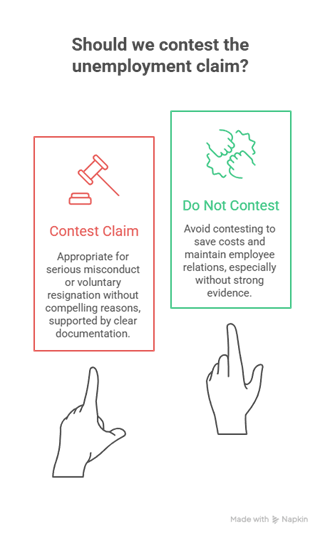
When Should Employers Contest Unemployment Claims?

  • Serious Misconduct or Voluntary Quit:
    Employers should generally only contest claims if the employee was terminated for serious misconduct (such as theft, violence, or repeated policy violations) or if the employee quit without a compelling reason. Contesting claims in other situations can be time-consuming and may not be successful.
  • Clear Documentation:
    Only proceed if you have solid documentation supporting your case, such as written warnings, termination letters, or evidence of policy violations.

Why Employers Should Rarely Fight Claims

  • Cost vs. Benefit:
    While unjustified claims can increase your unemployment insurance costs, fighting every claim is rarely cost-effective. Most HR experts recommend contesting only in clear-cut cases of misconduct or fraud.
  • Employee Relations:
    Aggressively contesting claims can harm your reputation and employee morale. It’s often better to reserve challenges for the most egregious cases.

How to Contest an Unemployment Claim

  1. Respond Promptly:
    When you receive notice of a claim, respond within the required timeframe and provide all requested information.
  2. Present Evidence:
    Be prepared to present evidence that the employee was terminated for misconduct or quit without good cause. This may include documentation of the employee’s duties, violations, and any warnings given.
  3. Participate in Hearings:
    If the claim is appealed, you may need to participate in a hearing. Bring witnesses and documentation to support your case.
  4. Be Honest and Consistent:
    Ensure all statements and evidence are truthful and consistent with previous records. Inconsistencies can undermine your credibility.

Best Practices

  • Maintain Thorough Records:
    Keep detailed records of employee performance, disciplinary actions, and reasons for separation.
  • Evaluate Each Case Individually:
    Assess the merits of each claim before deciding to contest. Blanket opposition to all claims is discouraged.
  • Consult Legal or HR Experts:
    When in doubt, seek advice from HR professionals or legal counsel to ensure compliance with state laws and best practices.
StateMaximum Unemployment BenefitState Agency Website and Phone Number
Alabama$275/weekAlabama DOL
(334)242-8025
Alaska$370/weekAlaska DOL
(907)269-4700
Arizona$240/weekArizona: How to Apply for UI
(877)600-2722
Arkansas$451/weekArkansas DOL
(501)682-2121
California$750/week through September 6, 2021
After this, it will come down to $451/week
California DOL
1(800)300-5616
Colorado$918/week through September 6, 2021
After this, it will come down to $618/week
Colorado DOL
(303)318-8000
Connecticut$949/week through September 6, 2021
After this, it will come down to $649/week
Connecticut DOL
(203)941-6868
Delaware$700/week through September 6, 2021
Then it will come down to $400/week
Delaware DOL
1(800)794-3032
D.C.$744/week through September 6, 2021
After this, it will come down to $444/week
D.C. DOES
(202)724-7000
Florida$275/weekFlorida DEO
1(833)352-7759
Georgia$365/weekGeorgia DOL
1(877)709-8185
Hawaii$948/week through September 6, 2021
After this, it will come down to $648/week
Hawaii DOL
Oahu: (808)586-8970
Hilo: (808)974-4086
Kona: (808)322-4822
Maui: (808)984-8400
Kauai: (808)274-3043
Idaho$463/weekIdaho DOL
(208)332-8942
Illinois$784/week through September 6, 2021
After this, it will come down to $484/week
Illinois DES
1(800)244-5631
Indiana$690/week through September 6, 2021
After this, it will come down to $390/week
Indiana DOL
1(800)891-6499
Iowa$481/weekIowa Workforce Development
1(866)239-0843
Kansas$788/week through September 6, 2021
After this, it will come down to $488/week
Kansas DOL
1(800)292-6333
Kentucky$852/week through September 6, 2021
After this, it will come down to $552/week
Kentucky Career Center
(502)875-0442
LouisianaLouisiana Workforce Commission
1(866)783-5567
Maine$745/week through September 6, 2021
After this, it will come down to $445/week
Maine DOL
1(800)593-7660
Maryland$730/week through September 6, 2021
After this, it will come to $430/week
Maryland DOL
Contact Info
Massachusetts$1,123/week through September 6, 2021
After this, it will come down to $823/week
Mass DUA
1(877)636-6800
Michigan$662/week through September 6, 2021
After this, it will come down to $362/week
Michigan Department of Labor and Opportunity
Contact Info
Minnesota$1,040/week through September 6, 2021
After this, it will come down to $740/week
Minnesota Unemployment Insurance
1-877-898-9090
Mississippi$235/weekMississippi DES
601-321-6000
Missouri$320/weekMissouri DOL
Contact Info
Montana$872/week through June 27, 2021
After this, it will come down to $552/week
Montana Unemployment Insurance Division
406-444-2545
Nebraska$440/weekNE Works
855-995-8863
Nevada$769/week through September 6, 2021
After this, it will come down to $469/week
Nevada DOL
Contact Info
New Hampshire$427/weekNew Hampshire Workforce Connect
1(800)852-3400
New Jersey$1,013/week through September 6, 2021
After this, it will come down to $713/week
New Jersey DOL
Contact Info
New Mexico$811/week through September 6, 2021
After this, it will come down to $511/week
New Mexico Workforce Connection
Contact Info
New York$804/week through September 6, 2021
After this, it will come down to $504/week
New York DOL
1(888)581-5812
North Carolina$650/week through September 6, 2021
After this, it will come down to $350/week
North Carolina DES
1(888)737-0259
North Dakota$618/weekNorth Dakota DOL
(701) 328-4995
Ohio$498/weekOhio Department of Job and Family Services
1(877)644-6562
Oklahoma$539/weekOklahoma ESC
1(800)555-1554
Oregon$973/week through September 6, 2021
After this, it will come down to $673/week
Oregon Employment Department
1(877)345-3484
Pennsylvania$872/week through September 6, 2021
After this, it will come down to $572/week
Pennsylvania Office of Unemployment Compensation
Contact Info
Rhode Island$886/week through September 6, 2021
After this, it will come down to $586/week
Rhode Island DLT
(401)415-6772
South Carolina$326/weekSouth Carolina Department of Employment and Workforce
1(866)831-1724
South Dakota$428/weekSouth Dakota Department of Labor & Regulation
(605)626-2452
Tennessee$275/weekTennessee Department of Labor & Workforce Development
1(877)813-0950
Texas$535/weekTexas Workforce Commission
1(800)628-5115
Utah$580/weekUtah Workforce Services
(801)526-9675
Vermont$831/week through September 6, 2021
After this, it will come down to $531/week
Vermont DOL
1(877) 214-3332
Virginia$678/week through September 6, 2021
After this, it will come down to $378/week
Virginia Employment Commission
Contact Info
Washington$1,144/week through September 6, 2021
After this, it will come down to $844/week
Washington Employment Security Department
1(800)318-6022
West Virginia$424/weekWorkforce West Virginia
1(800)379-1032
Wisconsin$670/week through September 6, 2021
After this, it will come down to $370/week
Wisconsin Department of Workforce Development
(608) 266-3131
Wyoming$508/weekWYUI
(307)473-3789

If the employee is the one asking for time off, though, the requirement is not triggered. This can include a leave of absence, vacation, parental leave, personal leave, or any other type of paid or unpaid leave.

https://gusto.com/resources/articles/benefits/covid-state-unemployment-insurance-benefits

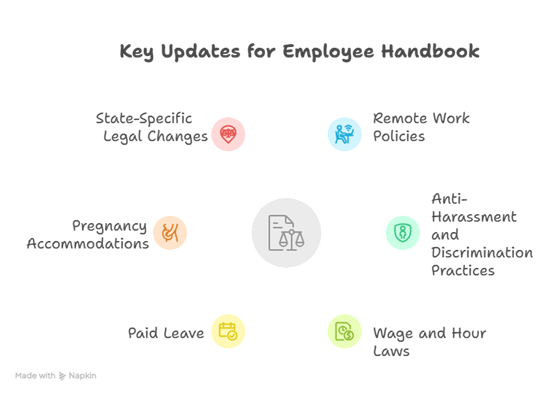
2025-2026 Employee Handbook Review & Updates

  1. Remote Work Policies
    With remote and hybrid work becoming more common, updating policies to clearly define expectations, eligibility, and equipment use is essential.
  2. Anti-Harassment and Discrimination Practices
    • Incorporate updated anti-harassment policies reflecting recent legal developments.
    • The EEOC is focusing on discrimination claims related to hair texture and style, so grooming and dress code policies should be reviewed and updated accordingly .
    • Use inclusive language throughout the handbook, such as gender-neutral pronouns (they/them), to foster inclusivity 
  3. Employee Classifications and Wage Laws
    • Review classifications under the Fair Labor Standards Act (FLSA) to ensure proper exemption status.
    • Stay current with state-specific wage and hour laws, including paid time off and leave policies 
  4. Paid Family and Medical Leave
    • Be aware of state-specific changes, such as Maryland delaying its Paid Family and Medical Leave program contributions until July 1, 2025, with benefits starting July 1, 2026 
  5. Pregnancy Accommodations
    • Update policies to comply with evolving pregnancy accommodation laws and ensure clear procedures for requesting accommodations.
  6. State-Specific Legal Changes
    • California employers should note changes affecting non-discrimination, leave, and vacation policies effective January 2025.
    • New York and New Jersey employers must incorporate recent federal and state legal developments into their handbooks .
  7. Company Culture and Compliance Balance
    • While compliance is critical, also ensure the handbook reflects your organization’s culture and values to engage employees effectively 
  8. General Policy Reviews
    • Regularly review key policies such as leave, attendance, workplace conduct, and disciplinary procedures to maintain compliance and clarity.

New York State Handbook Review & Update Considerations

  1. Paid Family Leave and Paid Sick Leave:
    New York State has been expanding its paid family leave and paid sick leave laws. Ensure your handbook reflects the latest eligibility, benefits, and procedures for requesting leave under these laws.
  2. Minimum Wage and Overtime Rules:
    New York State and many localities (e.g., NYC, Long Island) have scheduled minimum wage increases. Confirm that wage policies and overtime eligibility align with the current rates and thresholds effective in 2025-2026.
  3. Anti-Discrimination and Harassment Policies:
    Updates to reflect any new protected classes or changes in reporting procedures under New York State Human Rights Law and recent case law. Training requirements for harassment prevention may also have changed.
  4. Workplace Safety and COVID-19 Policies:
    While COVID-19 emergency rules have relaxed, some employers maintain policies on vaccination, testing, or remote work. Review any state or local health guidance that might affect workplace safety protocols.
  5. Employee Classification and Wage Transparency:
    New York has laws addressing gig workers, independent contractors, and wage transparency. Ensure handbook language clarifies employee status and complies with disclosure requirements.
  6. Leave for Voting, Jury Duty, and Military Service:
    Confirm that leave policies comply with New York State laws protecting these rights.
  7. Use of Technology and Social Media:
    Update policies on acceptable use of company devices, data privacy, and social media conduct, reflecting evolving norms and legal standards.

This is a shortlist of potential sections to review and revise in most employee handbooks.  Continue to review local and state changes as well, when reviewing and updating employee handbooks.  Communication, training and setting the expectations is necessary with any organizational change, including employee handbooks.

The EEOC and Fair Employment Practice Agencies (FEPAs) “Work Sharing Agreement”

“Many states, counties, cities, and towns have their own laws prohibiting discrimination, as well as agencies responsible for enforcing those laws. We call these state and local agencies “Fair Employment Practices Agencies” (FEPAs). Usually the laws enforced by these agencies are similar to those enforced by EEOC.”[i]   States and cities (including New York State and New York City) have entered into a work sharing agreement with the EEOC.  What does this mean for our organizations?  Does it have an impact on how we should operate or how we manage workplace allegations and investigations?


Work Sharing Agreements:

  1. Under these terms, both the EEOC and state authority (NYS Division of Human Rights) or City (NYC) can designate the other as its agent for receipt of charges.
  • What does this mean?  If a charge is received by one partner under the agreement, it is deemed received by the other.
  • “Moreover, these agreements typically proved that the state entity can waive its rights to process such a charge referred to it by the EEOC, which as the effect of permitting the federal agency to process the charge without waiting for the 60-day period to expire.
  • Many such agreements have an automatic waiver provision, which means that as soon as the charge is filed with the EEOC, the EEOC can begin processing it without going through the motions of referring it back to the state authority.
  • It also means that the grievant need not file with the state agency within 240 days of the unlawful practice, but, instead, has a full 300 days within which to take the initial step of filing a charge with the federal agency.”[i]
  • “You can file your charge with either the EEOC or with a Fair Employment Practices Agency.  If the charge is initially filed with EEOC and the charge is also covered by state or local law, EEOC dual files the charge with the state or local FEPA (meaning the FEPA will receive a copy of the charge), but ordinarily retains the charge for processing.
  • If a FEPA has a contract with EEOC, a Charging Party may request that the EEOC review the determination of the FEPA. EEOC will conduct a review only if the request is submitted in writing within fifteen (15) days of receipt of the FEPA’s determination.”[ii]

Confused yet?  To summarize, New York State and New York City have a working agreement with the EEOC, if a charge is filed, it is sent with the state or city, it is sent to the EEOC as well, if it falls within the 300-day requirement, under current federal law.  “The EEOC contracts with approximately 90 FEPAs nationwide to process more than 48,000 discrimination charges annually.”[iii]

EEOC State and Local Agencies Work Sharing Link

Fair Employment Practices Agencies (FEPAs) and Dual Filing

Summary of the Agreement’s Impact

In summary, New York State and New York City have a working agreement with the EEOC. If a charge is filed, it is shared with both the state or city agency and the EEOC, provided it falls within the 300-day requirement under current federal law. The EEOC contracts with approximately 90 FEPAs nationwide to process more than 48,000 discrimination charges annually.

Implications for Organizations

So, what does all of this mean for organizations operating in areas with work sharing agreements? Here are some key implications:

  • Awareness of Extended Filing Deadlines: Organizations must be aware that employees have 300 days to file a charge with the EEOC, even if the state or local filing deadline is shorter. This extended timeframe can impact internal investigation timelines and record retention policies.
  • Potential for Dual Investigations: While the EEOC typically retains the charge for processing, organizations should be prepared for the possibility of parallel investigations by both the EEOC and the relevant FEPA. Coordination with legal counsel is crucial in such situations.
  • Importance of Thorough Internal Investigations: Given the potential for charges to be filed with either the EEOC or a FEPA, organizations should conduct thorough and impartial internal investigations of any workplace allegations of discrimination or harassment. A well-documented investigation can be a valuable defense in the event of a formal charge.
  • Review of Policies and Procedures: Organizations should review their anti-discrimination and harassment policies and procedures to ensure they are up-to-date and compliant with both federal and state/local laws. This includes ensuring that employees are aware of their rights and responsibilities under these laws.
  • Training for Managers and Employees: Regular training for managers and employees on anti-discrimination and harassment laws is essential. This training should cover topics such as recognizing and preventing discrimination, handling complaints, and conducting investigations.
  • Consistent Application of Policies: It is crucial to apply policies and procedures consistently across the organization. Inconsistent application can lead to claims of discrimination and undermine the organization’s defense in the event of a charge.
  • Documentation: Maintain thorough and accurate records of all complaints, investigations, and disciplinary actions. This documentation can be critical in defending against discrimination charges.
  • Legal Counsel: Consult with legal counsel experienced in employment law to ensure compliance with all applicable federal, state, and local laws. Legal counsel can also provide guidance on handling specific charges and investigations.

[i] Joel Wm. Friedman, Examples & Explanations: Employment Discrimination. Third Edition (Wolters Kluwer 2017).

[ii] https://www.eeoc.gov/employees/fepa.cfm

[iii] https://www.eeoc.gov/field/newyork/fepa.cfm

[i] https://www.eeoc.gov/employees/fepa.cfm

The Vicarious Liability Doctrine & Infliction of Emotional Distress

Is the employer liable for an employee’s conduct in or outside the workplace?  Vicarious liability is the legal term outlining when an employer or principle is held liable for the wrongful acts committed by the employee, manager, supervisor, etc. within the scope of employment.  Defined in the California court system, as follows:

“Under the respondent superior doctrine, an employer may be vicariously liable for torts committed by an employee.  The rule is based on the policy that losses caused by the torts of employees, which as a practical matter are certain to occur in the conduct of the employer’s enterprise should be placed on the enterprise as a cost of doing business.”  (Kephart v. Genuity, Inc. (2006) 136 Cal.App.4th 280)

The answer is yes, the employer can be held liable for the actions of its managers, supervisors and employees.  The three primary reasons for implementing and ruling on this doctrine, is to prevent reoccurring conduct, greater assurance of compensation to the victim and to ensure equitable settlements to the victim. 

The courts have defined the course and scope of employment, to include:

  • Intent of the employee;
  • Nature, time and place of the employee’s conduct;
  • Type of work the employee was hired to do;
  • Incidental acts the employer should reasonably expect the employee to do;
  • Amount of freedom allowed to the employee in performing his or her duties; and
  • Amount of time consumed in the personal activity.

Infliction of emotional distress allows an employee to recover damages when the employer acts wrongfully; public policy violation or termination because of a disability. Employers can terminate someone legally.  If the organization terminates someone in an impermissible manner, they can be held liable for infliction of emotional distress with the past employee or even potentially a spouse if the emotional distress spills over outside of the workplace.  Courts have outlined four elements of an emotional distress tort:

  1. The defendant’s conduct was extreme and outrageous, beyond all bounds of human decency,
  2. The defendant intended to cause severe emotional distress to the plaintiff, or acted in disregard of a high probability that its conduct would inflict such harm,
  3. The defendant proximately caused emotional distress to the plaintiff, and
  4. The emotional distress was so severe that no reasonable person could be expected to endure.

A plaintiff’s success on an emotional distress story usually hinges on his or her ability to prove the first and fourth elements.  (Understanding Employment Law, 2nd Edition)

Thoughts and Suggestions:

  1. Review and Update Policies, Procedures and/or Employee Handbook
  2. Communicate expectations to the entire workforce
  3. Hold a separate training for managers and supervisors, they need to understand that they are held to a higher standard in the workplace
  4. Conduct Annual Training’s on Policies, Using Examples and Situations
  5. Consistently enforce policies and procedures throughout the organization
  6. If you have traveling employees, reinforce expectations of on the road behavior
  7. Review Local, State and Federal Laws
  8. Laws can change (New York State Sexual Harassment/DHR Laws)

I’m happy to work with any organization that has questions on policies, procedures, handbooks and/or training.

4 Thoughts on Employer, Employees and Social Media Workplace Expectations: Anticipate Changes Under the New Labor Board (NLRB)

2025 NYS Jury Duty Daily Rate Change

“For the first time in decades, the New York State Legislature and governor amended Sections 519 and 521 of the Judiciary Law, to increase the daily rate of pay for trial and grand jurors serving in New York State, from $40 to $72. This amendment was enacted through the New York State Budget for fiscal year 2025-2026, which was signed into law on May 9, 2025. Accordingly, as of June 8, 2025, most employers with 11 or more employees must pay their employees who are absent for jury duty at a daily rate of $72 for the first three days of jury duty…As a reminder, employers are also required to comply with Section 519 of the Judiciary Law, which provides that “any person who is summoned to serve as a juror [] and who notifies their employer to that effect prior to the commencement of a term of service shall not, on account of absence from employment by reason of such jury service, be subject to discharge or penalty.”

Pursuant to Section 750 of the Judiciary Law, an employer may be “punish[ed] for a criminal contempt” if they are found guilty of “subjection of an employee to discharge or penalty on account of his absence from employment by reason of jury or subpoenaed witness service.” Section 751 of the Judiciary Law provides that such punishment may be by fine, up to $1,000, or by imprisonment for up to 30 days, or both….If an employer has questions about its obligations to an employee when it receives notice that its employee has been summoned to serve as a juror or witness, please contact counsel.” https://www.jdsupra.com/legalnews/nys-legislature-increases-daily-jury-1498682/

And now social media…

Social media in the workplace and outside of the workplace can be a complicated area for employers to manage, if we see certain posts by employees.  Is an employee protected if the post disparaging content about an employer or another employee on social media?  It depends on the post.  Employees are free to complain about terms and conditions of employment under Section 7 of the National Labor Relations Act (Wagner Act).  Under the Trump Administration and National Labor Relations Board (NLRB), some of the broad Section 7 social media content is being reduced, pro-employer rules on social media content.  However, the employee still has a protected right to complain or discuss terms and conditions of employment (wages, benefits, working conditions, hours of work, seniority, safety issues, grievance and arbitration process, leave of absence, performance reviews, respect, integrity and culture issues) on social media, “water cooler talk.”  With the NLRB turnover, expect changes to current policy expectations and rules at the federal level, which can and will vary from state or local level. 

Creating a Workplace Culture:

  1. Eliminate the Need to Complain on social media: Create a culture that there is an open channel of communication and employees have the opportunity to ask questions and discuss concerns with leadership. 
  • Social Media Compliance Policy: The policy needs to clearly communicate anti-harassment, anti-discrimination, anti-bullying, sexual harassment, retaliation, etc.  The policy should also include a social media use policy in the workplace.  The policy cannot be overly broad; this can impact employee’s Section 7 rights.  As social media evolves, so should our policies.  I’m happy to work on a policy for any organization.
  • Create a Culture: A safe and open workplace that encourages employees to speak about any aspect of the work environment.  Not only a safe and open workplace, but a workplace that closes the loop on communication and concerns are addressed with follow-up back to the employee.  Internal complaint procedures (required in New York State for sexual harassment), whistleblower hotlines/policy, supervisor training and an active HR department are suggestions to build a culture such as this.
  • Training & Awareness: Writing policies is great, I see misses on setting the expectation, training and being consistent with expectations throughout the organization.  What does leadership need to understand and what do the employees need to understand?  Are we consistent?  Have we communicated the policies, rules and expectations?  Do we need an annual training or reminder?

These are a few suggestions for improving an organization and being consistent with a social media policy in the workplace.  Have the social media policy reviewed prior to implementation in the workplace, once it is implemented, communicate and train employees on the new policy.

New York Labor Law Section 201-d:

This labor law prohibits employers from refusing to hire individuals because of lawful; off-duty recreational activities.  What does this mean for our organizations?  If you review social media or conduct Google searches on applicants prior to the making an offer, be aware of this law.  Social media reviews or research can lead to bias decision making. 

What to Include

Alexiou recommends that social media policies include the following elements:

  • Roles. Identify the two main roles of employees on social media: official and unofficial. Make it clear that only the former can speak on behalf of the company.
  • Acceptable conduct and content. What can and can’t your employees post online? For example, employees must be respectful of others, be honest and transparent about their role, maintain workplace confidentiality, and so on. Prohibit online spats about the company and inflammatory or disrespectful language.
  • Regulations, legal restrictions and sensitive information. Make sure your employees are fully aware of the kinds of content they can and cannot post per industry regulations.
  • Procedure for conflict or crisis. Make it clear what your employees should do in these situations, including who they should reach out to for guidance and under what circumstances.
  • Call to action for participation. Explain that their participation in social media can help them build their personal brand, help the company recruit top talent, and drive the company’s sales and marketing activities. Encourage your employees to share why they enjoy working for you, how they feel supported by their manager or mentor, and customer testimonies about how your product or service impacted their life.

Arkansas: Prohibits employers from suggesting that an employee should disclose his or her social media username and password, add the employer as a social media contact, or change his or her social media privacy settings (2013).

California: Prohibits employers from requiring or requesting employees or applicants to disclose their username or password for their social media account and also prohibits employers from requiring the employee or applicant access his or her social media account in the presence of the employer. However, employers may make a reasonable request that an employee divulge personal social media account information, as is relevant to an investigation of employee misconduct (2012).

Colorado: Prohibits employers from requiring an employee or applicant to disclose a username, password or other means of accessing a personal account, unless an employer is conducting an investigation for legal compliance purposes (2013).

Connecticut: Prohibits an employer from requiring or requesting an employee or applicant to provide it with a username and password or to access a personal online account in the presence of the employer (effective Oct. 1, 2015).

Illinois: Bars employers from demanding employees or applicants reveal their usernames or passwords linked to social networking sites; also prohibits employers from forcing employees to display their social networking profiles for review (2012).

Louisiana: Employers cannot require prospective or current employees to disclose their username, password, or other login information that allows access to or observation of personal social media accounts (2014).

Maryland: Prohibits employers from requesting or requiring the disclosure of usernames or passwords to personal social media accounts and prohibits employers from taking or threatening to take any disciplinary action against employees or applicants who refuse to disclose such information (2012).

Michigan: Prohibits employers from asking for an employee’s or applicant’s personal Internet account information; does not prohibit an employer from conducting a work-related investigation into activity on an employee’s personal Internet account (2012).

Montana: Prohibits an employer from requiring or requesting an employee or applicant to disclose a username or password, access social media in the presence of the employer, or divulge information in a social media account as a condition of employment (2015).

Nevada: Prohibits employers from requiring access to an employee’s social media account as a condition of employment (2013).

New Hampshire: Employers cannot require prospective or current employees to disclose their username, password or other login information for personal social media accounts (2014).

New Jersey: Employers cannot require prospective or current employees to disclose their username, password or other means for accessing an electronic account or service (2013).

New Mexico: Employers are prohibited from requesting or requiring that prospective employees provide passwords or access to their social networking accounts (2013).

Oklahoma: Employers cannot require prospective or current employees to disclose their username, password or other login information to personal social media accounts or require prospective or current employees to log in to personal social media accounts in the presence of the employer (2014).

Oregon: It is unlawful for an employer to request that an employee or applicant disclose his or her username and password or add the employer to his or her list of contacts (2013).

Rhode Island: Employers cannot require or request prospective or current employees to disclose personal social media account information (2014).

Tennessee: Employers cannot require or request prospective or current employees to disclose login information to personal social media accounts or require prospective or current employees to log in to personal social media accounts in the presence of the employer (2015).

Utah: Generally prohibits employers from requesting information related to personal Internet accounts, including usernames and passwords; allows employers to investigate specific information on the employee’s personal Internet account to ensure compliance with certain laws (2013).

Virginia: Prohibits employers from requiring prospective or current employees to disclose the username and password to their social media accounts (effective July 1, 2015).

Washington: Prohibits employers from requesting personal social networking account login information from employees or applicants; allows employers to require disclosure of employees’ social media content in situations where necessary to comply with a federal law (2013).

Wisconsin: Employers cannot require or request prospective or current employees to disclose login information to personal social media accounts, or require prospective or current employees to allow employers to observe their personal social media account in the employer’s presence (2014).” (SHRM)

Additional Information

More Information

2025 NYS State & Federal Reminders

Upcoming New York State Minimum Wage, Executive & Administrative Exempt Salary Changes, Farm Overtime Threshold Reductions and Nationwide Changes

As you know, this will also impact the minimum salary levels to be paid to Executive and Administrative exempt employees. The new minimum wage and minimum salary levels can be found below. Things to keep in mind:

  • The updated poster. You will be required to post a new minimum wage poster. You will be able to find the new poster here. Remember, there could be corresponding increases in the tipped wage and wages paid for fast food employees in your area. 
  • The minimum salary level to be considered exempt from overtime under NYS law for Executive and Administrative employees is tied to the minimum wage and may also be increasing for your industry and area. Remember, there is no NYS minimum salary level for Professional exemptions. For Professional employees you would be subject to the Federal minimum salary level

Minimum Wage Increases

Once adopted, the FY2024 Budget would establish a new statutory minimum wage rate schedule in Section 652 of the Labor Law as follows:

A blue and white card with white text

Description automatically generatedIndexing the Minimum Wage

Starting January 1, 2027, additional annual minimum wage increases would be implemented each year based on the Northeast region measure of consumer price increases for urban wage earners and clerical workers (CPI-W). There would be no increases to the minimum wage if over a period of the prior year, the calculations published by the United States Department of Labor show that:

  • The CPI-W for Northeast Region Urban Wage Earners is negative.
  • The statewide unemployment rate increases by one-half percentage point or more.
  • Total non-farm employment decreases (measured seasonally).

Adjusted minimum wages are required to be published by the State Department of Labor no later than October 1st of each year.

Adjustments to Salary Thresholds, Allowances, and Gratuities

It is worth noting that minimum wage orders in effect would remain in effect, including wage orders that address minimum salary levels for executive and administrative exemptions, gratuities, and allowances for meals, apparel, etc. As these minimum wage increases take effect, the State Department of Labor would amend the wage orders to increase all monetary amounts (i.e., salary levels and allowances) in the same proportion as the increase in the hourly minimum wage.  The state is expected to publish the official amounts of these adjustments.  We calculate the salary threshold in 2024 for downstate would rise to $1,200 weekly, and the upstate salary basis threshold would rise to $1,125 weekly.

The wage for food service workers who receive tips would remain lower than the regular minimum wage by one-third and rounded to the nearest five cents. While the state has not issued its official calculations, our unofficial calculations for tipped food service workers in the Hospitality Industry would be as follows:

TIPPED FOOD SERVICE WORKERS
YearNew York City, Westchester, Nassau, Suffolk CountiesUpstate New York
2024$10.70$10.00
2025$11.00$10.35
2026$11.35$10.70
2027+$11.35 + annual increase$10.70 + annual increase


NYS Reduces Overtime Threshold for Farm Workers to 40 hours Per Week

New York State Department of Labor (NYSDOL) Commissioner Roberta Reardon issued an order accepting the recommendation of the Farm Laborers Wage Board to lower the current 60-hour threshold for overtime pay to 40 hours per week by January 1, 2032, allowing 10 years to phase in the new threshold. NYSDOL will now be undergoing a rule making process which will include a 60-day public comment period. This applies to certain agricultural employers and employees only.

Under proposed language, an employer shall pay an employee for overtime at a wage rate of one- and one-half times the employee’s regular rate of pay for hours worked in excess of the following number of hours in one workweek:

(a) 60 hours on or after January 1, 2020;
(b) 56 hours on or after January 1, 2024;
(c) 52 hours on or after January 1, 2026;
(d) 48 hours on or after January 1, 2028;
(e) 44 hours on or after January 1, 2030;
(f) 40 hours on or after January 1, 2032.

Minimum Wage for Fast Food Employees
The minimum wage for fast food employees working outside of New York City will increase to $14.50 per hour. The final scheduled increase to $15.00 per hour will take effect on July 1, 2021.

What is a living wage?

Currently, as of November 8th, 2023 in Tompkins County the living wage is $18.45/hour for a single person. This is based upon the following from a detailed study produced by a team from the Ithaca and Buffalo Co-Labs of Cornell’s School of Industrial and Labor Relations led by ILR Co-Lab Researchers, Ian Greer and Rusty Weaver. The latest study was updated to take into account the extreme inflation that took place this past year. Read more about the latest study.

  • Rent………………………………………………………………………….$1276.00/month
  • Transportation………………………………………………………..$ 320.02/month
  • Food…………………………………………………………………………$ 282.75/month
  • Health care – Insurance & out of pocket……………….$203.43/month
  • Savings…………………………………………………………………….$  77.53/month
  • Recreation……………………………………………………………… $137.54/month
  • Communication…………………………………………………….. $111.40/month
  • Miscellaneous………………………………………………………….$175.80/month
  • Taxes………………………………………………………………………….$613.25/month

TOTAL………………………………………………………………………………….$3,197.72/month

$38,373/year or $18.45/hour (based on 2,080/hours a year)

Current Study
MIT Living Wage Calculator

Below are the 2024-2025 New Hire Forms

  1. Form I-9, Eligibility to work in the United States: This form is required in every state for new hires. Organizations must verify that new employees are legally eligible to work in the United States. Ensure the form is filled out correctly and signed by the right person in the organization, audits are a great option for an organization to review old I-9 forms. 
  2. Form W-4, wage Withholding Allowance Certificate: This form is necessary for federal withholdings.  All employees should complete and sign a Form W-4 prior to starting work.  The 2025 is  pending.
  3. Form IT-2104, Employer Allowance Certificate (NYS):This is the New York State withholding form required for all new employees or any revised withholding information. 

Additional NYS Forms

Wage Theft Prevention Act New York State Forms

The Wage Theft Prevention Act (WTPA) took effect on April 9, 2011.

The law requires employers to give written notice of wage rates to each new hire.

The notice must include:

  • Rate or rates of pay, including overtime rate of pay (if it applies)
  • How the employee is paid: by the hour, shift, day, week, commission, etc.
  • Regular payday
  • Official name of the employer and any other names used for business (DBA)
  • Address and phone number of the employer’s main office or principal location
  • Allowances taken as part of the minimum wage (tips, meal and lodging deductions)

The notice must be given both in English and in the employee’s primary language (if the Labor Department offers a translation). The Department currently offers translations in the following languages: Spanish, Chinese, Haitian Creole, Korean, Polish and Russian.

Sample Pay Notices

The employer may provide its own notice, as long as it includes all of the required information, or use the Department’s sample notices. 

More Information

The WTPA also included other provisions that employers need to know, such as stronger protections for whistleblowers and increased penalties for wage theft.

Employers are strongly encouraged to review the Wage Theft Prevention Act Fact Sheet, and the Wage Theft Prevention Act Frequently Asked Questions.

Hourly Rate Employees

Notice and Acknowledgement of Pay Rate and Payday Under Section 195.1 of the New York State Labor Law Notice for Hourly Rate Employees LS 54 is a blank work agreement that contains all of the fields that employers must include to notify each employee in writing of conditions of employment at time of commitment to hire. This agreement must be completed to comply with the Wage Theft Prevention Act.

 It should be given to the employee in his or her primary language if that language is available. If the employee’s primary language is not available above, then the form should be given to the employee in English.

Multiple Hourly Rate Employees

Multiple Hourly Rate Employees

Notice and Acknowledgement of Pay Rate and Payday Under Section 195.1 of the New York State Labor Law Notice for Multiple Hourly Rate Employees LS 55 is a blank work agreement that contains all of the fields that employers must include to notify each employee in writing of conditions of employment at time of commitment to hire. This agreement must be completed to comply with the Wage Theft Prevention Act.

 It should be given to the employee in his or her primary language if that language is available. If the employee’s primary language is not available above, then the form should be given to the employee in English.

Employees Paid a Weekly Rate or a Salary for a Fixed Number of Hours (40 or Fewer in a Week)

Employees Paid a Weekly Rate or a Salary for a Fixed Number of Hours (40 or Fewer in a Week)

Notice and Acknowledgement of Pay Rate and Payday Under Section 195.1 of the New York State Labor Law Notice for Employees Paid a Weekly Rate or a Salary for a Fixed Number of Hours (40 or Fewer in a Week) LS 56 is a blank work agreement that contains all of the fields that employers must include to notify each employee in writing of conditions of employment at time of commitment to hire. This agreement must be completed to comply with the Wage Theft Prevention Act.

 It should be given to the employee in his or her primary language if that language is available. If the employee’s primary language is not available above, then the form should be given to the employee in English.

Employees Paid Salary for Varying Hours, Day Rate, Piece Rate, Flat Rate or Other Non-Hourly Pay

Notice and Acknowledgement of Pay Rate and Payday Under Section 195.1 of the New York State Labor Law Notice for Employees Paid Salary for Varying Hours, Day Rate, Piece Rate, Flat Rate or Other Non-Hourly Pay LS 57 is a blank work agreement that contains all of the fields that employers must include to notify each employee in writing of conditions of employment at time of commitment to hire. This agreement must be completed to comply with the Wage Theft Prevention Act.

 It should be given to the employee in his or her primary language if that language is available. If the employee’s primary language is not available above, then the form should be given to the employee in English.

Prevailing Rate and Other Jobs

Notice and Acknowledgement of Pay Rate and Payday Under Section 195.1 of the New York State Labor Law Notice for Prevailing Rate and Other Jobs LS 58 is a blank work agreement that contains all of the fields that employers must include to notify each employee in writing of conditions of employment at time of commitment to hire. This agreement must be completed to comply with the Wage Theft Prevention Act.

 It should be given to the employee in his or her primary language if that language is available. If the employee’s primary language is not available above, then the form should be given to the employee in English.

Exempt Employees

Notice and Acknowledgement of Pay Rate and Payday Under Section 195.1 of the New York State Labor Law Notice for Exempt Employees LS 59 is a blank work agreement that contains all of the fields that employers must include to notify each employee in writing of conditions of employment at time of commitment to hire. This agreement must be completed to comply with the Wage Theft Prevention Act.

 It should be given to the employee in his or her primary language if that language is available. If the employee’s primary language is not available above, then the form should be given to the employee in English.

Notice for Hourly Rate Employees

Notice and Acknowledgement of Pay Rate and Payday Under Section 195.1 of the New York State Labor Law for Home Care Aides Wage Parity and Other Jobs (LS62)

Notice and Acknowledgement of Pay Rate and Payday Under Section 195.1 of the New York State Labor Law for Home Care Aides Wage Parity and Other Jobs 

DOWNLOAD

Pay Notice and Acknowledgement for Farm Workers

Pay Notice and Acknowledgement for Farm Workers

New York State Department of Labor Form LS 309 is a blank farm work agreement that contains all of the fields that employers must include to notify each employee in writing of conditions of employment at time of commitment to hire. This agreement must be completed to comply with the Wage Theft Prevention Act.

 It should be given to the employee in his or her primary language if that language is available. If the employee’s primary language is not available above, then the form should be given to the employee in English.

Wage Statements for Agricultural Employers

Wage Statements for Agricultural Employers

New York State Department of Labor Form AL 447 is a blank wage statement. It contains all of the fields that employers of year-round or seasonal workers must provide to document each pay period to comply with the Wage Theft Prevention Act.

New York State Department of Labor Form AL 446 is a sample of a completed wage statement for agricultural workers.

Additional Information

Visit the Division of Labor Standards for additional information about New York’s Wage Theft Prevention Act and what is required of employers and workers.

  • 2019 W-9 Form: (Revised October 2018) these forms are utilized for consultants and others that might be working within your organization.  This form was updated in October 2018.  Ensure you have an updated form from any consultants or others that are issued a 1099. No current changes.

Additional Information

  • FMLA Forms: “The Family and Medical Leave Act (FMLA) provides certain employees with up to 12 weeks of unpaid, job-protected leave per year. It also requires that their group health benefits be maintained during the leave.

FMLA is designed to help employees balance their work and family responsibilities by allowing them to take reasonable unpaid leave for certain family and medical reasons. It also seeks to accommodate the legitimate interests of employers and promote equal employment opportunity for men and women.

FMLA applies to all public agencies, all public and private elementary and secondary schools, and companies with 50 or more employees. These employers must provide an eligible employee with up to 12 weeks of unpaid leave each year for any of the following reasons:

  • For the birth and care of the newborn child of an employee;
  • For placement with the employee of a child for adoption or foster care;
  • To care for an immediate family member (i.e., spouse, child, or parent) with a serious health condition; or
  • To take medical leave when the employee is unable to work because of a serious health condition.

Employees are eligible for leave if they have worked for their employer at least 12 months, at least 1,250 hours over the past 12 months, and work at a location where the company employs 50 or more employees within 75 miles. Whether an employee has worked the minimum 1,250 hours of service is determined according to FLSA principles for determining compensable hours or work.” (DOL Website)

FMLA Notice Forms

Employers covered by the FMLA are obligated to provide their employees with certain critical notices about the FMLA so that both the employees and the employer have a shared understanding of the terms of the FMLA leave. For more information on satisfying the FMLA’s employer notification requirements, see WHD Fact Sheet # 28D: Employer Notification Requirements under the Family and Medical Leave Act.

Employers can use the following forms to provide the notices required under the FMLA.

  1. General Notice, the FMLA poster – satisfies the requirement that every covered employer display or post an informative general notice about the FMLA. This notice can also be used by employers with eligible employees to satisfy their obligation also to provide FMLA general notice to employees in written leave guidance (e.g., handbook) or individually upon hire.
  2. Eligibility Notice, form WH-381 – informs the employee of his or her eligibility for FMLA leave or at least one reason why the employee is not eligible.
  3. Rights and Responsibilities Notice, form WH-381 (combined with the Eligibility Notice) – informs the employee of the specific expectations and obligations associated with the FMLA leave request and the consequences of failure to meet those obligations.
  4. Designation Notice, form WH-382 – informs the employee whether the FMLA leave request is approved; also informs the employee of the amount of leave that is designated and counted against the employee’s FMLA entitlement. An employer may also use this form to inform the employee that the certification is incomplete or insufficient and additional information is needed.

Certification Forms

Certification is an optional tool provided by the FMLA for employers to use to request information to support certain FMLA-qualifying reasons for leave. An employee can provide the required information contained on a certification form in any format, such as on the letterhead of the healthcare provider, or official documentation issued by the military.

Please do not send any completed certification forms to the U.S. Department of Labor, Wage and Hour Division. Return completed certifications to the employee to provide to his or her employer.

There are five DOL optional-use FMLA certification forms.

Certification of Healthcare Provider for a Serious Health Condition

Certification of Military Family Leave

2024 IRS Mileage Rate:

Standard Mileage Rate Website (Additional Information)

Additional National Changes:

Alaska (updated 11.15.2023)

To be classified as exempt from overtime under state law (Alaska Statute 23.10.055), bona fide administrative, professional and executive employees must satisfy certain salary and duties tests. The minimum salary required for exemption is two times the state minimum wage for the first 40 hours of employment each week. As a result of a change in the state’s minimum wage, the minimum salary required for these exemptions under state law will increase to $938.40 per week on January 1, 2024.

California

To qualify for the administrative, professional and executive exemptions in California, employees must meet certain salary and duties tests and must be paid at least twice the state minimum hourly wage based on a 40-hour week. The state’s minimum wage will increase on January 1, 2024. As a result, employers must pay a salary of at least $1,280 per week beginning January 1, 2024 to qualify for the exemption. 

Computer software employees may be paid on an hourly or a salary basis in order to qualify for exemption from California’s overtime requirements. Beginning January 1, 2024, computer software employees who are paid on an hourly basis must earn at least:

  • $55.58 per hour (for all hours worked); or
  • A monthly salary of $9,646.96; and
  • An annual salary of $115,763.35.

Colorado

In Colorado, employees must meet certain salary and duties tests to qualify for overtime exemption. As a result of the Colorado Overtime & Minimum Pay Standards Order, the minimum salary required to qualify for the executive/supervisor, administrative and professional exemptions under state law will increase to $1,057.69 per week on January 1, 2024.

Under the state’s exemption for highly technical computer employees, the employee may be paid by salary (at least $1,057.69 per week in 2024) or by the hour. The minimum hourly rate for 2024 for these employees hasn’t been published yet.

Note: In Colorado, an exempt employee’s salary generally must also be sufficient to satisfy the minimum wage for all hours worked in a workweek. This is true in certain other states as well, some of which will have a new minimum wage in 2024. Employers may want to consult legal counsel about how this rule may impact them.

Maine

To be classified as exempt from overtime under state law, administrative, professional and executive employees must satisfy certain salary and duties tests and receive a salary that exceeds 3,000 times the state minimum wage divided by 52. Due to an increase in the state’s minimum wage, the minimum salary required for the administrative, professional and executive exemptions from overtime under state law will increase to $816.35 per week on January 1, 2024.

Washington


In Washington, employees must satisfy certain salary and duties tests to be classified as exempt from overtime under state law. As a result of a new state minimum wage, the salary threshold used to determine which workers are exempt from overtime under state law will also increase to $1,302.40 per week effective January 1, 2024. 

Note: Employers may pay exempt computer professionals by the hour, provided they pay at least 3.5 times the minimum wage ($56.98 per hour in 2024).

(ADP)

Additional Information

2025 New York State Paid Family Leave and Workers Compensation Rates

Up to 12 weeks of leave

New York State Paid Family Leave provides eligible employees with up to 12 weeks of job protected, paid time off to bond with a new child, care for a family member with a serious health condition, or to assist loved ones when a family member is deployed abroad on active military service. This time can be taken all at once, or in increments of full days.

At 67% of pay (up to a cap)

Employees taking Paid Family Leave receive 67% of their average weekly wage, up to a cap of 67% of the current New York State Average Weekly Wage (NYSAWW). For 2025, the NYSAWW is $1,757.19, which means the maximum weekly benefit is $1,177.32. This is $26.16 more than the maximum weekly benefit for 2024.

Employees can get an estimate of their benefits using the PFL 2025 Benefits Calculator.

 Paid Family Leave Benefits Examples
Worker’s Average Weekly WageWeekly PFL Benefit*
$600$402
$1,000$670
$2,000$1,177.32

*The weekly PFL benefit is capped at $1,177.32(67% of the NYSAWW).

2023 Paid Family Leave Expansion

Through Legislation S.2928-A/A.06098-A, the definition of “family members” expands to include siblings. This includes biological siblings, adopted siblings, step-siblings and half-siblings. These family members can live outside of New York State, and even outside of the country.

Employer Resources

There are several resources to help employers understand and communicate New York Paid Family Leave benefit updates to their employees.

Draft PFL Policy Language:

NEW YORK STATE PAID FAMILY LEAVE

New York Paid Family Leave provides job-protected, paid time off so employees can:

  • bond with a newly born, adopted, or fostered child.
  • care for a close relative with a serious health condition; or
  • Assist loved ones when a family member is deployed abroad on active military service.

By NYS PFL Definition:

  • spouse
  • domestic partner (including same and different gender couples; legal registration not required)
  • child/stepchild and anyone for whom you have legal custody
  • parent/stepparent
  • parent-in-law
  • grandparent
  • grandchild
  • sibling (starting in 2023) Workers should check with their employer’s Paid Family Leave insurer to learn when sibling care goes into effect for their policy. For employees who work for self-insured employers, coverage begins January 1, 2023.

Employees who believe they are eligible for Paid Family Leave should contact their _______ as soon as possible. More information can be found at www.ny.gov/programs/new-york-state-paid-family-leave. Organization will abide by all changes to NYSPFL and communicate such changes to the employees.  For additional information please alert your President, or the Statement of Rights Posting on Paid Family Leave.

Legal Area’s and Changes to Remember and Communicate:

  1. Employees have job protection, similar to FMLA.
  2. Paid Sick Leave policies and procedures.
  3. Right to keep their health insurance while on leave.
  4. No retaliation or discrimination against those who take leave.
  5. Citizenship is never a factor in eligibility for NYSPFL.
  6. Review the language contained in your employee handbook, policy, or policy manual.  Update FMLA and NYSPFL language to reflect changes and communicate the policy to the workforce.
  7. Communicate PFL payroll deductions for 2020 to the workforce now or during open enrolment.  My recommendation is to do this in writing via a template and obtain a signature.  NYS has a PDF template referenced above.
  8. Ensure the NYS PFL statement of rights for Paid Family Leave in 2023 is up-to-date and communicated to the workforce.  This includes the postings; disability provider or state is providing these postings to employers.  Watch the expiration dates on the postings, this is a common area in an audit that needs to be corrected.
  9. A proper call-in procedure for intermittent leave is necessary.  Do you accept text messages?  What about emails?  This should all be clearly communicated in a policy or procedure.  How much notice?
  10. New York State Paid Sick Leave

I am happy to work with any employer’s on ensuring policy, communication mechanisms, postings and other NYSPFL material is legal and up to date.  Ensure you are reviewing this information annually and communicating changes to PFL rates annually.  Work with your payroll provider to ensure and verify the percentage deductions are accurate and live in the payroll system.  Remember interns and seasonal employees and communicate if they do or do not qualify for PFL.  There are forms to fill out online if they do not qualify to ensure the deduction is not taken.

Frequently Asked Questions

How many weeks of Paid Family Leave are available to employees? Eligible employees can take up to 12 weeks of Paid Family Leave.

How much will employees get paid when taking Paid Family Leave? Employees taking Paid Family Leave in 2025 will get 67% of their average weekly wage, up to a cap of 67% of the NYSAWW of $1,757.19.

What is the maximum weekly benefit? The maximum weekly benefit for 2025 is $1,177.32.

If I start my continuous leave in one year and it extends into the next, what will my benefit rate be? You get the benefit rate in effect on the first day of your leave.

If I start my intermittent leave in 2024, and it extends into 2025, am I eligible for the benefits at the 2025 rate? You get the benefit rate in effect on the first day of a period of leave. When more than three months pass between days of Paid Family Leave, your next day or period of Paid Family Leave is considered a new claim under the law. This means you will need to file a new request for Paid Family Leave and that you may be eligible for the increased benefits available should that day or period of Paid Family Leave begin in 2025.

I am having a baby in 2024; can I wait until 2025 to take Paid Family Leave? Yes, you can take (and must complete) Paid Family Leave for bonding with a new child at any time within the first 12 months of the child’s birth, adoption, or foster care placement, provided that you remain an eligible, covered employee.

I used all 12 weeks of Paid Family Leave in the last year; can I take more Paid Family Leave this year if I experience another qualifying event? You may take up to 12 weeks of Paid Family Leave in every 52-week period based on a rolling calendar. This means that if you used the full 12 weeks of leave, the next time you would be eligible to take Paid Family Leave again is one year from your first day of leave.

What is the weekly employee contribution rate? If you are paid weekly, the payroll contribution is 0.388% of your gross weekly wages and is capped at an annual maximum of $354.53. If your gross weekly wages are less than the NYSAWW ($1,757.19 per week), you will have an annual contribution amount less than the annual cap of $354.53, consistent with your actual wages.

For example, if you earn about $27,000 a year ($519 a week), you will contribute about $2.01 per week.

If you are not paid weekly, the payroll contribution will be 0.388% of your gross wages for the pay period.

What is the maximum amount employees will pay for Paid Family Leave? The maximum employee contribution for 2025 is $354.53.

On March 31, 2024, New York updated the NYSAWW. When does this NYSAWW take effect for Paid Family Leave deduction and benefit caps? The new NYSAWW only applies to the 2025 benefit and will not affect Paid Family Leave deductions or benefits until January 1, 2025, if leave was begun on or after that date. The new NYSAWW does not have any impact on Paid Family Leave benefits in 2024.

What is the NYSAWW that will be used for Paid Family Leave benefits in 2025? $1,757.19.

Fully funded by employees

New York State Paid Family Leave is insurance that may be funded by employees through payroll deductions. For 2025, employees will contribute 0.388% of their gross wages per pay period, with a maximum annual contribution of $354.53.

Employees earning less than the current NYSAWW of $1,757.19 will contribute less than the annual cap of $354.53, consistent with their actual wages.

Here are some contribution and benefit examples at different income levels:

  1. Employees earning $519 a week (about $27,000 a year) will contribute about $2.01 from their gross wages each week ($519 x 0.388%). When taking the benefit, these employees will receive $347.73 per week, up to a maximum total benefit of $4,172.76.
  2. Employees earning $1,000 a week ($52,000 a year) will contribute about $3.88 from their gross wages each week ($1,000 x 0.388%). When taking the benefit, these employees will receive $670 per week, up to a maximum total benefit of $8,040.
  3. Employees earning the NYSAWW of $1,757.19 (about $91,300 a year) or more will contribute 0.388% from their gross wages each pay period until they reach the maximum of $354.53. When taking the benefit, these employees will receive $1,177.32, up to a maximum total benefit of $14,127.84.

Employees can get an estimate of their deductions using the PFL 2025 Payroll Deduction Calculator.

Paid Family Leave by State & City

Workers Comp Rates

The maximum weekly benefit rate for workers’ compensation claimants is two-thirds of the New York State average weekly wage for the previous calendar year, as determined by the New York State Department of Labor (Workers’ Compensation Law §§ 2[16] and 15[6]).

https://www.wcb.ny.gov/content/main/Workers/ScheduleMaxWeeklyBenefit.jsp

Workers Comp Rates

The maximum weekly benefit rate for workers’ compensation claimants is two-thirds of the New York State average weekly wage for the previous calendar year, as determined by the New York State Department of Labor (Workers’ Compensation Law §§ 2[16] and 15[6]).

https://www.wcb.ny.gov/content/main/Workers/ScheduleMaxWeeklyBenefit.jsp

  • Qualified transportation fringe benefit. For tax year 2025, the monthly limitation for the qualified transportation fringe benefit and the monthly limitation for qualified parking rises to $325, increasing from $315 in tax year 2024.
  • Health flexible spending cafeteria plans. For the taxable years beginning in 2025, the dollar limitation for employee salary reductions for contributions to health flexible spending arrangements rises to $3,300, increasing from $3,200 in tax year 2024. For cafeteria plans that permit the carryover of unused amounts, the maximum carryover amount rises to $660, increasing from $640 in tax year 2024.
  • Medical savings accounts. For tax year 2025, participants who have self-only coverage the plan must have an annual deductible that is not less than $2,850 (a $50 increase from the previous tax year), but not more than $4,300 (an increase of $150 from the previous tax year). 

The maximum out-of-pocket expense amount rises to $5,700, increasing from $5,550 in tax year 2024.

For family coverage in tax year 2025, the annual deductible is not less than $5,700, increasing from $5,550 in tax year 2024; however, the deductible cannot be more than $8,550, an increase of $200 versus the limit for tax year 2024. For family coverage, the out-of-pocket expense limit is $10,500 for tax year 2025, rising from $10,200 in tax year 2024.

The Internal Revenue Service recently announced 2024 dollar limits for qualified retirement plans (including 401(k) plans), deferred compensation plans, and health and welfare plans. Adjustments to certain limits are based on a cost-of-living index.

In addition, the Social Security taxable wage base, which affects qualified retirement plans “integrated” with Social Security, typically adjusts each year. For 2024, the taxable wage base increases to $160,200.

For 2024, most limits increased with the exception of catch-up contributions limits and limits fixed by statute, the latter of which do not adjust based on the cost of living. The increased limits for 2024 are highlighted in bold below.

Qualified Retirement Plan Limits

 2024 Limit2023 Limit
Annual Limit on 401(k)/403(b) Deferral Contributions$23,000$22,500
Annual Limit on Age 50 and Older 401(k)/403(b) Catch-up Contributions$7,500$7,500
Annual Compensation Limit$345,000$330,000
Annual Contribution Limit for Defined Contribution Plans$69,000$66,000
Annual Benefit Limit for Defined Benefit Plans$275,000$265,000
Prior Year Compensation Amount for Determining Highly Compensated Employees$155,000$150,000
Key Employee Compensation Limit$220,000$215,000
Annual Limit on SIMPLE Contributions$16,000$15,000
Annual Limit on Catch-up Contributions to SIMPLE Plans$3,500$3,500
ESOP Account Balance Limit Subject to 5-Year Distribution Period$1,380,000$1,330,000
Incremental Amount Adding Additional Year(s) to ESOP 5-Year Distribution Period$275,000$265,000
Earnings Threshold for SEP Contribution$750$750

Deferred Compensation Limits

 2024 Limit2023 Limit
Annual Limit on 457(b) Contributions$23,000$22,500
Annual Limit on Catch-up Contributions to 457(b) Plans$7,500$7,500
409A Specified Employee Compensation Threshold$220,000$215,000
409A Involuntary Separation Pay Limit$690,000$660,000

Health and Welfare Plan Limits

 2024 Limit2023 Limit
Annual Limit on Salary Reduction Contributions to Health FSA$3,200$3,050
Annual Limit on Health FSA Carryover$640$610
Annual Limit on Salary Reduction Contributions to Dependent Care FSA$5,000 if married filing jointly or if single $2,500 if married filing separately$5,000 if married filing jointly or if single $2,500 if married filing separately
Annual Limit on HSA Contributions$4,150 (EE only) $8,300 (family)$3,850 (EE only) $7,750 (family)
Annual Limit on Catch-up Contributions to HSA$1,000$1,000
Annual Minimum Deductible for High Deductible Health Plans$1,600 (EE only) $3,200 (family)$1,500 (EE only) $3,000 (family)
Annual Limit on High Deductible Health Plan Out-of-pocket Expenses$8,050 (EE only) $16,100 (family)$7,500 (EE only) $15,000 (family)

2025 New York State Paid Family Leave and Workers Compensation Rates

Original Post Date: 10/15/2024

Up to 12 weeks of leave

New York State Paid Family Leave provides eligible employees with up to 12 weeks of job protected, paid time off to bond with a new child, care for a family member with a serious health condition, or to assist loved ones when a family member is deployed abroad on active military service. This time can be taken all at once, or in increments of full days.

At 67% of pay (up to a cap)

Employees taking Paid Family Leave receive 67% of their average weekly wage, up to a cap of 67% of the current New York State Average Weekly Wage (NYSAWW). For 2025, the NYSAWW is $1,757.19, which means the maximum weekly benefit is $1,177.32. This is $26.16 more than the maximum weekly benefit for 2024.

Employees can get an estimate of their benefits using the PFL 2025 Benefits Calculator.

 Paid Family Leave Benefits Examples
Worker’s Average Weekly WageWeekly PFL Benefit*
$600$402
$1,000$670
$2,000$1,177.32

*The weekly PFL benefit is capped at $1,177.32(67% of the NYSAWW).
 

2023 Paid Family Leave Expansion

Through Legislation S.2928-A/A.06098-A, the definition of “family members” expands to include siblings. This includes biological siblings, adopted siblings, step-siblings and half-siblings. These family members can live outside of New York State, and even outside of the country.

Employer Resources

There are several resources to help employers understand and communicate New York Paid Family Leave benefit updates to their employees.

Draft PFL Policy Language:

NEW YORK STATE PAID FAMILY LEAVE

New York Paid Family Leave provides job-protected, paid time off so employees can:

  • bond with a newly born, adopted, or fostered child.
  • care for a close relative with a serious health condition; or
  • Assist loved ones when a family member is deployed abroad on active military service.

By NYS PFL Definition:

  • spouse
  • domestic partner (including same and different gender couples; legal registration not required)
  • child/stepchild and anyone for whom you have legal custody
  • parent/stepparent
  • parent-in-law
  • grandparent
  • grandchild
  • sibling (starting in 2023) Workers should check with their employer’s Paid Family Leave insurer to learn when sibling care goes into effect for their policy. For employees who work for self-insured employers, coverage begins January 1, 2023.

Employees who believe they are eligible for Paid Family Leave should contact their _______ as soon as possible. More information can be found at www.ny.gov/programs/new-york-state-paid-family-leave. Organization will abide by all changes to NYSPFL and communicate such changes to the employees.  For additional information please alert your President, or the Statement of Rights Posting on Paid Family Leave.

Legal Area’s and Changes to Remember and Communicate:

  1. Employees have job protection, similar to FMLA.
  2. Paid Sick Leave policies and procedures.
  3. Right to keep their health insurance while on leave.
  4. No retaliation or discrimination against those who take leave.
  5. Citizenship is never a factor in eligibility for NYSPFL.
  6. Review the language contained in your employee handbook, policy, or policy manual.  Update FMLA and NYSPFL language to reflect changes and communicate the policy to the workforce.
  7. Communicate PFL payroll deductions for 2020 to the workforce now or during open enrolment.  My recommendation is to do this in writing via a template and obtain a signature.  NYS has a PDF template referenced above.
  8. Ensure the NYS PFL statement of rights for Paid Family Leave in 2023 is up-to-date and communicated to the workforce.  This includes the postings; disability provider or state is providing these postings to employers.  Watch the expiration dates on the postings, this is a common area in an audit that needs to be corrected.
  9. A proper call-in procedure for intermittent leave is necessary.  Do you accept text messages?  What about emails?  This should all be clearly communicated in a policy or procedure.  How much notice?
  10. New York State Paid Sick Leave

I am happy to work with any employer’s on ensuring policy, communication mechanisms, postings and other NYSPFL material is legal and up to date.  Ensure you are reviewing this information annually and communicating changes to PFL rates annually.  Work with your payroll provider to ensure and verify the percentage deductions are accurate and live in the payroll system.  Remember interns and seasonal employees and communicate if they do or do not qualify for PFL.  There are forms to fill out online if they do not qualify to ensure the deduction is not taken.

Frequently Asked Questions

How many weeks of Paid Family Leave are available to employees? Eligible employees can take up to 12 weeks of Paid Family Leave.

How much will employees get paid when taking Paid Family Leave? Employees taking Paid Family Leave in 2025 will get 67% of their average weekly wage, up to a cap of 67% of the NYSAWW of $1,757.19.

What is the maximum weekly benefit? The maximum weekly benefit for 2025 is $1,177.32.

If I start my continuous leave in one year and it extends into the next, what will my benefit rate be? You get the benefit rate in effect on the first day of your leave.

If I start my intermittent leave in 2024, and it extends into 2025, am I eligible for the benefits at the 2025 rate? You get the benefit rate in effect on the first day of a period of leave. When more than three months pass between days of Paid Family Leave, your next day or period of Paid Family Leave is considered a new claim under the law. This means you will need to file a new request for Paid Family Leave and that you may be eligible for the increased benefits available should that day or period of Paid Family Leave begin in 2025.

I am having a baby in 2024; can I wait until 2025 to take Paid Family Leave? Yes, you can take (and must complete) Paid Family Leave for bonding with a new child at any time within the first 12 months of the child’s birth, adoption, or foster care placement, provided that you remain an eligible, covered employee.

I used all 12 weeks of Paid Family Leave in the last year; can I take more Paid Family Leave this year if I experience another qualifying event? You may take up to 12 weeks of Paid Family Leave in every 52-week period based on a rolling calendar. This means that if you used the full 12 weeks of leave, the next time you would be eligible to take Paid Family Leave again is one year from your first day of leave.

What is the weekly employee contribution rate? If you are paid weekly, the payroll contribution is 0.388% of your gross weekly wages and is capped at an annual maximum of $354.53. If your gross weekly wages are less than the NYSAWW ($1,757.19 per week), you will have an annual contribution amount less than the annual cap of $354.53, consistent with your actual wages.

For example, if you earn about $27,000 a year ($519 a week), you will contribute about $2.01 per week.

If you are not paid weekly, the payroll contribution will be 0.388% of your gross wages for the pay period.

What is the maximum amount employees will pay for Paid Family Leave? The maximum employee contribution for 2025 is $354.53.

On March 31, 2024, New York updated the NYSAWW. When does this NYSAWW take effect for Paid Family Leave deduction and benefit caps? The new NYSAWW only applies to the 2025 benefit and will not affect Paid Family Leave deductions or benefits until January 1, 2025, if leave was begun on or after that date. The new NYSAWW does not have any impact on Paid Family Leave benefits in 2024.

What is the NYSAWW that will be used for Paid Family Leave benefits in 2025? $1,757.19.

Fully funded by employees

New York State Paid Family Leave is insurance that may be funded by employees through payroll deductions. For 2025, employees will contribute 0.388% of their gross wages per pay period, with a maximum annual contribution of $354.53.

Employees earning less than the current NYSAWW of $1,757.19 will contribute less than the annual cap of $354.53, consistent with their actual wages.

Here are some contribution and benefit examples at different income levels:

  1. Employees earning $519 a week (about $27,000 a year) will contribute about $2.01 from their gross wages each week ($519 x 0.388%). When taking the benefit, these employees will receive $347.73 per week, up to a maximum total benefit of $4,172.76.
  2. Employees earning $1,000 a week ($52,000 a year) will contribute about $3.88 from their gross wages each week ($1,000 x 0.388%). When taking the benefit, these employees will receive $670 per week, up to a maximum total benefit of $8,040.
  3. Employees earning the NYSAWW of $1,757.19 (about $91,300 a year) or more will contribute 0.388% from their gross wages each pay period until they reach the maximum of $354.53. When taking the benefit, these employees will receive $1,177.32, up to a maximum total benefit of $14,127.84.

Employees can get an estimate of their deductions using the PFL 2025 Payroll Deduction Calculator.

Paid Family Leave by State & City

Workers Comp Rates

The maximum weekly benefit rate for workers’ compensation claimants is two-thirds of the New York State average weekly wage for the previous calendar year, as determined by the New York State Department of Labor (Workers’ Compensation Law §§ 2[16] and 15[6]).

https://www.wcb.ny.gov/content/main/Workers/ScheduleMaxWeeklyBenefit.jsp