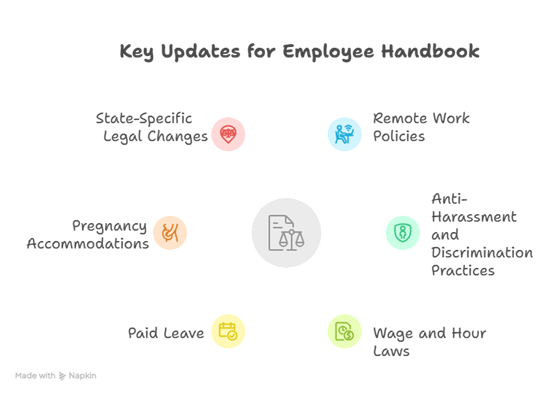
Remote Work Policies With remote and hybrid work becoming more common, updating policies to clearly define expectations, eligibility, and equipment use is essential.
The EEOC is focusing on discrimination claims related to hair texture and style, so grooming and dress code policies should be reviewed and updated accordingly .
Use inclusive language throughout the handbook, such as gender-neutral pronouns (they/them), to foster inclusivity
Employee Classifications and Wage Laws
Review classifications under the Fair Labor Standards Act (FLSA) to ensure proper exemption status.
Stay current with state-specific wage and hour laws, including paid time off and leave policies
Paid Family and Medical Leave
Be aware of state-specific changes, such as Maryland delaying its Paid Family and Medical Leave program contributions until July 1, 2025, with benefits starting July 1, 2026
Pregnancy Accommodations
Update policies to comply with evolving pregnancy accommodation laws and ensure clear procedures for requesting accommodations.
State-Specific Legal Changes
California employers should note changes affecting non-discrimination, leave, and vacation policies effective January 2025.
New York and New Jersey employers must incorporate recent federal and state legal developments into their handbooks .
Company Culture and Compliance Balance
While compliance is critical, also ensure the handbook reflects your organization’s culture and values to engage employees effectively
General Policy Reviews
Regularly review key policies such as leave, attendance, workplace conduct, and disciplinary procedures to maintain compliance and clarity.
New York State Handbook Review & Update Considerations
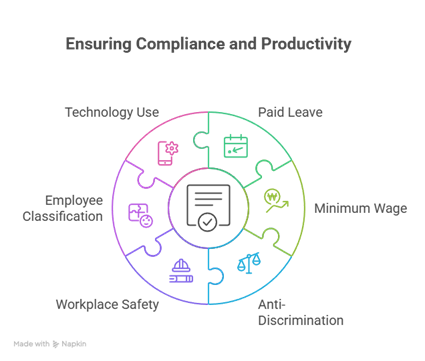
Paid Family Leave and Paid Sick Leave: New York State has been expanding its paid family leave and paid sick leave laws. Ensure your handbook reflects the latest eligibility, benefits, and procedures for requesting leave under these laws.
Minimum Wage and Overtime Rules: New York State and many localities (e.g., NYC, Long Island) have scheduled minimum wage increases. Confirm that wage policies and overtime eligibility align with the current rates and thresholds effective in 2025-2026.
Anti-Discrimination and Harassment Policies: Updates to reflect any new protected classes or changes in reporting procedures under New York State Human Rights Law and recent case law. Training requirements for harassment prevention may also have changed.
Workplace Safety and COVID-19 Policies: While COVID-19 emergency rules have relaxed, some employers maintain policies on vaccination, testing, or remote work. Review any state or local health guidance that might affect workplace safety protocols.
Employee Classification and Wage Transparency: New York has laws addressing gig workers, independent contractors, and wage transparency. Ensure handbook language clarifies employee status and complies with disclosure requirements.
Leave for Voting, Jury Duty, and Military Service: Confirm that leave policies comply with New York State laws protecting these rights.
Use of Technology and Social Media: Update policies on acceptable use of company devices, data privacy, and social media conduct, reflecting evolving norms and legal standards.
This is a shortlist of potential sections to review and revise in most employee handbooks. Continue to review local and state changes as well, when reviewing and updating employee handbooks. Communication, training and setting the expectations is necessary with any organizational change, including employee handbooks.
“Many states, counties, cities, and towns have their own laws prohibiting discrimination, as well as agencies responsible for enforcing those laws. We call these state and local agencies “Fair Employment Practices Agencies” (FEPAs). Usually the laws enforced by these agencies are similar to those enforced by EEOC.”[i] States and cities (including New York State and New York City) have entered into a work sharing agreement with the EEOC. What does this mean for our organizations? Does it have an impact on how we should operate or how we manage workplace allegations and investigations?
Work Sharing Agreements:
Under these terms, both the EEOC and state authority (NYS Division of Human Rights) or City (NYC) can designate the other as its agent for receipt of charges.
What does this mean? If a charge is received by one partner under the agreement, it is deemed received by the other.
“Moreover, these agreements typically proved that the state entity can waive its rights to process such a charge referred to it by the EEOC, which as the effect of permitting the federal agency to process the charge without waiting for the 60-day period to expire.
Many such agreements have an automatic waiver provision, which means that as soon as the charge is filed with the EEOC, the EEOC can begin processing it without going through the motions of referring it back to the state authority.
It also means that the grievant need not file with the state agency within 240 days of the unlawful practice, but, instead, has a full 300 days within which to take the initial step of filing a charge with the federal agency.”[i]
“You can file your charge with either the EEOC or with a Fair Employment Practices Agency. If the charge is initially filed with EEOC and the charge is also covered by state or local law, EEOC dual files the charge with the state or local FEPA (meaning the FEPA will receive a copy of the charge), but ordinarily retains the charge for processing.
If a FEPA has a contract with EEOC, a Charging Party may request that the EEOC review the determination of the FEPA. EEOC will conduct a review only if the request is submitted in writing within fifteen (15) days of receipt of the FEPA’s determination.”[ii]
Confused yet? To summarize, New York State and New York City have a working agreement with the EEOC, if a charge is filed, it is sent with the state or city, it is sent to the EEOC as well, if it falls within the 300-day requirement, under current federal law. “The EEOC contracts with approximately 90 FEPAs nationwide to process more than 48,000 discrimination charges annually.”[iii]
In summary, New York State and New York City have a working agreement with the EEOC. If a charge is filed, it is shared with both the state or city agency and the EEOC, provided it falls within the 300-day requirement under current federal law. The EEOC contracts with approximately 90 FEPAs nationwide to process more than 48,000 discrimination charges annually.
Implications for Organizations
So, what does all of this mean for organizations operating in areas with work sharing agreements? Here are some key implications:
Awareness of Extended Filing Deadlines: Organizations must be aware that employees have 300 days to file a charge with the EEOC, even if the state or local filing deadline is shorter. This extended timeframe can impact internal investigation timelines and record retention policies.
Potential for Dual Investigations: While the EEOC typically retains the charge for processing, organizations should be prepared for the possibility of parallel investigations by both the EEOC and the relevant FEPA. Coordination with legal counsel is crucial in such situations.
Importance of Thorough Internal Investigations: Given the potential for charges to be filed with either the EEOC or a FEPA, organizations should conduct thorough and impartial internal investigations of any workplace allegations of discrimination or harassment. A well-documented investigation can be a valuable defense in the event of a formal charge.
Review of Policies and Procedures: Organizations should review their anti-discrimination and harassment policies and procedures to ensure they are up-to-date and compliant with both federal and state/local laws. This includes ensuring that employees are aware of their rights and responsibilities under these laws.
Training for Managers and Employees: Regular training for managers and employees on anti-discrimination and harassment laws is essential. This training should cover topics such as recognizing and preventing discrimination, handling complaints, and conducting investigations.
Consistent Application of Policies: It is crucial to apply policies and procedures consistently across the organization. Inconsistent application can lead to claims of discrimination and undermine the organization’s defense in the event of a charge.
Documentation: Maintain thorough and accurate records of all complaints, investigations, and disciplinary actions. This documentation can be critical in defending against discrimination charges.
Legal Counsel: Consult with legal counsel experienced in employment law to ensure compliance with all applicable federal, state, and local laws. Legal counsel can also provide guidance on handling specific charges and investigations.
[i] Joel Wm. Friedman, Examples & Explanations: Employment Discrimination. Third Edition (Wolters Kluwer 2017).
Is the employer liable for an employee’s conduct in or outside the workplace? Vicarious liability is the legal term outlining when an employer or principle is held liable for the wrongful acts committed by the employee, manager, supervisor, etc. within the scope of employment. Defined in the California court system, as follows:
“Under the respondent superior doctrine, an employer may be vicariously liable for torts committed by an employee. The rule is based on the policy that losses caused by the torts of employees, which as a practical matter are certain to occur in the conduct of the employer’s enterprise should be placed on the enterprise as a cost of doing business.” (Kephart v. Genuity, Inc. (2006) 136 Cal.App.4th 280)
The answer is yes, the employer can be held liable for the actions of its managers, supervisors and employees. The three primary reasons for implementing and ruling on this doctrine, is to prevent reoccurring conduct, greater assurance of compensation to the victim and to ensure equitable settlements to the victim.
The courts have defined the course and scope of employment, to include:
Intent of the employee;
Nature, time and place of the employee’s conduct;
Type of work the employee was hired to do;
Incidental acts the employer should reasonably expect the employee to do;
Amount of freedom allowed to the employee in performing his or her duties; and
Amount of time consumed in the personal activity.
Infliction of emotional distress allows an employee to recover damages when the employer acts wrongfully; public policy violation or termination because of a disability. Employers can terminate someone legally. If the organization terminates someone in an impermissible manner, they can be held liable for infliction of emotional distress with the past employee or even potentially a spouse if the emotional distress spills over outside of the workplace. Courts have outlined four elements of an emotional distress tort:
The defendant’s conduct was extreme and outrageous, beyond all bounds of human decency,
The defendant intended to cause severe emotional distress to the plaintiff, or acted in disregard of a high probability that its conduct would inflict such harm,
The defendant proximately caused emotional distress to the plaintiff, and
The emotional distress was so severe that no reasonable person could be expected to endure.
A plaintiff’s success on an emotional distress story usually hinges on his or her ability to prove the first and fourth elements. (Understanding Employment Law, 2nd Edition)
Thoughts and Suggestions:
Review and Update Policies, Procedures and/or Employee Handbook
Communicate expectations to the entire workforce
Hold a separate training for managers and supervisors, they need to understand that they are held to a higher standard in the workplace
Conduct Annual Training’s on Policies, Using Examples and Situations
Consistently enforce policies and procedures throughout the organization
If you have traveling employees, reinforce expectations of on the road behavior
Review Local, State and Federal Laws
Laws can change (New York State Sexual Harassment/DHR Laws)
I’m happy to work with any organization that has questions on policies, procedures, handbooks and/or training.
California: Requires employers to include salary ranges in job postings.
Colorado: Enacted the Equal Pay for Equal Work Act, which includes pay transparency requirements.
Connecticut: Requires employers to disclose wage ranges in job postings and prohibits seeking salary history.
Hawaii: Requires employers to disclose salary ranges in job postings.
Illinois: Has pay transparency requirements, with some guidance rolling out in 2025.
Maryland: Requires employers to disclose wage ranges in job postings.
Massachusetts: Requires employers with 100+ employees to submit wage data reports annually.
Minnesota: Has pay transparency requirements, including disclosure of salary ranges.
Nevada: Requires employers to disclose wage or salary ranges.
New Jersey: Has pay transparency requirements.
New York: Requires employers to disclose salary ranges in job postings.
Rhode Island: Requires employers to provide the wage range prior to discussing compensation and upon request.
Vermont: Requires employers to disclose hourly wage or salary, or range, in job postings.
Washington: Requires employers to include salary ranges in job postings.
Washington D.C.: Requires employers to disclose wage ranges in job postings.
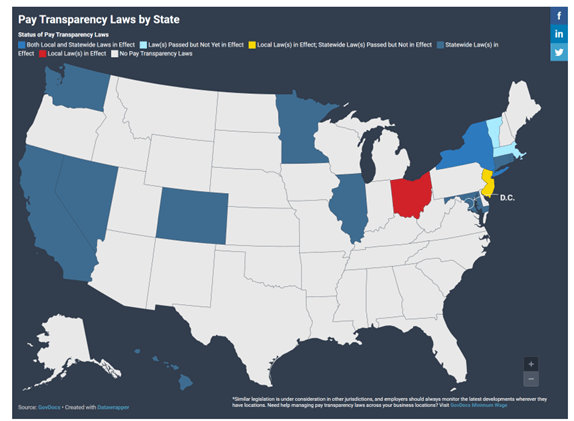
Pay Transparency Laws by State: Effective Dates
Below is an at-a-glance list of the states and corresponding effective dates that require disclosure of pay range under certain circumstances. Each law is different, so employers should review each specific jurisdiction’s requirements to ensure compliance:
California – effective Jan. 1, 2023
Colorado – effective Jan. 1, 2021
Connecticut – effective Oct. 1, 2021
District of Columbia – effective June 30, 2024
Hawaii – effective Jan. 1, 2024
Illinois – effective Jan. 1, 2025
Maryland – effective Oct. 1, 2020
Massachusetts – effective Oct. 29, 2025
Minnesota – effective Jan. 1, 2025
New Jersey – statewide law effective June 1, 2025
New York – effective Sept. 17, 2023
Nevada – effective Oct. 1, 2021
Rhode Island – effective Jan. 1, 2023
Vermont – effective July 31, 2025
Washington – effective Jan. 1, 2023
As of this writing, several jurisdictions in the U.S. have some form of a pay transparency law. But more could be on the horizon.
Of course, as with all aspects of employment law, each jurisdiction handles these requirements differently.
Starting at a high level, some states have laws that require employers to disclose the pay range for a position if the applicant asks for it:
California
Colorado
Connecticut
Maryland
Massachusetts – effective as of Oct. 29, 2025
Minnesota
Nevada
Rhode Island
Even among these states, there is some variation in how they implement their pay transparency laws.
Salary History Bans in the United States
Salary history bans are adjacent to pay transparency laws and generally prohibit employers from asking job applicants about their past or current pay.
These laws preclude employers from relying on pay history to set compensation, part of the growing employment law sector related to the #MeToo movement.
Employers can usually ask for pay expectations but not actual pay history.
What states have salary history bans?
States, or jurisdictions within them, that have salary history bans include:
1. Regularly Review and Update Compensation Policies
Conduct regular audits of pay practices to ensure compliance and identify any unjustified pay disparities
Establish clear, documented guidelines for setting and communicating pay ranges.
2. Standardize Job Postings
Include required salary ranges and compensation details in all job postings, especially for roles that could be performed in states with transparency laws.
For multistate employers, consider adopting the strictest applicable standard to streamline compliance
3. Train Managers and HR Staff
Ensure those involved in hiring and compensation decisions understand the requirements and are prepared to answer questions about pay transparency
4. Prepare for Employee Inquiries
Be ready to provide pay scale information to current employees and applicants upon request, as required by law
5. Monitor Legal Developments
Stay informed about new and evolving wage transparency laws, as more states and localities are expected to adopt similar requirements in the coming years
Strategic Opportunities
1. Building Trust and Employer Brand
Transparent pay practices can enhance employee trust, improve retention, and make the organization more attractive to top talent
2. Promoting Pay Equity
Wage transparency helps identify and address pay gaps, supporting diversity, equity, and inclusion goals
2023 New York State Wage Transparency September 17, 2023
“As a reminder, the pay transparency law, which is codified at Section 194-b of the New York Labor Law, will require employers with four or more employees to include the following whenever they “advertise” for a job, promotion, or transfer opportunity:
The compensation or “range of compensation” for the job, promotion, or transfer opportunity.
The job description for the job, promotion, or transfer opportunity, if one exists.
The original legislation did not define the term “advertise.” The amendment adds the following definition:
“[A]dvertise” shall mean to make available to a pool of potential applicants for internal or public viewing, including electronically, a written description of an employment opportunity.
This is a broad definition and will likely encompass internal postings on an intranet or job board, postings in newspapers and “want ads,” as well as electronic postings on the employer’s website or job posting sites such as Indeed.com or ZipRecruiter.” (https://www.hodgsonruss.com/newsroom-publications-14258.html)
“On Dec. 21, 2022, Gov. Kathy Hochul signed the long-anticipated New York State pay transparency bill into law. The bill amends New York State Labor Law by adding a new section 194-b, which takes effect on Sept. 17, 2023. Labor Law § 194-b continues a recent trend toward pay transparency both nationally and locally, including similar laws in New York City, Albany County, Westchester County and Ithaca.
Employers subject to the law are broadly defined to include nearly every entity with four or more employees, as well as agents and recruiters. Only temporary help firms, as defined under New York State Labor Law § 916(5), are exempt.[1]
Similar to other pay transparency laws, Labor Law § 194-b requires employers to disclose an amount or a range of compensation for any open job, promotion or transfer opportunity that can or will be performed, at least in part, in New York State. The law defines “range of compensation” as “the minimum and maximum annual salary or hourly range of compensation . . . that the employer in good faith believes to be accurate at the time of the posting of an advertisement” for the job, promotion or transfer opportunity. Advertisements for jobs, promotions or transfer opportunities that are paid solely on commission must disclose that in writing. Additionally, the law requires employers to post a job description if one exists.
Labor Law § 194-b does not define “advertisement,” so the breadth of the law’s application to activities such as direct recruitment and internal promotion is unclear. Presumably, the Commissioner of Labor will clarify the scope of coverage by regulations, which the law directs the Commissioner to promulgate.
Employers are required to keep and maintain records in connection to the law, including the history of compensation ranges for each job, promotion or transfer opportunity and the job descriptions for these positions, if such job descriptions exist.
Any person claiming to be aggrieved under Labor Law § 194-b may file a complaint with the Department of Labor, which has the authority to impose civil penalties of up to three thousand dollars for violations of the law or forthcoming regulations. Employers are prohibited from refusing to interview, hire, promote, employ or otherwise retaliate against an applicant or current employee for exercising any rights under this new law.
Finally, Labor Law § 194-b contains a provision stating that it shall not be construed or interpreted to supersede or preempt any local law, rules, or regulation. Most of the existing local pay transparency laws in New York failed to predict a parallel state law (despite the fact that one had already passed in the legislature), so employers subject to these laws will have to comply with overlapping obligations unless the local jurisdictions yield. The Westchester County Salary Transparency Law is the outlier and expressly gives way to “substantially similar” state legislation.” (Bond)
May 12, 2022, the Salary Transparency Law was enacted in New York City, which was postponed to the effective date of November 1, 2022.
“In addition to employers, 134-A specifies that employment agencies, and employees or agents thereof, must also include a salary range or hourly wage range in each advertised position, promotion, or transfer opportunity. Job advertisements for “temporary employment at temporary help firms” are still exempted from the law. Temporary help firms are defined as businesses that recruit and hire their own employees and assign those employees to perform work at or perform services for other organizations or businesses.” (Littler)
“The civil penalty for the first violation will be $0 if the employer cures the violation within 30 days of receipt of a complaint. The proof of cure may be submitted either electronically or in person and is deemed an admission of liability by the employer.
In line with the recent CCHR guidance (which has now been updated), the law would apply to job listings for both salaried and hourly positions, and would not apply to any position “that cannot or will not be performed, at least in part, in the city of New York.”
While an individual may only file a lawsuit based on a violation arising from an advertisement by their current employer, any aggrieved person may file a complaint with the Commission, regardless of whether the alleged violator is the grievant’s current employer.” (Bond)
New York Wage Transparency Law
As assumed, on June 3, 2022, New York State passed a similar law on wage transparency.
“The new law would require covered employers to disclose compensation or a range of compensation to applicants and employees upon issuing an employment opportunity for internal or public viewing, or upon employee request. The Bill is intended to enhance transparency around compensation and reducing any existing wage disparities among employees.
The Bill defines a covered employer as: (i) “any person, corporation, limited liability company, association, labor organization or entity employing four or more employees in any occupation, industry, trade, business or service, or any agent thereof;” and (ii) “any person, corporation, limited liability company, association or entity acting as an employment agent or recruiter, or otherwise connecting applicants with employers, provided that “employer” shall not include a temporary help firm” as the term is defined under New York Labor Law Section 916 (5).
The Bill requires covered employers to disclose the following information in job postings, including for promotions and transfer opportunities, that can or will be performed at least in part in the State of New York:
The compensation or a range of compensation for such job, promotion, or transfer opportunity; and
The job description for such job, promotion, or transfer opportunity, if such description exists.
For positions that are paid solely on commission, compliance with the law’s compensation disclosure requirements can be achieved by providing a written general statement that compensation shall be based on commission.
Additionally, the new law would prohibit employers from refusing to interview, hire, promote, employ or otherwise retaliating against an applicant or current employee for exercising their rights under new Section 194-b. The law would allow individuals aggrieved by a violation to file a complaint with the NYS Department of Labor (NYSDOL). Violations of the any of the requirements of the new law or any subsequently published regulations could result in a civil penalty pursuant to NY Labor Law Section 218 which generally provides civil monetary penalties for non-wage related violations ranging from $1,000 to $3,000, to be assessed by the NYSDOL.
Under the new law, covered employers would also be required to maintain records of compliance, including but not limited to the history of compensation ranges for each job, promotion or transfer opportunity as well as the job descriptions for such positions (if applicable).” (Bond)
If enacted, the proposed bill would take effect 270 days after it becomes law.
These are simple changes to make when posting for openings and recruiting. Ensure that you are communicating the anticipated changes throughout your organization. Continue to monitor for any upcoming changes or modifications to the proposed legislation. These changes are a trend nationally.
Ithaca New York Pay Transparency Law Effective September 1, 2022: “The City of Ithaca will require employers to disclose the minimum and maximum pay in every job posting, starting September 1. The new city ordinance applies to any employer with more than three permanent workers based in Ithaca. That could also include employers of certain Ithaca-based remote workers.”
Workers’ compensation is a benefit mandated by laws in all 50 states, the District of Columbia, Puerto Rico and the Virgin Islands for most employers. Regardless of how safe an employer may try to make its workplace, on-the-job accidents and job-related illnesses occur.
When and what are these laws designed for:
Workers’ compensation is a system of state laws that originated in 1911.
These laws provide medical care and compensation to injured workers on a no-faultbasis.
The purpose of workers’ compensation laws is to provide:
Coverage of medical expenses for treatment of injuries or occupational illness.
Income protection for employees who must be absent from work because of occupational illness or injury.
Limited compensation for serious permanent injury such as loss of limb or loss of life.
These laws also contain anti-retaliation provisions, which prohibit employers from retaliating against any employee because he or she has filed a claim or received benefits under the law.
Reviewing and Reducing Workers Compensation Costs:
Promptly provide first aid, and if the employee requires emergency medical treatment, accompany the employee to a health care provider.
Obtain facts from the employee about the accident.
Inform the employee of his or her workers’ compensation coverage for job-related injuries.
Investigate and document the accident as soon as possible and the steps to follow to prevent similar accidents, as relevant.
Direct the immediate supervisor to stay in touch with the employee and/or a family member of the employee.
Develop and implement an employee safety culture.
Establish and empower a safety management committee that is in charge of your accident prevention program.
Educate managers about the cost and impact of workers’ compensation and hold them accountable for prevention of injuries.
Report workers’ compensation injuries as soon as possible and decide on appropriate steps to take to prevent similar injuries.
Have a light-duty/return-to-work program.
Maintain frequent contact with the injured employee and the workers’ compensation case manager.
Dispute claims that might not be related to a workplace injury.
Work with insurance provider to truly understand open claims, costs associated with claims and settlement options.
If you are disputing, ensure you understand the legal hearing process, this can add tremendous costs if trials are delayed or rescheduled. Guess what, you pay for the legal fees associated with this.
Settle ongoing claims so the injury is off your books.
Change insurance providers. If your organizations rates continue to rise, it might be time to review other compensation companies. I recently spoke to a client, small business with 20-30 employees, the comp company raised the rates $10,000 per year. The small business switched insurance providers and found immediate savings.
Who needs workers compensation insurance (New York State):
Workers in all for-profit businesses and most nonprofits
Domestic workers, sitters, companions and live-in maids employed 40 hours per week in a residence
Farm workers whose employer paid $1,200 or more for farm labor in the preceding year
(catch all in NYS) Any other worker the Workers’ Compensation Board determines is an employee (Uber, might be an example of this)
Some states have severe penalties for not carrying workers’ comp insurance
The penalty for not purchasing workers’ comp insurance when it is required varies by state. It can result in a fine, jail time, or both.
States with severe penalties include:
California: In California, it is a criminal offense to not provide workers’ compensation for your employees. It’s punishable by up to a year in jail and a fine of no less than $10,000 – or both. Illegally uninsured employers could face a penalty of up to $100,000.
Illinois: An employer who did not provide workers’ comp when it was required must pay $500 for each day of noncompliance, with a minimum fine of $10,000.
New York: Illegally uninsured employers could be charged with a misdemeanor or a felony. Fines range from $1,000 to $50,000, in addition to a penalty of $2,000 for every 10 days without coverage.
Pennsylvania: In Pennsylvania, intentional noncompliance is a felony of the third degree. It can result in a fine of $15,000 and up to seven years in jail.
INCIDENT/NEAR MISS REPORT
(Check one):
___An incident is an event that caused injury to a person or damage to equipment, building or materials.
___A near miss is an event that could have caused injury to a person or damage to equipment, building or materials.
Person completing this form: _________________________ Date: __________________
Name and job title of the employee involved in the incident/near miss: ____________________
Date of incident/near miss: ________________Time of incident/near miss: _______a.m./p.m.
Department and location where the incident/near miss occurred: _________________________________________________________
Employee’s shift on the day of the incident/near miss (from) _____________ a.m./p.m. (to) _____________ a.m./p.m.
Did an injury occur? _____ Yes _____ No
Nature of the injury (strain, cut, bruise, etc.): ______________________________________ __________________________________________________________________________
Body part(s) affected: ________________________________________________________
Medical treatment required? _____ Yes _____ No If yes, what type? _____ First aid on-site _____ Express care _____ Doctor _____ Hospital
Name of the facility, hospital or physician: _________________________________________
Was the employee hospitalized overnight as a patient? _____ Yes _____ No
Did the employee leave work early due to the injury? _____ Yes _____ No If yes, what time? __________ a.m./p.m.
Date the employee returned to regular duty: ____________________
Date the employee returned with light duty restrictions: _________________
Describe the incident fully: (use back page if necessary or sketch on back if needed to clarify):
Forward this form to the Human Resources Department as soon as possible following the incident or near miss.
Note: If an employee receives medical treatment from a doctor or hospital, additional forms will need to be filled out and forwarded to the HR Dept. along with the incident report so a workers’ compensation claimed can be filed.




 BURR CONSULTING, LLC