New York City’s Predictable-Scheduling Law

On February 18, 2020, “State Trial Judge Arthur Engoron dismissed a lawsuit, finding that the city’s scheduling regulation isn’t pre-empted by state law. Covered employers in the Big Apple, therefore, must continue to ensure that their policies and practices align with employee-scheduling rules outlined in the 2017 Fair Workweek Law.” (SHRM)  What this means in NYC?  Fast-Food and retail employers throughout New York City must comply with both the city’s predictable-scheduling law and New York State’s wage and hour laws.  Don’t forget the Fair Labor Standards Act (FLSA) at the federal level.  The original NYC laws were passed in late 2017.


New York City’s Fair Workweek Laws Fast-Food Employees:

“Under the Fair Workweek Law, fast food employees have the right to:

  1. Good Faith Estimate of Schedule:
    On or before workers’ first day of work, employers must provide written schedules for the first two weeks of work with hours, dates, start and end times of shifts and written “Good Faith Estimates” (days, times, hours, locations you can expect to work during your employment). Employers must provide an updated estimate if the estimate changes.
  2. Advanced Notice of Work Schedules:
    Employers must give workers their written work schedule at least 14 days before their first shift in the schedule. Schedules must include at least seven calendar days with dates, shift start and end times, and location(s) of all shifts. If the schedule changes, employers must contact all affected workers within 24 hours, or as soon as possible.
  3. Priority to Work Newly Available Shifts:
    Before hiring a new employee when new shifts become available, employers must advertise shifts to existing workers in NYC first by: 1) posting information at the worksite where the shifts have become available and by directly providing the information to workers electronically, which may include via text or email; 2) giving priority to work open shifts to workers at the worksite where shifts are available; 3) giving shifts to interested workers from other worksites only when no or not enough workers from the worksite accept. Employers can only hire new workers if no current NYC workers accept the shifts by the posted deadline.
  4. Consent Plus $100 for “Clopening” Shifts:
    Employers cannot schedule workers to work two shifts over two days when the first shift ends a day and when there are less than 11 hours between shifts (a “clopening”) UNLESS workers consent in writing AND are paid a $100 premium to work the shift.” (NYC.gov)

New York City’s Fair Workweek Laws Fast-Food Employees:

“Under the Fair Workweek Law, retail employees have the right to:

  1. 72 Hours’ Advance Notice of Work Schedule:
    Employers must give workers their written work schedule at least 72 hours before the start of the schedule in the way the employer usually contacts workers, which may include via text and email. They must post the schedule at the workplace where all workers can see it. This schedule must include dates, shift start and end times, and location(s) of all shifts in the work schedule. If the schedule is changed, employers must update and repost the schedule and contact all affected workers.
  2. No On-call Shifts:
    Employers cannot require workers to be ready and available to work at any time the employer demands, regardless of whether workers actually work or report to work; or to “check in” within 72 hours of a scheduled shift to find out if they should report for the shift.
  3. No Shift Additions with Less than 72 Hours’ Notice:
    If employers want to add time or shifts to your schedule less than 72 hours before the change, workers have the right to accept or decline the change. If workers accept an additional shift, they must do so in writing.
  4. No Shift Cancellations with Less than 72 Hours’ Notice:
    Employers cannot cancel a shift less than 72 hours before the start of the shift except under the following circumstances: threats to worker safety or employer property, public utility failure, shutdown of public transportation, fire, flood, or other natural disaster, or a government-declared state of emergency. However, workers may trade shifts voluntarily.” (NYC.gov)

The legislation also contains fast-food employee’s right to voluntary deductions and contributions to a nonprofit, revoking authorization and receiving information about the nonprofit. 

Predictable Scheduling Fast-Food Posting

Predictable Scheduling Retail Posting

Fast Food Deductions

Fair Workweek: Fast Food

Fair Workweek: RetailDeductions
FAQs

Employee Complaint Forms: Fair Workweek: Fast FoodFair Workweek: RetailDeductions

New York State Definitions for Fast-Food & Retail Establishments:

WHAT IS A FAST FOOD ESTABLISHMENT?
A fast food establishment is any business that meets the following criteria:

  • Primarily serves food or drinks, including coffee shops, juice bars, donut shops, and ice cream parlors
  • Offers limited service, where customers order and pay before eating, including restaurants with tables but without full table service, and places that only provide take-out service
  • Is part of a chain of 30 or more locations, including individually owned establishments associated with a brand that has 30 or more locations nationally

Examples of fast food establishments include Ben & Jerry’s, Chipotle, Dunkin Donuts, Golden Krust Caribbean Bakery and Grill, Jamba Juice, KFC, McDonald’s, Nathan’s Famous, Pizza Hut, Quiznos, Shake Shack, Starbucks, Subway, Taco Bell, Tim Hortons, Uno Pizzeria & Grill, Wendy’s, and White Castle.” (NY DOL Website)

RETAIL DEFINITION:
“”Retail store” shall mean a store that sells stock-keeping units directly to consumers and charges or is liable for the collection of sales taxes. For the purposes of this section the term “retail store” shall include those stores that use Universal Product Code (UPC) scanners or price-look-up (PLU) codes in checkout systems or use manual pricing of items.” (NYS Senate Website)

What impact does this have on the “Remainder of New York State,” as defined by Albany?  There are no current impacts on retail or fast-food establishments throughout the remainder of the state.  However, I say “current impacts.”  As California and New York City pass laws, there is at times a domino impact throughout the remainder of the state. 

Continue to watch for any changes in NYC and/or California related to these laws and any other labor and employment laws.  If you have locations in NYC, I am happy to answer any questions on these laws.

States with Statewide Laws

  • Oregon: Only state with a broad law for large retail/hospitality/food service (500+ employees), requiring 7 days’ notice and predictability pay. 

Key Cities with Local Laws (Examples)

  • New York City: Retail/Fast Food: 14-day notice, predictability pay for changes, right to decline shifts.
  • Chicago: Retail/Food Service/Hotels/Manufacturing/Warehouse: 14-day notice, predictability pay.
  • Seattle: Retail/Food Service: 14-day notice, predictability pay.
  • Los Angeles: Some sectors: Notice, predictability pay.
  • San Francisco: Advance notice (2 weeks), predictability pay. 

https://www.paycom.com/resources/blog/predictive-scheduling-laws/
https://www.hrdive.com/news/a-running-list-of-states-and-localities-with-predictive-scheduling-mandates/540835/

Additional State and Local Information on Predictive Scheduling (HR Dive)

ARKANSAS
State-wide

Effective Date: March 24, 2017
Employers Affected: None
Local governments may not create or adopt employer requirements outside state or federal requirements.
View the law

CALIFORNIA
San Francisco

Effective Date: July 3, 2015
Employers Affected: “Formula Retail Use” employers in San Francisco with at least 40 retail sales establishments worldwide. Includes bars, restaurants, liquor stores, sales and service providers (including banks and other financial institutions) and take-out food shops. More information on a Formula Retail Use employer can be found here.
The Formula Retail Employee Rights Ordinances (FRERO) regulate hours, notice of work schedules and predictability pay for schedule changes and on-call shifts. Employers must provide schedules two weeks in advance and provide a “good faith written estimate” of the expected number of scheduled shifts per month and the days and hours of those shifts when an employee starts working.
View the law

Emeryville

Effective Date: Jan. 1, 2018
Employers Affected: Retail employers with 56 or more employees globally or fast food companies with 56 or more employees globally and 20 or more employees in Emeryville.
Affected employers in Emeryville must give a “good faith estimate” of an employee’s work schedule. Schedules should be given at least 14 days in advance or an employer must pay Predictability Pay in a calculation which can be seen in the final regulations linked below. Employees also get paid time-and-a-half if scheduled with two shifts within 11 hours of each other for every hour within that 11-hour window.
View the law

GEORGIA
State-wide
Effective Date: July 1, 2017
Employers Affected: None
Local governments may not create or adopt minimum wage laws or laws that require “additional pay to employees based on schedule changes.”
View the law


ILLINOIS
Chicago

Effective Date: July 1, 2020
Employers Affected: Businesses with 100 or more employees, nonprofits with more than 250 employees, restaurants with at least 30 locations and 250 employees globally. To be eligible, employees must earn less than or equal to $26.00 per hour or earn less than or equal to $50,000 per year as a salaried employee.

The Chicago Fair Workweek Ordinance includes building services, healthcare providers, hotels and manufacturers, as well as the standard retail and food service occupations. Employers must give 10 days’ notice of workers’ schedules; that window will rise to 14 days on July 1, 2022. Employers that make alterations to schedules after that 10-day deadline without mutual agreement to the change must pay one hour of Predictability Pay (one hour of the employee’s regular rate) for each adjusted shift. Employees have the right to decline shifts that start less than 10 hours after the end of the previous shift. Employees that do work shifts that begin less than 10 hours after the end of the previous shift must be paid at a rate of 1.25 times their regular rate of pay. This ordinance, due to its scope, also has a number of exceptions, which can be viewed in the law linked below.
View the law


IOWA
State-wide

Effective Date: March 30, 2017
Employers Affected: None
Local governments may not create or adopt regulations “relating to employment matters.”
View the law

OREGON
State-wide

Effective Date: Aug. 8, 2017
Employers Affected: Employers in the retail, hospitality and food service industries that have at least 500 employees.

Currently, employers must provide written work schedules at least seven days in advance, provide a good faith estimate of hours upon hiring and give workers a rest period of at least 10 hours between two shifts or else pay a time-and-a-half rate if the employee opts to work that shift. By July 2020, employers must provide work schedules 14 days in advance.
View the law

Related Stories

Oregon becomes first state to require predictive scheduling

PENNSYLVANIA
Philadelphia

Effective Date: April 1, 2020
Employers Affected: Employers in the retail, hospitality and food service industries that have at least 250 employees and 30 locations worldwide.
Employers must provide a good faith estimate of a new employee’s work schedule, though this requirement will not be in effect until July 1, 2020. Notice of schedules must be given 10 days in advance in 2020, and then 14 days in advance starting Jan. 1, 2021. Employers that change the schedule after the advance notice period must pay the affected employees one hour of predictability pay. Employees are also entitled to a rest period of at least 9 hours between two shifts or pay $40 to the worker for each shift worked within such a period.
View the law

TENNESSEE
State-wide

Effective Date: April 19, 2017
Employers Affected: None
Local governments are not allowed to adopt or enforce any regulations that impose “a requirement upon an employer pertaining to employee scheduling.”
View the law


WASHINGTON
Seattle

Effective Date: July 1, 2017
Employers Affected: Retail and food service establishments with 500 or more employees worldwide and restaurants with 500 or more employees and 40 or more locations worldwide.
Employers must provide a good faith estimate of hours an employee can expect upon hire, cannot schedule shifts separated by less than 10 hours unless an employee consents to work such hours at a time-and-a-half rate, and must provide work schedules 14 days in advance or pay workers at least an extra hour at the standard rate.
View the ordinance
2026 New York State Passes Bill for Personnel Records & Additional State Information

In late May, 2026 both state chambers passed, (S3460) that would require employers to provide employees with access to their personnel records and impose significant new recordkeeping and disclosure obligations on employers.

If signed by the Governor, the law would take effect 60 days after enactment, leaving employers with a relatively short window to assess and update compliance practices. Under New York’s legislative procedure, the bill could remain pending for many months before being presented to the Governor for approval or veto, and there is no current indication of when that might occur.

Access to Personnel Records 

The bill would amend the Labor Law by adding a new Section 210‑b which would require employers to provide access to their personnel records upon request, subject to several key requirements:

  • Timing: Employers must provide a copy of the personnel record within five (5) business days of receiving a written request;
  • Cost: Records must be provided at no cost to the employee;
  • Scope: The term “personnel records” is broadly defined to include records used, or records that may be used, in connection with an employee’s qualifications for employment, compensation, promotion, transfer, or discipline, including applications, evaluations, and disciplinary documents.

Employers would be prohibited from retaliating against employees who exercise their rights under the statute.

The legislation also would require employers to retain personnel records for at least three years after termination of employment.

The law would not supersede a Collective Bargaining Agreement where it provides substantially similar or greater access to personnel records.

Violations of these requirements would be subject to civil penalties of $500 to $2,500, enforceable by the Attorney General.

Recommendations:

  1. Review of handbook policies and procedures
  2. Review files and access
  3. Train managers and supervisors
  4. Prepare for the law to take effect

Additional Information

Additional State Information:

PA Inspection of Employment Records Law
SHRM Article: Personnel Records Access Legal Obligation Federal Laws & Policies

“In some states, an employee’s request to see his or her file must be in writing: California, Connecticut, Maine, Massachusetts, Michigan, Minnesota and Rhode Island. In other states, the employer may create a policy requiring written requests: Delaware, Illinois, Pennsylvania and Wisconsin.

State laws also vary as to whether employees are allowed to make copies of their records and who must bear the cost of making copies. In Colorado, for example, employees may request copies of their records and employers may require workers to pay reasonable expenses. Pennsylvania employers, however, don’t have to allow copying, but employees are permitted to take notes when viewing their files.

Some state laws set a minimum number of times individuals must be allowed to inspect their files. For instance, in Colorado, current employees are allowed to view their files at least once a year and former employees may take a look at their files once after termination. Minnesota employees can inspect their files once every six months, but former employees can only do so one time within the first year after separation.” (SHRM)

Draft Organizational Policy (varies by State & City):
Employee personnel records are maintained in our human resources department. As required by law, some records pertaining to employees are maintained in separate files relating to medical issues and internal investigations. Employees, or their representative, may request access to their basic personnel file. Depending upon the circumstances, employees may be provided access to records pertaining to internal investigations, with appropriate redactions to protect the rights of others.

All requests for access to your personnel file must be provided in writing to human resources. Upon receipt of your written request, human resources will schedule an appointment for you to view your file during normal office hours. For purposes of this policy, your personnel file includes records related to performance and training as well as other records used for hiring, promotion and disciplinary decisions. It will not include any reference checks, medical records or investigation files. Employees are not permitted to remove any documents from the personnel file but may provide a written response to any document in the personnel file. Written responses will be attached to the original document in the personnel file.

Employees may request copies of documents in their personnel file. Requests for copies must also be made in writing to human resources.

Alaska
In Alaska, all employees are permitted to inspect and duplicate employee personnel documents maintained by their employer. Employees and former employees are allowed to view and copy personnel files and employees may view records during regular business hours under reasonable rules. If the employer requests, then the employee.

California
In the state of California, every current employee, or his or her representative has the right to inspect and receive a copy of their personnel records, maintained by their employer. Once requested in writing by the employee, or an agent of the employee, the employer has up to 30 days to produce the documents unless a later date is agreed upon by the requesting party. All employers are subject to the state personnel file law. Employees have the right to inspect their files at reasonable intervals and check any personnel records relating to performance or to a grievance proceeding. Employees may view records during break or non-work hours. If the records are kept off site or the employer does not make them available at the workplace, the employee must be allowed to view them at the storage location without loss of pay. Employees have the right to copy any documents that employees have signed. The employer can require the employee to pay a reasonable copying cost. See the California website for more information.

Connecticut
Employees have the right to inspect files within seven days after making a request, but not more than twice a year. A former employee has the right to inspect personnel files within 10 business days after making a request. A written request to check files is required. Employers must keep files of former employees for at least one year after termination. Employees may view records during regular business hours in a location at or near the worksite. Employers may require that files be viewed in the presence of employer’s designated official. Employers must provide copies within a reasonable time after receiving an employee’s written request. The request must identify the materials that the employee wants to copy. Employer may charge a fee that is based on the cost of supplying documents. Employees are entitled to a copy of any disciplinary action against the employee within 1 business day after it is imposed. If an employee disagrees with the information in the files, and cannot reach an agreement with employers to remove or correct it, the employee may submit an explanatory written statement. The rebuttal must be maintained as part of the file. See the law for more information.

Delaware
In the state of Delaware, all employers are subject to the state personnel file law. Employees that are current, laid off, with reemployment rights, or on leave of absence may inspect personnel records. An employee’s agent is not entitled to have access to records, unless there is reasonable cause. Employer may limit access to once a year. A written request is only required at employer’s discretion. Records may be viewed during employer’s regular business hours. Employer may require that employees view files on their own time and may also require that files be viewed on the premises and in the presence of a designated official. Employers are not required to allow employees to copy records, however, employees may take notes. If employees disagree with information in the file, and cannot reach an agreement with the employer to remove or correct it, the employee may submit an explanatory written statement. The rebuttal must be maintained as part of the file. See the law for more information.

Florida
Public employees have the right to access their personnel files and request copies of their contents under the Florida Public Records Act, also known as the “Sunshine” law. If a supervisor or department refuses to allow access, the employee can take legal action. 

Private employees do not have an automatic right to access their personnel files, but there are some exceptions: 

  • Union employees: A union contract may grant union employees the right to access their personnel files.
  • Employer policy: The employer may have a policy that allows employees to access their files.

Illinois
In the state of Illinois, employers with 5 or more employees are subject to the state personnel file law. Current employees, or former employees terminated within the past year, are permitted to inspect records twice a year at reasonable intervals, unless a collective bargaining agreement provides otherwise. An employee involved in a current grievance may designate a representative of the union or collective bargaining unit, or other agent, to inspect personnel records that may be relevant to resolving the grievance. An employer must make records available within 7 business days after the employee makes the request. Employers may require the request of certain personnel files be in writing. Records may be viewed during normal business hours at or near worksite or, at employer’s discretion, during nonworking hours at a different location if more convenient for the employee. After reviewing records, employee may get a copy and the employer may charge only for the actual cost of duplication. If employee disagrees with any information on the personnel file and cannot reach an agreement with employer to remove or correct it, employee may submit an explanatory statement. The rebuttal must remain in file with no additional comment by employer. Employers may however, withhold medical records, letters of reference, test documents, staff planning materials, information about a person other than the employee, records subject to a court proceeding, or any records alleging criminal activity. See the Illinois website for more information.

Iowa
In the state of Iowa, all employers with salaried employees or commissioned salespeople are subject to the state personnel file law. Employees may have access to personnel files at a time agreed upon between employers and employees. An employer’s representative may be present. Employers may charge a copying fee for each page that is relevant to a commercial copying service fee. See the law for more information.

Louisiana
In Louisiana, an employee does not have the right to view his or personnel file unless an employee handbook specifically grants that right.  Many other states have laws allowing employees to review their personnel files, although these laws are often subject to limitations. 

Maine
In the state of Maine, all employers are subject to the state personnel file law. Employees can access records ten days within submitting a request. These include employees, former employees or authorized representatives, who all can view and copy personnel files. The request must be in writing. Employees may view records during normal business hours at the location where the files are kept, unless the employer, at its own discretion, arranges a time and place more convenient for the employee. If files are in electronic or any other non-print format, the employer must provide equipment for viewing and copying. Employees are entitled to one free copy of files during each calendar year, including any materials added to the file during that year. Employee must pay for any additional copies. See the law for more information.

Massachusetts
In the state of Massachusetts, employees have the right to review their personnel files within five business days of submitting a request.  Employees may view their records at the workplace during normal business hours and they must be given a copy of their records within five business days of submitting a written request. The request must be in writing. Employer must notify an employee within 10 days of placing in the employee’s personnel record any information to the extent that the information is, has been, or may be used, to negatively affect the employee’s qualification for employment, promotion, transfer, additional compensation, or the possibility that the employee will be subject to disciplinary action. If an employee disagrees with information in the file, and cannot reach an agreement with the employer to remove or correct it, the employee may submit an explanatory written statement. Rebuttals become part of the file. See the law for more information.

Michigan
In the state of Michigan, employers with four or more employees are subject to the state personnel file law. Current or former employees are entitled to review personnel records at reasonable intervals, generally not more than twice a year, unless a collective bargaining agreement provides otherwise. Employees must describe the record(s) they request to review in writing. They may view these records during normal office hours either at or reasonably near the worksite. If these hours would require employees to take time off of work, the employer must provide another reasonable time for review. Employees can copy files and employers may charge only actual cost of duplication. If the employee is unable to view files at the worksite, the employer, upon receipt of a written request, must mail a copy to the employee. If an employee disagrees with information in the file, and cannot reach an agreement with the employer to remove or correct it, the employee may submit an explanatory written statement explaining his or her position. See the law for more information.

Minnesota
Upon written request by an employee, the employer shall provide the employee with an opportunity to review the employee’s personnel record. An employer is not required to provide an employee with an opportunity to review the employee’s personnel record if the employee has reviewed the personnel record during the previous six months; except that, upon separation from employment, an employee may review the employee’s personnel record once each year after separation for as long as the personnel record is maintained.

The employer shall comply with a written request pursuant to subdivision 1 no later than seven working days after receipt of the request if the personnel record is located in this state, or no later than 14 working days after receipt of the request if the personnel record is located outside this state.

With respect to current employees, the personnel record or an accurate copy must be made available for review by the employee during the employer’s normal hours of operation at the employee’s place of employment or other reasonably nearby location, but need not be made available during the employee’s working hours. The employer may require that the review be made in the presence of the employer or the employer’s designee. After the review and upon the employee’s written request, the employer shall provide a copy of the record to the employee.

With respect to employees who are separated from employment, upon the employee’s written request, the employer shall provide a copy of the personnel record to the employee. Providing a copy of the employee’s personnel record to the employee satisfies the employer’s responsibility to allow review.

The employer may not charge a fee for the copy. See the Minnesota website for more information.

Nevada
In the state of Nevada, all employers are subject to the state personnel file law. Any employee who has worked at least 60 days and a former employee, within 60 days of termination, must be given a reasonable opportunity to inspect personnel records. Employees may view records during employer’s normal business hours. Employers may charge only actual cost of providing access and copies. Employees may submit a reasonable written explanation in direct response to any entry in personnel record. These statements must be of reasonable length and employer may specify the format. Employers must also maintain the statement in personnel records. See the law for more information.

New Hampshire
In the state of New Hampshire, all employers are subject to the state personnel file law. Employers must provide employees a reasonable opportunity to inspect personnel records and may charge a fee reasonably related to cost of supplying copies. If an employee disagrees with information in the file, and cannot reach an agreement with the employer to remove or correct it, the employee may submit an explanatory written statement along with supporting evidence. These statements must be maintained as part of personnel file. See the law for more information.

North Carolina
North Carolina law protects the confidentiality of employee personnel files and gives employees the right to review their own files. This law applies to state employees and employees of universities in the state. Here are some details about personnel files in North Carolina: 

All information in a personnel file is confidential, except for certain people: 

  • The employee, applicant, former employee, or their authorized agent can review their entire file, except for letters of reference from before employment 
  • The employee’s supervisor can review their file 
  • A court order or subpoena can allow someone to review a specific part of the file 

Certain information in an employee’s file is open for inspection, including:

  • Name
  • Age
  • Date of employment
  • Terms of employment contract
  • Current position and title
  • Current salary 

See the law for more information.

Oregon
In the state of Oregon, all employers are subject to the state personnel file law. Within 45 days after receipt of a request, employers must provide employees with a reasonable opportunity to inspect personnel records used to determine qualifications for employment, promotion, or additional compensation, termination, or other disciplinary action. Employee may view records at worksite or place of work assignment. Employers must keep records for 60 days after termination of employee. Employees may review records at the workplace or places of work assignment. Employers must provide employees, within 45 days after receipt of request, a certified copy of requested record to current employees. Former employees, if request is made within 60 days of termination, can have certified copies of requested records.

If an employee makes a request 60 days after termination, employers should provide a certified copy of requested records, if employer has the records at the time of request. The employer may charge the amount reasonably calculated to recover actual cost of providing copy.

See the Oregon website for more information.

Pennsylvania
In the state of Pennsylvania, all employers are subject to the state personnel file law. The employer must allow the employee to inspect personnel records at reasonable times. Unless there is reasonable cause, employers may limit the review to once a year by the employee and once a year by employee’s agent.

A written request is required at the employer’s discretion and the records may be viewed during regular business hours at the office where the records are kept. Employee may view records during regular business hours at the office where records are maintained, when there is enough time for employee to complete the review.

Employers may require that employees view records on their own time and may also require that inspection take place on the premises and in the presence of employer’s designated official. Employers are not obligated to permit copying; the employee may take notes, however. The Bureau of Labor Standards may allow employees to place a counter statement into the file, after a petition hearing.

See the law for more information.

Rhode Island
In the state of Rhode Island, all employers are subject to the state personnel file law. Employees need to give employers a seven-day advance notice to access records, excluding weekends and holidays. Employers may limit access to no more than three times a year. Employees can view the records at any reasonable time, other than employee’s work hours. This inspection should take place in the presence of the employer or the employer’s representative. The employee may not make copies or remove any files from place of inspection and the employer may charge a fee reasonably related to supplying copies.
See the law for more information.

South Carolina
Employees in South Carolina have a right to inspect their personnel files. The law applies to all employers in South Carolina and employers who are doing business in the state. 

The request must be made during normal business hours of the organization or entity and must be complied with by the organization or entity within seventy-two hours after receipt of the request.

The employer shall provide the person his file in its entirety with no information removed, edited, expunged, or otherwise altered.
The employer may charge the employee  making the request an amount not to exceed ten dollars to defray the cost of granting access to the personnel file or making copies.
See the law for more information.

Washington
In the state of Washington, all employers are subject to the state personnel file law. Employees may have access to personnel files at least once within a reasonable time after making a request. Employees may also petition annually that the employer review all of the information in the employee’s personnel file and remove any irrelevant or incorrect information.

If there is any irrelevant or incorrect information in the file, employer must remove it. If employee does not agree with employer’s review, employee may have a statement of rebuttal or correction placed in file. Former employee has right of rebuttal for two years after termination.
See the Washington website for more information.

Wisconsin
In the state of Wisconsin, all employers who maintain personnel records are subject to the state personnel file law. Employees or former employees must have the opportunity to review personnel files within seven business days of submitting a request. Access will be permitted twice per calendar year, unless a collective bargaining agreement provides otherwise. Employee involved in a current grievance may designate a representative of the union or collective bargaining unit, or other agent, to inspect records that may be relevant to resolving the grievance.

The employer has discretion to require a written request. Current employees may view the records during normal office hours, either at the worksite or reasonably near the worksite. An employee’s right of inspection includes the right to make or receive copies. If the employer provides copies, they may charge only actual cost of reproduction.

In the event that the employee disagrees with information in the file, and cannot reach an agreement with the employer to remove or correct it, the employee may submit an explanatory written statement. Employer must attach the statement to the disputed portion of the personnel record.

See the Wisconsin website for more information.
https://www.workplacefairness.org/personnel-files-state-law/

Unemployment Benefits Increase 72% in New York, Effective October 1, 2025

As of October 1, 2025, the maximum weekly unemployment benefit in New York will increase from $504 to $869. This is the first increase since 2019, as the state’s unemployment trust fund had a federal debt from the COVID-19 pandemic. 

Key details about the unemployment increase:

·        Maximum weekly benefit: The cap will be raised to $869, an increase of over 70%.

·        Effective date: October 1, 2025.

·        Funding and trust fund: The 2025 state budget included using up to $8 billion from rainy-day funds to pay off the federal debt and return the trust fund to solvency.

·        Benefit indexing: After the initial increase, the maximum benefit will be indexed annually at 50% of the state’s average weekly wage.

·        Employer tax relief: Paying off the federal debt will also eliminate the annual “Interest Assessment Surcharge” for New York businesses.

·        Striking workers: The budget agreement reduces the waiting period for striking workers to receive unemployment benefits from three weeks to two. 

2023 New York State Unemployment Notice Requirement

Beginning November 13, 2023, the law will require every employer who is obligated to contribute to the unemployment insurance system to notify their employees about their right to apply for unemployment benefits, when applicable.

That statute will now require employers to provide specific notifications to employees regarding their potential eligibility for unemployment benefits.

New York employers have already been expected to provide employees with a Record of Employment upon separation, the law will now require notification in more situations that don’t necessarily involve termination of employment.

When Is the Unemployment Notice Required?

Employers must provide this unemployment notice:

  • At the time of each permanent or indefinite separation from employment.
  • During a reduction in hours.
  • During a temporary separation.
  • For any other interruption of continued employment resulting in total or partial unemployment.

Unfortunately, the above terms are not specifically defined in the amended statute.

What Should the Unemployment Notice Include?

The required notice must be in writing and should be on a form either furnished or approved by the New York Department of Labor.

The notice must contain:

  1. Employer’s Details: This includes the employer’s name and registration number.
  2. Address for Communication: The notice should specify the address of the employer to which any request for remuneration and employment information regarding the employee should be directed.
  3. Additional Information: Any other information as required by the Department of Labor should also be included.

So far, the DOL has not yet released the required notice form. It is hoped that when it does so, the DOL will better explain the circumstances where notice must be provided short of permanent employment separation.

Implications for Employers

This new unemployment notice provision emphasizes the state’s commitment to ensuring that employees are well-informed about their rights. For employers, it means:

  • Being Proactive: Employers should be ready with the required forms and processes in place by November 13, 2023.
  • Training HR Teams: HR teams should be trained to understand the nuances of the new unemployment notice provision and ensure compliance.
  • Avoiding Penalties: Non-compliance could lead to negative consequences regarding unemployment claims. It’s crucial for employers to adhere to these new unemployment notice requirements diligently. (Horton PLLC)

NYS Assembly Bill

NYS Unemployment Website

Advice on Fighting Unemployment Claims

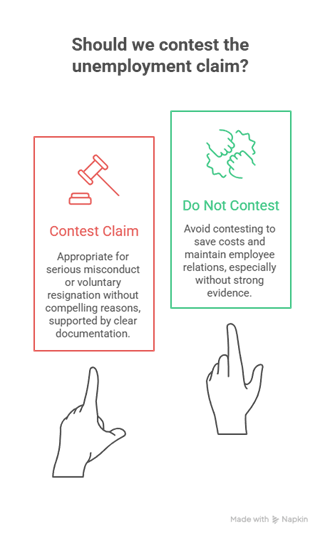
When Should Employers Contest Unemployment Claims?

  • Serious Misconduct or Voluntary Quit:
    Employers should generally only contest claims if the employee was terminated for serious misconduct (such as theft, violence, or repeated policy violations) or if the employee quit without a compelling reason. Contesting claims in other situations can be time-consuming and may not be successful.
  • Clear Documentation:
    Only proceed if you have solid documentation supporting your case, such as written warnings, termination letters, or evidence of policy violations.

Why Employers Should Rarely Fight Claims

  • Cost vs. Benefit:
    While unjustified claims can increase your unemployment insurance costs, fighting every claim is rarely cost-effective. Most HR experts recommend contesting only in clear-cut cases of misconduct or fraud.
  • Employee Relations:
    Aggressively contesting claims can harm your reputation and employee morale. It’s often better to reserve challenges for the most egregious cases.

How to Contest an Unemployment Claim

  1. Respond Promptly:
    When you receive notice of a claim, respond within the required timeframe and provide all requested information.
  2. Present Evidence:
    Be prepared to present evidence that the employee was terminated for misconduct or quit without good cause. This may include documentation of the employee’s duties, violations, and any warnings given.
  3. Participate in Hearings:
    If the claim is appealed, you may need to participate in a hearing. Bring witnesses and documentation to support your case.
  4. Be Honest and Consistent:
    Ensure all statements and evidence are truthful and consistent with previous records. Inconsistencies can undermine your credibility.

Best Practices

  • Maintain Thorough Records:
    Keep detailed records of employee performance, disciplinary actions, and reasons for separation.
  • Evaluate Each Case Individually:
    Assess the merits of each claim before deciding to contest. Blanket opposition to all claims is discouraged.
  • Consult Legal or HR Experts:
    When in doubt, seek advice from HR professionals or legal counsel to ensure compliance with state laws and best practices.
StateMaximum Unemployment BenefitState Agency Website and Phone Number
Alabama$275/weekAlabama DOL
(334)242-8025
Alaska$370/weekAlaska DOL
(907)269-4700
Arizona$240/weekArizona: How to Apply for UI
(877)600-2722
Arkansas$451/weekArkansas DOL
(501)682-2121
California$750/week through September 6, 2021
After this, it will come down to $451/week
California DOL
1(800)300-5616
Colorado$918/week through September 6, 2021
After this, it will come down to $618/week
Colorado DOL
(303)318-8000
Connecticut$949/week through September 6, 2021
After this, it will come down to $649/week
Connecticut DOL
(203)941-6868
Delaware$700/week through September 6, 2021
Then it will come down to $400/week
Delaware DOL
1(800)794-3032
D.C.$744/week through September 6, 2021
After this, it will come down to $444/week
D.C. DOES
(202)724-7000
Florida$275/weekFlorida DEO
1(833)352-7759
Georgia$365/weekGeorgia DOL
1(877)709-8185
Hawaii$948/week through September 6, 2021
After this, it will come down to $648/week
Hawaii DOL
Oahu: (808)586-8970
Hilo: (808)974-4086
Kona: (808)322-4822
Maui: (808)984-8400
Kauai: (808)274-3043
Idaho$463/weekIdaho DOL
(208)332-8942
Illinois$784/week through September 6, 2021
After this, it will come down to $484/week
Illinois DES
1(800)244-5631
Indiana$690/week through September 6, 2021
After this, it will come down to $390/week
Indiana DOL
1(800)891-6499
Iowa$481/weekIowa Workforce Development
1(866)239-0843
Kansas$788/week through September 6, 2021
After this, it will come down to $488/week
Kansas DOL
1(800)292-6333
Kentucky$852/week through September 6, 2021
After this, it will come down to $552/week
Kentucky Career Center
(502)875-0442
LouisianaLouisiana Workforce Commission
1(866)783-5567
Maine$745/week through September 6, 2021
After this, it will come down to $445/week
Maine DOL
1(800)593-7660
Maryland$730/week through September 6, 2021
After this, it will come to $430/week
Maryland DOL
Contact Info
Massachusetts$1,123/week through September 6, 2021
After this, it will come down to $823/week
Mass DUA
1(877)636-6800
Michigan$662/week through September 6, 2021
After this, it will come down to $362/week
Michigan Department of Labor and Opportunity
Contact Info
Minnesota$1,040/week through September 6, 2021
After this, it will come down to $740/week
Minnesota Unemployment Insurance
1-877-898-9090
Mississippi$235/weekMississippi DES
601-321-6000
Missouri$320/weekMissouri DOL
Contact Info
Montana$872/week through June 27, 2021
After this, it will come down to $552/week
Montana Unemployment Insurance Division
406-444-2545
Nebraska$440/weekNE Works
855-995-8863
Nevada$769/week through September 6, 2021
After this, it will come down to $469/week
Nevada DOL
Contact Info
New Hampshire$427/weekNew Hampshire Workforce Connect
1(800)852-3400
New Jersey$1,013/week through September 6, 2021
After this, it will come down to $713/week
New Jersey DOL
Contact Info
New Mexico$811/week through September 6, 2021
After this, it will come down to $511/week
New Mexico Workforce Connection
Contact Info
New York$804/week through September 6, 2021
After this, it will come down to $504/week
New York DOL
1(888)581-5812
North Carolina$650/week through September 6, 2021
After this, it will come down to $350/week
North Carolina DES
1(888)737-0259
North Dakota$618/weekNorth Dakota DOL
(701) 328-4995
Ohio$498/weekOhio Department of Job and Family Services
1(877)644-6562
Oklahoma$539/weekOklahoma ESC
1(800)555-1554
Oregon$973/week through September 6, 2021
After this, it will come down to $673/week
Oregon Employment Department
1(877)345-3484
Pennsylvania$872/week through September 6, 2021
After this, it will come down to $572/week
Pennsylvania Office of Unemployment Compensation
Contact Info
Rhode Island$886/week through September 6, 2021
After this, it will come down to $586/week
Rhode Island DLT
(401)415-6772
South Carolina$326/weekSouth Carolina Department of Employment and Workforce
1(866)831-1724
South Dakota$428/weekSouth Dakota Department of Labor & Regulation
(605)626-2452
Tennessee$275/weekTennessee Department of Labor & Workforce Development
1(877)813-0950
Texas$535/weekTexas Workforce Commission
1(800)628-5115
Utah$580/weekUtah Workforce Services
(801)526-9675
Vermont$831/week through September 6, 2021
After this, it will come down to $531/week
Vermont DOL
1(877) 214-3332
Virginia$678/week through September 6, 2021
After this, it will come down to $378/week
Virginia Employment Commission
Contact Info
Washington$1,144/week through September 6, 2021
After this, it will come down to $844/week
Washington Employment Security Department
1(800)318-6022
West Virginia$424/weekWorkforce West Virginia
1(800)379-1032
Wisconsin$670/week through September 6, 2021
After this, it will come down to $370/week
Wisconsin Department of Workforce Development
(608) 266-3131
Wyoming$508/weekWYUI
(307)473-3789

If the employee is the one asking for time off, though, the requirement is not triggered. This can include a leave of absence, vacation, parental leave, personal leave, or any other type of paid or unpaid leave.

https://gusto.com/resources/articles/benefits/covid-state-unemployment-insurance-benefits

The Vicarious Liability Doctrine & Infliction of Emotional Distress

Is the employer liable for an employee’s conduct in or outside the workplace?  Vicarious liability is the legal term outlining when an employer or principle is held liable for the wrongful acts committed by the employee, manager, supervisor, etc. within the scope of employment.  Defined in the California court system, as follows:

“Under the respondent superior doctrine, an employer may be vicariously liable for torts committed by an employee.  The rule is based on the policy that losses caused by the torts of employees, which as a practical matter are certain to occur in the conduct of the employer’s enterprise should be placed on the enterprise as a cost of doing business.”  (Kephart v. Genuity, Inc. (2006) 136 Cal.App.4th 280)

The answer is yes, the employer can be held liable for the actions of its managers, supervisors and employees.  The three primary reasons for implementing and ruling on this doctrine, is to prevent reoccurring conduct, greater assurance of compensation to the victim and to ensure equitable settlements to the victim. 

The courts have defined the course and scope of employment, to include:

  • Intent of the employee;
  • Nature, time and place of the employee’s conduct;
  • Type of work the employee was hired to do;
  • Incidental acts the employer should reasonably expect the employee to do;
  • Amount of freedom allowed to the employee in performing his or her duties; and
  • Amount of time consumed in the personal activity.

Infliction of emotional distress allows an employee to recover damages when the employer acts wrongfully; public policy violation or termination because of a disability. Employers can terminate someone legally.  If the organization terminates someone in an impermissible manner, they can be held liable for infliction of emotional distress with the past employee or even potentially a spouse if the emotional distress spills over outside of the workplace.  Courts have outlined four elements of an emotional distress tort:

  1. The defendant’s conduct was extreme and outrageous, beyond all bounds of human decency,
  2. The defendant intended to cause severe emotional distress to the plaintiff, or acted in disregard of a high probability that its conduct would inflict such harm,
  3. The defendant proximately caused emotional distress to the plaintiff, and
  4. The emotional distress was so severe that no reasonable person could be expected to endure.

A plaintiff’s success on an emotional distress story usually hinges on his or her ability to prove the first and fourth elements.  (Understanding Employment Law, 2nd Edition)

Thoughts and Suggestions:

  1. Review and Update Policies, Procedures and/or Employee Handbook
  2. Communicate expectations to the entire workforce
  3. Hold a separate training for managers and supervisors, they need to understand that they are held to a higher standard in the workplace
  4. Conduct Annual Training’s on Policies, Using Examples and Situations
  5. Consistently enforce policies and procedures throughout the organization
  6. If you have traveling employees, reinforce expectations of on the road behavior
  7. Review Local, State and Federal Laws
  8. Laws can change (New York State Sexual Harassment/DHR Laws)

I’m happy to work with any organization that has questions on policies, procedures, handbooks and/or training.