New Form I-9 Issued in July 2017

It seems like we just had a new Form I-9 issued in November 2016, effective in January 2017.  We did.  The U.S. Citizenship and Immigration Services (USCIS) published an updated version of the I-9 Form on July 17, 2017.  This new form will be mandatory to verify employment eligibility on September 18, 2017.  The revised form issued on November 14, 2016 can be used through September 17, 2017.  The current storage and retention rules remain the same.  “The new version brings very subtle changes to the form’s instructions and list of acceptable documents, which were created with the theoretical goal of making the form easier to navigate,” said Davis Bae, managing partner of the Seattle office of law firm Fisher Phillips. “Besides changing the wording on the form in almost imperceptible ways, the new version renumbers all List C documents except the Social Security card, and streamlines the certification process for certain foreign nationals.”[i]

Download the new here: Form I-9: July 17, 2017

Below are six, common I-9 Questions:

  1. Returning Summer Employees: If you rehire an employee within three years of the date that a previous Form I-9 was completed, you may either complete a new Form I-9 for your employee or complete Section 3 of the previously completed Form I-9, as long as the original I-9 shows current work authorization.”[ii]
  2. Re-verify a Female Employee Upon Getting Married: There is no requirement to re-verify a female employee or any employee who has a name change, currently.  “One other interesting point about transgender employees: The “Other Names Used field in the form has been changed to Other Last Names Used” to avoid potential discrimination issues and provide increased privacy for transgender individuals and others who have changed their first names.”[iii]
  3. Scan I-9s and Store Electronically: Due to the complexity of the rules and regulations regarding electronic scanning of I-9 Forms, the Society of Human Resource Management (SHRM) recommends using a qualified vendor to store I-9 Forms electronically.
  4. End of Retention Period: Shred I-9 Forms at the end of the required retention period.  However, verify the retention period requirements prior to shredding any documents.
  5. Completion Date of I-9 Form: The form can be completed as soon as you offer an individual the job and the job is accepted. It is best practice to have the offer and acceptance in writing.  Remind employees to bring the required documentation on the first day of work, if you do not require completion prior to the first day.
  6. Expired Driver’s License with a Receipt for Extension:  This is not legal.  “You may accept a receipt for a driver’s license that was requested to replace a license that was lost, stolen or damaged.”[iv]

We have seen multiple revisions to the I-9 Form over the past 10-months.  Remember to use the correct form on the dates required.  Switching the form now will save you time in September 2017.  Review the latest identification requirements and know what is acceptable when you are filling out the form.  Remember to fill out the form completely and ensure that the employee fills in their sections completely, signs and dates.  If you are confused seek guidance, I-9 Forms have grown in complexity and length since 1986.


Looking for more fast, up-to-date HR advice?

Check out our new podcast, Upstate HR  Recruitment in the Modern Age

Download an iTunes subscription and it will update you whenever we post a new podcast!

 – Matthew Burr, HR Consultant

[i] https://www.shrm.org/ResourcesAndTools/hr-topics/talent-acquisition/Pages/USCIS-Issues-Revised-New-Form-I9.aspx

[ii] https://www.shrm.org/resourcesandtools/legal-and-compliance/employment-law/pages/tough-i-9-issues.aspx
[iii] https://www.shrm.org/resourcesandtools/legal-and-compliance/employment-law/pages/tough-i-9-issues.aspx

[iv] https://www.shrm.org/resourcesandtools/legal-and-compliance/employment-law/pages/tough-i-9-issues.aspx


5 Updates on Job Description

Job descriptions are an important part of the employment relationship.  Once we complete, modify or update the job description, we might assume that the work is done.  However; essential functions, duties, technology, responsibilities, etc. can and change throughout the employment relationship.  As leaders, we need to review job descriptions and ensure these documents are up-to-date with accurate responsibilities and essential functions.  The link at the end of the article provides additional information on legal cases in which a job description protected the employer and one that harmed the employer.

Below are 5 thoughts on job descriptions:

  1. Current and Accurate: Keep all job descriptions current and accurate.  These descriptions can be reviewed during the annual review process or throughout the year.  Ask the employee for input on duties and responsibilities.  They should know the job!
  2. Essential Job Functions: Ensure that the essential job functions section is accurate and up-to-date.  Physical skills should be included in the essential functions or in another area of the job description.  Is prolonged walking or standing an essential function?  What about lifting material?  How many pounds and how often?  This should also be included in the job description.  Do not forget time spent at a desk.  If the job requires 6-8 hours on the computer, this should be included.  This section can be lengthy or detailed.
  3. FMLA Leave: “If the job description is out of date when an employee seeks FMLA leave, create a current and accurate list of essential job functions, indicate in the designation notice that the employee will be required to submit a fitness for duty certification addressing his or her ability to perform his or her specific job, and provide the list of essential job functions with the notice.”[i]
  4. Approval and Signature: My recommendation is to have more than one individual review and approve the job description prior to finalizing the draft.  There should be a signoff/approval process to ensure we have not missed anything.  Once the description is approved, the employee should review and signoff on the job description.
  5. Internet Search: It is easy to search the internet and find thousands of job descriptions.  However, this does not mean the information is legal, up-to-date or fits the job within your organization.  O’net and SHRM are great resources when drafting or updating job descriptions.  These can be used as templates and resources, to help lay the foundation of a job description that fits the needs of your organization.

As jobs and responsibilities change, so too should job descriptions.  As leaders, we should ask for input when modifying and updating job descriptions, to ensure accuracy and employee engagement.  If you are unsure on where to begin or how to draft a job description, ask for assistance.  Do not assume an internet search will provide legal and accurate information.  The case below is an example of when an inaccurate job description harmed an employer and references a case in which a job description helped an employer.

SHRM Saved – Or Sunk – By the Job Description?


– Matthew Burr, HR Consultant


[i] https://www.shrm.org/ResourcesAndTools/hr-topics/talent-acquisition/Pages/Saved-Sunk-Job-Description.aspx


6 Thoughts for Non-HR Professionals

We recently completed an HR training in Dallas, Texas, for Non-HR MBA students.  The training focused on the key areas that HR can and does impact in any organization.  Throughout the training we discussed the importance of aligning the HR department with the needs of the employees and organization; not an easy task, but necessary to move forward and progress.  I know the group of 100 MBA students have a new respect for the many hats that HR professionals continue to wear.

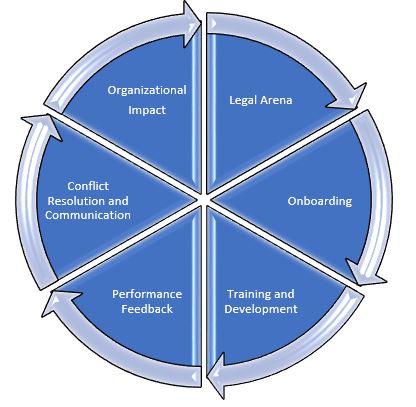
Below are 6 thoughts for non-HR professionals:

  1. Organizational Impact: HR can and does have an impact on the direction and strategy of the organization.  The HR function is as important as any other function within the organization.  Know the impact HR can have on the organizations mission, vision, culture, goals and objectives.
  2. Legal Arena: Labor and employment laws evolve and they change rapidly.  Interpreting and implementing legal change, continues to grow in complexity.  Federal, state and local laws can have an impact on the organization.  Ask questions and never assume you have the answer, legislation is one piece.  Remember the case law and amendments.
  3. Onboarding: Onboarding begins when an applicant applies for a job.  This process is critical to recruit and retain top talent.  Managers, coworkers and direct reports have ownership in ensuring the onboarding processes are organized and aligned with the organizations mission, vision and values.  If you were a new hire, what would you expect from recruiting to hire?  Put yourself in their shoes and reverse engineer a great experience.
  4. Training and Development: Training and development are extremely important pieces of the employment experiences.  Have we asked what training is important to the organization?  To the employee?  What can we afford?  Is there grant money available?  What about leadership development training?  Look for local and national opportunities for industry and profession specific training and development.
  5. Performance Feedback: Yes, employees want feedback!  In fact, continuous coaching and feedback, more than once per year will probably be an effective model.  Goals should be aligned with organizations goals and department goals.  These goals should also include training and development opportunities; degree, certification, leadership development, computer system training, financial, stretch assignments, etc.
  6. Conflict Resolution and Communication: The final thought can be the most difficult.  Resolving conflict and ensuring effective communication.  Never easy, but necessary.  As leader’s we will be in situations that require us to have that “difficult” conversation.  Practicing these conversations is never enjoyable, at times necessary to ensure we are prepared.  Communication is essential.  Know your organization and which communication tools are effective for your workforce.


6ThoughtsforNonHrProfessionals

These six thoughts are just a few of the important pieces of HR that do and will impact your organization.  As leader’s we need to recognize how these pieces effect our mission, vision, values, culture and employees.  Turnover is costly.  Recruiting is costly.  Training and retraining is costly.  Understanding these six areas’ will take work, but being an effective leader takes work.  Ask for help if you need it, people spend their careers specializing in each of the six areas.  Strategic HR can shape the mission statement, vision, culture, employee engagement and values of any of our organizations.

– Matthew Burr, HR Consultant

13 Common Job Application Mistakes Made by Employers

The Society of Human Resources Management recently published an article, “Top 10 Mistakes Employers Make in Job Applications.”  I decided to add three more to the list, based on my experience.  Most employers nationwide, are still using a job application, handwritten or during the online application process.  As leaders, we need to be aware of the potential issues of not updating employment applications or using a generic employment application.  As laws continue to evolve, so too should our employment application processes.       

Below are the 13 common job application mistakes:

  1. “Including any disability-related or medical questions
  2. Not including an at-will disclaimer
  3. Not including a nondiscrimination statement
  4. Requesting graduation dates in the education section
  5. Asking about arrests and convictions, without appropriate disclaimers
  6. Putting a background check acknowledgement on the employment application (I see this too often)
  7. Not including language telling applicants how to request a reasonable accommodation
  8. Asking for a photograph
  9. Asking about marital or familial status
  10. Asking about citizenship”[i]
  11. Not including a signature section to verify that the applicant is acknowledging the information is true and accurate. Remember a resume or CV is not the same thing as an employment application.
  12. Including a section for a social security number, on either the paper application or by not allowing a person to continue through the applicant tracking system. Do we really need a social security number?  “An employment application should request only information directly related to an applicant’s ability to perform a specific job… general practice, employers should request SSN information only when absolutely necessary.”[ii]  If you do not need it, don’t ask for it.
  13. Using generic employment applications. “Well I found this on the internet, it should be okay.” Ensure that someone reviews the application or helps you develop a new one prior to using it during the hiring process.  Just because it is found on the internet does not make it legal and valid.

Employment applications are an important piece to the recruitment and retention process for all organizations.  Asking irrelevant questions on the application can be a potential liability.  As the laws continue to evolve, we need to ensure our employment application, both paper and electronic are legally compliant and efficient for job applicants.  If you have questions about your application, ask for assistance.  Do not assume that the first Google search will provide a legal job application.  Remember laws vary; federally, state-wide and city specific.  These laws will impact what can and cannot be asked on the employment application.


– Matthew Burr, HR Consultant

“Short Name, Proven Results”


[i] https://www.shrm.org/resourcesandtools/hr-topics/talent-acquisition/pages/top-10-mistakes-employers-make-job-applications.aspx


[ii] https://www.shrm.org/resourcesandtools/tools-and-samples/hr-qa/pages/socialsecuritynumber.aspx