6 Need to Knows About New York State Paid Family Leave

I have written about New York State Paid Family Leave three or four times over the past 8 months, and will more than likely write a few more articles about the legislation as we approach deadlines and implementation in 2018.  We are still patiently waiting for final rules and regulations to be issued from the New York State Workers’ Compensation Board, which continue to be communicated slowly to employers and insurance companies.  Continue to monitor for any changes that can and will impact your organization.

Below are 6 Need to Knows about NYSPFL as we approach 1/1/2018:

  1. Employer Eligibility: Qualifying reasons for leave under current PFL include; bonding with a new child (birth, adoption or placement in foster care), employee providing care for a child, parent, grandparent, grandchild, spouse or domestic partner with a serious health condition and qualifying exigencies arising from military services of the employee’s spouse, domestic partner, child, or parent.  Serious health condition or qualifying exigencies, follow the same guidelines that we see under the Family Medical Leave Act (FMLA)
  2. New York State’s Average Weekly Wage: The current average weekly wage is $1,305.92.  On March 31st of each calendar year, the rate is recalculated by the New York State Department of Labor.  More than likely, we will see this rate continue to increase year over year.
  3. Employer’s Obligation to Fund Paid Family Leave: “Although employers are required to provide PFL benefits to eligible employees, employers are not required to pay anything towards the cost of those benefits. Paid family leave is intended to be 100% employee-funded.”[i]  The Worker’s Compensation Board has yes to publish all rules in this area, continue to monitor for additional updates and new guidelines.
  4. Maximum Deductions: The most that can be deducted is 0.126% of the New York State average weekly wage.  This will be for an employee’s weekly wage.
  5. Insurance or Self-Insure: The employer can forego obtaining insurance and has the option to self-insure. Currently, the employer must elect to do so and file the required paperwork with New York State, no later than September 30, 2017.
  6. Employer’s Offering Benefits That Exceed NYSPFL: If an employer is already offering paid family leave that exceed the legal requirements and pay full salary during leave, the employer may request reimbursement from the insurance carrier for advance payment of benefits.  The employee is not entitled to add-on or double dip NYSPFL or short-term disability.  Benefits are limited to a total of 26-weeks; paid family leave and disability.   


As we approach January 1, 2018, continue to watch for updated rules and regulations from the New York State Worker’s Compensation Board.  There are still unanswered questions and areas of the legislation that need to be clarified.  Organizations should now be working with insurance companies or determining if they would like to be self-insured.  Do not wait until the last minute to begin implementing, taking deductions or communicating with the workforce.  The law is complex, seek guidance if you are confused.

New York State Paid Family Leave Resource Website

FMLA & NYPFL – Key Differences
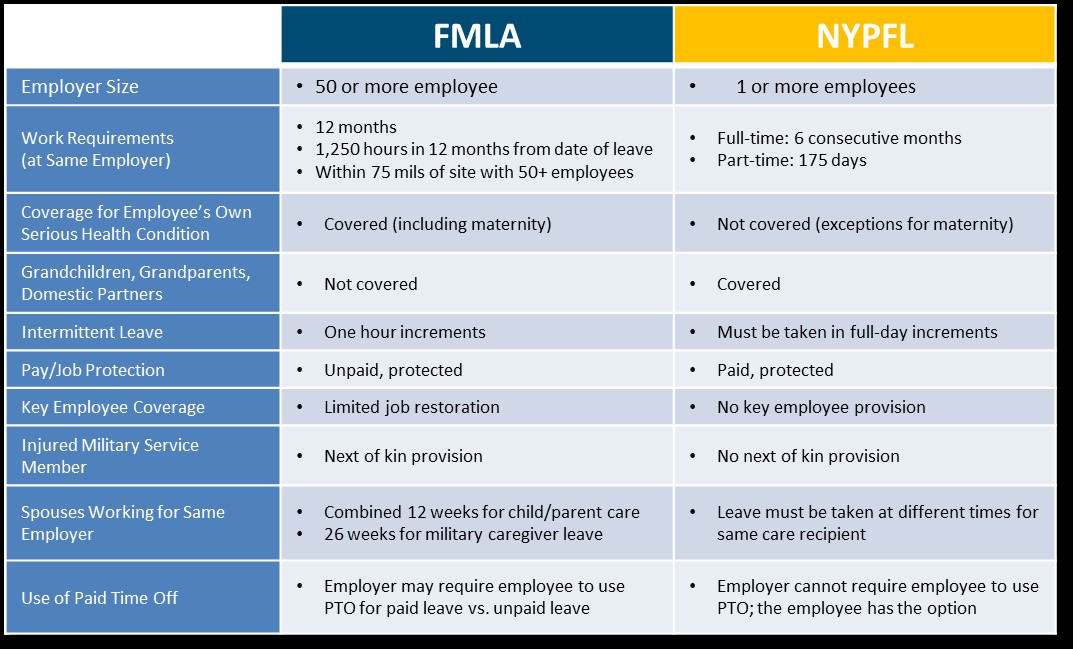
PFLvsFMLA

[ii]

– Matthew Burr, HR Consultant

[i] https://www.bsk.com/media-center/3746-labor-employment-faqs-mdash-things-you-want-and-need-know-about#.WWfMyYVh068.linkedin


[ii] Guardian NYSPFL Presentation

3 Updates to the New York Paid Family Leave Law

As we move closer to 2018, the regulations on the New York State Paid Family Leave Law will continue to be communicated from the state.  On June 1, 2017, the state released the maximum employee contributions.  This will be the average deduction that will be taken out of the employee’s paycheck.

Below are the 3 updates:

  1. Clarification on the payroll deductions and employer portions. This clarification is not new.  However, I have been asked about the employer portion many times.  The paid family leave “is intended to be funded entirely through employee payroll deductions and employers are not required to fund any portion of this benefit.”[i]
  2. The maximum employee contribution was set at 0.126% on June 1, 2017, of an employee’s weekly wage, up to and not to exceed 0.126% of the NY statewide average weekly wage. The current statewide wage is $1,305.92.  “So, for example, if an employee’s weekly wage amounts to $1,000.00, the maximum payroll deduction for PFL would be $1.26 for that week.”[ii]  If any employee makes more than $1,305.92, the weekly amount will be capped at $1.65.  Multiply the 0.126% by the wage to calculate the deduction.
  3. The statewide average weekly wage is calculated annually on March 31st and will be based on the previous calendar year’s average weekly wage. As wages increase across the state, so will the paid family leave contribution deductions, out of the employee’s paycheck.        

As new information is released, I will send a breakdown of the regulations.  Now is the time to begin reviewing, drafting, updating and revising policies and procedures related to FMLA and Paid Family Leave.  January 1, 2018 is only six short months away.  If you are confused, ask questions and do not assume.  This law is very complex, it continues to change as new regulations are slowly released.

New York State Paid Family Leave Website

Premium Rate for Family Leave Maximum Employee Benefit Contribution Website


Reminder of Previous Information: 

[iii]


Want to learn more? Check out the upcoming trainings I will be conducting at Elmira College, Corning Community College (CCC), 24/7 Compliance and Compliance Online  in July & August:

Elmira College: SHRM Certification Exam Prep Course- September through November

Upcoming Corning Community College Training’s

247 Compliance: Performance of Dashboard Using KPIs and Designing


– Matthew Burr, HR Consultant


[i] https://www.bsk.com/media-center/3723-labor-employment-new-york-sets-maximum-employee-contribution-paid-family


[ii] https://www.bsk.com/media-center/3723-labor-employment-new-york-sets-maximum-employee-contribution-paid-family


[iii] Guardian PPT Training Slides

5 Proposed Regulations to the New York Paid Family Leave Law

The New York State Worker’s Compensation Board issued five proposed regulations on May 24, 2017, for organizations to incorporate, when implementing the New York Paid Family Leave requirements on January 1, 2018.  The initial regulations were published on February 22, 2017 and included a comment period.  The new regulations released on May 24, 2017 will have a 30-day comment period.

Below are 5 proposed regulation changes:

  1. An employee using intermittent leave must give the employer separate notice each day of use of the Paid Family Leave. Previous language stated that employees only needed to provide notice once to employers when using intermittent leave, which was inconsistent with the FMLA rules.


  1. Collective bargaining language must provide benefits as favorable as the Paid Family Leave law, including the length of leave and amount of pay. This section is still evolving and negotiated language can include the union responsibility for time records and pay deductions.  This has not been finalized and more changes will come to this section.


  1. Paid Family Leave language has been clarified that the eligibility of employees working 20-hours or more per week is measured based on the number of weeks in employment, which must be at least 26-weeks. Employees who work less than 20-hours per week is measured in days, which must be at least 175 working days.      


  1. The Worker’s Compensation Board clarified the July 1, 2017 deductions language. The employer can start taking payroll deductions on July 1, 2017, but cannot take deductions more than the maximum weekly contribution to retroactively cover the cost of providing Paid Family Leave.  The reason for early deductions is to offset the cost of acquiring the mandated insurance policy.


  1. The Worker’s Compensation Board issued additional guidance on accrued leave running concurrently with Paid Family Leave. The complexity of this language and requirements is related to accrued leave is still being drafted.  Further clarification is needed from the Board on the concurrent and accrued requirements, which include; FMLA, worker’s comp, and disability.  More updates to come on this proposed language.

Now is the time to begin reviewing, drafting, updating and revising policies and procedures related to FMLA and Paid Family Leave.  January 1, 2018 is only six short months away.  Continue to monitor for updates and changes to the proposed language.  If you are confused, ask questions and do not assume.  This law is very complex, it continues to change as concerns arise and the implementation will impact most organizations throughout New York State.


New York State Paid Family Leave Website


Additional Information:

[i]


Employers Providing Pawternity Leave to Employee’s (End on a Positive)


– Matthew Burr, HR Consultant

[i] Guardian PPT Training Slides