2025 Wage, Paid Family Leave & IRS COLA Updates Impacting Your Organization

Original Post Date: 10/29/2024

Upcoming New York State Minimum Wage, Executive & Administrative Exempt Salary Changes, Farm Overtime Threshold Reductions and Nationwide Changes

The NYS Department of Labor is proceeding with scheduled increases to the state’s minimum wage effective December 31, 2022. While there is no change for New York City employers, Long Island, or Westchester employers, the remainder of upstate New York will see increases. As you know, this will also impact the minimum salary levels to be paid to Executive and Administrative exempt employees. The new minimum wage and minimum salary levels can be found below. Things to keep in mind:

  • The updated poster. You will be required to post a new minimum wage poster. You will be able to find the new poster here. Remember, there could be corresponding increases in the tipped wage and wages paid for fast food employees in your area. 
  • The minimum salary level to be considered exempt from overtime under NYS law for Executive and Administrative employees is tied to the minimum wage and may also be increasing for your industry and area. Remember, there is no NYS minimum salary level for Professional exemptions. For Professional employees you would be subject to the Federal minimum salary level

Minimum Wage Increases

Once adopted, the FY2024 Budget would establish a new statutory minimum wage rate schedule in Section 652 of the Labor Law as follows:

Effective DateNew York City, Westchester, Nassau, Suffolk CountiesUpstate New York
January 1, 2023$15.00$14.20
January 1, 2024$16.00$15.00
January 1, 2025$16.50$15.50
January 1, 2026$17.00$16.00
January 1, 2027+$17.00 + annual increase$16.00 + annual increase

Indexing the Minimum Wage

Starting January 1, 2027, additional annual minimum wage increases would be implemented each year based on the Northeast region measure of consumer price increases for urban wage earners and clerical workers (CPI-W). There would be no increases to the minimum wage if over a period of the prior year, the calculations published by the United States Department of Labor show that:

  • The CPI-W for Northeast Region Urban Wage Earners is negative.
  • The statewide unemployment rate increases by one-half percentage point or more.
  • Total non-farm employment decreases (measured seasonally).

Adjusted minimum wages are required to be published by the State Department of Labor no later than October 1st of each year.

Adjustments to Salary Thresholds, Allowances, and Gratuities

It is worth noting that minimum wage orders in effect would remain in effect, including wage orders that address minimum salary levels for executive and administrative exemptions, gratuities, and allowances for meals, apparel, etc. As these minimum wage increases take effect, the State Department of Labor would amend the wage orders to increase all monetary amounts (i.e., salary levels and allowances) in the same proportion as the increase in the hourly minimum wage.  The state is expected to publish the official amounts of these adjustments.  We calculate the salary threshold in 2024 for downstate would rise to $1,200 weekly, and the upstate salary basis threshold would rise to $1,125 weekly.

The wage for food service workers who receive tips would remain lower than the regular minimum wage by one-third and rounded to the nearest five cents. While the state has not issued its official calculations, our unofficial calculations for tipped food service workers in the Hospitality Industry would be as follows:

TIPPED FOOD SERVICE WORKERS
YearNew York City, Westchester, Nassau, Suffolk CountiesUpstate New York
2024$10.70$10.00
2025$11.00$10.35
2026$11.35$10.70
2027+$11.35 + annual increase$10.70 + annual increase

Executive and Administrative Employees

New York City and the rest of “downstate” (Nassau, Suffolk, and Westchester counties):

·      $1,200 per week ($62,400 per year) on January 1, 2024

·      $1,237.50 per week ($64,350 per year) on January 1, 2025

·      $1,275 per week ($66,300 per year) on January 1, 2026

The rest of New York State (areas outside of New York City and Nassau, Suffolk, and Westchester counties):

·      $1,124.20 per week ($58,458.40 per year) on January 1, 2024

·      $1,161.65 per week ($60,405.80 per year) on January 1, 2025

·      $1,199.10 per week ($62,353.20 per year) on January 1, 2026

Professional Employees:

Employees who “[w]ork in a bona fide … professional capacity” (ellipsis in original) may also be exempt if they meet the specific requirement of Section 142-2.14 of the NYCRR, which does not include specific salary thresholds for individuals like those working in an executive or administrative capacity. The new NYDOL regulations do not change those rules.

“Effective July 1, 2024, the salary threshold for EAP-exempt workers will increase from the current rate of $684/week ($35,568 annually) to $844/week ($43,888 annually). The salary threshold is slated to increase again on January 1, 2025, to $1,128/week ($58,656 annually). Thus, barring judicial action between now and July 1, 2024, employees who are currently treated as exempt from overtime as EAP-exempt workers must be paid overtime if they work more than 40 hours per workweek unless they receive a salary of at least $844/week.  

The Final Rule also modifies the salary threshold for highly compensated employees (HCEs). HCEs are paid on a salary basis and perform office or non-manual work and at least one of the exempt EAP duties. Under current DOL regulations, HCEs must earn a salary of at least $684/week and receive total annual compensation of at least $107,432. However, beginning July 1, 2024, HCEs must be paid at least $844/week on a salary basis and their total annual compensation must equal or exceed $132,964. Then, effective January 1, 2025, HCEs will need to be paid at least $1,128/week on a salary basis and earn a total annual salary of at least $151,164 to remain exempt.

The Final Rule has been the subject of three major legal challenges:

  • On May 22, 2024, a group of businesses and business associations filed suit in the Eastern District of Texas, asserting that the DOL exceeded its authority in adopting the Final Rule. (Complaint, Plano Chamber of Commerce, et al. v. Su, 4:24-CV-468 (E.D. Tex., filed May 22, 2024).)
  • On June 3, 2024, the State of Texas filed suit – also in the Eastern District of Texas – seeking a preliminary injunction delaying the effective date of, and a permanent injunction enjoining the enforcement of, the Final Rule. (Complaint, State of Texas v. Dep’t of Labor, et al., 4:24-CV-499 (E.D. Tex., filed Jun. 3, 2024).)
  • Also on June 3, a software company filed suit seeking preliminary and permanent injunctive relief enjoining the Final Rule. (Complaint, Flint Avenue, LLC v. Su, et al., 5:24-CV-00130-C (N.D. Tex., filed Jun. 3, 2024).).

As the Plano Chamber of Commerce and State of Texas lawsuits were both filed in the same Court and assigned to the same trial judge (Hon. Sean D. Jordan), the court suggested consolidating the cases, with the State of Texas challenge as the lead case. [See 4:24-cv-00468-SDJ, ECF No. 7 (Jun. 5, 2024).] The Plano Chamber of Commerce plaintiffs filed a notice on June 7 agreeing to consolidate their lawsuit with the State of Texas case, and further consenting to the court holding a hearing on Texas’s motion for injunctive relief on June 24, 2024. The DOL filed a notice opposing consolidation, but it has agreed to a hearing on State of Texas’s motion for preliminary injunctive relief on June 24.”

Final Rule Overview

  • Effective July 1, 2024:
    • The exempt salary increases to $844/week ($43,888 annually). Employees who make less than $844/week are not exempt and are eligible to receive overtime for all hours worked in excess of 40 hours per week.
  • •Effective January 1, 2025:
    • The exempt salary increases to $1,128/week ($58,656 annually).
  • Highly Compensated Employees
    • The Final Rule also impacts an exemption for highly compensated employees who do not meet other elements of the “white-collar” exemptions. For highly compensated employees, the minimum salary will be $132,964 on July 1, 2024, and increase to $151,164 on January 1, 2025.
  • Automatic Increases Beginning 2027
    • The Final Rule creates automatic increases to exempt salary thresholds in the future. The first increase is scheduled for July 1, 2027, and subsequent increases will occur every three years afterward. These increases will be based on up-to-date earnings data. 

https://www.dol.gov/agencies/whd/overtime/salary-levels

Continue to monitor for any changes to the implementation of the law, as a reminder a court in Texas stopped the Obama Era FLSA changes with an injunction in late 2015.

Fact Sheet #17A: Exemption for Executive, Administrative, Professional, Computer & Outside Sales Employees Under the Fair Labor Standards Act (FLSA)

The 6 exempt level definitions under the FLSA:

  1. The Executive Exemption: Primary duties include managing the enterprise, directing the work of at least two or more full-time employees and has the authority to hire and fire employees.  The link(s) goes into specific duties tests on the exemptions.  NY State Law
  2. The Administrative Exemption: Primary duties must be the performance of office or non-manual work related to the management of the business and exercising discretion and independent judgement with respect to matters of significance.  NY State Law
  3. The Learned Professional Exemption: Primary duties must be the performance of work requiring advanced knowledge, which is predominantly intellectual in character and requires discretion and judgement.
  4. Computer Employee Exemption: Primary duties consist of the application of systems analysis techniques, design development, documentation, analysis, creation, modification of computer systems and designing, testing or modifying computer programs.  This exemption is complex, ensure you read through the FLSA definition prior to deciding and thoroughly understand the duties test. 
  5. The Outside Sales Exemption:  Primary duties must include making sales, obtaining orders or contracts.  The employee must be regularly engaged away from the employer’s place of business. 
  6. The Highly Compensated Employees Exemption: They regularly perform at least one of the duties of an exempt executive, administrative or learned professional identified in the standard tests of exemption.
  7. Other Definitions:                   Blue Collar Worker

Police Officers, Fire Fighters and First Responders


NYS Reduces Overtime Threshold for Farm Workers to 40 hours Per Week

New York State Department of Labor (NYSDOL) Commissioner Roberta Reardon issued an order accepting the recommendation of the Farm Laborers Wage Board to lower the current 60-hour threshold for overtime pay to 40 hours per week by January 1, 2032, allowing 10 years to phase in the new threshold. NYSDOL will now be undergoing a rule making process which will include a 60-day public comment period. This applies to certain agricultural employers and employees only.

Under proposed language, an employer shall pay an employee for overtime at a wage rate of one- and one-half times the employee’s regular rate of pay for hours worked in excess of the following number of hours in one workweek:

(a) 60 hours on or after January 1, 2020;
(b) 56 hours on or after January 1, 2024;
(c) 52 hours on or after January 1, 2026;
(d) 48 hours on or after January 1, 2028;
(e) 44 hours on or after January 1, 2030;
(f) 40 hours on or after January 1, 2032.

Minimum Wage for Fast Food Employees
The minimum wage for fast food employees working outside of New York City will increase to $14.50 per hour. The final scheduled increase to $15.00 per hour will take effect on July 1, 2021.

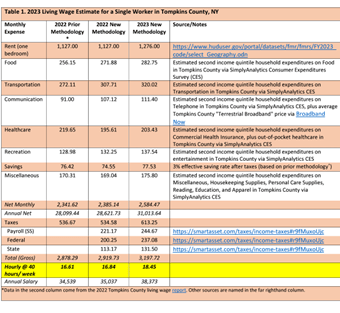
Tompkins County Living Wage Study
IRS Releases 2025 Cost-of-Living Adjusted Limits for Benefit Plans

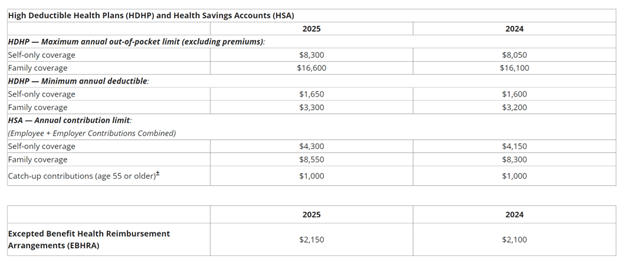
https://www.lifetimebenefitsolutions.com/members/resources/irs-limits

  • Qualified transportation fringe benefit. For tax year 2025, the monthly limitation for the qualified transportation fringe benefit and the monthly limitation for qualified parking rises to $325, increasing from $315 in tax year 2024.
  • Health flexible spending cafeteria plans. For the taxable years beginning in 2025, the dollar limitation for employee salary reductions for contributions to health flexible spending arrangements rises to $3,300, increasing from $3,200 in tax year 2024. For cafeteria plans that permit the carryover of unused amounts, the maximum carryover amount rises to $660, increasing from $640 in tax year 2024.
  • Medical savings accounts. For tax year 2025, participants who have self-only coverage the plan must have an annual deductible that is not less than $2,850 (a $50 increase from the previous tax year), but not more than $4,300 (an increase of $150 from the previous tax year). 

The maximum out-of-pocket expense amount rises to $5,700, increasing from $5,550 in tax year 2024.

For family coverage in tax year 2025, the annual deductible is not less than $5,700, increasing from $5,550 in tax year 2024; however, the deductible cannot be more than $8,550, an increase of $200 versus the limit for tax year 2024. For family coverage, the out-of-pocket expense limit is $10,500 for tax year 2025, rising from $10,200 in tax year 2024.

The Internal Revenue Service recently announced 2024 dollar limits for qualified retirement plans (including 401(k) plans), deferred compensation plans, and health and welfare plans. Adjustments to certain limits are based on a cost-of-living index.

In addition, the Social Security taxable wage base, which affects qualified retirement plans “integrated” with Social Security, typically adjusts each year. For 2024, the taxable wage base increases to $160,200.

For 2024, most limits increased with the exception of catch-up contributions limits and limits fixed by statute, the latter of which do not adjust based on the cost of living. The increased limits for 2024 are highlighted in bold below.


 2024 Limit2023 Limit
Annual Limit on 401(k)/403(b) Deferral Contributions$23,000$22,500
Annual Limit on Age 50 and Older 401(k)/403(b) Catch-up Contributions$7,500$7,500
Annual Compensation Limit$345,000$330,000
Annual Contribution Limit for Defined Contribution Plans$69,000$66,000
Annual Benefit Limit for Defined Benefit Plans$275,000$265,000
Prior Year Compensation Amount for Determining Highly Compensated Employees$155,000$150,000
Key Employee Compensation Limit$220,000$215,000
Annual Limit on SIMPLE Contributions$16,000$15,000
Annual Limit on Catch-up Contributions to SIMPLE Plans$3,500$3,500
ESOP Account Balance Limit Subject to 5-Year Distribution Period$1,380,000$1,330,000
Incremental Amount Adding Additional Year(s) to ESOP 5-Year Distribution Period$275,000$265,000
Earnings Threshold for SEP Contribution$750$750

Deferred Compensation Limits

 2024 Limit2023 Limit
Annual Limit on 457(b) Contributions$23,000$22,500
Annual Limit on Catch-up Contributions to 457(b) Plans$7,500$7,500
409A Specified Employee Compensation Threshold$220,000$215,000
409A Involuntary Separation Pay Limit$690,000$660,000

Health and Welfare Plan Limits

 2024 Limit2023 Limit
Annual Limit on Salary Reduction Contributions to Health FSA$3,200$3,050
Annual Limit on Health FSA Carryover$640$610
Annual Limit on Salary Reduction Contributions to Dependent Care FSA$5,000 if married filing jointly or if single $2,500 if married filing separately$5,000 if married filing jointly or if single $2,500 if married filing separately
Annual Limit on HSA Contributions$4,150 (EE only) $8,300 (family)$3,850 (EE only) $7,750 (family)
Annual Limit on Catch-up Contributions to HSA$1,000$1,000
Annual Minimum Deductible for High Deductible Health Plans$1,600 (EE only) $3,200 (family)$1,500 (EE only) $3,000 (family)
Annual Limit on High Deductible Health Plan Out-of-pocket Expenses$8,050 (EE only) $16,100 (family)$7,500 (EE only) $15,000 (family)

IRS Mileage Website (2025 TBD)

2025 New York State Paid Family Leave and Workers Compensation Rates

Original Post Date: 10/15/2024

Up to 12 weeks of leave

New York State Paid Family Leave provides eligible employees with up to 12 weeks of job protected, paid time off to bond with a new child, care for a family member with a serious health condition, or to assist loved ones when a family member is deployed abroad on active military service. This time can be taken all at once, or in increments of full days.

At 67% of pay (up to a cap)

Employees taking Paid Family Leave receive 67% of their average weekly wage, up to a cap of 67% of the current New York State Average Weekly Wage (NYSAWW). For 2025, the NYSAWW is $1,757.19, which means the maximum weekly benefit is $1,177.32. This is $26.16 more than the maximum weekly benefit for 2024.

Employees can get an estimate of their benefits using the PFL 2025 Benefits Calculator.

 Paid Family Leave Benefits Examples
Worker’s Average Weekly WageWeekly PFL Benefit*
$600$402
$1,000$670
$2,000$1,177.32

*The weekly PFL benefit is capped at $1,177.32(67% of the NYSAWW).
 

2023 Paid Family Leave Expansion

Through Legislation S.2928-A/A.06098-A, the definition of “family members” expands to include siblings. This includes biological siblings, adopted siblings, step-siblings and half-siblings. These family members can live outside of New York State, and even outside of the country.

Employer Resources

There are several resources to help employers understand and communicate New York Paid Family Leave benefit updates to their employees.

Draft PFL Policy Language:

NEW YORK STATE PAID FAMILY LEAVE

New York Paid Family Leave provides job-protected, paid time off so employees can:

  • bond with a newly born, adopted, or fostered child.
  • care for a close relative with a serious health condition; or
  • Assist loved ones when a family member is deployed abroad on active military service.

By NYS PFL Definition:

  • spouse
  • domestic partner (including same and different gender couples; legal registration not required)
  • child/stepchild and anyone for whom you have legal custody
  • parent/stepparent
  • parent-in-law
  • grandparent
  • grandchild
  • sibling (starting in 2023) Workers should check with their employer’s Paid Family Leave insurer to learn when sibling care goes into effect for their policy. For employees who work for self-insured employers, coverage begins January 1, 2023.

Employees who believe they are eligible for Paid Family Leave should contact their _______ as soon as possible. More information can be found at www.ny.gov/programs/new-york-state-paid-family-leave. Organization will abide by all changes to NYSPFL and communicate such changes to the employees.  For additional information please alert your President, or the Statement of Rights Posting on Paid Family Leave.

Legal Area’s and Changes to Remember and Communicate:

  1. Employees have job protection, similar to FMLA.
  2. Paid Sick Leave policies and procedures.
  3. Right to keep their health insurance while on leave.
  4. No retaliation or discrimination against those who take leave.
  5. Citizenship is never a factor in eligibility for NYSPFL.
  6. Review the language contained in your employee handbook, policy, or policy manual.  Update FMLA and NYSPFL language to reflect changes and communicate the policy to the workforce.
  7. Communicate PFL payroll deductions for 2020 to the workforce now or during open enrolment.  My recommendation is to do this in writing via a template and obtain a signature.  NYS has a PDF template referenced above.
  8. Ensure the NYS PFL statement of rights for Paid Family Leave in 2023 is up-to-date and communicated to the workforce.  This includes the postings; disability provider or state is providing these postings to employers.  Watch the expiration dates on the postings, this is a common area in an audit that needs to be corrected.
  9. A proper call-in procedure for intermittent leave is necessary.  Do you accept text messages?  What about emails?  This should all be clearly communicated in a policy or procedure.  How much notice?
  10. New York State Paid Sick Leave

I am happy to work with any employer’s on ensuring policy, communication mechanisms, postings and other NYSPFL material is legal and up to date.  Ensure you are reviewing this information annually and communicating changes to PFL rates annually.  Work with your payroll provider to ensure and verify the percentage deductions are accurate and live in the payroll system.  Remember interns and seasonal employees and communicate if they do or do not qualify for PFL.  There are forms to fill out online if they do not qualify to ensure the deduction is not taken.

Frequently Asked Questions

How many weeks of Paid Family Leave are available to employees? Eligible employees can take up to 12 weeks of Paid Family Leave.

How much will employees get paid when taking Paid Family Leave? Employees taking Paid Family Leave in 2025 will get 67% of their average weekly wage, up to a cap of 67% of the NYSAWW of $1,757.19.

What is the maximum weekly benefit? The maximum weekly benefit for 2025 is $1,177.32.

If I start my continuous leave in one year and it extends into the next, what will my benefit rate be? You get the benefit rate in effect on the first day of your leave.

If I start my intermittent leave in 2024, and it extends into 2025, am I eligible for the benefits at the 2025 rate? You get the benefit rate in effect on the first day of a period of leave. When more than three months pass between days of Paid Family Leave, your next day or period of Paid Family Leave is considered a new claim under the law. This means you will need to file a new request for Paid Family Leave and that you may be eligible for the increased benefits available should that day or period of Paid Family Leave begin in 2025.

I am having a baby in 2024; can I wait until 2025 to take Paid Family Leave? Yes, you can take (and must complete) Paid Family Leave for bonding with a new child at any time within the first 12 months of the child’s birth, adoption, or foster care placement, provided that you remain an eligible, covered employee.

I used all 12 weeks of Paid Family Leave in the last year; can I take more Paid Family Leave this year if I experience another qualifying event? You may take up to 12 weeks of Paid Family Leave in every 52-week period based on a rolling calendar. This means that if you used the full 12 weeks of leave, the next time you would be eligible to take Paid Family Leave again is one year from your first day of leave.

What is the weekly employee contribution rate? If you are paid weekly, the payroll contribution is 0.388% of your gross weekly wages and is capped at an annual maximum of $354.53. If your gross weekly wages are less than the NYSAWW ($1,757.19 per week), you will have an annual contribution amount less than the annual cap of $354.53, consistent with your actual wages.

For example, if you earn about $27,000 a year ($519 a week), you will contribute about $2.01 per week.

If you are not paid weekly, the payroll contribution will be 0.388% of your gross wages for the pay period.

What is the maximum amount employees will pay for Paid Family Leave? The maximum employee contribution for 2025 is $354.53.

On March 31, 2024, New York updated the NYSAWW. When does this NYSAWW take effect for Paid Family Leave deduction and benefit caps? The new NYSAWW only applies to the 2025 benefit and will not affect Paid Family Leave deductions or benefits until January 1, 2025, if leave was begun on or after that date. The new NYSAWW does not have any impact on Paid Family Leave benefits in 2024.

What is the NYSAWW that will be used for Paid Family Leave benefits in 2025? $1,757.19.

Fully funded by employees

New York State Paid Family Leave is insurance that may be funded by employees through payroll deductions. For 2025, employees will contribute 0.388% of their gross wages per pay period, with a maximum annual contribution of $354.53.

Employees earning less than the current NYSAWW of $1,757.19 will contribute less than the annual cap of $354.53, consistent with their actual wages.

Here are some contribution and benefit examples at different income levels:

  1. Employees earning $519 a week (about $27,000 a year) will contribute about $2.01 from their gross wages each week ($519 x 0.388%). When taking the benefit, these employees will receive $347.73 per week, up to a maximum total benefit of $4,172.76.
  2. Employees earning $1,000 a week ($52,000 a year) will contribute about $3.88 from their gross wages each week ($1,000 x 0.388%). When taking the benefit, these employees will receive $670 per week, up to a maximum total benefit of $8,040.
  3. Employees earning the NYSAWW of $1,757.19 (about $91,300 a year) or more will contribute 0.388% from their gross wages each pay period until they reach the maximum of $354.53. When taking the benefit, these employees will receive $1,177.32, up to a maximum total benefit of $14,127.84.

Employees can get an estimate of their deductions using the PFL 2025 Payroll Deduction Calculator.

Paid Family Leave by State & City

Workers Comp Rates

The maximum weekly benefit rate for workers’ compensation claimants is two-thirds of the New York State average weekly wage for the previous calendar year, as determined by the New York State Department of Labor (Workers’ Compensation Law §§ 2[16] and 15[6]).

https://www.wcb.ny.gov/content/main/Workers/ScheduleMaxWeeklyBenefit.jsp

Developing an Effective and Legal Hiring Process

Original Posting Date: 10/8/2024

The hiring process for any organization can make or break the recruitment and retention efforts for talented employees in a very competitive labor market and low levels of unemployment.  Setting the tone with an inefficient or ineffective hiring process will impact the successes we have recruiting applicants into any organizations, regardless of benefits and perks being offered.  Most people decide to stay or start looking for a new job within the first 60-days of employment.  We should investigate the applicant’s qualifications, collect valid and useful data, avoid any stereotypes and hire legally.  We should communicate and train supervisors and managers in our hiring processes, to ensure a consistent and effective method throughout the organization.    

Questions and Inquiries Not to Ask:

  1. You look so familiar to me.  You sit behind me in church, right?
  2. I can’t place your accent.  What is it?
  3. How are you feeling?  When are you due?  Do you have kids?
  4. Are you married?
  5. Do you have a disability?
  6. Would you need a reasonable accommodation if you were offered this job?
  7. How many sick days did you use last year?
  8. Have you ever been on Workers’ Compensation?
  9. Have you ever had a work-related injury?
  10. What medications are you currently taking? 

New York Labor Law Section 201-d:

This labor law prohibits employers from refusing to hire individuals because of lawful; off-duty recreational activities.  What does this mean for our organizations?  If you review social media or conduct Google searches on applicants prior to the making an offer, be aware of this law.  Social media reviews or searches can lead to bias decision making. 

Reference & Employment Checks:

Reference and employment checks can be an effective tool to use during the hiring process.  Asking the applicant to sign a waiver prior to conducting reference and employment checks, can increase the information we can obtain during the process.  The waiver provides a release of liability and claims for providing information about the applicant.  I’m happy to draft waiver language for an employer.

Educational and Certification History:

A SHRM survey found that only half of employers verify candidate’s education credentials and 85% of others surveyed, reported uncovering a lie or misrepresentation on a candidate’s resume or job application.  In my career, I have been involved in two cases of lying about degrees on a resume and job application.  The one area I do not see employers check often is, certification active vs. in-active certification status or not renewed/no continuing education credit.  With SHRM and HRCI credentials, certified professionals must recertify with continuing education credit every three-years.  Many professional certifications have a similar process, we can and should review the active status of certifications, along with academic credentials.

Salary History: 

Watch for changes in New York State on this law, it will impact most employers throughout the state, if not all.  We will need to review our hiring process, job applications and communicate the changes to managers and supervisors.  This will be a change to watch for at the end of 2019, start preparing now.  Remember city and county specific requirements in this area.

“Ban the Box” Regulations:

  1. New York City: Fair Chance Act; applies to employers with 4 or more employees, prohibits inquiring about or considering the criminal history of job applicants until after extending a conditional offer of employment
  2. Buffalo: no criminal history inquires on initial job applications
  3. Rochester: no criminal history inquiries until after initial job interview or conditional job offer.
  4. Syracuse: no criminal history inquiries or background checks until after conditional job offer
  5. Westchester: no criminal history inquiries until after application is submitted (includes job posting prohibition)

Criminal Background Checks New York Employers:

  1. Post a copy of Article 23-A of the New York Corrections Law
  2. Provide a copy of Article 23-A to a candidate if a background check report contains criminal information. Recommendation provide to the candidate before conducting the check.
  3. We must also comply with the Fair Credit Reporting Act disclosures and notice requirements as well.

New York City Information

These are just a few thoughts on developing a legal and effective hiring process.  As laws continue to change, so to should our hiring processes. Open communication, proactive feedback and follow-up is necessary for an effective process.  Ask for feedback during the hiring process and make evolutionary changes to ensure a successful recruiting campaign.

2025 New York State Retailer Worker Safety Act

Additional Information by State

New York Governor Kathy Hochul signed a bill on September 4, 2024 that requires retail employers to develop and implement workplace violence prevention training and policies, among other measures. The law becomes effective 180 days after her signature, or March 3, 2025.

The “Retail Worker Safety Act,” (the “Act”) applies to any person, entity, business, or company that has at least 10 employees working at a retail store. A “retail store” is defined as a store that sells consumer commodities at retail and is not primarily engaged in the sale of food for consumption on the premises. It requires covered employers to adopt a workplace violence prevention policy to be provided to all employees upon hire and annually thereafter.

The Act further requires covered employers to implement a workplace violence prevention training program and present it to their employees upon hire and annually thereafter.

Additionally, this law requires covered employers to provide panic buttons to their retail workers to be used in case of an emergency (more on this requirement below). (Littler)

Retailers With 10+ Employees

The act covers all employers with at least 10 retail employees who work at a retail store, which is defined broadly as “a store that sells consumer commodities at retail and which is not primarily engaged in the sale of food for consumption on the premises.”

Written Workplace Violence Prevention Policies – the act requires employers to assess potential workplace violence hazards and adopt written workplace violence prevention policies that address risk factors and prevention methods. Notably, the act requires the Department of Labor (“DOL”) to create and publish a model retail workplace violence prevention guidance document and retail workplace violence prevention policy. The model policy will:

  1. Outline a list of factors or situations in the workplace that might place retail employees at risk of workplace violence, including, but not limited to:
    1. Working late-night or early-morning hours;
    1. Exchanging money with the public;
    1. Working alone or in small numbers; and
    1. Uncontrolled access to the workplace.
  2. Outline methods that employers may use to prevent incidents of workplace violence, including, but not limited to, establishing and implementing reporting systems for incidents of workplace violence.
  3. Include information concerning the federal and state statutory provisions concerning violence against retail workers and remedies available to victims of violence in the workplace and statement that applicable local laws may exist.
  4. Clearly state that retaliation against individuals who complain of workplace violence or the presence of factors or situations in the workplace that might place retail employees at risk of workplace violence, or who testify or assist in any proceeding under the law, is unlawful.

Employers subject to the act are required to adopt the model policy or to implement their own policy that equals or exceeds the minimum standards set forth in the statute and the model policy. Accordingly, in the event an employer enacts a workplace violence prevention policy before the DOL issues its model policy, it is important that the policy satisfy these statutory elements.

Moreover, the workplace violence prevention policy must be provided to all employees in writing upon hire and annually thereafter.

Workplace Violence Prevention Training – the act mandates that employers conduct interactive workplace violence prevention training, a model of which will be published by the DOL. Employers subject to the act must utilize the model training or establish training that equals or exceeds the minimum standards provided by the model. Importantly, the training must be interactive and include, but not be limited to:

  1. Information regarding the requirements of the act;
  2. Examples of measures retail employees can use to protect themselves when faced with workplace violence from customers;
  3. De-escalation tactics;
  4. Active-shooter drills;
  5. Emergency procedures;
  6. Instructions on the use of security alarms, panic buttons, and other related emergency devices;
  7. Supervisor conduct and additional responsibilities for supervisors to address workplace-specific emergency procedures; and
  8. Identification of a site-specific list of emergency exits and meeting places in case of emergency.

The workplace violence prevention training must be provided upon hire and on an annual basis thereafter.

Written Notice – the act mandates that employers provide retail employees upon hire and at each annual training a written notice in English and in the language identified by each employee as their primary language (so long as the DOL has issued a model in that language). If the DOL has not issued a model in an employee’s primary language, the employer may provide an English-language notice.

These requirements are effective March 3, 2025.

Retailers With 500+ Employees

Effectively January 1, 2027, employers with 500 or more employees nationwide will be required to install panic buttons in their New York locations. Under the act, employers must either install buttons throughout their stores or provide wearable or mobile phone-based panic buttons to employees. If the employer chooses to utilize wearable or mobile phone-based panic buttons, the employer must provide such panic buttons to all retail employees. When activated, the button would alert the local 9-1-1 public safety answering point, relay the employee’s location, and dispatch local law enforcement to the site. (Lexicology)

Additional Recommendations

Employers take a close look at the DOL’s model policy and training and ensure that any training and policies adopted are complaint with this new law. One additional item to be aware of: the policy must be provided in the employee’s primary language