2026 Independent Contractor Considerations

Questions to Consider:
 
Behavioral control

  • Instructions: An employee is given instructions on how, when, and where to perform the work, while a contractor is not.
  • Training: The hiring entity does not train an independent contractor on how to do their job; the contractor uses their own methods.
  • Personal services: The contractor usually has the right to hire others to do the work, whereas an employee typically must perform the services personally. 

Financial control

  • Investment: An independent contractor often has a significant investment in tools, equipment, or a business, while an employee does not.
  • Expenses: An independent contractor may have unreimbursed business expenses, while an employee’s expenses are often reimbursed.
  • Opportunity for profit or loss: A contractor’s opportunity to earn a profit or incur a loss based on their managerial skill is a key indicator of independence.
  • Payment: Contractors are often paid a flat fee for a job, while employees are usually paid an hourly or salary wage. 

Type of relationship

  • Permanency: The relationship is typically less permanent for an independent contractor than for an employee.
  • Integration: The work performed by an independent contractor is often not an integral part of the hiring company’s main business activities.
  • Benefits: Independent contractors do not receive employee-type benefits like health insurance or vacation pay.
  • Written contract: A written agreement stating the worker is an independent contractor is considered, but it is not the only factor. 

https://www.dol.gov/agencies/whd/fact-sheets/13-flsa-employment-relationship

“Governor Hochul signed legislation on November 22, 2023, creating protections for independent contractors that are very similar to the requirements of New York City’s Freelance Isn’t Free Act.

The law creates a new section of the New York Labor Law, 191-D, and sets forth wage and job protections for freelance workers in New York State. The law defines “freelance worker” as any person or an organization composed of only one person (in other words, an individual contractor’s corporation) hired as an independent contractor for at least $800. It excludes construction contractors.

The law requires companies who enter into covered agreements with freelance workers to reduce the terms of the agreement to writing, provide a written copy of the contract to the freelance worker, and include the following minimum information in the contract:

  • The name and mailing address of both the hiring party and freelance worker
  • An itemization of all services to be provided by the freelance worker, the value of these services, and the rate and method of compensation
  • The date on which the hiring party must pay the contracted compensation or the mechanism by which such date will be determined (if this provision is not included, then payment must be made no later than 30 days after the completion of the freelance worker’s services)
  • The date by which the freelance worker must submit a list of all services rendered to meet any payment processing deadline of the hiring party

The hiring party is required to keep contracts for at least six years. The bill provides that the failure to produce a freelancer contract upon request by the NY DOL shall give rise to a presumption that the terms that the freelance worker has presented are the agreed upon terms. The law also requires the NY DOL to create template contracts, although companies would not be prohibited from creating or continuing to use their own.

Under the law, any freelance worker can file a confidential complaint with the NY DOL. The bill expressly provides that failure of a hiring party to keep adequate records can expose them to penalties and, in the absence of any records, “the hiring party…shall bear the burden of proving that the complaining employee was paid in accordance with this section.” The bill also gives freelance workers protection from intimidation, harassment, or discrimination for exercising their rights under the law.

Finally, the law provides a private right of action and six-year statute of limitations, except for claims regarding failure to provide a compliant written contract, which have a two-year statute of limitations and require a plaintiff to demonstrate they requested a written contract before the work began. Statutory damages for failing to provide a written contract are set at $250. Liquidated damages and attorney fees are available for a plaintiff who prevails on claims regarding failure to timely pay for services owed or retaliation.

The law takes effect on May 20, 2024, and applies only to contracts entered into on or after that date.” (Morgan Lewis)

https://www.morganlewis.com/pubs/2023/12/new-york-state-year-end-legislative-developments-for-employers-to-know

https://www.jdsupra.com/legalnews/new-york-state-2024-employment-law-6603981/

Additional Freelance Legal Protections by State & City

https://freelancerfiles.com/blogs/news/5-states-cities-are-now-regulating-freelance-work-in-the-us-here-s-what-you-need-to-know

Federal Updates:

The federal article below continues to evolve, expect more changes defining independent contractors at the FEDERAL DOL with the Trump Administration.

Trump DOL Pauses Biden Independent Contractor Rule Defense

The U.S. Department of Labor announced Tuesday a final rule revising its interpretation of the Fair Labor Standards Act’s classification provision to determine whether a worker may be considered an independent contractor.

The final rule largely tracks the agency’s October 2022 proposed rule. It retains the multifactor, “totality-of-the-circumstances” framework for analyzing independent contractors’ status included in that proposal.
Under this framework, DOL will consider six non exhaustive factors when examining the relationship between a worker and a potential employer:

  1. Worker’s opportunity for profit or loss.
  2. Investments made by the worker and the employer.
  3. Degree of permanence of the work relationship.
  4. Nature and degree of control over performance of the work.
  5. Extent to which the work performed is an integral part of the employer’s business.
  6. Use of the worker’s skill and initiative.

The rule will be published in the Federal Register on Wednesday, Jan. 10, and is slated to take effect March 11, officials said. (HR Dive)

Current Independent Factor Test

“An employment relationship under the FLSA must be distinguished from a strictly contractual one. Such a relationship must exist for any provision of the FLSA to apply to any person engaged in work which may otherwise be subject to the Act. In the application of the FLSA an employee, as distinguished from a person who is engaged in a business of his or her own, is one who, as a matter of economic reality, follows the usual path of an employee and is dependent on the business which he or she serves. The employer-employee relationship under the FLSA is tested by “economic reality” rather than “technical concepts.” It is not determined by the common law standards relating to master and servant.

The U.S. Supreme Court has on a number of occasions indicated that there is no single rule or test for determining whether an individual is an independent contractor or an employee for purposes of the FLSA. The Court has held that it is the total activity or situation which controls. Among the factors which the Court has considered significant are:

  1. The extent to which the services rendered are an integral part of the principal’s business.
  2. The permanency of the relationship.
  3. The amount of the alleged contractor’s investment in facilities and equipment.
  4. The nature and degree of control by the principal.
  5. The alleged contractor’s opportunities for profit and loss.
  6. The amount of initiative, judgment, or foresight in open market competition with others required for the success of the claimed independent contractor.
  7. The degree of independent business organization and operation.

There are certain factors which are immaterial in determining whether there is an employment relationship. Such facts as the place where work is performed, the absence of a formal employment agreement, or whether an alleged independent contractor is licensed by State/local government are not considered to have a bearing on determinations as to whether there is an employment relationship. Additionally, the Supreme Court has held that the time or mode of pay does not control the determination of employee status.

Exempt and nonexempt, hourly, salaried, and salaried nonexempt are definitions that most of us know and currently use to classify the positions in our organizations.  We know that we must classify individuals in an exempt or nonexempt (overtime eligible) position for payroll, overtime and reporting purposes.  There are numerous definitions to define exempt level positions under the current FLSA (federal) regulations. 

Remember that the salary threshold in New York State varies for executive and administrative professionals, when comparing with the federal law.  As leaders, we need to ensure our classifications for each position within our organizations are accurate and our workforce is paid correctly for work performed and hours worked.”

(https://www.dol.gov/agencies/whd/fact-sheets/13-flsa-employment-relationship)

https://www.dol.gov/agencies/whd/fact-sheets/13-flsa-employment-relationship

National Labor Relations Board June 2023 Ruling
“A new ruling from the National Labor Relations Board (NLRB) alters the standard employers must use to determine whether someone qualifies as an independent contractor.

In the June 13 ruling, the board concluded that the makeup artists, wig artists and hairstylists who work at the Atlanta Opera are employees, not independent contractors. The workers had filed an election petition with the board, seeking union representation.

The NLRB rejected the previous ruling in SuperShuttle that entrepreneurial opportunity for gain or loss should be the animating principle of the independent contractor test. Instead, it said entrepreneurial opportunity should be taken into account alongside a list of traditional common-law factors.

Those factors include:

  • The extent of control the employer exercises over the details of the work.
  • Whether the work is usually done under the direction of the employer or without supervision.
  • Whether the worker is engaged in a distinct occupation or business.
  • How much skill is required in the particular occupation.
  • Whether the employer supplies the tools and the place of work.
  • The length of time for which the worker is employed.
  • The method of payment, whether by the hour or by the job.
  • Whether the work is a part of the regular business of the employer.

“Applying this clear standard will ensure that workers who seek to organize or exercise their rights under the National Labor Relations Act (NLRA) are not improperly excluded from its protections,” said NLRB Chairman Lauren McFerran.

The SuperShuttle ruling “cannot be squared with board precedent, with the common law, or with Supreme Court precedent,” the NLRB wrote in its opinion.

In this case, the creative workers did not have true entrepreneurial opportunity because in reality there was no other opera across town that they could take their talents to, according to David Korn, an attorney with Phelps Dunbar in New Orleans.

“Hypothetical opportunity should not be considered,” said James Evans, an attorney with Alston Bird in Los Angeles.

The new ruling “is designed and intended to make it much more difficult for employers to classify workers as independent contractors and therefore avoid the potential for those workers to organize,” said Jason Reisman, an attorney with Blank Rome in Philadelphia. “This new decision will serve potentially as a solid deterrent for many employers and create doubt for others, or at least make them think twice and re-evaluate how and how often they utilize independent contractors.”

In light of the NLRB decision, “it might be time to reevaluate what our written agreement looks like” for independent contractors and how it’s working in practice, said David Pryzbylski, an attorney with Barnes & Thornburg in Indianapolis. “Anybody using independent contractors needs to take notice of this. The gig economy is top of mind.”

“Employers should know it is not enough to rely upon the method of payment or industry past practices and norms to classify and treat service providers as independent contractors,” said Michael Gotzler, an attorney with Littler in Madison, Wis. “The legal risks and attendant financial exposure are too great nowadays for any business to ignore this evolving area of law.”

However, Todd Lebowitz, an attorney with BakerHostetler in Cleveland said, “This is a low-impact decision. More than anything else, it just reflects that different board members have different perspectives when applying the same common-law test, just like different judges have different perspectives when applying the same test,”

How Employees Differ from Independent Contractors
Under federal law, employees may be entitled to union rights, minimum wage, overtime pay and other benefits. Independent contractors are not entitled to such benefits, but they generally have more flexibility to set their own schedules and work for multiple companies.

Contractors can’t form unions and can’t file unfair labor practice charges with the NLRB, Pryzbylski said.

SHRM filed a friend-of-the-court brief with the NLRB in favor of keeping the SuperShuttle standard. “In order to recruit and retain the best talent, especially during these challenging economic times, [businesses] must offer a myriad of work relationship options that provide the 21st-century worker the autonomy necessary to make the best decisions for them and their families. To that end, the availability of independent work is not only valuable to workers, but necessary for businesses to compete in today’s global marketplace,” SHRM stated, noting that almost 50 percent of Generation Z and 44 percent of Millennials engage in some form of independent work.” (SHRM)


What Is the Most Common Test for Independent Contractors?The ABC test is the most common test used for determining whether someone is an independent contractor. If an employee meets all three of these conditions, they are considered to be an independent contractor.

Conditions of the ABC test:

  • Condition A — The individual must be free from the direction and control of the hiring entity. This includes the execution of the work and how the employee is supervised.
  • Condition B — Second, the independent contractor has to perform work that is considered to be outside the scope of the hiring entity’s business. For example, a software company may hire someone to fix its plumbing system.
  • Condition C — Finally, the worker must be engaged in an independently established occupation, business, or trade that is the same as the work they are performing.

Condition B is particularly challenging for many contractors to meet and is often criticized as overly restrictive. For example, a self-employed freelance journalist hired by a magazine or website to write an article would be unable to meet Condition B because their line of work is the same as that of the hiring company: producing written content. The same would apply to many temporary workers, including a musician hired to fill in for an unavailable band member, a carpenter hired to help a construction firm build a house, or a baker hired to help a caterer with a particularly large event.

To alleviate for Condition B’s unintentional heavy-handedness, many states pass additional laws, such as California‘s AB 2257, giving certain professions exemptions from Condition B (or the ABC test as a whole).

Common Law Rules for independent contractors:

States that do not use the ABC test typically use the similar Common Law Rules as outlined by the US Internal Revenue Service (IRS). The answers to the common law questions help determine if a worker is considered an independent contractor or a full employee.

  1. Behavioral control: Does the hiring company control the worker and/or the methods they use to complete the work?
  2. Financial control: Does the hiring company control aspects of the worker’s compensation, such as how they are paid, if expenses are reimbursed, and who furnishes needed supplies?
  3. Relational control: Does the hiring company offer the worker benefits such as insurance or vacation pay? Is the work being done part of the hiring company’s main business? Is the working relationship ongoing?

What States Use the ABC Test?

There are several states that commonly use the ABC test to decide whether someone is an independent contractor. These include AlaskaArkansas, California, ConnecticutDelawareGeorgiaHawaiiIllinoisIndianaKansasLouisianaMaineMarylandMassachusettsNebraskaNevadaNew HampshireNew JerseyNew MexicoOhioOregonRhode IslandTennesseeUtahVermontWashington, and West Virginia. Anyone working as an independent contractor in these states must pass the ABC test if they want to be classified as such.

Any other states generally have requirements that are very similar, but there may be a few differences. For example, several states require the contractor to meet only conditions A and C of the ABC test or utilize Common Law Rules instead.

https://worldpopulationreview.com/state-rankings/independent-contractor-laws-by-state

Employee or Independent Contractor?
The most basic question about the employment relationship is whether a worker is, in fact, an employee or an independent contractor. As with so many employment law issues, the answer is it depends. In this case, it depends on who is asking: the Internal Revenue Service (IRS), the U.S. Department of Labor (DOL), a workers’ compensation hearing officer and so on. Even courts have admitted that the distinction is not always clear. Regardless of what the employer calls the worker; contractor, freelancer, consultant or gig worker, the same principles apply. SeeNavigating Employment Law in the Gig Economy.

Employee status triggers employer obligations under various federal and state laws that do not apply to independent contractors, and the responsibility for classifying a worker correctly falls squarely on the employer. HR professionals must understand the practical and legal differences between employees and independent contractors.

No bright-line test exists to determine when a worker should be classified as an employee rather than as an independent contractor. However, a wealth of information is readily available to help organizations make the necessary case-by-case determinations. Once the decision has been made to meet a staffing need through independent contractors, organizations can take several practical steps to manage independent contractors effectively.

SeeBLS: Contingent and Alternative Employment Arrangements Summary and Gigs Are the Future of Work: A Q&A with Sarah Kessler.

How to Classify Properly
No legal test applies in every situation when deciding to classify a worker as an independent contractor. For example, the IRS and DOL use different, although similar, analytical frameworks. In fact, the multiplicity of tests defining independent contractor status applied across federal and state laws makes it possible for a worker to be classified as an independent contractor under one law but as an employee under another.

To minimize legal risk, employers are well-advised to ensure that classification as an independent contractor would satisfy every test that may be applicable where the organization does business.

TESTS FOR INDEPENDENT CONTRACTOR STATUS
Various federal government agencies and some states have their own tests to determine independent contractor status.

DOL. According to the DOL’s Fact Sheet 13: Employment Relationship Under the Fair Labor Standards Act, “The U.S. Supreme Court has on a number of occasions indicated that there is no single rule or test for determining whether an individual is an independent contractor or an employee for purposes of the FLSA. The Court has held that it is the total activity or situation which controls.” The following factors have been considered significant in determining independent contractor classification:

  • The extent to which the services rendered are an integral part of the principal’s business.
  • The permanency of the relationship.
  • The amount of the alleged contractor’s investment in facilities and equipment.
  • The nature and degree of control by the principal.
  • The alleged contractor’s opportunities for profit and loss.
  • The amount of initiative, judgment, or foresight in open market competition with others required for the success of the claimed independent contractor.
  • The degree of independent business organization and operation.

SeeMisclassification of Employees as Independent Contractors and DOL Issues Guidance on Independent Contractors.

Additionally, some statutes enforced by the DOL, such as the federal Service Contract Act, contain their own definitions of what constitutes an employee for purposes of the statute. SeeEmployee coverage does not depend on form of employment contract.

IRS. As reflected in Section 2 of its Publication 15-A: Employer’s Supplemental Tax Guide, the IRS now looks at 11 factors (rather than the previous 20 factors) within three areas:

  • Behavioral: Does the company control or have the right to control what the worker does and how the worker does his or her job?
  • Financial: Are the business aspects of the worker’s job controlled by the payer? (These include such considerations as how the worker is paid, whether expenses are reimbursed, who provides tools/supplies, etc.)
  • Type of Relationship: Are there written contracts or employee-type benefits (e.g., pension plan, insurance, vacation pay, etc.)? Will the relationship continue, and is the work performed a key aspect of the business?

SeeIndependent Contractor (Self-Employed) or Employee?

Organizations or individuals can request an official determination of a worker’s status under the IRS test by filing IRS Form SS-8.

Workers’ compensation laws. The test for independent contractor status under workers’ compensation laws varies from state to state. To find out more about the workers’ compensation test in a given state, employers may contact the state department of industrial relations or the state labor department. See State Workers’ Compensation Officials.

State laws. Some states may have different or more-restrictive independent contractor classification rules. Several states, such as California, use their own three-factor test, also known as an “ABC” test, where three main criteria must be met. Each employer should check the laws in the states in which they wish to hire independent contractors to ensure compliance. SeeHow do I know if an individual is considered an employee or independent contractor in California?

Legal Ramifications of Misclassification
Classifying a gig worker as an independent contractor should always be an informed and bona fide business decision, not a subterfuge to avoid the employer’s obligations to employees. Misclassification of an individual as an independent contractor can give rise to a variety of liabilities. SeeIndependent-Contractor Classifications May Need to Be Reviewed.

If the purported independent contractor arrangement is between two organizations, that is, between the organization receiving the services and the organization that actually engages the workers, there is a risk of being found to be a joint employer—a legal relationship in which both client and contractor can be liable for violations of employment laws. SeeHow to Minimize Staffing Agency Snags.

TAX CONSEQUENCES
Employers are required to withhold income taxes based on information employees provide on IRS Form W-4. If an employer fails to withhold income taxes on behalf of a worker improperly classified as an independent contractor, and the individual has failed to pay the taxes, the employer may be liable for federal or state taxes that were required to be withheld but were not.

Furthermore, independent contractors are not eligible to receive tax-free benefits from the organization. If the company chooses to offer health care benefits to an independent contractor, the contractor must pay income taxes on the value of the benefit. If the company includes an independent contractor in its defined benefit pension plan, it risks losing the tax-exempt status of the plan. SeeWhat Benefits Can Companies Offer Gig Workers?

Additionally, beginning with tax year 2020, employers must use Form 1099-NEC to report nonemployee compensation rather than the 1099-MISC. SeeWhat is the difference between IRS Form 1099-NEC and Form 1099-MISC?

EMPLOYEE BENEFITS OBLIGATIONS
In Vizcaino v. Microsoft Corporation, the court found that Microsoft had mischaracterized certain workers as independent contractors and freelancers. Although the workers had been hired for specific projects, some continued to work on successive projects for several years. They were fully integrated into Microsoft’s workforce, and worked onsite and on work teams along with Microsoft’s regular employees. They also shared the same supervisors, performed identical functions and worked the same core hours as regular employees. Microsoft provided them with admittance card keys, office equipment and supplies. However, as independent contractors, these workers were not eligible for the same employee benefits that Microsoft’s regular employees received. Microsoft reached a settlement for $96.89 million and was subsequently assessed approximately $27.13 million in attorney fees and costs.

WORKERS’ COMPENSATION
A misclassified gig worker can result in the supposed employer being held liable for on-the-job injuries outside the protections of the workers’ compensation system, and for penalties as well.

UNEMPLOYMENT COMPENSATION
A worker may file a claim for unemployment compensation and be granted benefits if the unemployment agency believes that the worker was misclassified as an independent contractor. If the organization misclassified the worker, it may be liable for penalties and interest in addition to unpaid unemployment insurance premiums. SeeNew York Uber Drivers Can Collect Unemployment Benefits.

WAGE AND HOUR LIABILITY
The widespread use of gig workers invites the scrutiny of plaintiffs’ attorneys who may be eager to bring a class- or collective-action suit for unpaid overtime or minimum wage violations under the Fair Labor Standards Act (FLSA) or state wage and hour laws. SeeWage and Hour Class Actions Can Cost Employers Millions.

VICARIOUS LIABILITY
An employer may incur liability for wrongful acts of a worker who it has mistakenly classified as an independent contractor. Even when an individual has been correctly classified as an independent contractor, an employer may still be liable for work that is considered “inherently dangerous activity,” or if the employer exercises control over the work or the activity that caused harm to a third party. (SHRM)

Independent Contractor Tax Information
The 1099-MISC form has been used in the past to report certain payments, including nonemployee compensation (NEC), to the IRS. Beginning with tax year 2020, the 1099-MISC has been redesigned due to the creation of Form 1099-NEC. Employers will no longer report nonemployee compensation, such as payments to independent contractors, on Form 1099-MISC.

Form 1099-NEC
Beginning with tax year 2020, employers must use Form 1099-NEC to report nonemployee compensation. If the following four conditions are met, you must generally report a payment as nonemployee compensation:

  1. You made the payment to someone who is not your employee.
  2. You made the payment for services rendered in the course of your trade or business (including government agencies and nonprofit organizations).
  3. You made the payment to an individual, a partnership, an estate or, in some cases, a corporation.
  4. You made payments to the payee of at least $600 during the year.

Common examples of nonemployee compensation include payments to independent contractors, fees paid for professional services such as of attorneys and accountants, and commissions paid to nonemployee salespersons that are subject to repayment but not repaid during the calendar year.

Employers are required to furnish Form 1099-NEC to the payee and file with the IRS by January 31 (February 1 in 2021, since January 31 falls on a Sunday).

Form 1099-NEC example: 


Form 1099-MISC
According to the IRS, beginning with tax year 2020, you should file Form 1099-MISC for each person to whom you have paid the following in the course of your business during the year:

  • At least $10 in royalties or broker payments in lieu of dividends or tax-exempt interest.
  • At least $600 in the following:
    • Rents.
    • Prizes and awards.
    • Other income payments.
    • Generally, cash from a notional principal contract to an individual, a partnership or an estate.
    • Any fishing boat proceeds.
    • Medical and health care payments.
    • Crop insurance proceeds.
    • Payments to an attorney.
    • Section 409A deferrals.
    • Nonqualified deferred compensation.

Employers must furnish the Form 1099-MISC to the recipient by January 31 and file with the IRS by February 28 (March 31 if filing electronically). For 2021, the due dates are February 1 to the recipient and March 1 to the IRS.
 
For detailed instructions and examples for both forms, see Instructions for Forms 1099-MISC and 1099‑NEC.
 
IRS Independent Contractor Website
 
https://www.irs.gov/forms-pubs/about-form-w-9
 
Checklist: Utilizing Independent Contractors
Contract Development
☐ Review Department of Labor and IRS criteria to ensure an independent contractor relationship.
☐ Use Form SS-8 for IRS determination of independent contractor status if unclear and the determination cannot be made by the business.
☐ Develop a written agreement with an assigned specific scope of work for a specific duration.
☐ Do not have a contractor complete an employment application.
☐ Require the contractor to supply his or her own workers’ compensation and liability insurance.
☐ Require the contractor to supply his or her own equipment and tools.
☐ Establish invoicing requirements and payment dates.
☐ Do not pay contractor expenses; expenses should be built into the contract for the cost of the entire job.
☐ Do not provide continuing education training. The company may provide training specific to the assignment or company procedures.
☐ Do not have contractors perform similar work of employees or perform routine work.
☐ Contractor work should not be close to core business operations and therefore considered employee-type work.  
☐ Require documentation demonstrating an independent contractor relationship, such as a copy of business or professional license, copy of insurance certificates, copies of the independent contractor’s advertising, and copy of the contractor’s business card and stationery. 
 
Contract Signed; Contractor Work to Begin
☐ Require the contractor complete Form W-9, Request for Taxpayer Identification Number and Certification. This form can be used to request the correct name and taxpayer identification number, or TIN, of the worker. A TIN may be either a Social Security number (SSN) or an employer identification number (EIN).
☐ Do not complete an I-9 form.
☐ Do not pay contractors from a payroll account.
☐ Do not provide an employee handbook.
☐ Do not allow independent contractors to enroll in any company-sponsored benefit plans or offer other benefits.
☐ Do not invite or permit contractors to attend company parties or special events intended for employees.
☐ Do not issue company business cards or employee ID badges to contractors.
☐ Restrict contractor participation in projects or department meetings.
☐ Do not give independent contractors authority for hiring, disciplinary action or termination decisions.
☐ Do not require the contractor to work “full time” or have set hours. Contractors should control when and how they work.
☐ Do not conduct performance evaluations similar to employee evaluations. Companies should require deadlines and results and can require contractors to follow job and company rules.
 
Contract Work in Progress (1 month to end of contract)
☐ Periodically review the contract and assigned scope of work to ensure contractor is working within the contract scope and maintaining independent contractor status.
☐ Confirm with company contact(s) that the contractor has not been provided additional duties or benefits outside the scope of the contract or anything else that would jeopardize independent contractor status.
☐ Retain records of all transactions with the contractor, such as the contractor’s invoices for billing.

Ongoing
☐ Review IRS criteria to ensure company is maintaining an independent contractor relationship.
☐ Confirm W-9 is on record and retained for four years.
☐ Send form 1099-NEC each year for any contractor (e.g., attorney, accountant, consultant) paid $600 or more for services provided during the year.
☐ Review W-9 Record Retention Schedule to purge unneeded files.
 Retain W-9 for four years for future reference in case of any questions from the worker or the IRS. 
☐ Destroy records that have met the retention requirements unless employer is involved in a dispute that has not yet been resolved.
 
Draft Independent Contractor Agreement (Review State or Local Law)
This independent contractor agreement (Agreement) is entered into this ____ day of ______________, 20__, by and between ______________(Corporation), and _______________________________, an independent contractor (Contractor), in consideration of the mutual promises made herein, as follows:

Term of Agreement
This Agreement will become effective on the ______ day of _______________, 20__, and will continue in effect until: ________, 20__.

Services to be Rendered by Contractor
Contractor agrees to provide the following services:
____________________________________________________________________________
 
Method of Performing Services:
Contractor will determine the method, details, and means of performing the above-described services, including the determination of the need for and hiring of assistants at the Contractor’s own expense. The Corporation may not control, direct or otherwise supervise Contractor’s assistants or employees in the performance of those services.

Compensation:
In consideration for the services to be performed by Contractor, Corporation agrees to pay Contractor the sum of ________________________ dollars ($__________), upon completion of the work to be performed.

Tools and Instruments:
Contractor will supply all tools, equipment and supplies required to perform the services under this Agreement.

Workers Compensation:
Contractor agrees to provide workers’ compensation insurance for Contractor’s employees and agents and agrees to hold harmless and indemnify Corporation for any and all claims arising out of any injury, disability, or death of any of Contractor’s employees or agents.

Insurance:
Contractor agrees to maintain a policy of insurance in the minimum amount of _________________ Dollars ($__________) to cover any negligent acts committed by Contractor or Contractor’s employees or agents during the performance of any duties under this Agreement. Contractor further agrees to hold Corporation free and harmless from any and all claims arising from any such negligent act or omission.

Obligations of Corporation
Corporation agrees to meet the terms of all reasonable requests of Contractor necessary to the performance of Contractor’s duties under this Agreement.

Assignment:
Neither this Agreement nor any duties or obligations under this Agreement may be assigned by Corporation or Contractor without the prior written consent of Contractor and Corporation.

Termination of Agreement:
Notwithstanding any other provisions of this Agreement, either party hereto may terminate this Agreement at any time by giving ________ days written notice to the other party.

General Provisions
Notices:
Any notices to be given hereunder by either party to the other may be made either by personal delivery or by mail, registered or certified, postage prepaid with return receipt requested. Mailed notices shall be addressed to the parties at the following addresses:

Corporation: ______________________________________________________________
Contractor: _______________________________________________________________
Each party may change the above address by written notice in accordance with this paragraph. Notices delivered personally shall be deemed communicated as of the date of actual receipt; mailed notices shall be deemed communicated as of three (3) days after the date of mailing.

Entire Agreement:
This Agreement supersedes any and all other agreements, either oral or in writing, between the parties hereto with respect to the performance of services by Contractor for Corporation and contains all of the covenants and agreements between the parties with respect to the rendering of such services in any manner whatsoever. Each party to this Agreement acknowledges that no representations, inducements, promises or agreements, orally or otherwise, have been made by any party, or anyone acting on behalf of any party, which are not embodied herein, and that no other agreement, statement, or promise not contained in this Agreement shall be valid or binding. Any modification of this Agreement will be effective only if it is in writing signed by the party to be charged.

Partial Invalidity:
If any provision of this Agreement is held by a court of competent jurisdiction to be invalid, void or unenforceable, the remaining provisions shall nevertheless continue in full force without being impaired or invalidated in any way.

Governing Law:
This Agreement shall be governed by and construed in accordance with the laws of the State of ________________________________.
 
Corporation, by _____________________                Date______________________________
 
Contractor, by ______________________                Date ______________________________
 

Invoice Template
[ADD LOGO/IMAGE] HOURLY CONTRACTOR
INVOICE
 
DETAILS
DATE: 2/1/2025
INVOICE NO. [#]
FROM BILL TO
[COMPANY NAME] [COMPANY NAME]
[ATTN] [ATTN]
[STREET ADDRESS] [STREET ADDRESS]
[CITY, STATE, ZIP CODE] [CITY, STATE, ZIP CODE]
[PHONE] [PHONE]
[E-MAIL] [E-MAIL]
 
DESCRIPTION QUANTITY UNIT PRICE AMOUNT ($)
 
NOTES: ___________________________________________
__________________________________________________
__________________________________________________
 
SUBTOTAL
DISCOUNT
TAX / VAT
TOTAL
 
THANK YOU FOR YOUR BUSINESS

2026 HR Consulting Priorities

Always opportunity to continue to build culture, strategy and partnerships. 

Benefits for Employers

1. Harnessing AI to Revolutionize HR

  • AI Strategy: HR leaders are expected to craft and implement a clearly defined, HR-focused AI strategy. This includes leveraging AI for talent management, recruitment, and employee experience, while ensuring ethical and responsible use 
  • AI’s Impact on Work: There is a strong emphasis on taking an enterprise-wide view of AI’s impact, not just on processes but also on how it changes leadership roles, employee expectations, and organizational culture 
  • AI Agents: The adoption of AI agents is already transforming HR, making it crucial for HR consultants to guide organizations through this technological shift 

2. Adapting to Shifting Talent Models

  • Agile, Multidisciplinary Teams: Organizations are moving away from traditional HR structures, forming agile pods that focus on priority areas such as onboarding redesign, retention improvement, and leadership pipeline development 
  • Talent Flexibility: HR must help organizations adapt to new talent models, including gig work, remote/hybrid arrangements, and skills-based hiring 

3. Driving Organizational Culture and Change

  • Culture Evolution: As AI and new talent models disrupt the workplace, evolving organizational culture to support performance, innovation, and adaptability is a top priority 
  • Well-being, Fairness, and Trust: Employees expect organizations to prioritize well-being, fairness, and trust. HR consultants must help leaders balance innovation with a people-first approach 

4. Building Alignment, Adaptability, and Trust

  • Strategic Alignment: HR must ensure that people strategies are tightly aligned with business goals, especially as organizations navigate rapid change 
  • Adaptability: Helping organizations remain agile and responsive to market signals, regulatory changes, and workforce expectations is essential 
  • Trust: Maintaining trust, especially as AI and automation increase is critical for employee engagement and retention 

5. Supporting Leadership and Employee Experience

  • Leadership Development: There is a renewed focus on developing leaders who can manage change, inspire teams, and drive transformation 
  • Employee Experience: HR must continue to enhance the employee experience, from onboarding to career development, ensuring that technology enhances rather than detracts from human connection 

6 Requirements for Employer Related Awards


Many of our organizations award employees based on length of service, safety-achievement, productivity goals, employee of the month, employee of the year, continuous improvement metrics, lean six sigma, spot bonuses, etc.  What are the tax implications on these employer sponsored awards?  Does this impact the employee’s end of the year W-2?  How much can we give as an award without impact to taxes?  Awarding employees for performance is a great idea, if we do this consistent and fairly.  As employers, we need to ensure we follow the IRS guidelines on taxation as well.

Below are 6 requirements for employer related awards:

  1. Employers can deduct a maximum amount for a single employee in a single tax year for both service and safety awards is $400 for an unqualified plan and $1,600 for a qualified plan.
  2. A qualified plan will be established if it is written and if the average combined value of service and safety awards per employee in the given tax year does not exceed $400.
  3. The awards must be defined as “tangible personal property.”  Award certificates, cards or credits are not eligible unless they are redeemable only for tangible personal property.
  4. Length of service awards are recognitions that many of our organizations award to employees that work for several years.  They may be given tax-free to an employee only on a fifth anniversary and then only once every five years after that; ten, fifteen, twenty, etc.  The five-year plan is standard for many organizations.
  5. Safety-achievement awards may be given tax-free to no more than 10 percent of eligible employees in any one years.
  6. Productivity awards are never eligible for tax benefits.

Helpful Link:

IRS Publication 525 (2017), Taxable and Nontaxable Income

Many other restrictions can and do apply to tax implications related to employer related awards.  These are federal IRS guidelines, ensure you review any state and local taxation requirements prior to developing a policy or giving an award.  Safety awards, length of service, spot bonuses are great options for organizations.  However, if we provide a gift card or award to an employee in March and then it shows up on their taxes at the end of the year, the positive momentum can end quick, if the employee was unaware of the added tax accountabilities during the taxation year.  Communicate the tax implications upfront to ensure no confusion or negative feedback.  Develop a policy and practice that is consistent throughout the organization.  Seek guidance on other questions related to employer related awards, the tax laws can be confusing and complex.

IRS Guidance on De Minimis Fringe Benefits

Labor and Employment Poster Compliance- Fines, Remote Worker Requirements & Additional Language Posting Requirements


In my 10 years conducting compliance audits, I find posting mistakes in almost every organization, regardless of size, location and type (government, for-profit, not-for-profit).  Compliance audits are necessary to ensure compliance, postering requirements change throughout the year.  Annual subscription will ensure compliance; I can help with an annual subscription for digital and posters!

Identify Required Posters: Create a comprehensive list of all federal, state, and local labor law posters required for each location. Utilize online resources, legal counsel, or labor law poster compliance services to ensure accuracy.Physical Inspection: Conduct a physical inspection of each workplace to verify that all required posters are displayed in conspicuous locations where employees can easily access and read them. Common locations include break rooms, employee entrances, and near-time clocks.Poster Content Review: Carefully examine each poster to ensure it is the most current version. Labor laws are subject to change, and outdated posters can lead to non-compliance. Check for revision dates or contact the relevant government agency to confirm the poster’s validity.Accessibility Assessment: Evaluate the accessibility of the posters for all employees, including those with disabilities. Ensure that posters are displayed at an appropriate height and are readable. Consider providing posters in multiple languages if a significant portion of the workforce speaks a language other than English.Documentation: Maintain detailed records of the audit, including the date of the audit, the locations inspected, the posters reviewed, and any identified deficiencies. This documentation will be valuable for demonstrating compliance and tracking progress in addressing any issues. 
Penalty ExamplesOccupational Safety and Health Act (OSHA): Up to a $16,550 maximum fine per violation.Employee Polygraph Protection Act (EPPA): Up to a $26,262 maximum fine per violation.Equal Employment Opportunity is the Law (EEOC): Up to $659 per violation.Family and Medical Leave Act (FMLA): Up to $216 per violation for employers with 50 or more employees. How to stay compliant

Display posters correctly: 
Post all required federal and state posters in a prominent and easily accessible location where employees can see them, such as a break room or time-clock area. 

Keep them updated: 
Replace posters whenever there is a mandatory change in the law. 

Provide for remote employees: 
If your employees work exclusively remotely, you may be able to provide digital copies. However, many federal statutes require both electronic and hard-copy postings, and you should not rely on electronic notices as a complete substitute unless all employees are remote and have easy access to the digital versions. 

Check specific requirements: 
Pay attention to specific requirements, such as the OSHA poster having a minimum paper size of 8.5 by 14 inches. 
 
NYS Requirements
“In addition to the increasing number of posters employers are required to physically display, effective December 16, 2022, New York employers must now furnish all employees with digital copies of all required posters via email or by posting them on the employer’s website.

Section 201 of New York’s Labor Law requires employers to furnish employees with “copies or abstracts” of laws, rules, and orders, that are designated by the New York State Department of Labor (NYDOL) as affecting employees.

Traditionally, this obligation was satisfied by an employer posting the copies and abstracts “in a conspicuous place on each floor of the premises.” Indeed, the NYDOL’s guidance has previously indicated that furnishing required notices electronically only may not be sufficient for employers to satisfy their obligations under Section 201. The physical requirement piece of Section 201 has now been confirmed with the latest amendment.

On December 16, 2022, Governor Kathy Hochul signed into law an amendment to Section 201 that expanded the posting requirements. Employers must now:Furnish digital versions of all copies and abstracts required under New York law or the NYDOL’s regulations to all employees through either the employer’s website or by email;Furnish digital versions of all other documents required to be physically posted in the workplace pursuant to any state or federal law or regulation to all employees through either the employer’s website or by email; andProvide notice to employees that all physically posted notices are available electronically.The amendment language indicates that these new requirements do not substitute an employer’s obligations under New York or federal law to physically display postings in a conspicuous place in the workplace. Instead, the electronic furnishing of postings is an additional requirement for employers to satisfy.

Failure to comply with these new requirements can result in monetary fines. Additionally, non-compliance may be used as evidence to support other alleged workplace violations by an employer. (Fox Rothchild)
As many of our organizations have been implementing and utilizing remote worker options, we cannot forget the requirements for labor and employment law posters.  Local, State and Federal laws have different requirements and definitions for remote workers.
 
Broad Definition of Remote Workers:Works at homeDoes not report to a physical job siteIs an employeeOther Considerations:Independent Contractors: Organization is not requiredDigital Nomads: Organization is not requiredGig Workers: Depends on payrolling of the individualTemporary Workers: Depends on payrollingWorkers on site at customer’s office: If the customer’s office has posters, more than likely no, but you do want to work with the customer to ensure compliance.General Posting Requirements:VisibleConspicuous LocationReadableNot DefacedPost Where Employees Report to Work Each DayRemote Workers with Internet Access:Internal website linkConspicuously Displayed: Ensure it is easy to find on your intranet portal and not buried in folders.Ensure workers are aware of how to accessMake remote workers aware of their rightsCan send them their own set of postersElectronic posters = best practiceStill need paper posters at main office and other locationsEEOC: In most cases, electronic posting supplements physical posting but does not itself fulfill the employer’s basic obligation to physically post the required information in its workplaces.
 
The majority of the agencies, laws and regulations were written prior to the remote work became a popular model for organizations to implement.  However, there are a few federal and state laws that have implemented electronic posting language.USERRA Notice: May be posted or distributed in other ways.FMLA Notice: May be distributed electronically if all other requirements are met.EEOC: employers are encouraged to post the electronic notice on their internal websites in a conspicuous locationColorado Paid Leave, Whistleblowing & PPE: Provide through electronic communication, or conspicuous posting in the web-based platformFFCRA: An employer may also directly mail the required notice to any employees who are not able to access information at the worksite, through email, or online.Pennsylvania Mandatory Requirements


The 15 Mandatory Federal Contractor Postings:“National Labor Relations Act (NLRA)Informs employees of their rights under the National Labor Relations Act to form, join, and support a union and to bargain collectively with their employerMust be posted in English and any language common to a significant portion of workers if they are not fluent in EnglishPosting requirement does not apply to contracts of less than $100,000Enforced by the U.S. Department of Labor – Office of Labor-Management Standards and Office of Federal Contract Compliance ProgramsThere has been some confusion recently on whether this is a required poster. The National Labor Relations Board previously required private employers to post a similar notice, but a recent case has put that requirement on hold until further notice. That decision has no impact on federal contractors who are still required to post this poster.Walsh-Healey Public Contracts Act/Service Contract ActNotifies employees of the minimum wage rate, overtime requirements and safety and health requirementsMust be posted by federal contractors and subcontractors with contracts in excess of $10,000 for the manufacturing or furnishing of materials, supplies, and equipment to the federal government or federal contractors who provide services to the federal government using service employees whose contract exceeds $2,500Enforced by the U.S. Department of Labor – Employment Standards Administration – Wage and Hour DivisionAmerican Recovery and Reinvestment Act (ARRA) Whistleblower RightsInforms employees of their whistleblower rights under the American Recovery and Reinvestment ActMust be posted by federal contractors who received funds under the ARRAEnforced by the Recovery Accountability and Transparency BoardDepartment of Defense (DOD) Fraud HotlineInforms employees of the Department of Defense Fraud Hotline number for reporting fraud, waste and abuseMust be posted by federal contractors who have contracts with the Department of Defense that exceed $5,000,000Enforced by the U.S. Department of DefenseDepartment of Defense (DOD) Whistleblower HotlineInforms employees of their whistleblower rightsMust be posted by federal contractors who have contracts with the Department of Defense that exceed $5,000,000Enforced by the U.S. Department of DefenseDepartment of Homeland Security (DHS) Fraud HotlineInforms employees of the Department of Homeland Security Hotline number for reporting suspected criminal violations, misconduct and wasteful activitiesMust be posted by federal contractors who have contracts with the Department of Defense that exceed $5,000,000 and if the DOD contract is funded, in whole or in part, by DHS disaster relief fundsEnforced by the U.S. Department of Homeland Security – Office of the Inspector GeneralNotice to Workers with Disabilities/Special Minimum WageInforms employees the conditions under which special minimum wages may be paidMust be posted by federal contractors who employ disabled employees paid at a special minimum wageEnforced by the U.S. Department of Labor – Employment Standards Administration – Wage and Hour DivisionE-VerifyNotifies applicant and employees of their rights under the E-Verify programMust be posted by federal contractors in English and Spanish and posted near entranceEnforced by the U.S. Department of Homeland SecurityRight to WorkNotifies applicants and employees of their discrimination rights under the E-Verify programMust be posted by federal contractors in English and Spanish and posted near entranceEnforced by the U.S. Department of Homeland Security 2Federal Contractor Minimum WageInforms employees of the federal minimum wage for contractorsMust be posted by federal contractors and subcontractors that have FLSA-covered workers performing work in connection with a covered Service Contract Act or Davis-Bacon Act contract, as well as those with concessions contracts or contracts offering services to federal employees or the public on federal propertyEnforced by the U.S. Department of Labor – Employment Standards Administration – Wage and Hour Division“EEO is the Law” SupplementInforms applicants and employees of federal nondiscrimination laws and procedures for filling complaints with the Office of Federal Contract Compliance ProgramsMust be posted by federal contractors and subcontractors with contracts in excess of $10,000Enforced by the U.S. Department of Labor – Office of Federal Contract Compliance ProgramsPay Transparency Policy StatementInforms applicants and employees of their pay transparency rightsMust be posted by federal contractors and subcontractors with contracts in excess of $10,000Enforced by the U.S. Department of Labor – Office of Federal Contractor Compliance ProgramsFederal Contractor Paid Sick LeaveInforms employees of their paid sick leave rightsMust be posted by federal contractors and subcontractors that have FLSA-covered workers performing work in connection with a covered Service Contract Act or Davis-Bacon Act contract, as well as those with concessions contracts or contracts offering services to federal employees or the public on federal propertyEnforced by the U.S. Department of Labor – Employment Standards AdministrationDavis-Bacon ActNotifies employees of prevailing wage requirements and overtime pay under the Davis-Bacon ActMust be posted by federal contractors and subcontractors performing on federally funded construction projects in excess of $2,000 for the actual construction, alteration/repair of public buildings or public worksEnforced by the U.S. Department of Labor – Employment Standards Administration – Wage and Hour DivisionDepartment of Transportation (DOT) Federal Highway ConstructionInforms employees to report any false statement, false reports or false claims made to the character, quality, quantity, or cost of any work performed on the contractMust be posted by federal contractors who work on federally funded highway construction projectsEnforced by the U.S. Department of Transportation” (Poster Guard)

Daylight Saving Time FLSA Questions to Consider


The clocks will be set back one hour at 2 a.m. on Sunday, November 2, 2025, causing confusion and challenges for employers with nonexempt employees who were working during the time the clocks turned forward.  How do we pay employees during this time?  What is our legal obligation related to hours worked and paid?

On November 2, 2025, Daylight Saving Time ends in the U.S. and clocks will “fall back” one hour at 2 a.m. local time, which is a requirement under the Fair Labor Standards Act (FLSA) for employers to pay employees for all hours worked. This means employees working an overnight shift that includes this change will work one hour longer than usual and must be compensated for that extra hour, with potential overtime implications if the extra hour puts them over 40 hours for the week. 

Daylight Saving Time Change

  • Date and time: Clocks will be set back one hour at 2 a.m. local time on Sunday, November 2, 2025.
  • Effect: This will result in one additional hour being worked for those on overnight shifts, and an earlier sunrise. 

FLSA and Payroll Considerations

  • Guaranteed hours: Under the FLSA, employees must be paid for all hours they actually work.
  • Overnight shifts: Employees on overnight shifts that cross the time change will work an extra hour. This hour must be paid.
  • Overtime pay: If the extra hour pushes an employee’s total hours for the week over 40, they must be paid overtime for that hour as well.
  • Employer responsibility: Employers must ensure their payroll systems accurately account for this change and that employees are compensated correctly. 

The AI Answer

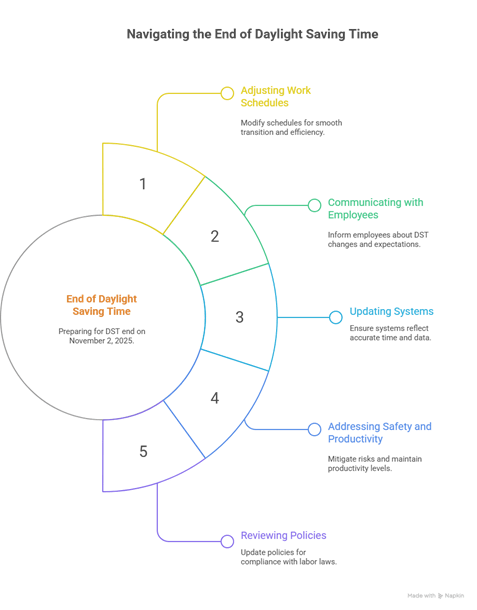
What Employers Should Do for Daylight Saving Time in November 2025


Employer Considerations:

  1. Adjust Work Schedules:
    • Since clocks fall back one hour at 2 a.m. on November 2, employees working overnight shifts that span this time will effectively work an extra hour.
    • Employers should decide how to handle this extra hour—whether to pay for it, treat it as overtime, or adjust schedules accordingly.
  2. Communicate Clearly:
    • Notify employees ahead of time about the time change and how it affects their work hours.
    • Remind employees to set their clocks back before going to bed on Saturday, November 1, 2025, to avoid confusion.
  3. Update Systems and Devices:
    • Many digital devices update automatically, but analog clocks, ovens, and some machinery may need manual adjustment.
    • Employers should ensure all timekeeping systems, security systems, and scheduling software reflect the time change accurately.
  4. Consider Safety and Productivity:
    • The time change can affect sleep patterns and alertness. Employers might want to be mindful of potential impacts on employee safety and productivity immediately following the time change 
  5. Review Policies:
    • Check company policies regarding pay and hours worked during DST changes to ensure compliance with labor laws and fairness.

Below are three wage and hour answers, for daylight saving time change(s):
Pay and Hours Worked:  Employers are required to pay employees for all hours worked.  Nonexempt employees working last night at 2:00 a.m. must be paid one additional hour of pay, unless the start/end times of their shifts are adjusted in anticipation of the time change.  In essence, such an employee will have worked the hour from 1:00 a.m. to 2:00 a.m. twice.”[i]

Overtime:  The one additional hour must be considered into the overtime compensation/calculation for the entire week.  If the nonexempt employee is scheduled for 40-hours this week, the additional hour would put the employee at 41-hours, one hour of overtime, at least time and one-half the normal hourly rate. 

Overtime Rate: “In addition, employers must take this additional hour of work into account when computing the employee’s regular rate of pay for purposes of calculating the employee’s overtime rate.”[ii]

Additionally, ensure that your payroll systems fall back during the time change on Sunday.  I have seen issues with timekeeping and payroll systems not resetting for the one-hour time change, which will cause additional issues when processing payroll. 

Previously, employment law experts told HR Dive that managers should be mindful of giving employees proper break times if shifts encompass daylight saving transitions. So, for example, if supervisors typically rely on computers to automate break times, this would be an instance where manual timekeeping is encouraged.
Additionally, HR should look into whether there are any wage and hour provisions in their workers’ collective bargaining agreement that addresses the daylight-saving time change.

Employers should ensure that they are following any provisions in a collective bargaining agreement that addresses wage and hour provisions for time change. Ultimately, the employment attorney who spoke to HR Dive reaffirmed the DOL’s guidance: Timekeeping is about “staying true” to the hours worked.

Another compliance consideration is workplace safety: A 2018 National Safety Council study found that post-daylight saving transition fatigue leads to an annual uptick in accidents, due to “circadian misalignment” or talent fighting to stay awake.” (HR Dive)

FLSA Hours Worked Advisor
Daylight Saving Time
Most states participate in daylight saving time. Those employees working the graveyard shift when Daylight Saving Time begins work one hour less because the clocks are set ahead one hour. Those employees working the graveyard shift when Daylight Saving Time ends work an extra hour because the clocks are set back one hour at 2:00 a.m.

For example:
The scheduled shift starts at 11:00 p.m. and ends at 7:30 a.m. The next day, your employee works an eight- hour shift and receives a 30-minute lunch break.

  • On Sunday Daylight Saving Time starts at 2:00 a.m., the employee does not work the hours from 2:00 a.m. to 3:00 a.m. because at 2:00 a.m. all of the clocks are turned forward to 3:00 a.m. Thus, on this day the employee only worked 7 hours, even though the schedule was for 8 hours.
  • On the Sunday that Daylight Saving Time ends at 2:00 a.m., the employee works the hour from 1:00 a.m. to 2:00 a.m. twice because at 2:00 a.m. all of the clocks are turned back to 1:00 a.m. Thus, on this day the employee worked 9 hours, even though the schedule only reflected 8 hours.

The FLSA requires that employees must be credited with all of the hours actually worked. Therefore, if the employee is in a work situation similar to that described in the above example, he or she worked 7 hours on the day that Daylight Saving Time begins and 9 hours on the day that Daylight Saving Time ends. This assumes, of course, that the employee actually worked the scheduled shift as in our example.

https://webapps.dol.gov/elaws/whd/flsa/hoursworked/screener11.asp

“Unanticipated challenges”

That extra hour of work can present several unanticipated challenges, in addition to an unpaid hour:

  • Breaks. In states requiring that employees take breaks at a certain point in their shifts, workers may not automatically get that time, says Caroline Brown, of counsel at Fisher Phillips. “For that day, back off of relying on the time keeping computer so much,” Brown suggests, and figure out the time manually.
  • Overtime. If that additional hour puts an employee at more than 40 hours during that workweek, the Fair Labor Standards Act requires the employee be paid overtime. Employees who fall under the “8 and 80” system — or in states that require daily overtime — may be eligible for overtime for that day.
  • Collective Bargaining Agreements. Employers should ensure that they are following any provisions in a collective bargaining agreement that addresses wage and hour provisions for time change.

Making Adjustments
Although appropriate tracking for the seasonal time change is frequently forgotten, it can be easily remedied, says Green.

The best approach is to go back to basics, Brown suggests. “There is a tendency for employers to focus on days and shifts when it comes to wage and hour requirements, when it’s really about staying true to the time of how many hours someone did the work.”

Whether timekeeping is manual or automatic, grab a pen and paper if necessary, and figure out the actual hours for that day, Brown says; “Give that payroll a glance to make sure everything lines up.” The same goes when spring rolls around: an employee working 11 p.m. to 7 a.m. when we turn the clocks forward must be paid for only seven hours of work.

It’s worth noting that not all states and regions observe Daylight Saving Time, but if yours is one that does, be prepared so you — and your employees — can avoid any unpleasant wage and hour surprises.” (HR Dive)

States That Deviate from the Daylight Saving Standard
Note that Arizona (with the exception of the Navajo Nation) and Hawaii do not observe daylight saving time. Not to be outdone, Florida and Nevada have passed bills that would ensure that daylight saving time is observed year-round. Though their respective state legislatures approved these bills, and their governors signed them, they are still awaiting federal approval. And, of course, there’s California, which just a few days after the end of daylight-saving time will vote on a proposition to move the state to year-round daylight-saving time as well. Even if that proposition passes, it will require congressional approval for the change to become permanent.” (JDSUPRA)

Additional Considerations

  1. Ensure timeclocks adjusted.
  2. Camera’s need to align with timeclock.
  3. The payroll smartphone app time alignment
  4. Computer system time updates
  5. Communication on pay and policies.
  6. Smart phones, computers, etc.

Additional Legislative Information:

Introduced in House (01/03/2025)
Sunshine Protection Act of 2025
This bill makes daylight saving time the new, permanent standard time.
States with areas exempt from daylight saving time may choose the standard time for those areas.

https://www.congress.gov/bill/119th-congress/house-bill/139

Eighteen states have enacted legislation or passed resolutions to provide for year-round daylight-saving time if Congress were to allow such a change. Will that eventually happen? Only time will tell.

Daylight-saving State Legislation Link


[i] https://www.shrm.org/resourcesandtools/hr-topics/compensation/pages/daylight-saving-time-wage-hour-problems.aspx
 

[ii] https://www.shrm.org/resourcesandtools/hr-topics/compensation/pages/daylight-saving-time-wage-hour-problems.aspx

Unemployment Benefits Increase 72% in New York, Effective October 1, 2025

As of October 1, 2025, the maximum weekly unemployment benefit in New York will increase from $504 to $869. This is the first increase since 2019, as the state’s unemployment trust fund had a federal debt from the COVID-19 pandemic. 

Key details about the unemployment increase:

·        Maximum weekly benefit: The cap will be raised to $869, an increase of over 70%.

·        Effective date: October 1, 2025.

·        Funding and trust fund: The 2025 state budget included using up to $8 billion from rainy-day funds to pay off the federal debt and return the trust fund to solvency.

·        Benefit indexing: After the initial increase, the maximum benefit will be indexed annually at 50% of the state’s average weekly wage.

·        Employer tax relief: Paying off the federal debt will also eliminate the annual “Interest Assessment Surcharge” for New York businesses.

·        Striking workers: The budget agreement reduces the waiting period for striking workers to receive unemployment benefits from three weeks to two. 

2023 New York State Unemployment Notice Requirement

Beginning November 13, 2023, the law will require every employer who is obligated to contribute to the unemployment insurance system to notify their employees about their right to apply for unemployment benefits, when applicable.

That statute will now require employers to provide specific notifications to employees regarding their potential eligibility for unemployment benefits.

New York employers have already been expected to provide employees with a Record of Employment upon separation, the law will now require notification in more situations that don’t necessarily involve termination of employment.

When Is the Unemployment Notice Required?

Employers must provide this unemployment notice:

  • At the time of each permanent or indefinite separation from employment.
  • During a reduction in hours.
  • During a temporary separation.
  • For any other interruption of continued employment resulting in total or partial unemployment.

Unfortunately, the above terms are not specifically defined in the amended statute.

What Should the Unemployment Notice Include?

The required notice must be in writing and should be on a form either furnished or approved by the New York Department of Labor.

The notice must contain:

  1. Employer’s Details: This includes the employer’s name and registration number.
  2. Address for Communication: The notice should specify the address of the employer to which any request for remuneration and employment information regarding the employee should be directed.
  3. Additional Information: Any other information as required by the Department of Labor should also be included.

So far, the DOL has not yet released the required notice form. It is hoped that when it does so, the DOL will better explain the circumstances where notice must be provided short of permanent employment separation.

Implications for Employers

This new unemployment notice provision emphasizes the state’s commitment to ensuring that employees are well-informed about their rights. For employers, it means:

  • Being Proactive: Employers should be ready with the required forms and processes in place by November 13, 2023.
  • Training HR Teams: HR teams should be trained to understand the nuances of the new unemployment notice provision and ensure compliance.
  • Avoiding Penalties: Non-compliance could lead to negative consequences regarding unemployment claims. It’s crucial for employers to adhere to these new unemployment notice requirements diligently. (Horton PLLC)

NYS Assembly Bill

NYS Unemployment Website

Advice on Fighting Unemployment Claims

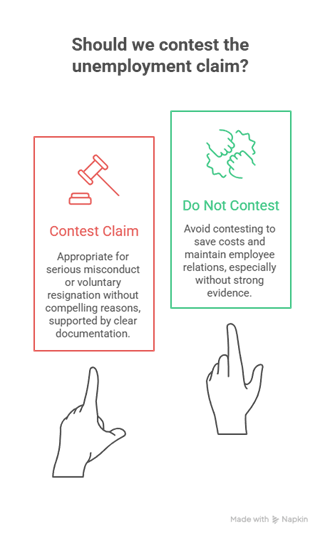
When Should Employers Contest Unemployment Claims?

  • Serious Misconduct or Voluntary Quit:
    Employers should generally only contest claims if the employee was terminated for serious misconduct (such as theft, violence, or repeated policy violations) or if the employee quit without a compelling reason. Contesting claims in other situations can be time-consuming and may not be successful.
  • Clear Documentation:
    Only proceed if you have solid documentation supporting your case, such as written warnings, termination letters, or evidence of policy violations.

Why Employers Should Rarely Fight Claims

  • Cost vs. Benefit:
    While unjustified claims can increase your unemployment insurance costs, fighting every claim is rarely cost-effective. Most HR experts recommend contesting only in clear-cut cases of misconduct or fraud.
  • Employee Relations:
    Aggressively contesting claims can harm your reputation and employee morale. It’s often better to reserve challenges for the most egregious cases.

How to Contest an Unemployment Claim

  1. Respond Promptly:
    When you receive notice of a claim, respond within the required timeframe and provide all requested information.
  2. Present Evidence:
    Be prepared to present evidence that the employee was terminated for misconduct or quit without good cause. This may include documentation of the employee’s duties, violations, and any warnings given.
  3. Participate in Hearings:
    If the claim is appealed, you may need to participate in a hearing. Bring witnesses and documentation to support your case.
  4. Be Honest and Consistent:
    Ensure all statements and evidence are truthful and consistent with previous records. Inconsistencies can undermine your credibility.

Best Practices

  • Maintain Thorough Records:
    Keep detailed records of employee performance, disciplinary actions, and reasons for separation.
  • Evaluate Each Case Individually:
    Assess the merits of each claim before deciding to contest. Blanket opposition to all claims is discouraged.
  • Consult Legal or HR Experts:
    When in doubt, seek advice from HR professionals or legal counsel to ensure compliance with state laws and best practices.
StateMaximum Unemployment BenefitState Agency Website and Phone Number
Alabama$275/weekAlabama DOL
(334)242-8025
Alaska$370/weekAlaska DOL
(907)269-4700
Arizona$240/weekArizona: How to Apply for UI
(877)600-2722
Arkansas$451/weekArkansas DOL
(501)682-2121
California$750/week through September 6, 2021
After this, it will come down to $451/week
California DOL
1(800)300-5616
Colorado$918/week through September 6, 2021
After this, it will come down to $618/week
Colorado DOL
(303)318-8000
Connecticut$949/week through September 6, 2021
After this, it will come down to $649/week
Connecticut DOL
(203)941-6868
Delaware$700/week through September 6, 2021
Then it will come down to $400/week
Delaware DOL
1(800)794-3032
D.C.$744/week through September 6, 2021
After this, it will come down to $444/week
D.C. DOES
(202)724-7000
Florida$275/weekFlorida DEO
1(833)352-7759
Georgia$365/weekGeorgia DOL
1(877)709-8185
Hawaii$948/week through September 6, 2021
After this, it will come down to $648/week
Hawaii DOL
Oahu: (808)586-8970
Hilo: (808)974-4086
Kona: (808)322-4822
Maui: (808)984-8400
Kauai: (808)274-3043
Idaho$463/weekIdaho DOL
(208)332-8942
Illinois$784/week through September 6, 2021
After this, it will come down to $484/week
Illinois DES
1(800)244-5631
Indiana$690/week through September 6, 2021
After this, it will come down to $390/week
Indiana DOL
1(800)891-6499
Iowa$481/weekIowa Workforce Development
1(866)239-0843
Kansas$788/week through September 6, 2021
After this, it will come down to $488/week
Kansas DOL
1(800)292-6333
Kentucky$852/week through September 6, 2021
After this, it will come down to $552/week
Kentucky Career Center
(502)875-0442
LouisianaLouisiana Workforce Commission
1(866)783-5567
Maine$745/week through September 6, 2021
After this, it will come down to $445/week
Maine DOL
1(800)593-7660
Maryland$730/week through September 6, 2021
After this, it will come to $430/week
Maryland DOL
Contact Info
Massachusetts$1,123/week through September 6, 2021
After this, it will come down to $823/week
Mass DUA
1(877)636-6800
Michigan$662/week through September 6, 2021
After this, it will come down to $362/week
Michigan Department of Labor and Opportunity
Contact Info
Minnesota$1,040/week through September 6, 2021
After this, it will come down to $740/week
Minnesota Unemployment Insurance
1-877-898-9090
Mississippi$235/weekMississippi DES
601-321-6000
Missouri$320/weekMissouri DOL
Contact Info
Montana$872/week through June 27, 2021
After this, it will come down to $552/week
Montana Unemployment Insurance Division
406-444-2545
Nebraska$440/weekNE Works
855-995-8863
Nevada$769/week through September 6, 2021
After this, it will come down to $469/week
Nevada DOL
Contact Info
New Hampshire$427/weekNew Hampshire Workforce Connect
1(800)852-3400
New Jersey$1,013/week through September 6, 2021
After this, it will come down to $713/week
New Jersey DOL
Contact Info
New Mexico$811/week through September 6, 2021
After this, it will come down to $511/week
New Mexico Workforce Connection
Contact Info
New York$804/week through September 6, 2021
After this, it will come down to $504/week
New York DOL
1(888)581-5812
North Carolina$650/week through September 6, 2021
After this, it will come down to $350/week
North Carolina DES
1(888)737-0259
North Dakota$618/weekNorth Dakota DOL
(701) 328-4995
Ohio$498/weekOhio Department of Job and Family Services
1(877)644-6562
Oklahoma$539/weekOklahoma ESC
1(800)555-1554
Oregon$973/week through September 6, 2021
After this, it will come down to $673/week
Oregon Employment Department
1(877)345-3484
Pennsylvania$872/week through September 6, 2021
After this, it will come down to $572/week
Pennsylvania Office of Unemployment Compensation
Contact Info
Rhode Island$886/week through September 6, 2021
After this, it will come down to $586/week
Rhode Island DLT
(401)415-6772
South Carolina$326/weekSouth Carolina Department of Employment and Workforce
1(866)831-1724
South Dakota$428/weekSouth Dakota Department of Labor & Regulation
(605)626-2452
Tennessee$275/weekTennessee Department of Labor & Workforce Development
1(877)813-0950
Texas$535/weekTexas Workforce Commission
1(800)628-5115
Utah$580/weekUtah Workforce Services
(801)526-9675
Vermont$831/week through September 6, 2021
After this, it will come down to $531/week
Vermont DOL
1(877) 214-3332
Virginia$678/week through September 6, 2021
After this, it will come down to $378/week
Virginia Employment Commission
Contact Info
Washington$1,144/week through September 6, 2021
After this, it will come down to $844/week
Washington Employment Security Department
1(800)318-6022
West Virginia$424/weekWorkforce West Virginia
1(800)379-1032
Wisconsin$670/week through September 6, 2021
After this, it will come down to $370/week
Wisconsin Department of Workforce Development
(608) 266-3131
Wyoming$508/weekWYUI
(307)473-3789

If the employee is the one asking for time off, though, the requirement is not triggered. This can include a leave of absence, vacation, parental leave, personal leave, or any other type of paid or unpaid leave.

https://gusto.com/resources/articles/benefits/covid-state-unemployment-insurance-benefits

2025-2026 Employee Handbook Review & Updates

  1. Remote Work Policies
    With remote and hybrid work becoming more common, updating policies to clearly define expectations, eligibility, and equipment use is essential.
  2. Anti-Harassment and Discrimination Practices
    • Incorporate updated anti-harassment policies reflecting recent legal developments.
    • The EEOC is focusing on discrimination claims related to hair texture and style, so grooming and dress code policies should be reviewed and updated accordingly .
    • Use inclusive language throughout the handbook, such as gender-neutral pronouns (they/them), to foster inclusivity 
  3. Employee Classifications and Wage Laws
    • Review classifications under the Fair Labor Standards Act (FLSA) to ensure proper exemption status.
    • Stay current with state-specific wage and hour laws, including paid time off and leave policies 
  4. Paid Family and Medical Leave
    • Be aware of state-specific changes, such as Maryland delaying its Paid Family and Medical Leave program contributions until July 1, 2025, with benefits starting July 1, 2026 
  5. Pregnancy Accommodations
    • Update policies to comply with evolving pregnancy accommodation laws and ensure clear procedures for requesting accommodations.
  6. State-Specific Legal Changes
    • California employers should note changes affecting non-discrimination, leave, and vacation policies effective January 2025.
    • New York and New Jersey employers must incorporate recent federal and state legal developments into their handbooks .
  7. Company Culture and Compliance Balance
    • While compliance is critical, also ensure the handbook reflects your organization’s culture and values to engage employees effectively 
  8. General Policy Reviews
    • Regularly review key policies such as leave, attendance, workplace conduct, and disciplinary procedures to maintain compliance and clarity.

New York State Handbook Review & Update Considerations

  1. Paid Family Leave and Paid Sick Leave:
    New York State has been expanding its paid family leave and paid sick leave laws. Ensure your handbook reflects the latest eligibility, benefits, and procedures for requesting leave under these laws.
  2. Minimum Wage and Overtime Rules:
    New York State and many localities (e.g., NYC, Long Island) have scheduled minimum wage increases. Confirm that wage policies and overtime eligibility align with the current rates and thresholds effective in 2025-2026.
  3. Anti-Discrimination and Harassment Policies:
    Updates to reflect any new protected classes or changes in reporting procedures under New York State Human Rights Law and recent case law. Training requirements for harassment prevention may also have changed.
  4. Workplace Safety and COVID-19 Policies:
    While COVID-19 emergency rules have relaxed, some employers maintain policies on vaccination, testing, or remote work. Review any state or local health guidance that might affect workplace safety protocols.
  5. Employee Classification and Wage Transparency:
    New York has laws addressing gig workers, independent contractors, and wage transparency. Ensure handbook language clarifies employee status and complies with disclosure requirements.
  6. Leave for Voting, Jury Duty, and Military Service:
    Confirm that leave policies comply with New York State laws protecting these rights.
  7. Use of Technology and Social Media:
    Update policies on acceptable use of company devices, data privacy, and social media conduct, reflecting evolving norms and legal standards.

This is a shortlist of potential sections to review and revise in most employee handbooks.  Continue to review local and state changes as well, when reviewing and updating employee handbooks.  Communication, training and setting the expectations is necessary with any organizational change, including employee handbooks.

The EEOC and Fair Employment Practice Agencies (FEPAs) “Work Sharing Agreement”

“Many states, counties, cities, and towns have their own laws prohibiting discrimination, as well as agencies responsible for enforcing those laws. We call these state and local agencies “Fair Employment Practices Agencies” (FEPAs). Usually the laws enforced by these agencies are similar to those enforced by EEOC.”[i]   States and cities (including New York State and New York City) have entered into a work sharing agreement with the EEOC.  What does this mean for our organizations?  Does it have an impact on how we should operate or how we manage workplace allegations and investigations?


Work Sharing Agreements:

  1. Under these terms, both the EEOC and state authority (NYS Division of Human Rights) or City (NYC) can designate the other as its agent for receipt of charges.
  • What does this mean?  If a charge is received by one partner under the agreement, it is deemed received by the other.
  • “Moreover, these agreements typically proved that the state entity can waive its rights to process such a charge referred to it by the EEOC, which as the effect of permitting the federal agency to process the charge without waiting for the 60-day period to expire.
  • Many such agreements have an automatic waiver provision, which means that as soon as the charge is filed with the EEOC, the EEOC can begin processing it without going through the motions of referring it back to the state authority.
  • It also means that the grievant need not file with the state agency within 240 days of the unlawful practice, but, instead, has a full 300 days within which to take the initial step of filing a charge with the federal agency.”[i]
  • “You can file your charge with either the EEOC or with a Fair Employment Practices Agency.  If the charge is initially filed with EEOC and the charge is also covered by state or local law, EEOC dual files the charge with the state or local FEPA (meaning the FEPA will receive a copy of the charge), but ordinarily retains the charge for processing.
  • If a FEPA has a contract with EEOC, a Charging Party may request that the EEOC review the determination of the FEPA. EEOC will conduct a review only if the request is submitted in writing within fifteen (15) days of receipt of the FEPA’s determination.”[ii]

Confused yet?  To summarize, New York State and New York City have a working agreement with the EEOC, if a charge is filed, it is sent with the state or city, it is sent to the EEOC as well, if it falls within the 300-day requirement, under current federal law.  “The EEOC contracts with approximately 90 FEPAs nationwide to process more than 48,000 discrimination charges annually.”[iii]

EEOC State and Local Agencies Work Sharing Link

Fair Employment Practices Agencies (FEPAs) and Dual Filing

Summary of the Agreement’s Impact

In summary, New York State and New York City have a working agreement with the EEOC. If a charge is filed, it is shared with both the state or city agency and the EEOC, provided it falls within the 300-day requirement under current federal law. The EEOC contracts with approximately 90 FEPAs nationwide to process more than 48,000 discrimination charges annually.

Implications for Organizations

So, what does all of this mean for organizations operating in areas with work sharing agreements? Here are some key implications:

  • Awareness of Extended Filing Deadlines: Organizations must be aware that employees have 300 days to file a charge with the EEOC, even if the state or local filing deadline is shorter. This extended timeframe can impact internal investigation timelines and record retention policies.
  • Potential for Dual Investigations: While the EEOC typically retains the charge for processing, organizations should be prepared for the possibility of parallel investigations by both the EEOC and the relevant FEPA. Coordination with legal counsel is crucial in such situations.
  • Importance of Thorough Internal Investigations: Given the potential for charges to be filed with either the EEOC or a FEPA, organizations should conduct thorough and impartial internal investigations of any workplace allegations of discrimination or harassment. A well-documented investigation can be a valuable defense in the event of a formal charge.
  • Review of Policies and Procedures: Organizations should review their anti-discrimination and harassment policies and procedures to ensure they are up-to-date and compliant with both federal and state/local laws. This includes ensuring that employees are aware of their rights and responsibilities under these laws.
  • Training for Managers and Employees: Regular training for managers and employees on anti-discrimination and harassment laws is essential. This training should cover topics such as recognizing and preventing discrimination, handling complaints, and conducting investigations.
  • Consistent Application of Policies: It is crucial to apply policies and procedures consistently across the organization. Inconsistent application can lead to claims of discrimination and undermine the organization’s defense in the event of a charge.
  • Documentation: Maintain thorough and accurate records of all complaints, investigations, and disciplinary actions. This documentation can be critical in defending against discrimination charges.
  • Legal Counsel: Consult with legal counsel experienced in employment law to ensure compliance with all applicable federal, state, and local laws. Legal counsel can also provide guidance on handling specific charges and investigations.

[i] Joel Wm. Friedman, Examples & Explanations: Employment Discrimination. Third Edition (Wolters Kluwer 2017).

[ii] https://www.eeoc.gov/employees/fepa.cfm

[iii] https://www.eeoc.gov/field/newyork/fepa.cfm

[i] https://www.eeoc.gov/employees/fepa.cfm

2025 Updated Wage Transparency Laws and Regulations

2025 State Changes

States with Wage Transparency Laws:

  • California: Requires employers to include salary ranges in job postings. 
  • Colorado: Enacted the Equal Pay for Equal Work Act, which includes pay transparency requirements. 
  • Connecticut: Requires employers to disclose wage ranges in job postings and prohibits seeking salary history. 
  • Hawaii: Requires employers to disclose salary ranges in job postings. 
  • Illinois: Has pay transparency requirements, with some guidance rolling out in 2025. 
  • Maryland: Requires employers to disclose wage ranges in job postings. 
  • Massachusetts: Requires employers with 100+ employees to submit wage data reports annually. 
  • Minnesota: Has pay transparency requirements, including disclosure of salary ranges. 
  • Nevada: Requires employers to disclose wage or salary ranges. 
  • New Jersey: Has pay transparency requirements. 
  • New York: Requires employers to disclose salary ranges in job postings. 
  • Rhode Island: Requires employers to provide the wage range prior to discussing compensation and upon request. 
  • Vermont: Requires employers to disclose hourly wage or salary, or range, in job postings. 
  • Washington: Requires employers to include salary ranges in job postings. 
  • Washington D.C.: Requires employers to disclose wage ranges in job postings. 

Pay Transparency Laws by State: Effective Dates

Below is an at-a-glance list of the states and corresponding effective dates that require disclosure of pay range under certain circumstances. Each law is different, so employers should review each specific jurisdiction’s requirements to ensure compliance:

  • California – effective Jan. 1, 2023
  • Colorado – effective Jan. 1, 2021
  • Connecticut – effective Oct. 1, 2021
  • District of Columbia – effective June 30, 2024
  • Hawaii – effective Jan. 1, 2024
  • Illinois – effective Jan. 1, 2025
  • Maryland – effective Oct. 1, 2020
  • Massachusetts – effective Oct. 29, 2025
  • Minnesota – effective Jan. 1, 2025
  • New Jersey – statewide law effective June 1, 2025
  • New York – effective Sept. 17, 2023
  • Nevada – effective Oct. 1, 2021
  • Rhode Island – effective Jan. 1, 2023
  • Vermont – effective July 31, 2025
  • Washington – effective Jan. 1, 2023

As of this writing, several jurisdictions in the U.S. have some form of a pay transparency law. But more could be on the horizon.

Of course, as with all aspects of employment law, each jurisdiction handles these requirements differently.

Starting at a high level, some states have laws that require employers to disclose the pay range for a position if the applicant asks for it:

  • California
  • Colorado
  • Connecticut
  • Maryland
  • Massachusetts – effective as of Oct. 29, 2025
  • Minnesota
  • Nevada
  • Rhode Island

Even among these states, there is some variation in how they implement their pay transparency laws.

Salary History Bans in the United States

Salary history bans are adjacent to pay transparency laws and generally prohibit employers from asking job applicants about their past or current pay.

These laws preclude employers from relying on pay history to set compensation, part of the growing employment law sector related to the #MeToo movement.

Employers can usually ask for pay expectations but not actual pay history.

What states have salary history bans?

States, or jurisdictions within them, that have salary history bans include:

  • Alabama
  • California
  • Colorado
  • Connecticut
  • Delaware
  • District of Columbia
  • Hawaii
  • Illinois
  • Maine
  • Maryland
  • Massachusetts
  • Minnesota
  • Missouri
  • Nevada
  • New Jersey
  • New York State
  • Ohio (only Toledo and Cincinnati)
  • Oregon
  • Pennsylvania (Philadelphia only)
  • Rhode Island
  • Vermont
  • Washington

https://www.govdocs.com/pay-transparency-laws/

Additional Consideration

Best Practices for Employers

1. Regularly Review and Update Compensation Policies

  • Conduct regular audits of pay practices to ensure compliance and identify any unjustified pay disparities 
  • Establish clear, documented guidelines for setting and communicating pay ranges.

2. Standardize Job Postings

  • Include required salary ranges and compensation details in all job postings, especially for roles that could be performed in states with transparency laws.
  • For multistate employers, consider adopting the strictest applicable standard to streamline compliance 

3. Train Managers and HR Staff

  • Ensure those involved in hiring and compensation decisions understand the requirements and are prepared to answer questions about pay transparency 

4. Prepare for Employee Inquiries

  • Be ready to provide pay scale information to current employees and applicants upon request, as required by law 

 5. Monitor Legal Developments

  • Stay informed about new and evolving wage transparency laws, as more states and localities are expected to adopt similar requirements in the coming years 

Strategic Opportunities

1. Building Trust and Employer Brand

  • Transparent pay practices can enhance employee trust, improve retention, and make the organization more attractive to top talent 

2. Promoting Pay Equity

  • Wage transparency helps identify and address pay gaps, supporting diversity, equity, and inclusion goals 

2023 New York State Wage Transparency September 17, 2023

“As a reminder, the pay transparency law, which is codified at Section 194-b of the New York Labor Law, will require employers with four or more employees to include the following whenever they “advertise” for a job, promotion, or transfer opportunity:

  • The compensation or “range of compensation” for the job, promotion, or transfer opportunity. 
  • The job description for the job, promotion, or transfer opportunity, if one exists.

The original legislation did not define the term “advertise.” The amendment adds the following definition:

“[A]dvertise” shall mean to make available to a pool of potential applicants for internal or public viewing, including electronically, a written description of an employment opportunity.

This is a broad definition and will likely encompass internal postings on an intranet or job board, postings in newspapers and “want ads,” as well as electronic postings on the employer’s website or job posting sites such as Indeed.com or ZipRecruiter.” (https://www.hodgsonruss.com/newsroom-publications-14258.html)

“On Dec. 21, 2022, Gov. Kathy Hochul signed the long-anticipated New York State pay transparency bill into law. The bill amends New York State Labor Law by adding a new section 194-b, which takes effect on Sept. 17, 2023. Labor Law § 194-b continues a recent trend toward pay transparency both nationally and locally, including similar laws in New York City, Albany County, Westchester County and Ithaca.

Employers subject to the law are broadly defined to include nearly every entity with four or more employees, as well as agents and recruiters. Only temporary help firms, as defined under New York State Labor Law § 916(5), are exempt.[1]

Similar to other pay transparency laws, Labor Law § 194-b requires employers to disclose an amount or a range of compensation for any open job, promotion or transfer opportunity that can or will be performed, at least in part, in New York State. The law defines “range of compensation” as “the minimum and maximum annual salary or hourly range of compensation . . . that the employer in good faith believes to be accurate at the time of the posting of an advertisement” for the job, promotion or transfer opportunity. Advertisements for jobs, promotions or transfer opportunities that are paid solely on commission must disclose that in writing. Additionally, the law requires employers to post a job description if one exists.

Labor Law § 194-b does not define “advertisement,” so the breadth of the law’s application to activities such as direct recruitment and internal promotion is unclear. Presumably, the Commissioner of Labor will clarify the scope of coverage by regulations, which the law directs the Commissioner to promulgate. 

Employers are required to keep and maintain records in connection to the law, including the history of compensation ranges for each job, promotion or transfer opportunity and the job descriptions for these positions, if such job descriptions exist.

Any person claiming to be aggrieved under Labor Law § 194-b may file a complaint with the Department of Labor, which has the authority to impose civil penalties of up to three thousand dollars for violations of the law or forthcoming regulations. Employers are prohibited from refusing to interview, hire, promote, employ or otherwise retaliate against an applicant or current employee for exercising any rights under this new law.

Finally, Labor Law § 194-b contains a provision stating that it shall not be construed or interpreted to supersede or preempt any local law, rules, or regulation. Most of the existing local pay transparency laws in New York failed to predict a parallel state law (despite the fact that one had already passed in the legislature), so employers subject to these laws will have to comply with overlapping obligations unless the local jurisdictions yield. The Westchester County Salary Transparency Law is the outlier and expressly gives way to “substantially similar” state legislation.” (Bond)

May 12, 2022, the Salary Transparency Law was enacted in New York City, which was postponed to the effective date of November 1, 2022. 

“In addition to employers, 134-A specifies that employment agencies, and employees or agents thereof, must also include a salary range or hourly wage range in each advertised position, promotion, or transfer opportunity. Job advertisements for “temporary employment at temporary help firms” are still exempted from the law. Temporary help firms are defined as businesses that recruit and hire their own employees and assign those employees to perform work at or perform services for other organizations or businesses.” (Littler)

  1. “The civil penalty for the first violation will be $0 if the employer cures the violation within 30 days of receipt of a complaint. The proof of cure may be submitted either electronically or in person and is deemed an admission of liability by the employer.
  2. In line with the recent CCHR guidance (which has now been updated), the law would apply to job listings for both salaried and hourly positions, and would not apply to any position “that cannot or will not be performed, at least in part, in the city of New York.”
  3. While an individual may only file a lawsuit based on a violation arising from an advertisement by their current employer, any aggrieved person may file a complaint with the Commission, regardless of whether the alleged violator is the grievant’s current employer.” (Bond)

New York Wage Transparency Law

As assumed, on June 3, 2022, New York State passed a similar law on wage transparency. 

“The new law would require covered employers to disclose compensation or a range of compensation to applicants and employees upon issuing an employment opportunity for internal or public viewing, or upon employee request. The Bill is intended to enhance transparency around compensation and reducing any existing wage disparities among employees.

The Bill defines a covered employer as: (i) “any person, corporation, limited liability company, association, labor organization or entity employing four or more employees in any occupation, industry, trade, business or service, or any agent thereof;” and (ii) “any person, corporation, limited liability company, association or entity acting as an employment agent or recruiter, or otherwise connecting applicants with employers, provided that “employer” shall not include a temporary help firm” as the term is defined under New York Labor Law Section 916 (5).

The Bill requires covered employers to disclose the following information in job postings, including for promotions and transfer opportunities, that can or will be performed at least in part in the State of New York:

  1. The compensation or a range of compensation for such job, promotion, or transfer opportunity; and
  2. The job description for such job, promotion, or transfer opportunity, if such description exists.

For positions that are paid solely on commission, compliance with the law’s compensation disclosure requirements can be achieved by providing a written general statement that compensation shall be based on commission.

Additionally, the new law would prohibit employers from refusing to interview, hire, promote, employ or otherwise retaliating against an applicant or current employee for exercising their rights under new Section 194-b. The law would allow individuals aggrieved by a violation to file a complaint with the NYS Department of Labor (NYSDOL). Violations of the any of the requirements of the new law or any subsequently published regulations could result in a civil penalty pursuant to NY Labor Law Section 218 which generally provides civil monetary penalties for non-wage related violations ranging from $1,000 to $3,000, to be assessed by the NYSDOL.

Under the new law, covered employers would also be required to maintain records of compliance, including but not limited to the history of compensation ranges for each job, promotion or transfer opportunity as well as the job descriptions for such positions (if applicable).” (Bond)

If enacted, the proposed bill would take effect 270 days after it becomes law.

These are simple changes to make when posting for openings and recruiting.  Ensure that you are communicating the anticipated changes throughout your organization.  Continue to monitor for any upcoming changes or modifications to the proposed legislation.  These changes are a trend nationally.

Ithaca New York Pay Transparency Law Effective September 1, 2022:
“The City of Ithaca will require employers to disclose the minimum and maximum pay in every job posting, starting September 1. The new city ordinance applies to any employer with more than three permanent workers based in Ithaca. That could also include employers of certain Ithaca-based remote workers.”

Workplace Dating, Leadership Ethics & Love Contracts, Oh My!

In light of recent unfortunate events at a Coldplay Concert, when a CEO and HR Director were caught on a camera moment, ducking and hiding away from the media.  Dating in the workplace is common, every organization should have parameters in place to ensure expectation is set, consequences and clear ethical guidelines are in place.  We have all seen the fallout from the recent events at the Coldplay Concert, the CEO resigns, the HR Director is under investigation and internal workplace ethical credibility is gone.  Ethics starts at the top of the organization, if we don’t follow the mission, vision, values and code of ethics in the organization, why should we expect the workforce to follow anything?  Setting the tone at the top helps drive, culture, communication, internal equity, transparency, trust and open communication throughout the organization. 

Dating in the workplace is a common occurrence, given how much time employees spend together. However, it brings unique challenges and risks that employers must address to maintain a professional, safe, and productive environment.

1. Clear Policies and Guidelines
Employers are increasingly expected to have clear, written policies regarding workplace relationships. These policies typically outline:

  • Disclosure Requirements: Many employers require employees to disclose romantic relationships, especially if there is a reporting relationship or potential conflict of interest. Disclosure allows the employer to manage risks, such as favoritism or conflicts, and to make adjustments if necessary (e.g., changing reporting lines).
  • Prohibited Relationships: Most policies explicitly prohibit relationships between managers and their direct reports to avoid power imbalances and perceptions of favoritism or coercion.
  • Consensual Relationships: Employers emphasize that all relationships must be consensual and free from any form of harassment or coercion. Some require both parties to sign a consensual relationship agreement.

2. Professional Conduct
Employers expect employees to maintain professionalism at all times, which includes:

  • No Public Displays of Affection (PDA): Employees are expected to refrain from PDA or any behavior that could make colleagues uncomfortable.
  • No Favoritism: Employees should avoid any actions that could be perceived as favoritism or bias due to their relationship.
  • Maintaining Boundaries: Personal issues should not spill over into the workplace. If a relationship ends, both parties are expected to remain professional and not disrupt the work environment.

3. Anti-Harassment and Complaint Procedures
Employers are required to have robust anti-harassment policies and complaint procedures:

  • Sexual Harassment Training: Regular training is expected, especially for supervisors, to ensure everyone understands what constitutes harassment and how to report it.
  • Multiple Reporting Channels: Employees should have several avenues to report inappropriate conduct, not just through their direct supervisor.
  • Prompt Investigation: Employers are expected to investigate complaints thoroughly and impartially, taking corrective action if necessary.

4. Confidentiality and Non-Retaliation

  • Confidentiality: Employers stress the importance of keeping personal relationships and related information confidential to protect privacy and prevent gossip.
  • Non-Retaliation: Employees must be protected from retaliation if they report concerns or end a relationship.

5. Consequences for Policy Violations
Violating workplace dating policies can result in disciplinary action, including reassignment or termination, depending on the severity of the infraction.

Key Takeaways for Employees

  • Know Your Company’s Policy: Always check your employee handbook or consult HR before starting a workplace relationship.
  • Disclose When Required: If your company requires disclosure, do so promptly to avoid potential disciplinary action.
  • Maintain Professionalism: Keep your relationship separate from your work life, avoid PDA, and treat your partner and colleagues equally.
  • Understand the Risks: Be aware that workplace relationships can lead to gossip, perceptions of favoritism, and complications if the relationship ends.
  • Seek Support if Needed: If you experience harassment or retaliation, use the reporting channels provided by your employer.

What Are Love Contracts?
love contract—also known as a consensual relationship agreement—is a voluntary document signed by two employees who are in a romantic relationship at work. The contract typically acknowledges that the relationship is voluntary and consensual, and it often outlines expectations for professional conduct in the workplace 

Why Employers Use Love Contracts

  • Legal Protection: Love contracts are primarily used to protect employers from potential legal claims, especially those related to sexual harassment or favoritism. By having both parties acknowledge the consensual nature of the relationship, employers can reduce the risk of later claims that the relationship was unwelcome or coerced 
  • Clarifying Boundaries: These agreements help clarify how the romantic relationship will (and will not) affect the working relationship, which can be especially important if one party supervises the other 
  • Managing Breakups: In the event of a breakup, a love contract can help smooth the transition and set expectations for continued professionalism 

When Are Love Contracts Used?
Love contracts are most commonly used when a workplace romance involves a manager and a subordinate, as this dynamic poses the greatest risk for claims of harassment or favoritism. Most companies do not require love contracts for relationships between employees at the same level.

Ethics in the Workplace
Leadership ethics in the workplace refers to the practice of leaders making decisions and guiding their teams based on moral principles and values, rather than just focusing on profits or personal gain. Ethical leadership is about doing the right thing for the common good, considering the needs of employees, customers, communities, and the organization as a whole.

Core Principles of Ethical Leadership
Ethical leadership is built on several foundational principles:

  • Respect: Ethical leaders value the skills and contributions of others, fostering mutual respect rather than demanding it one-way. This creates healthier workplace relationships and a positive environment 
  • Accountability: Leaders hold themselves responsible for their actions, lead by example, and communicate openly about challenges without shifting blame 
  • Service: Ethical leaders prioritize the well-being of employees, customers, and the community, often engaging in charitable activities and encouraging their teams to do the same 
  • Honesty and Transparency: Open and honest communication builds trust within the organization and with customers, even when addressing difficult or unpopular issues 
  • Justice and Fairness: Ethical leaders ensure fair treatment for everyone, striving for equity and inclusion in decision-making 
  • Community: They view the organization as a community, considering the impact of decisions on all stakeholders and promoting collaboration 

A helpful framework for remembering these principles is the acronym FATHER: Fairness, Accountability, Trust, Honesty, Equality, and Respect.

Why Leadership Ethics Matter

Ethical leadership has significant benefits for organizations:

  • Improved Workplace Culture: Ethical leaders inspire trust, psychological safety, and a sense of belonging, leading to higher employee morale and engagement 
  • Attracting and Retaining Talent: Employees, especially younger generations like Gen Z, are drawn to organizations with strong ethical values and are more likely to stay with such companies 
  • Customer Loyalty: Consumers increasingly prefer to support businesses that demonstrate ethical practices and social responsibility 
  • Risk Reduction: Ethical decision-making minimizes legal issues, fines, and reputational damage 
  • Long-Term Success: Ethical leadership helps prevent scandals and fosters sustainable growth by building loyal partnerships, customers, and employees 

What Should Employers Consider?

  • Reporting Requirements: Love contracts usually require employees to report their relationship to HR, and also to notify HR if the relationship ends 
  • Favoritism Concerns: Even with a love contract, employers must be vigilant about potential claims of favoritism or discrimination from other employees.
  • Policy Integration: Love contracts should be part of a broader workplace romance policy that addresses reporting, confidentiality, and professional conduct.