4 Updates on the 2016 Overtime Rule

On June 30, 2017, the Department of Justice released a brief to the 5th U.S. Circuit Court of Appeals, “that the Department of Labor (DOL) intends to revisit the $47,476 ($913 per-week) salary limit set by the rule through new rule-making.”[i]  Recall from the November 2016 district court ruling, which blocked the overtime rule.  The court blocked the rule based on the lack of authority by the Department of Labor to set any salary-level threshold for the exemptions.  The court case has been delayed since March 2017.  The new administration could set a new direction for the Department of Labor, overtime rule, and salary threshold.

Below are 4 thoughts updates on the 2016 overtime rule:

  1. 3-Part Test: This process to determine exemption has not changed in 75 years.  To be exempt, a worker must satisfy the following; be paid on a salary basis, earn a specified salary and satisfy a duties test.  Reminder the exempt levels for Executive and Administrative professionals in New York State will rise again at the end of 2017.
  2. Potential Changes: During his confirmation hearing, Secretary of Labor Alexander Acosta wants to raise the $23,600 threshold to “somewhere around $33,000.”[ii]
  3. New Rule-making: The Department of Labor will revisit the salary level(s) through the rule-making process.  Under the new administration we could see no need for any courts to evaluate the 2016 rule, blocking the overtime rule and new salary threshold.
  4. Appeals Court: The 2016 case has not been decided yet.  We could still see a ruling from the court system on the salary thresholds blocked in November 2016.  Continue to monitor for any potential updates on this case.

Under the new administration we can expect to see changes to the Department of Labor and potential salary threshold increases.  However, this is a federal threshold.  Remember that state thresholds can be higher than federal thresholds, based on exemption status and the duties tests.  This is comparable to what we see with minimum wage increases, state versus federal.  If you are confused about job classifications, duties tests and threshold levels, ask for guidance.  This legislation will could evolve in the court system or under the new administration.

[i] https://www.shrm.org/resourcesandtools/legal-and-compliance/employment-law/pages/dol-right-to-set-salary-threshold.aspx

[ii] https://www.shrm.org/resourcesandtools/legal-and-compliance/employment-law/pages/dol-right-to-set-salary-threshold.aspx

-Matthew W. Burr 
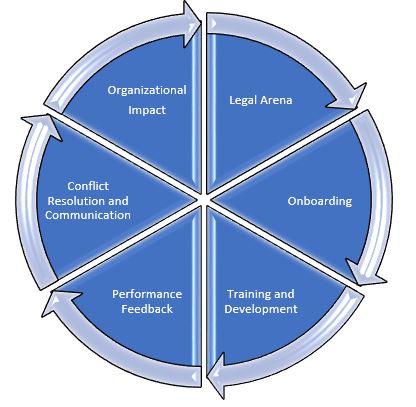
6 Thoughts for Non-HR Professionals

We recently completed an HR training in Dallas, Texas, for Non-HR MBA students.  The training focused on the key areas that HR can and does impact in any organization.  Throughout the training we discussed the importance of aligning the HR department with the needs of the employees and organization; not an easy task, but necessary to move forward and progress.  I know the group of 100 MBA students have a new respect for the many hats that HR professionals continue to wear.

Below are 6 thoughts for non-HR professionals:

  1. Organizational Impact: HR can and does have an impact on the direction and strategy of the organization.  The HR function is as important as any other function within the organization.  Know the impact HR can have on the organizations mission, vision, culture, goals and objectives.
  2. Legal Arena: Labor and employment laws evolve and they change rapidly.  Interpreting and implementing legal change, continues to grow in complexity.  Federal, state and local laws can have an impact on the organization.  Ask questions and never assume you have the answer, legislation is one piece.  Remember the case law and amendments.
  3. Onboarding: Onboarding begins when an applicant applies for a job.  This process is critical to recruit and retain top talent.  Managers, coworkers and direct reports have ownership in ensuring the onboarding processes are organized and aligned with the organizations mission, vision and values.  If you were a new hire, what would you expect from recruiting to hire?  Put yourself in their shoes and reverse engineer a great experience.
  4. Training and Development: Training and development are extremely important pieces of the employment experiences.  Have we asked what training is important to the organization?  To the employee?  What can we afford?  Is there grant money available?  What about leadership development training?  Look for local and national opportunities for industry and profession specific training and development.
  5. Performance Feedback: Yes, employees want feedback!  In fact, continuous coaching and feedback, more than once per year will probably be an effective model.  Goals should be aligned with organizations goals and department goals.  These goals should also include training and development opportunities; degree, certification, leadership development, computer system training, financial, stretch assignments, etc.
  6. Conflict Resolution and Communication: The final thought can be the most difficult.  Resolving conflict and ensuring effective communication.  Never easy, but necessary.  As leader’s we will be in situations that require us to have that “difficult” conversation.  Practicing these conversations is never enjoyable, at times necessary to ensure we are prepared.  Communication is essential.  Know your organization and which communication tools are effective for your workforce.


6ThoughtsforNonHrProfessionals

These six thoughts are just a few of the important pieces of HR that do and will impact your organization.  As leader’s we need to recognize how these pieces effect our mission, vision, values, culture and employees.  Turnover is costly.  Recruiting is costly.  Training and retraining is costly.  Understanding these six areas’ will take work, but being an effective leader takes work.  Ask for help if you need it, people spend their careers specializing in each of the six areas.  Strategic HR can shape the mission statement, vision, culture, employee engagement and values of any of our organizations.

– Matthew Burr, HR Consultant

3 Updates to the New York Paid Family Leave Law

As we move closer to 2018, the regulations on the New York State Paid Family Leave Law will continue to be communicated from the state.  On June 1, 2017, the state released the maximum employee contributions.  This will be the average deduction that will be taken out of the employee’s paycheck.

Below are the 3 updates:

  1. Clarification on the payroll deductions and employer portions. This clarification is not new.  However, I have been asked about the employer portion many times.  The paid family leave “is intended to be funded entirely through employee payroll deductions and employers are not required to fund any portion of this benefit.”[i]
  2. The maximum employee contribution was set at 0.126% on June 1, 2017, of an employee’s weekly wage, up to and not to exceed 0.126% of the NY statewide average weekly wage. The current statewide wage is $1,305.92.  “So, for example, if an employee’s weekly wage amounts to $1,000.00, the maximum payroll deduction for PFL would be $1.26 for that week.”[ii]  If any employee makes more than $1,305.92, the weekly amount will be capped at $1.65.  Multiply the 0.126% by the wage to calculate the deduction.
  3. The statewide average weekly wage is calculated annually on March 31st and will be based on the previous calendar year’s average weekly wage. As wages increase across the state, so will the paid family leave contribution deductions, out of the employee’s paycheck.        

As new information is released, I will send a breakdown of the regulations.  Now is the time to begin reviewing, drafting, updating and revising policies and procedures related to FMLA and Paid Family Leave.  January 1, 2018 is only six short months away.  If you are confused, ask questions and do not assume.  This law is very complex, it continues to change as new regulations are slowly released.

New York State Paid Family Leave Website

Premium Rate for Family Leave Maximum Employee Benefit Contribution Website


Reminder of Previous Information: 

[iii]


Want to learn more? Check out the upcoming trainings I will be conducting at Elmira College, Corning Community College (CCC), 24/7 Compliance and Compliance Online  in July & August:

Elmira College: SHRM Certification Exam Prep Course- September through November

Upcoming Corning Community College Training’s

247 Compliance: Performance of Dashboard Using KPIs and Designing


– Matthew Burr, HR Consultant


[i] https://www.bsk.com/media-center/3723-labor-employment-new-york-sets-maximum-employee-contribution-paid-family


[ii] https://www.bsk.com/media-center/3723-labor-employment-new-york-sets-maximum-employee-contribution-paid-family


[iii] Guardian PPT Training Slides