Mathew W. Burr, MJ-LEL, MBA, MHRIR, GPHR, SHRM-SCP, SPHR, CPHR-INT, Chartered MCIPD
Lean Six Sigma Black Belt
ABOUT:
Matthew Burr has over 18-years of experience working in the human resources field, starting his career as an Industrial Relations Intern at Kennedy Valve Manufacturing to most recently founding and managing a human resource consulting company; Burr Consulting, LLC, Talentscape, LLC and Co-Owner of Labor Love, a Labor, and Employment Law poster printing company. Prior to founding the consulting firm, the majority of his career was heavy industry manufacturing and healthcare. He specializes in compliance auditing, training labor and employment law, conflict resolution, performance management, labor, and employment relations. Matthew has a generalist background in HR and operations, while providing strategic HR and operational solutions to his clients, focusing on small and medium sized organizations. He works as an Adjunct at Alfred State University, Tompkins Cortland Community College, and Montgomery Community College. He successfully designed an HR Concentration in the business management major that aligned with both SHRM and HRCI certifications, providing opportunities for students to sit for both the SHRM-CP and aPHR certifications upon completion of the degree, concentration, and internship hours as an Assistant Professor of Management at Elmira College (Retired January 2022). Matthew is also the SHRM Certification Exam Instructor, with a current pass rate of 92% on the SHRM-SCP and 83% pass rate on the SHRM-CP and a combined 88% on both exams over a 7-year period of instructing the course (Elmira College, Collin College & The College of St. Rose). Matthew works as a trainer at Tompkins Cortland Community College, Corning Community College, Broome Community College, and HR Instructor for Certification Preparation for the Human Resource Certification Institute (HRCI). He also acts as an On-Call Mediator and Factfinder through the Public Employment Relations Board in New York State, working with public sector employers and labor unions.
PUBLICATIONS:
Matthew has over 70+ publications including, American Bar Association (ABA) Experience Magazine, Cornell HR Review, Business Insider, New York State Bar Association (NYSBA), PayScale, Society of Human Resource Management (SHRM), and Expert 360 (in Australia). In early 2017, he published his first book, “$74,000 in 24 Months: How I killed my student loans (and you can too!),” proceeded by his second book, which was published in January 2021, “Slay the Student Loan Dragon: Tips and Tricks on How to Conquer the Student Loan Game” and his most recent book, “Unbox Your HR Career” in July 2023.
VOLUNTEER WORK:
Matthew is currently the New York State Society of Human Resource Management (NYSSHRM) District-Director.
EDUCATION & TRAINING:
Additional Training & Development:
SHRM Workplace Coaching and Mentoring Recertification Program, 2020
SHRM Foundation Employing Abilities @Work Certificate, 2020
SHRM Foundation Veterans at Work Certificate Program, 2018
Delta County Chamber of Commerce: Delta Force Leadership Program, 2013
FEATURED IN & ON:
Matthew was featured on CNN Money, Fast Company, Fits Small Business, Fox News, Magnify Money, Monster.com, My Twin Tiers, Namely, Student Loan Hero, Smart Sheet and CEO Blog Nation, Human Resource Certification Institute (HRCI), Society of Human Resource Management (SHRM).
Burr Consulting, LLC Capabilities Statement
General Information:
Burr Consulting, LLC
Owner: Matthew W. Burr
Mission Statement:
“Strategically Aligning HR as a Partner for the Success of Your Business”
Contact Information:
Burr Consulting, LLC
What's New in HR Blog
Talentscape, LLC
Labor Love, LLC (Labor Posters)
The HR Support Center
The Upstate HR Podcast
(607)227-4386
Matthew@Burrconsultingllc.com
Facebook: Burr Consulting, LLC
LinkedIn: Burr Consulting, LLC
Twitter: @Burrconsulting
Online Certification Verification: Credibly
Dun & Bradstreet (D&B) Number: 080776443
NAICS Codes: 541612, 923130, 54161, 541611,
541613, 611430, 541618, 561312, 561311
SIC: 8742, 8748, 9441, 8748001, 8748026
Our Services
HR MANAGEMENT
New Hire Orientation; Temporary HR Support; Recruiting and Application Tracking; HR Compliance (ADA, FMLA); Employee Handbook; Policy and Procedure; HRIS; HR Audits; Job Profile Design and Revision; HR Key Performance Indicators; EEO Reporting and Classification; State Unemployment Insurance Services
TRAINING & TRAINING DEVELOPMENT
Organizational Development; Employee Relations; Workplace Violence; Harassment & Sexual Harassment; Union Awareness; Managerial
EMPLOYEE & LABOR RELATIONS
Employee Relations Training; Conflict Resolution; Mentoring; Workplace Investigations; Labor Contract Costing; Mediation & Arbitration Prep; Fact-Finding; Workplace Investigations; Coaching & Counseling; Performance Reviews; Contingency Plan Development; Contingency Plan Training; State of New York Public Employment Relations Board (PERB)PERB Mediation and Fact-Finding Panels (Albany, NY covering the Elmira, NY Area)
HIRING & RECRUITMENT
Applicant Tracking Systems; Metric Development; Interview Training; Workforce Planning; Recruitment; Interviews; Job Offers; New Hire Process
POLICY & COMPENSATION
Group Plans – Healthcare, Dental, Vision, Group Life, Short- and Long-Term Disability; Retirement – 401(k), Profit Sharing, Roth; Workers Compensation; Total Compensation Design and Strategy; Deferred Compensation Plans; Salary Surveys; Reward Systems; Online Payroll; Customized Payroll Processing; Employee Self Service; Customized Reporting
HR COMPLIANCE MATERIALS
Burr Consulting, LLC is excited to announce a new partnership with Labor Love LLC, expanding our services to include HR printed materials compliant with industry standards.
Always opportunity to continue to build culture, strategy and partnerships.
Benefits for Employers
1. Harnessing AI to Revolutionize HR
AI Strategy: HR leaders are expected to craft and implement a clearly defined, HR-focused AI strategy. This includes leveraging AI for talent management, recruitment, and employee experience, while ensuring ethical and responsible use
AI’s Impact on Work: There is a strong emphasis on taking an enterprise-wide view of AI’s impact, not just on processes but also on how it changes leadership roles, employee expectations, and organizational culture
AI Agents: The adoption of AI agents is already transforming HR, making it crucial for HR consultants to guide organizations through this technological shift
2. Adapting to Shifting Talent Models
Agile, Multidisciplinary Teams: Organizations are moving away from traditional HR structures, forming agile pods that focus on priority areas such as onboarding redesign, retention improvement, and leadership pipeline development
Talent Flexibility: HR must help organizations adapt to new talent models, including gig work, remote/hybrid arrangements, and skills-based hiring
3. Driving Organizational Culture and Change
Culture Evolution: As AI and new talent models disrupt the workplace, evolving organizational culture to support performance, innovation, and adaptability is a top priority
Well-being, Fairness, and Trust: Employees expect organizations to prioritize well-being, fairness, and trust. HR consultants must help leaders balance innovation with a people-first approach
4. Building Alignment, Adaptability, and Trust
Strategic Alignment: HR must ensure that people strategies are tightly aligned with business goals, especially as organizations navigate rapid change
Adaptability: Helping organizations remain agile and responsive to market signals, regulatory changes, and workforce expectations is essential
Trust: Maintaining trust, especially as AI and automation increase is critical for employee engagement and retention
5. Supporting Leadership and Employee Experience
Leadership Development: There is a renewed focus on developing leaders who can manage change, inspire teams, and drive transformation
Employee Experience: HR must continue to enhance the employee experience, from onboarding to career development, ensuring that technology enhances rather than detracts from human connection
Many of our organizations award employees based on length of service, safety-achievement, productivity goals, employee of the month, employee of the year, continuous improvement metrics, lean six sigma, spot bonuses, etc. What are the tax implications on these employer sponsored awards? Does this impact the employee’s end of the year W-2? How much can we give as an award without impact to taxes? Awarding employees for performance is a great idea, if we do this consistent and fairly. As employers, we need to ensure we follow the IRS guidelines on taxation as well.
Below are 6 requirements for employer related awards:
Employers can deduct a maximum amount for a single employee in a single tax year for both service and safety awards is $400 for an unqualified plan and $1,600 for a qualified plan.
A qualified plan will be established if it is written and if the average combined value of service and safety awards per employee in the given tax year does not exceed $400.
The awards must be defined as “tangible personal property.” Award certificates, cards or credits are not eligible unless they are redeemable only for tangible personal property.
Length of service awards are recognitions that many of our organizations award to employees that work for several years. They may be given tax-free to an employee only on a fifth anniversary and then only once every five years after that; ten, fifteen, twenty, etc. The five-year plan is standard for many organizations.
Safety-achievement awards may be given tax-free to no more than 10 percent of eligible employees in any one years.
Productivity awards are never eligible for tax benefits.
Many other restrictions can and do apply to tax implications related to employer related awards. These are federal IRS guidelines, ensure you review any state and local taxation requirements prior to developing a policy or giving an award. Safety awards, length of service, spot bonuses are great options for organizations. However, if we provide a gift card or award to an employee in March and then it shows up on their taxes at the end of the year, the positive momentum can end quick, if the employee was unaware of the added tax accountabilities during the taxation year. Communicate the tax implications upfront to ensure no confusion or negative feedback. Develop a policy and practice that is consistent throughout the organization. Seek guidance on other questions related to employer related awards, the tax laws can be confusing and complex.
In my 10 years conducting compliance audits, I find posting mistakes in almost every organization, regardless of size, location and type (government, for-profit, not-for-profit). Compliance audits are necessary to ensure compliance, postering requirements change throughout the year. Annual subscription will ensure compliance; I can help with an annual subscription for digital and posters!
Identify Required Posters: Create a comprehensive list of all federal, state, and local labor law posters required for each location. Utilize online resources, legal counsel, or labor law poster compliance services to ensure accuracy.Physical Inspection: Conduct a physical inspection of each workplace to verify that all required posters are displayed in conspicuous locations where employees can easily access and read them. Common locations include break rooms, employee entrances, and near-time clocks.Poster Content Review: Carefully examine each poster to ensure it is the most current version. Labor laws are subject to change, and outdated posters can lead to non-compliance. Check for revision dates or contact the relevant government agency to confirm the poster’s validity.Accessibility Assessment: Evaluate the accessibility of the posters for all employees, including those with disabilities. Ensure that posters are displayed at an appropriate height and are readable. Consider providing posters in multiple languages if a significant portion of the workforce speaks a language other than English.Documentation: Maintain detailed records of the audit, including the date of the audit, the locations inspected, the posters reviewed, and any identified deficiencies. This documentation will be valuable for demonstrating compliance and tracking progress in addressing any issues. Penalty ExamplesOccupational Safety and Health Act (OSHA): Up to a $16,550 maximum fine per violation.Employee Polygraph Protection Act (EPPA): Up to a $26,262 maximum fine per violation.Equal Employment Opportunity is the Law (EEOC): Up to $659 per violation.Family and Medical Leave Act (FMLA): Up to $216 per violation for employers with 50 or more employees. How to stay compliant
Display posters correctly: Post all required federal and state posters in a prominent and easily accessible location where employees can see them, such as a break room or time-clock area.
Keep them updated: Replace posters whenever there is a mandatory change in the law.
Provide for remote employees: If your employees work exclusively remotely, you may be able to provide digital copies. However, many federal statutes require both electronic and hard-copy postings, and you should not rely on electronic notices as a complete substitute unless all employees are remote and have easy access to the digital versions.
Check specific requirements: Pay attention to specific requirements, such as the OSHA poster having a minimum paper size of 8.5 by 14 inches.
NYS Requirements “In addition to the increasing number of posters employers are required to physically display, effective December 16, 2022, New York employers must now furnish all employees with digital copies of all required posters via email or by posting them on the employer’s website.
Section 201 of New York’s Labor Law requires employers to furnish employees with “copies or abstracts” of laws, rules, and orders, that are designated by the New York State Department of Labor (NYDOL) as affecting employees.
Traditionally, this obligation was satisfied by an employer posting the copies and abstracts “in a conspicuous place on each floor of the premises.” Indeed, the NYDOL’s guidance has previously indicated that furnishing required notices electronically only may not be sufficient for employers to satisfy their obligations under Section 201. The physical requirement piece of Section 201 has now been confirmed with the latest amendment.
On December 16, 2022, Governor Kathy Hochul signed into law an amendment to Section 201 that expanded the posting requirements. Employers must now:Furnish digital versions of all copies and abstracts required under New York law or the NYDOL’s regulations to all employees through either the employer’s website or by email;Furnish digital versions of all other documents required to be physically posted in the workplace pursuant to any state or federal law or regulation to all employees through either the employer’s website or by email; andProvide notice to employees that all physically posted notices are available electronically.The amendment language indicates that these new requirements do not substitute an employer’s obligations under New York or federal law to physically display postings in a conspicuous place in the workplace. Instead, the electronic furnishing of postings is an additional requirement for employers to satisfy.
Failure to comply with these new requirements can result in monetary fines. Additionally, non-compliance may be used as evidence to support other alleged workplace violations by an employer. (Fox Rothchild) As many of our organizations have been implementing and utilizing remote worker options, we cannot forget the requirements for labor and employment law posters. Local, State and Federal laws have different requirements and definitions for remote workers.
Broad Definition of Remote Workers:Works at homeDoes not report to a physical job siteIs an employeeOther Considerations:Independent Contractors: Organization is not requiredDigital Nomads: Organization is not requiredGig Workers: Depends on payrolling of the individualTemporary Workers: Depends on payrollingWorkers on site at customer’s office: If the customer’s office has posters, more than likely no, but you do want to work with the customer to ensure compliance.General Posting Requirements:VisibleConspicuous LocationReadableNot DefacedPost Where Employees Report to Work Each DayRemote Workers with Internet Access:Internal website linkConspicuously Displayed: Ensure it is easy to find on your intranet portal and not buried in folders.Ensure workers are aware of how to accessMake remote workers aware of their rightsCan send them their own set of postersElectronic posters = best practiceStill need paper posters at main office and other locationsEEOC: In most cases, electronic posting supplements physical posting but does not itself fulfill the employer’s basic obligation to physically post the required information in its workplaces.
The majority of the agencies, laws and regulations were written prior to the remote work became a popular model for organizations to implement. However, there are a few federal and state laws that have implemented electronic posting language.USERRA Notice: May be posted or distributed in other ways.FMLA Notice: May be distributed electronically if all other requirements are met.EEOC: employers are encouraged to post the electronic notice on their internal websites in a conspicuous locationColorado Paid Leave, Whistleblowing & PPE: Provide through electronic communication, or conspicuous posting in the web-based platformFFCRA: An employer may also directly mail the required notice to any employees who are not able to access information at the worksite, through email, or online.Pennsylvania Mandatory Requirements
The 15 Mandatory Federal Contractor Postings:“National Labor Relations Act (NLRA)Informs employees of their rights under the National Labor Relations Act to form, join, and support a union and to bargain collectively with their employerMust be posted in English and any language common to a significant portion of workers if they are not fluent in EnglishPosting requirement does not apply to contracts of less than $100,000Enforced by the U.S. Department of Labor – Office of Labor-Management Standards and Office of Federal Contract Compliance ProgramsThere has been some confusion recently on whether this is a required poster. The National Labor Relations Board previously required private employers to post a similar notice, but a recent case has put that requirement on hold until further notice. That decision has no impact on federal contractors who are still required to post this poster.Walsh-Healey Public Contracts Act/Service Contract ActNotifies employees of the minimum wage rate, overtime requirements and safety and health requirementsMust be posted by federal contractors and subcontractors with contracts in excess of $10,000 for the manufacturing or furnishing of materials, supplies, and equipment to the federal government or federal contractors who provide services to the federal government using service employees whose contract exceeds $2,500Enforced by the U.S. Department of Labor – Employment Standards Administration – Wage and Hour DivisionAmerican Recovery and Reinvestment Act (ARRA) Whistleblower RightsInforms employees of their whistleblower rights under the American Recovery and Reinvestment ActMust be posted by federal contractors who received funds under the ARRAEnforced by the Recovery Accountability and Transparency BoardDepartment of Defense (DOD) Fraud HotlineInforms employees of the Department of Defense Fraud Hotline number for reporting fraud, waste and abuseMust be posted by federal contractors who have contracts with the Department of Defense that exceed $5,000,000Enforced by the U.S. Department of DefenseDepartment of Defense (DOD) Whistleblower HotlineInforms employees of their whistleblower rightsMust be posted by federal contractors who have contracts with the Department of Defense that exceed $5,000,000Enforced by the U.S. Department of DefenseDepartment of Homeland Security (DHS) Fraud HotlineInforms employees of the Department of Homeland Security Hotline number for reporting suspected criminal violations, misconduct and wasteful activitiesMust be posted by federal contractors who have contracts with the Department of Defense that exceed $5,000,000 and if the DOD contract is funded, in whole or in part, by DHS disaster relief fundsEnforced by the U.S. Department of Homeland Security – Office of the Inspector GeneralNotice to Workers with Disabilities/Special Minimum WageInforms employees the conditions under which special minimum wages may be paidMust be posted by federal contractors who employ disabled employees paid at a special minimum wageEnforced by the U.S. Department of Labor – Employment Standards Administration – Wage and Hour DivisionE-VerifyNotifies applicant and employees of their rights under the E-Verify programMust be posted by federal contractors in English and Spanish and posted near entranceEnforced by the U.S. Department of Homeland SecurityRight to WorkNotifies applicants and employees of their discrimination rights under the E-Verify programMust be posted by federal contractors in English and Spanish and posted near entranceEnforced by the U.S. Department of Homeland Security 2Federal Contractor Minimum WageInforms employees of the federal minimum wage for contractorsMust be posted by federal contractors and subcontractors that have FLSA-covered workers performing work in connection with a covered Service Contract Act or Davis-Bacon Act contract, as well as those with concessions contracts or contracts offering services to federal employees or the public on federal propertyEnforced by the U.S. Department of Labor – Employment Standards Administration – Wage and Hour Division“EEO is the Law” SupplementInforms applicants and employees of federal nondiscrimination laws and procedures for filling complaints with the Office of Federal Contract Compliance ProgramsMust be posted by federal contractors and subcontractors with contracts in excess of $10,000Enforced by the U.S. Department of Labor – Office of Federal Contract Compliance ProgramsPay Transparency Policy StatementInforms applicants and employees of their pay transparency rightsMust be posted by federal contractors and subcontractors with contracts in excess of $10,000Enforced by the U.S. Department of Labor – Office of Federal Contractor Compliance ProgramsFederal Contractor Paid Sick LeaveInforms employees of their paid sick leave rightsMust be posted by federal contractors and subcontractors that have FLSA-covered workers performing work in connection with a covered Service Contract Act or Davis-Bacon Act contract, as well as those with concessions contracts or contracts offering services to federal employees or the public on federal propertyEnforced by the U.S. Department of Labor – Employment Standards AdministrationDavis-Bacon ActNotifies employees of prevailing wage requirements and overtime pay under the Davis-Bacon ActMust be posted by federal contractors and subcontractors performing on federally funded construction projects in excess of $2,000 for the actual construction, alteration/repair of public buildings or public worksEnforced by the U.S. Department of Labor – Employment Standards Administration – Wage and Hour DivisionDepartment of Transportation (DOT) Federal Highway ConstructionInforms employees to report any false statement, false reports or false claims made to the character, quality, quantity, or cost of any work performed on the contractMust be posted by federal contractors who work on federally funded highway construction projectsEnforced by the U.S. Department of Transportation” (Poster Guard)
New York State’s Secure Choice Savings Program was officially launched on October 8, 2025. This means that employers who don’t already offer a retirement plan must register with Secure Choice and allow their employees to save through the state program before the following deadlines:
Employer Eligibility
As of October 2025, the following criteria determine employer eligibility for the New York State Secure Choice Savings Program:
Business Size: Employers with 10 or more employees who have been in business for at least two years are required to participate in the program if they do not already sponsor a qualified retirement plan.
No Existing Retirement Plan: Employers are exempt from participating in Secure Choice if they already offer a qualified retirement plan, such as a 401(k), 403(b), Simplified Employee Pension (SEP) plan, Savings Incentive Match Plan for Employees (SIMPLE) IRA, or a defined benefit plan.
Employee Definition: An employee is defined as someone who is at least 18 years old and works at least 20 hours per week.
Employer Responsibilities
Employers subject to the Secure Choice Savings Program have specific responsibilities, including:
Registration: Employers must register with the Secure Choice Savings Program within the timeframe specified by the state. Registration typically involves providing basic business information and employee details.
Employee Notification: Employers are required to notify their employees about the Secure Choice Savings Program and their option to participate. This includes providing employees with program information and enrollment materials.
Facilitating Enrollment: Employers must facilitate employee enrollment in the program. This typically involves providing employees with access to the program’s online enrollment portal or paper enrollment forms.
Payroll Deductions: Employers are responsible for deducting employee contributions from their paychecks and remitting those contributions to the Secure Choice Savings Program.
Maintaining Records: Employers must maintain accurate records of employee participation, contributions, and other relevant information related to the Secure Choice Savings Program.
No Employer Contributions: Employers are not required or permitted to contribute to their employees’ Secure Choice accounts. The program is funded solely by employee contributions.
Neutrality: Employers must remain neutral regarding employee participation in the program. They cannot encourage or discourage employees from enrolling.
Compliance: Employers must comply with all applicable rules and regulations of the Secure Choice Savings Program.
Employee Participation
Automatic Enrollment: Employees are automatically enrolled in the Secure Choice Savings Program, but they have the option to opt out.
Contribution Rate: The default contribution rate is typically a percentage of the employee’s salary (e.g., 3% or 5%). Employees can choose to adjust their contribution rate or opt out of the program altogether.
Investment Options: Employees have access to a range of investment options within the Secure Choice Savings Program, typically including a default investment option (e.g., a target-date fund) and other diversified investment choices.
Portability: Employees can take their Secure Choice Savings Program accounts with them if they change jobs.
Withdrawals: Employees can typically withdraw funds from their Secure Choice Savings Program accounts, subject to certain restrictions and potential tax penalties.
Important Deadlines Employers should be aware of the following important deadlines related to the Secure Choice Savings Program:
Registration Deadline: Employers must register with the Secure Choice Savings Program by the deadline specified by the state. This deadline may vary depending on the size of the employer.
Enrollment Deadline: Employers must facilitate employee enrollment in the program by the deadline specified by the state.
Contribution Remittance Deadline: Employers must remit employee contributions to the Secure Choice Savings Program by the deadline specified by the state.
Note: It is crucial for employers to stay informed about these deadlines and ensure that they meet all requirements in a timely manner.
Penalties for Non-Compliance Employers who fail to comply with the requirements of the Secure Choice Savings Program may be subject to penalties, including:
Fines: Employers may be assessed fines for failing to register, enroll employees, or remit contributions in a timely manner.
Other Sanctions: The state may impose other sanctions on employers who violate the rules and regulations of the Secure Choice Savings Program.
Resources for Employers Employers can access a variety of resources to help them understand and comply with the Secure Choice Savings Program, including:
Official Program Website: The official New York State Secure Choice Savings Program website provides comprehensive information about the program, including eligibility requirements, employer responsibilities, employee participation, and important deadlines.
Program Administrator: The program administrator can provide assistance to employers with registration, enrollment, and other aspects of the program.
Counsel: Employers may wish to consult with legal counsel to ensure that they are in compliance with all applicable laws and regulations.
Financial Advisors: Employers can encourage employees to seek advice from qualified financial advisors to help them make informed decisions about their retirement savings.
All active state mandate programs The following states have enacted legislation and have either implemented or are in the process of implementing a state-mandated program.
Deadlines: Deadline passed for 5+ employees; December 31, 2025, for 1-4 employees
Details: Not all employers are required to participate. Only employers who do not sponsor a retirement plan and have one or more California employees must join CalSavers.
Details: Not all employers are eligible. Only private-sector employers who do not offer a qualified retirement plan, had at least five employees in every quarter of the previous calendar year, and have been in business for at least two years must facilitate Illinois Secure Choice.
Fines: $250 per employee for the first calendar year the employer is non-compliant
Details: All Colorado employers who have been in business for at least 2 years, have 5 or more employees, and don’t offer a qualified retirement plan for their employees are required by law to facilitate Colorado SecureSavings.
Fines: $100 per affected employee with $5,000 maximum fine per year
Details: Every Maine employer with 5 or more employees will need to facilitate the program if they don’t already offer their own qualified retirement savings plan.
Fines: Penalties for failing to enroll employees go into effect on July 1, 2025, as follows:
$20 per employee from July 1, 2025, to July 30, 2026
$50 per employee from July 1, 2026, to July 30, 2027
Details: State law requires Virginia employers with 25 or more eligible employees who have operated for 2 or more years and not offered a qualified, employer-sponsored retirement plan must now register and facilitate RetirePath.
Deadlines: Deadline passed for 40+ employees; November 15, 24 for 25+ employees
Details: Every New Jersey employer with 25 or more employees will need to register with the program if they don’t already offer their own qualified retirement savings plan.
Fines: Businesses that don’t follow state-mandated retirement legislation within one year will receive a written warning. Each following year of non-compliance will result in fines of:
Details: Every Delaware employer with five or more employees will need to facilitate the program if they don’t already offer their own tax-qualified retirement plan.
Fines: $250 per affected employee, with $5,000 maximum fine per year
Details: Businesses are required to register if they have been in operation for at least 2 calendar years, have at least one employee over the age of 18, and use an automated payroll system.
Fines: Maryland does not impose a penalty, instead, they use an incentive, offering businesses that enroll $300 per year, waiving the annual filing fee for Maryland businesses.
Status: Mandatory for Vermont employers with 5+ employees who do not offer a qualified retirement plan.
Deadlines: March 1, 2025 for 5+ employees
Details: Employees are automatically enrolled in a Roth IRA with a default contribution rate of 5% that increases by 1% annually up to 8%, unless they opt out or select a different rate. Employers are not required to contribute but must facilitate payroll deductions. The program is free for employers and integrates with existing payroll systems.
Fines: $10 per employee before October 1, 2025, then $20 per employee until September 30, 2026. After October 1, 2026 employers could pay up to $75 per employee.
Deadlines: July 1, 2025 for 1,000+ employees; January 1, 2026 for 500-999 employees; July 1, 2026 for 100-499 employees; Jan 1, 2027 for <100 employees
Details: In 2023, the Nevada legislature passed SB305 which mandates the establishment of a retirement savings program for private sector employees.
Deadlines: Currently effective, but no deadline yet
Details: Massachusetts nonprofit organizations with 20 employees or fewer may be eligible to adopt the CORE Plan. The CORE Plan is structured as a 401(k) Multiple Employer Plan (MEP). The MEP structure allows each adopting employer to join the CORE Plan under one plan and trust by executing a Participation Agreement.
Deadlines: The SCSP is under development and there is no enrollment requirement at this time.
Details: If you’re an employer in New York, state laws require you to offer the Secure Choice Savings Program if you have had 10 or more employees during the entire prior calendar year, have been in business for at least two years, and have not offered a qualified retirement plan during the prior two years.
Details: On May 19, 2023, Governor Walz signed into law a bill establishing the Minnesota Secure Choice Retirement Program. Employers with 5 or more covered employees that do not sponsor a retirement plan for their employees are required to participate in the plan.
Details: The Hawaii Retirement Savings Program is a state-facilitated payroll-deduction retirement savings plan where individuals can choose to opt into the program. Employers will be required to provide covered employees with written notice that they may opt into the program, withhold covered employees’ contribution amount from their salary or wages, and transmit covered employees’ payroll deduction contributions to the program.
Details: Employers must offer their employees access to a state-facilitated IRA if they don’t offer a retirement savings plan. Employees would be enrolled automatically unless they opt out. The program is slated to launch in 2027 and Washington will continue to offer its small-business retirement marketplace in the meantime.
Details: Work and Save is a voluntary savings program for private-sector and nonprofit employers and employees and the self-employed facilitated through a Roth Individual Retirement Account.
Deadlines: To be determined pending bill passage by Pennsylvania State Senate
Details: Employers will be required to offer a state-sponsored IRA or other qualified retirement plan. Employers do not have to participate if they have an established retirement program, have fewer than five employees, or have been in business less than 15 months.
Fines: According to the current bill, covered employers shall not be subject to a penalty for not participating in the program.
Details: In February 2025, Georgia introduced SB 226, requiring businesses with 5+ employees and over one year in operation to offer a state-sponsored IRA or another retirement plan unless they already have one.The default payroll deduction is a Roth IRA with a 5% contribution rate. The state may add a traditional IRA option and adjust the contribution rate, increasing it annually by up to 1% (maximum 10%).
Fines: Not applicable.
States with legislation being considered The following states have legislation currently being considered for state-mandated reprograms: Alaska, Arizona, Arkansas, Idaho, Indiana, Iowa, Kansas, Kentucky, Louisiana, Michigan, Mississippi, Montana, Nebraska, New Hampshire, North Carolina, North Dakota, Ohio, Oklahoma, South Carolina, Tennessee, Texas, Utah, West Virginia, Wisconsin, Wyoming
Unknown state mandate programs The following states have not yet made clear if they intend to mandate a state retirement program. We will actively update this article as legislation changes.
Alabama
Florida
South Dakota
Original 2022 Article
New York State Secure Choice Savings Plan Legislation
In late 2021, new legislation was signed into law, requiring private employers who do not sponsor a retirement plan to automatically enroll their employees into the State’s new program. The New York State Secure Choice Savings Plan (Program). The savings plan is an IRA program funded through payroll deferrals. The plans are portable and can move from one employer to another if an employee change organization.
“Eligible Employers The Program covers employers who have employed at least 10 employees in New York State at all times during the previous calendar year, that have been in business at least two years, and have not sponsored a qualified retirement plan for their employees in the preceding two years. Employers include all persons or entities engaged in a business, industry, profession, trade or other enterprise in New York state – including both for profit and nonprofit organizations.
Employers are prohibited from terminating their own retirement plan in order to join the Program, and, to this end, the Program specifically excludes employers who have offered a qualified retirement plan in the prior two years.
Eligible Employees Eligible employees will be automatically enrolled into the Program, with a deferral rate of 3%, and may change this rate at any time (subject to rules set by the Board). Participating employees will be able to make elective deferrals up to the maximum limits under Internal Revenue Code (Code) Section 219 ($6,000 + $1,000 catch up – although catch up contributions are not mentioned in the statute). Employees who opt out may re-enroll again during an open enrollment period (at least once per year).
Program Highlights
Investment Options – The Program will contain various types of investment options intended to offer returns on employee contributions, with the long-term goal of utilizing these account balances to secure retirement income without incurring debt or liabilities to New York State.
Default Investment Option. The Program will employ a default investment option that will take into account various factors, including cost, risk, benefit level and ease of enrollment.
Other investment options under consideration include: a conservative principal protection fund; a growth fund; a secure return fund; an annuity fund; a growth and income fund; and a life cycle fund with a target date based upon factors determined by the Board.
Use of Third-Party Service Providers. The Program will contract with necessary service providers to offer retirement benefits, including investment managers, financial organizations, other financial service providers, consultants, actuaries, counsel, auditors, third-party administrators and other professionals as necessary.
Performance Reviews. Financial organizations’ performance will be periodically reviewed, including reviews of returns, fees and customer service, with reviews posted to the Program’s website.
Plan Administration Reviews. The Program’s enrollment process will be monitored, including such aspects as employee opt-in procedures, setting contribution rates, selecting investment options and termination of participation in the Program.
Financial Education. The Program will facilitate education and outreach for both employers and employees.
Disclosures. The Board will design and disseminate informational materials, which shall include background information on the Program as well as necessary disclosures as required by law.
In-Service Withdrawals. The Board will also consider withdrawal provisions (i.e., economic hardships, plan loans, portability, leakage). However, no such provisions will be available at inception.
Program Fees and Expenses. Program fees will initially come from New York state funds, but ultimately be paid out of future employee contributions.
Required Disclosures Employers must provide employees with informational materials, including a disclosure form explaining many facets of the program, addressing:
the benefits and risks associated with making contributions to the Program;
the process for making contributions to the Program;
how to opt out of the Program at any time;
the process by which an employee can change the contribution rate from 3%;
that employees are not required to participate in the Program or contribute more than 3%;
the process for withdrawal of retirement savings;
the process for selecting beneficiaries of their retirement account;
how to obtain additional information about the Program;
an advisory informing employees to contact financial advisors for financial advice, as employers are not liable for investment decisions;
information on how to access any available financial literacy programs; and
a notice that the Program fund is not guaranteed by the State.
Employers must also provide a form to employees allowing them to elect to either opt-out or select a deferral rate other than 3%. As a matter of first impression, these forms and disclosures appear to be similar to those associated with qualified retirement plans, such as a summary plan description. The Board will develop informational materials for use by employers.
NYS Secure Choice Savings Plan vs. NYC Retirement Security for All Act Earlier in 2021, Mayor DeBlasio enacted the New York City Retirement Security For All Act (NYC Act), which contained similar provisions to the Program, but was limited to New York City employers. Some of the key differences between the two legislative packages are:
NYS Secure Choice
NYC Retirement for All
Applies to employers who at all times during the previous calendar year employed at least 10 employees in New York State, and have been in business at least two years.
Applies to employers with at least five employees in NYC
Covered employees include those 18 years of age or older, employed by a NY employer, earning wages in New York State
Covered employees include those working 20+ hours per week, age 21+, with regular work duties in NYC
Automatically enroll eligible employees at 3%
Automatically enroll eligible employees at 5%
No penalties listed
Penalties for noncompliance
“ (JDSUPRA)
NYC Retirement Security for All Act This document outlines the key provisions and potential impact of the proposed NYC Retirement Security for All Act. The Act aims to address the retirement savings gap among private-sector workers in New York City by establishing a city-sponsored retirement savings program. This program would automatically enroll eligible employees, offering them a pathway to build retirement savings through payroll deductions. The document will explore the eligibility criteria, contribution mechanisms, investment options, and potential benefits and challenges associated with the implementation of this Act.
Overview of the Act The NYC Retirement Security for All Act proposes the creation of a retirement savings program for private-sector employees in New York City who do not have access to a retirement plan through their employer. The program, often referred to as “NYC Secure Choice,” is designed to be a simple, accessible, and portable retirement savings option.
Eligibility The Act targets employees who meet the following criteria:
Working for a Covered Employer: The employee must work for a private-sector employer in New York City that does not offer a qualified retirement plan (e.g., 401(k), 403(b), pension plan).
Employment Status: The employee must be at least 18 years old and work at least 20 hours per week.
Exclusions: Certain categories of workers may be excluded, such as independent contractors or those covered by collective bargaining agreements that provide for retirement benefits.
Enrollment
Automatic Enrollment: Eligible employees will be automatically enrolled in the program.
Opt-Out Option: Employees have the right to opt-out of the program if they choose. They can also re-enroll at a later date.
Employer Responsibilities: Employers are responsible for facilitating the program by:
Enrolling eligible employees.
Deducting contributions from employee paychecks.
Remitting contributions to the program administrator.
Providing employees with information about the program.
The clocks will be set back one hour at 2 a.m. on Sunday, November 2, 2025, causing confusion and challenges for employers with nonexempt employees who were working during the time the clocks turned forward. How do we pay employees during this time? What is our legal obligation related to hours worked and paid?
On November 2, 2025, Daylight Saving Time ends in the U.S. and clocks will “fall back” one hour at 2 a.m. local time, which is a requirement under the Fair Labor Standards Act (FLSA) for employers to pay employees for all hours worked. This means employees working an overnight shift that includes this change will work one hour longer than usual and must be compensated for that extra hour, with potential overtime implications if the extra hour puts them over 40 hours for the week.
Daylight Saving Time Change
Date and time: Clocks will be set back one hour at 2 a.m. local time on Sunday, November 2, 2025.
Effect: This will result in one additional hour being worked for those on overnight shifts, and an earlier sunrise.
FLSA and Payroll Considerations
Guaranteed hours: Under the FLSA, employees must be paid for all hours they actually work.
Overnight shifts: Employees on overnight shifts that cross the time change will work an extra hour. This hour must be paid.
Overtime pay: If the extra hour pushes an employee’s total hours for the week over 40, they must be paid overtime for that hour as well.
Employer responsibility: Employers must ensure their payroll systems accurately account for this change and that employees are compensated correctly.
The AI Answer
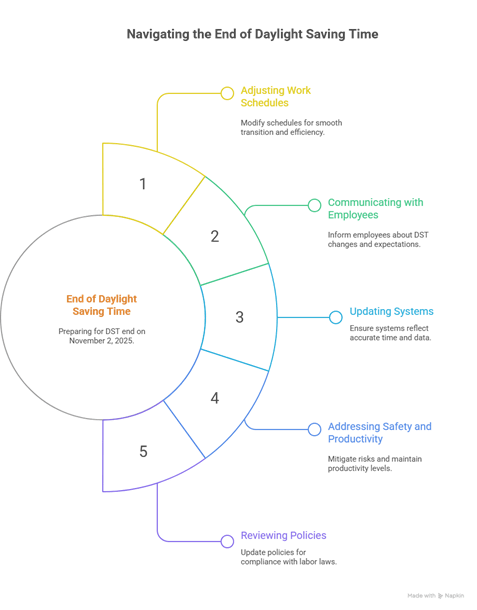
What Employers Should Do for Daylight Saving Time in November 2025
Employer Considerations:
Adjust Work Schedules:
Since clocks fall back one hour at 2 a.m. on November 2, employees working overnight shifts that span this time will effectively work an extra hour.
Employers should decide how to handle this extra hour—whether to pay for it, treat it as overtime, or adjust schedules accordingly.
Communicate Clearly:
Notify employees ahead of time about the time change and how it affects their work hours.
Remind employees to set their clocks back before going to bed on Saturday, November 1, 2025, to avoid confusion.
Update Systems and Devices:
Many digital devices update automatically, but analog clocks, ovens, and some machinery may need manual adjustment.
Employers should ensure all timekeeping systems, security systems, and scheduling software reflect the time change accurately.
Consider Safety and Productivity:
The time change can affect sleep patterns and alertness. Employers might want to be mindful of potential impacts on employee safety and productivity immediately following the time change
Review Policies:
Check company policies regarding pay and hours worked during DST changes to ensure compliance with labor laws and fairness.
Below are three wage and hour answers, for daylight saving time change(s): Pay and Hours Worked: Employers are required to pay employees for all hours worked. Nonexempt employees working last night at 2:00 a.m. must be paid one additional hour of pay, unless the start/end times of their shifts are adjusted in anticipation of the time change. In essence, such an employee will have worked the hour from 1:00 a.m. to 2:00 a.m. twice.”[i]
Overtime: The one additional hour must be considered into the overtime compensation/calculation for the entire week. If the nonexempt employee is scheduled for 40-hours this week, the additional hour would put the employee at 41-hours, one hour of overtime, at least time and one-half the normal hourly rate.
Overtime Rate: “In addition, employers must take this additional hour of work into account when computing the employee’s regular rate of pay for purposes of calculating the employee’s overtime rate.”[ii]
Additionally, ensure that your payroll systems fall back during the time change on Sunday. I have seen issues with timekeeping and payroll systems not resetting for the one-hour time change, which will cause additional issues when processing payroll.
“Previously, employment law experts told HR Dive that managers should be mindful of giving employees proper break times if shifts encompass daylight saving transitions. So, for example, if supervisors typically rely on computers to automate break times, this would be an instance where manual timekeeping is encouraged. Additionally, HR should look into whether there are any wage and hour provisions in their workers’ collective bargaining agreement that addresses the daylight-saving time change.
Employers should ensure that they are following any provisions in a collective bargaining agreement that addresses wage and hour provisions for time change. Ultimately, the employment attorney who spoke to HR Dive reaffirmed the DOL’s guidance: Timekeeping is about “staying true” to the hours worked.
Another compliance consideration is workplace safety: A 2018 National Safety Council study found that post-daylight saving transition fatigue leads to an annual uptick in accidents, due to “circadian misalignment” or talent fighting to stay awake.” (HR Dive)
FLSA Hours Worked Advisor Daylight Saving Time Most states participate in daylight saving time. Those employees working the graveyard shift when Daylight Saving Time begins work one hour less because the clocks are set ahead one hour. Those employees working the graveyard shift when Daylight Saving Time ends work an extra hour because the clocks are set back one hour at 2:00 a.m.
For example: The scheduled shift starts at 11:00 p.m. and ends at 7:30 a.m. The next day, your employee works an eight- hour shift and receives a 30-minute lunch break.
On Sunday Daylight Saving Time starts at 2:00 a.m., the employee does not work the hours from 2:00 a.m. to 3:00 a.m. because at 2:00 a.m. all of the clocks are turned forward to 3:00 a.m. Thus, on this day the employee only worked 7 hours, even though the schedule was for 8 hours.
On the Sunday that Daylight Saving Time ends at 2:00 a.m., the employee works the hour from 1:00 a.m. to 2:00 a.m. twice because at 2:00 a.m. all of the clocks are turned back to 1:00 a.m. Thus, on this day the employee worked 9 hours, even though the schedule only reflected 8 hours.
The FLSA requires that employees must be credited with all of the hours actually worked. Therefore, if the employee is in a work situation similar to that described in the above example, he or she worked 7 hours on the day that Daylight Saving Time begins and 9 hours on the day that Daylight Saving Time ends. This assumes, of course, that the employee actually worked the scheduled shift as in our example.
That extra hour of work can present several unanticipated challenges, in addition to an unpaid hour:
Breaks. In states requiring that employees take breaks at a certain point in their shifts, workers may not automatically get that time, says Caroline Brown, of counsel at Fisher Phillips. “For that day, back off of relying on the time keeping computer so much,” Brown suggests, and figure out the time manually.
Overtime. If that additional hour puts an employee at more than 40 hours during that workweek, the Fair Labor Standards Act requires the employee be paid overtime. Employees who fall under the “8 and 80” system — or in states that require daily overtime — may be eligible for overtime for that day.
Collective Bargaining Agreements. Employers should ensure that they are following any provisions in a collective bargaining agreement that addresses wage and hour provisions for time change.
Making Adjustments Although appropriate tracking for the seasonal time change is frequently forgotten, it can be easily remedied, says Green.
The best approach is to go back to basics, Brown suggests. “There is a tendency for employers to focus on days and shifts when it comes to wage and hour requirements, when it’s really about staying true to the time of how many hours someone did the work.”
Whether timekeeping is manual or automatic, grab a pen and paper if necessary, and figure out the actual hours for that day, Brown says; “Give that payroll a glance to make sure everything lines up.” The same goes when spring rolls around: an employee working 11 p.m. to 7 a.m. when we turn the clocks forward must be paid for only seven hours of work.
It’s worth noting that not all states and regions observe Daylight Saving Time, but if yours is one that does, be prepared so you — and your employees — can avoid any unpleasant wage and hour surprises.” (HR Dive)
States That Deviate from the Daylight Saving Standard Note that Arizona (with the exception of the Navajo Nation) and Hawaii do not observe daylight saving time. Not to be outdone, Florida and Nevada have passed bills that would ensure that daylight saving time is observed year-round. Though their respective state legislatures approved these bills, and their governors signed them, they are still awaiting federal approval. And, of course, there’s California, which just a few days after the end of daylight-saving time will vote on a proposition to move the state to year-round daylight-saving time as well. Even if that proposition passes, it will require congressional approval for the change to become permanent.” (JDSUPRA)
Additional Considerations
Ensure timeclocks adjusted.
Camera’s need to align with timeclock.
The payroll smartphone app time alignment
Computer system time updates
Communication on pay and policies.
Smart phones, computers, etc.
Additional Legislative Information:
Introduced in House (01/03/2025) Sunshine Protection Act of 2025 This bill makes daylight saving time the new, permanent standard time. States with areas exempt from daylight saving time may choose the standard time for those areas.
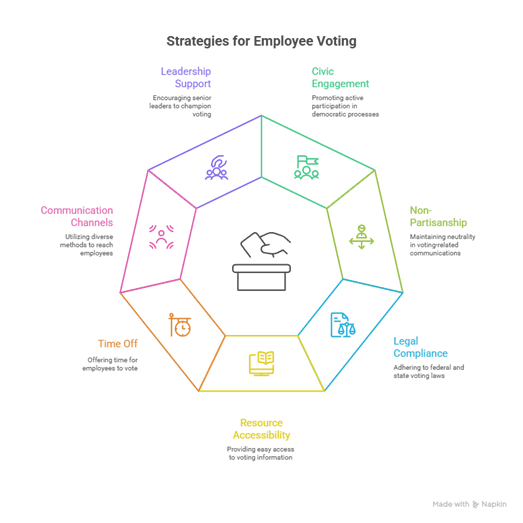
As we approach November 2025 NYS voting dates (see attached PDF for reminders), it is necessary for all organizations to review laws and regulations regarding voting leave laws. I highly encourage all organizations to review current policies, procedures, and postings. New York State has specific regulations on when postings need to be up in the workplace, in a breakroom or virtual.
Required Notices Across the U.S.:
“California, DC, and New York also require that employers post a notice about employees’ voting rights in a conspicuous location in the workplace. Employees who work from home or don’t report to the workplace regularly should be provided with these notices electronically.
California
California requires the notice to be posted at least 10 days before the November 5 election, which is October 26, a Saturday. If you’re closed on Saturdays, we recommend posting or sending this notice by Friday the 25th.
The District of Columbia
DC requires that employers post a voting leave notice created by the DC Board of Elections (DCBOE) at least 60 days before the November 5 election—which is September 6. If you provide this notice electronically for remote employees, you need to get their acknowledgment of receipt. This election’s notice can be found in English and in other languages here. The DCBOE has a web page with additional information.
New York
New York requires the notice to be posted at least 10 working days before the November 5 election (this would be October 22 for a Monday through Friday workplace). New York’s notice is available here.” (Mineral)
Example Policy:
“Employees will be considered to have sufficient time to vote outside their scheduled work hours if they have four consecutive hours between the polls opening and the beginning of their work shift, or four hours after the polls close. Employees who need time to vote need to communicate the request to HR or management prior to the day of voting, per New York State and federal law. PTO time can be used for time off to vote.”
New York State Time Off to Vote 2020 Legislation:
New York State Election Law (As amended by Chapter 56 of the Laws of 2020) § 3-110.
Time allowed employees to vote.
If a registered voter does not have sufficient time outside of his or her scheduled working hours, within which to vote on any day at which he or she may vote, at any election, he or she may, without loss of pay for up to two hours, take off so much working time as will, when added to his or her voting time outside his or her working hours, enable him or her to vote.
If an employee has four consecutive hours either between the opening of the polls and the beginning of his or her working shift, or between the end of his or her working shift and the closing of the polls, he or she shall be deemed to have sufficient time outside his or her working hours within which to vote. If he or she has less than four consecutive hours he or she may take off so much working time as will, when added to his or her voting time outside his or her working hours enable him or her to vote, but not more than two hours of which shall be without loss of pay, provided that he or she shall be allowed time off for voting only at the beginning or end of his or her working shift, as the employer may designate, unless otherwise mutually agreed.
If the employee requires working time off to vote the employee shall notify his or her employer not more than ten nor less than two working days before the day of the election that he or she requires time off to vote in accordance with the provisions of this section.
Not less than ten working days before every election, every employer shall post conspicuously in the place of work where it can be seen as employees come or go to their place of work, a notice setting forth the provisions of this section. Such notice shall be kept posted until the close of the polls on election day.
ATTENTION ALL EMPLOYEES Time allowed employees to vote on election day
N.Y. ELECTION LAW SECTION 3-110i states that:
IF YOU DO NOT HAVE 4 consecutive hours to vote, either from the opening of the Polls to the beginning of YOUR WORKING shift, or between the end of your working shift and the closing of the polls, YOU MAY TAKE OFF UP TO 2 HOURS, without loss of pay, TO ALLOW YOU TIME TO VOTE if you are a registered voter.
You may take time off at the beginning or end of your working shift, as your employer may designate, unless otherwise mutually agreed.
YOU MUST NOTIFY YOUR EMPLOYER Not less than 2 days, but not MORE THAN 10 days, before THE DAY OF THE ELECTION THAT YOU WILL TAKE TIME off to vote.
Revised 4.14.2020
i Employers: Not less than ten working days before any Election Day, every employer shall post conspicuously in the place of work where it can be seen as employees come or go to their place of work, a notice setting forth the provisions of this law. Such notice shall be kept posted until the close of the polls on Election Day
Current State of Pennsylvania Voting Leave Legislation:
“Time off Allotted: The statute does not provide for any period of leave. It is unlawful for a person to use force, violence, restraint, or to inflict or threaten to inflict injury, damage, harm or loss on a person to induce or compel such person to vote or refrain from voting.”[i]
State of Pennsylvania Draft Organizational Policy (this is an example):
“Organization ________believes that it is the responsibility and duty of employees to exercise the privilege of voting in elections. In accordance with this philosophy, the company will grant its employees approved time off to vote if necessary due to work schedules.
Time Off for Voting:
All employees should be able to vote either before or after regularly assigned work hours. However, when this is not possible due to work schedules, managers are authorized to grant a reasonable period of time, up to three hours, during the workday to vote. Time off for voting should be reported and coded appropriately on timekeeping records.”[i][ii]
[Company Name] believes that it is the responsibility and duty of employees to exercise the privilege of voting in elections. In accordance with this philosophy, the company will grant its employees approved time off to vote if necessary due to work schedules and for periods of service as an election official.
Time Off for Voting
All employees should be able to vote either before or after regularly assigned work hours. However, when this is not possible due to work schedules, managers are authorized to grant a reasonable period of time, up to [insert number] hours, during the work day to vote. This time off will be [with/without] pay. Time off for voting should be reported and coded appropriately on timekeeping records.
Time Off for Election Service
Employees who are chosen to serve as election officials at polling sites will be permitted to take required time off to serve in this capacity. Employees who are chosen to act as election officials must notify their manager a minimum of [insert number] days in advance of their need for time off in order to accommodate the necessary rescheduling of work periods. Employees must report time engaged as an election official and code this time accordingly on timekeeping records.
Purpose/Objective
[Company Name] encourages all employees to accept their civic responsibilities, and as a good corporate citizen, the company is pleased to assist employees in the performance of their civic duties. The company provides a reasonable amount of time off, including up to two hours of paid time off, to employees whose work schedules do not provide sufficient time on an election day to vote.
Eligibility
In circumstances where an employee’s work schedule does not provide sufficient time to vote on an election day, the company will provide a reasonable amount of time off during scheduled work time, including up to two hours of paid time off, for employees to vote. Employees who need time off to vote should notify [their supervisors/human resources/other job title] at least two days prior to election day. The company reserves the right in its sole discretion to specify a time period during which the polls are open for employees to leave work to vote.
Procedures
Employees requesting leave under this policy should comply with the following requirements:
Notify [their supervisors/human resources/other job title] at least two days prior to election day of the need for time off to vote.
Coordinate the time off with [their supervisors/human resources/other job title] prior to election day to ensure as little disruption as possible in the flow of work.
For more information about this policy, employers should contact [their supervisors/human resources/other job title].
Tis the season for Halloween decorations, office parties and costumes. Holiday parties can be a terrific opportunity for employee engagement, communication, team building and simply having fun with coworkers. There are tremendous benefits to gatherings such as this in the workplace. However, we should recognize when decorations, parties or costumes go awry, we will need to address these concerns. Not all employees want to participate in decorating the office, participate in the office party or wear a costume to work (me included). Leaders need to recognize that workplace rules and dress code policies still exist, while maintaining workplace professionalism. Have fun but be accountable.
Below are my 4 thoughts on Halloween pitfalls:
Manger and Supervisor Training: “Some employees may be offended or even afraid to celebrate something they associate with evil, and supervisors need to be sensitive to that…Any parties, department decorations or costume contests should be clearly presented as voluntary, and equal support should be given to those who don’t participate and those who do.”[i]
What Dress Code: “People magazine and Amazon have identified some popular 2018 Halloween costumes that raise red flags:
An inflatable, giant “poop” emoji.
A President costume, complete with a garish, comb-over wig.”[ii]
Halloween parties, costume events and even athletic jersey days allow employees to depart from the normal dress code we normally expect at work. However, the dress code policy still needs to be enforced. Advice from SHRM is a simple metric, employees should be covered from shoulders to knees. Organizations should give examples of appropriate and inappropriate costumes, jerseys, or other dress down days to ensure adherence to the dress code and to proactively avoid any future pitfalls. What if an employee violates the policy? Simple, send them home to change or ask them to cover the inappropriate attire. Coach and council or discipline as needed. Set the example and hold set the standard.
Halloween Decorations: “Generally speaking, I would not advise companies to decorate,” Wilson said. “If employees want to put a small pumpkin on their desk, which can be a personal decision, but perhaps send an e-mail advising all employees that any gruesome or graphic or otherwise distracting decor is not allowed… witches, demons and goblins can be unprofessional and potentially offensive to co-workers and customers.”[iii]
Is this Mandatory: The organization should make clear that participation in any Halloween festivities; decorating, party or costumes will be voluntary, and no forced participation.
Seasonal parties can be a magnificent event for team building, communication and having fun as an organization. As leaders, we still need to enforce rules and ensure there are no issues related to inappropriate decorations, dress code violating costumes and/or mandatory parties. Communicate expectations and hold everyone accountable. The tone is always set at the top.
The AI Answer: Halloween Costume Recommendations for Employers in the Workplace
When selecting Halloween costumes for the workplace, it’s important to balance fun with professionalism and respect for diverse beliefs. Here are some key recommendations and ideas:
General Guidelines for Employers
Make participation optional: Not everyone may want to dress up due to personal, cultural, or religious reasons, so avoid making costume-wearing mandatory
Set clear guidelines: Ensure costumes are appropriate, non-offensive, and respectful to all employees. Avoid costumes that could be seen as controversial or culturally insensitive.
Encourage creativity within professionalism: Costumes should be playful but polished enough to maintain a professional atmosphere.
Work-Appropriate Costume Ideas
Classic and easy costumes:
Rosie the Riveter — simple with a headscarf, button-down shirt, and a flexed arm pose.
Wednesday Addams — black dress with a white collar and braids
Punny or themed costumes:
“Smart Cookie” (wear a cookie-themed outfit with glasses or a graduation cap).
’80s Pac-Man or other nostalgic office-themed costumes.
Simple and subtle:
Dressing as a mime is a foolproof, office-friendly option.
Costumes inspired by popular but non-scary characters like the M3gan doll can be conversation starters without being disruptive.
Last-minute and easy:
Many costumes can be put together quickly with items you already have, making them perfect for spontaneous office celebrations.
Final Tips
Encourage costumes that foster team spirit and inclusiveness.
Consider hosting a costume contest with categories like “Most Creative” or “Best Group Costume” to engage employees.
Remind everyone to keep costumes safe and comfortable for a work environment.
By following these guidelines and ideas, employers can create a festive, inclusive, and enjoyable Halloween atmosphere at work!
Halloween in the Workplace: 10 Do’s and Don’ts
Communicate a clear intention for the festivities. You can’t plan for everything that may come up during a Halloween celebration. There’s always a chance something unexpected might happen (like the Hulk picking up co-workers), and somebody might get upset—or worse. To avoid Halloween nightmares, be sure to clearly express an intention of creating connection through a secular and respectful approach to Halloween in the office and be prepared to listen to people’s different perspectives about whatever plans you make.
Involve employees in Halloween planning. “Organizations should trust employees enough to include them in defining guidelines and ground rules for any Halloween celebration, asking employees to use common sense in their decisions around costumes and celebrations,” said author and HR guru David Ulrich. For example, your organization could set up a celebration committee to brainstorm party ideas, define and communicate guidelines, and manage the party budget.
Let people opt out. Allow people who want to opt out of festivities to work from home that day or otherwise be away from the distractions of your Halloween happenings. “Expecting someone to put their head down and work quietly in their cubicle while an office Halloween celebration goes on around them is unrealistic,” DeFee said.
Set guardrails around costumes. Halloween is a time to have fun, not get political or religious or push any other agenda. So, reinforce that costumes must meet work safety requirements and comply with your dress code. It might help to set a theme for costumes, such as video game characters or superheroes. If people are wearing costumes all day in the office, they should also be able to do their jobs while in costume. “Dressing up in the office is fun, but it shouldn’t distract people from doing their work,” Ulrich explained. Emphasize to each employee that even on Halloween, the basics of mutual respect still apply in the office, including wearing attire that does not malign or making fun of any protected group. It’s a good idea to provide specific examples of Halloween costumes that comply with your dress code, as well as those that cross the line.
Have costume contests, with prizes. Try breaking the contest into categories such as best monster or superhero costume, most creative team/couple’s costume, or best historical figure costume. The prizes might be company clothing, coffee mugs or other branded swag.
Host Halloween-related team trivia, with prizes. Maybe offer quotes from scary films and ask teams to name the film or ask questions about monsters or places associated with Halloween (such as Salem, Mass., or Transylvania). Good Halloween trivia is just an online search away.
Decorate the office by theme or area. “One organization I worked with did a ‘trick-or-treat street’ with different floors/areas of their office decorated in a different Halloween-related theme, such as the wild west, space, and Jurassic Park/dinosaurs,” DeFee said.
Offer Halloween-related food options. Food choices could involve potluck-style where employees bring in their own dishes, or the organization could provide breakfast or lunch that includes holiday-themed fare such as pumpkin muffins and apple cider.
Have fun and be responsible and respectful. The goal of celebrating Halloween in the office isn’t to scare or trick people, but to treat them to some Halloween-themed camaraderie that enhances the employee experience. Keep the atmosphere of fun at the forefront.
Release ’em early. Make sure you end Halloween-related office activities early in the afternoon to give your people enough time to get home for trick-or-treating. (SHRM)
As of October 1, 2025, the maximum weekly unemployment benefit in New York will increase from $504 to $869. This is the first increase since 2019, as the state’s unemployment trust fund had a federal debt from the COVID-19 pandemic.
Key details about the unemployment increase:
· Maximum weekly benefit: The cap will be raised to $869, an increase of over 70%.
· Effective date: October 1, 2025.
· Funding and trust fund: The 2025 state budget included using up to $8 billion from rainy-day funds to pay off the federal debt and return the trust fund to solvency.
· Benefit indexing: After the initial increase, the maximum benefit will be indexed annually at 50% of the state’s average weekly wage.
· Employer tax relief: Paying off the federal debt will also eliminate the annual “Interest Assessment Surcharge” for New York businesses.
· Striking workers: The budget agreement reduces the waiting period for striking workers to receive unemployment benefits from three weeks to two.
2023 New York State Unemployment Notice Requirement
Beginning November 13, 2023, the law will require every employer who is obligated to contribute to the unemployment insurance system to notify their employees about their right to apply for unemployment benefits, when applicable.
That statute will now require employers to provide specific notifications to employees regarding their potential eligibility for unemployment benefits.
New York employers have already been expected to provide employees with a Record of Employment upon separation, the law will now require notification in more situations that don’t necessarily involve termination of employment.
When Is the Unemployment Notice Required?
Employers must provide this unemployment notice:
At the time of each permanent or indefinite separation from employment.
During a reduction in hours.
During a temporary separation.
For any other interruption of continued employment resulting in total or partial unemployment.
Unfortunately, the above terms are not specifically defined in the amended statute.
What Should the Unemployment Notice Include?
The required notice must be in writing and should be on a form either furnished or approved by the New York Department of Labor.
The notice must contain:
Employer’s Details: This includes the employer’s name and registration number.
Address for Communication: The notice should specify the address of the employer to which any request for remuneration and employment information regarding the employee should be directed.
Additional Information: Any other information as required by the Department of Labor should also be included.
So far, the DOL has not yet released the required notice form. It is hoped that when it does so, the DOL will better explain the circumstances where notice must be provided short of permanent employment separation.
Implications for Employers
This new unemployment notice provision emphasizes the state’s commitment to ensuring that employees are well-informed about their rights. For employers, it means:
Being Proactive: Employers should be ready with the required forms and processes in place by November 13, 2023.
Training HR Teams: HR teams should be trained to understand the nuances of the new unemployment notice provision and ensure compliance.
Avoiding Penalties: Non-compliance could lead to negative consequences regarding unemployment claims. It’s crucial for employers to adhere to these new unemployment notice requirements diligently. (Horton PLLC)
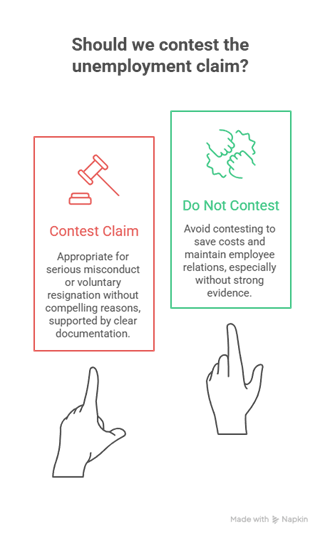
When Should Employers Contest Unemployment Claims?
Serious Misconduct or Voluntary Quit: Employers should generally only contest claims if the employee was terminated for serious misconduct (such as theft, violence, or repeated policy violations) or if the employee quit without a compelling reason. Contesting claims in other situations can be time-consuming and may not be successful.
Clear Documentation: Only proceed if you have solid documentation supporting your case, such as written warnings, termination letters, or evidence of policy violations.
Why Employers Should Rarely Fight Claims
Cost vs. Benefit: While unjustified claims can increase your unemployment insurance costs, fighting every claim is rarely cost-effective. Most HR experts recommend contesting only in clear-cut cases of misconduct or fraud.
Employee Relations: Aggressively contesting claims can harm your reputation and employee morale. It’s often better to reserve challenges for the most egregious cases.
How to Contest an Unemployment Claim
Respond Promptly: When you receive notice of a claim, respond within the required timeframe and provide all requested information.
Present Evidence: Be prepared to present evidence that the employee was terminated for misconduct or quit without good cause. This may include documentation of the employee’s duties, violations, and any warnings given.
Participate in Hearings: If the claim is appealed, you may need to participate in a hearing. Bring witnesses and documentation to support your case.
Be Honest and Consistent: Ensure all statements and evidence are truthful and consistent with previous records. Inconsistencies can undermine your credibility.
Best Practices
Maintain Thorough Records: Keep detailed records of employee performance, disciplinary actions, and reasons for separation.
Evaluate Each Case Individually: Assess the merits of each claim before deciding to contest. Blanket opposition to all claims is discouraged.
Consult Legal or HR Experts: When in doubt, seek advice from HR professionals or legal counsel to ensure compliance with state laws and best practices.
If the employee is the one asking for time off, though, the requirement is not triggered. This can include a leave of absence, vacation, parental leave, personal leave, or any other type of paid or unpaid leave.
Remote Work Policies With remote and hybrid work becoming more common, updating policies to clearly define expectations, eligibility, and equipment use is essential.
The EEOC is focusing on discrimination claims related to hair texture and style, so grooming and dress code policies should be reviewed and updated accordingly .
Use inclusive language throughout the handbook, such as gender-neutral pronouns (they/them), to foster inclusivity
Employee Classifications and Wage Laws
Review classifications under the Fair Labor Standards Act (FLSA) to ensure proper exemption status.
Stay current with state-specific wage and hour laws, including paid time off and leave policies
Paid Family and Medical Leave
Be aware of state-specific changes, such as Maryland delaying its Paid Family and Medical Leave program contributions until July 1, 2025, with benefits starting July 1, 2026
Pregnancy Accommodations
Update policies to comply with evolving pregnancy accommodation laws and ensure clear procedures for requesting accommodations.
State-Specific Legal Changes
California employers should note changes affecting non-discrimination, leave, and vacation policies effective January 2025.
New York and New Jersey employers must incorporate recent federal and state legal developments into their handbooks .
Company Culture and Compliance Balance
While compliance is critical, also ensure the handbook reflects your organization’s culture and values to engage employees effectively
General Policy Reviews
Regularly review key policies such as leave, attendance, workplace conduct, and disciplinary procedures to maintain compliance and clarity.
New York State Handbook Review & Update Considerations
Paid Family Leave and Paid Sick Leave: New York State has been expanding its paid family leave and paid sick leave laws. Ensure your handbook reflects the latest eligibility, benefits, and procedures for requesting leave under these laws.
Minimum Wage and Overtime Rules: New York State and many localities (e.g., NYC, Long Island) have scheduled minimum wage increases. Confirm that wage policies and overtime eligibility align with the current rates and thresholds effective in 2025-2026.
Anti-Discrimination and Harassment Policies: Updates to reflect any new protected classes or changes in reporting procedures under New York State Human Rights Law and recent case law. Training requirements for harassment prevention may also have changed.
Workplace Safety and COVID-19 Policies: While COVID-19 emergency rules have relaxed, some employers maintain policies on vaccination, testing, or remote work. Review any state or local health guidance that might affect workplace safety protocols.
Employee Classification and Wage Transparency: New York has laws addressing gig workers, independent contractors, and wage transparency. Ensure handbook language clarifies employee status and complies with disclosure requirements.
Leave for Voting, Jury Duty, and Military Service: Confirm that leave policies comply with New York State laws protecting these rights.
Use of Technology and Social Media: Update policies on acceptable use of company devices, data privacy, and social media conduct, reflecting evolving norms and legal standards.
This is a shortlist of potential sections to review and revise in most employee handbooks. Continue to review local and state changes as well, when reviewing and updating employee handbooks. Communication, training and setting the expectations is necessary with any organizational change, including employee handbooks.
“Many states, counties, cities, and towns have their own laws prohibiting discrimination, as well as agencies responsible for enforcing those laws. We call these state and local agencies “Fair Employment Practices Agencies” (FEPAs). Usually the laws enforced by these agencies are similar to those enforced by EEOC.”[i] States and cities (including New York State and New York City) have entered into a work sharing agreement with the EEOC. What does this mean for our organizations? Does it have an impact on how we should operate or how we manage workplace allegations and investigations?
Work Sharing Agreements:
Under these terms, both the EEOC and state authority (NYS Division of Human Rights) or City (NYC) can designate the other as its agent for receipt of charges.
What does this mean? If a charge is received by one partner under the agreement, it is deemed received by the other.
“Moreover, these agreements typically proved that the state entity can waive its rights to process such a charge referred to it by the EEOC, which as the effect of permitting the federal agency to process the charge without waiting for the 60-day period to expire.
Many such agreements have an automatic waiver provision, which means that as soon as the charge is filed with the EEOC, the EEOC can begin processing it without going through the motions of referring it back to the state authority.
It also means that the grievant need not file with the state agency within 240 days of the unlawful practice, but, instead, has a full 300 days within which to take the initial step of filing a charge with the federal agency.”[i]
“You can file your charge with either the EEOC or with a Fair Employment Practices Agency. If the charge is initially filed with EEOC and the charge is also covered by state or local law, EEOC dual files the charge with the state or local FEPA (meaning the FEPA will receive a copy of the charge), but ordinarily retains the charge for processing.
If a FEPA has a contract with EEOC, a Charging Party may request that the EEOC review the determination of the FEPA. EEOC will conduct a review only if the request is submitted in writing within fifteen (15) days of receipt of the FEPA’s determination.”[ii]
Confused yet? To summarize, New York State and New York City have a working agreement with the EEOC, if a charge is filed, it is sent with the state or city, it is sent to the EEOC as well, if it falls within the 300-day requirement, under current federal law. “The EEOC contracts with approximately 90 FEPAs nationwide to process more than 48,000 discrimination charges annually.”[iii]
In summary, New York State and New York City have a working agreement with the EEOC. If a charge is filed, it is shared with both the state or city agency and the EEOC, provided it falls within the 300-day requirement under current federal law. The EEOC contracts with approximately 90 FEPAs nationwide to process more than 48,000 discrimination charges annually.
Implications for Organizations
So, what does all of this mean for organizations operating in areas with work sharing agreements? Here are some key implications:
Awareness of Extended Filing Deadlines: Organizations must be aware that employees have 300 days to file a charge with the EEOC, even if the state or local filing deadline is shorter. This extended timeframe can impact internal investigation timelines and record retention policies.
Potential for Dual Investigations: While the EEOC typically retains the charge for processing, organizations should be prepared for the possibility of parallel investigations by both the EEOC and the relevant FEPA. Coordination with legal counsel is crucial in such situations.
Importance of Thorough Internal Investigations: Given the potential for charges to be filed with either the EEOC or a FEPA, organizations should conduct thorough and impartial internal investigations of any workplace allegations of discrimination or harassment. A well-documented investigation can be a valuable defense in the event of a formal charge.
Review of Policies and Procedures: Organizations should review their anti-discrimination and harassment policies and procedures to ensure they are up-to-date and compliant with both federal and state/local laws. This includes ensuring that employees are aware of their rights and responsibilities under these laws.
Training for Managers and Employees: Regular training for managers and employees on anti-discrimination and harassment laws is essential. This training should cover topics such as recognizing and preventing discrimination, handling complaints, and conducting investigations.
Consistent Application of Policies: It is crucial to apply policies and procedures consistently across the organization. Inconsistent application can lead to claims of discrimination and undermine the organization’s defense in the event of a charge.
Documentation: Maintain thorough and accurate records of all complaints, investigations, and disciplinary actions. This documentation can be critical in defending against discrimination charges.
Legal Counsel: Consult with legal counsel experienced in employment law to ensure compliance with all applicable federal, state, and local laws. Legal counsel can also provide guidance on handling specific charges and investigations.
[i] Joel Wm. Friedman, Examples & Explanations: Employment Discrimination. Third Edition (Wolters Kluwer 2017).


 Identify Required Posters: Create a comprehensive list of all federal, state, and local labor law posters required for each location. Utilize online resources, legal counsel, or labor law poster compliance services to ensure accuracy.Physical Inspection: Conduct a physical inspection of each workplace to verify that all required posters are displayed in conspicuous locations where employees can easily access and read them. Common locations include break rooms, employee entrances, and near-time clocks.Poster Content Review: Carefully examine each poster to ensure it is the most current version. Labor laws are subject to change, and outdated posters can lead to non-compliance. Check for revision dates or contact the relevant government agency to confirm the poster’s validity.Accessibility Assessment: Evaluate the accessibility of the posters for all employees, including those with disabilities. Ensure that posters are displayed at an appropriate height and are readable. Consider providing posters in multiple languages if a significant portion of the workforce speaks a language other than English.Documentation: Maintain detailed records of the audit, including the date of the audit, the locations inspected, the posters reviewed, and any identified deficiencies. This documentation will be valuable for demonstrating compliance and tracking progress in addressing any issues.