November 2025 Voting Laws for Employer Reminders & Additional State Information

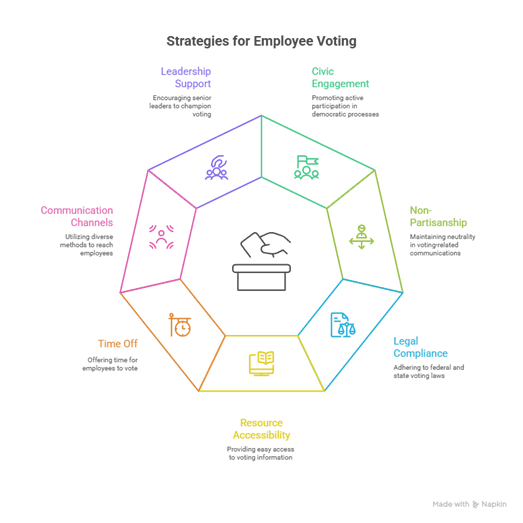
As we approach November 2025 NYS voting dates (see attached PDF for reminders), it is necessary for all organizations to review laws and regulations regarding voting leave laws.  I highly encourage all organizations to review current policies, procedures, and postings.  New York State has specific regulations on when postings need to be up in the workplace, in a breakroom or virtual.

Required Notices Across the U.S.:

“California, DC, and New York also require that employers post a notice about employees’ voting rights in a conspicuous location in the workplace. Employees who work from home or don’t report to the workplace regularly should be provided with these notices electronically.

California

California requires the notice to be posted at least 10 days before the November 5 election, which is October 26, a Saturday. If you’re closed on Saturdays, we recommend posting or sending this notice by Friday the 25th.

The District of Columbia

DC requires that employers post a voting leave notice created by the DC Board of Elections (DCBOE) at least 60 days before the November 5 election—which is September 6. If you provide this notice electronically for remote employees, you need to get their acknowledgment of receipt. This election’s notice can be found in English and in other languages here. The DCBOE has a web page with additional information.

New York

New York requires the notice to be posted at least 10 working days before the November 5 election (this would be October 22 for a Monday through Friday workplace). New York’s notice is available here.”  (Mineral)

Example Policy:

“Employees will be considered to have sufficient time to vote outside their scheduled work hours if they have four consecutive hours between the polls opening and the beginning of their work shift, or four hours after the polls close.  Employees who need time to vote need to communicate the request to HR or management prior to the day of voting, per New York State and federal law.  PTO time can be used for time off to vote.” 

New York State Time Off to Vote 2020 Legislation:

New York State Election Law (As amended by Chapter 56 of the Laws of 2020) § 3-110.

Time allowed employees to vote.

  1. If a registered voter does not have sufficient time outside of his or her scheduled working hours, within which to vote on any day at which he or she may vote, at any election, he or she may, without loss of pay for up to two hours, take off so much working time as will, when added to his or her voting time outside his or her working hours, enable him or her to vote.
  2. If an employee has four consecutive hours either between the opening of the polls and the beginning of his or her working shift, or between the end of his or her working shift and the closing of the polls, he or she shall be deemed to have sufficient time outside his or her working hours within which to vote. If he or she has less than four consecutive hours he or she may take off so much working time as will, when added to his or her voting time outside his or her working hours enable him or her to vote, but not more than two hours of which shall be without loss of pay, provided that he or she shall be allowed time off for voting only at the beginning or end of his or her working shift, as the employer may designate, unless otherwise mutually agreed.
  3. If the employee requires working time off to vote the employee shall notify his or her employer not more than ten nor less than two working days before the day of the election that he or she requires time off to vote in accordance with the provisions of this section.
  4. Not less than ten working days before every election, every employer shall post conspicuously in the place of work where it can be seen as employees come or go to their place of work, a notice setting forth the provisions of this section. Such notice shall be kept posted until the close of the polls on election day.
  5.  

ATTENTION ALL EMPLOYEES Time allowed employees to vote on election day

N.Y. ELECTION LAW SECTION 3-110i states that:

  • IF YOU DO NOT HAVE 4 consecutive hours to vote, either from the opening of the Polls to the beginning of YOUR WORKING shift, or between the end of your working shift and the closing of the polls, YOU MAY TAKE OFF UP TO 2 HOURS, without loss of pay, TO ALLOW YOU TIME TO VOTE if you are a registered voter.
  • You may take time off at the beginning or end of your working shift, as your employer may designate, unless otherwise mutually agreed.
  • YOU MUST NOTIFY YOUR EMPLOYER Not less than 2 days, but not MORE THAN 10 days, before THE DAY OF THE ELECTION THAT YOU WILL TAKE TIME off to vote.

Revised 4.14.2020

i Employers: Not less than ten working days before any Election Day, every employer shall post conspicuously in the place of work where it can be seen as employees come or go to their place of work, a notice setting forth the provisions of this law. Such notice shall be kept posted until the close of the polls on Election Day

New York State Employer Posting Link (10 Working Days)
Current State of Pennsylvania Voting Leave Legislation:

  1. “Time off Allotted: The statute does not provide for any period of leave. It is unlawful for a person to use force, violence, restraint, or to inflict or threaten to inflict injury, damage, harm or loss on a person to induce or compel such person to vote or refrain from voting.”[i]

[i] https://www.dorsey.com/~/media/files/newsresources/publications/2008/10/employee-time-off-on-election-day-a-statebystate__/files/election-guide/fileattachment/election-guide.pdf

State Laws

Here’s a list of jurisdictions that require time off for voting:

  • Alabama.
  • Alaska.
  • Arizona.
  • Arkansas.
  • California.
  • Colorado.
  • Connecticut.
  • District of Columbia.
  • Georgia.
  • Illinois.
  • Iowa.
  • Kansas.
  • Kentucky.
  • Maryland.
  • Massachusetts.
  • Minnesota.
  • Missouri.
  • Nebraska.
  • Nevada.
  • New Mexico.
  • New York.
  • North Dakota.
  • Ohio.
  • Oklahoma.
  • South Dakota.
  • Tennessee.
  • Texas.
  • Utah.
  • West Virginia.
  • Wisconsin.
  • Wyoming.

Additional Information

State of Pennsylvania Draft Organizational Policy (this is an example):

“Organization ________believes that it is the responsibility and duty of employees to exercise the privilege of voting in elections. In accordance with this philosophy, the company will grant its employees approved time off to vote if necessary due to work schedules.

Time Off for Voting:

All employees should be able to vote either before or after regularly assigned work hours. However, when this is not possible due to work schedules, managers are authorized to grant a reasonable period of time, up to three hours, during the workday to vote. Time off for voting should be reported and coded appropriately on timekeeping records.”[i][ii]

[Company Name] believes that it is the responsibility and duty of employees to exercise the privilege of voting in elections. In accordance with this philosophy, the company will grant its employees approved time off to vote if necessary due to work schedules and for periods of service as an election official.

Time Off for Voting

All employees should be able to vote either before or after regularly assigned work hours. However, when this is not possible due to work schedules, managers are authorized to grant a reasonable period of time, up to [insert number] hours, during the work day to vote. This time off will be [with/without] pay. Time off for voting should be reported and coded appropriately on timekeeping records.

Time Off for Election Service

Employees who are chosen to serve as election officials at polling sites will be permitted to take required time off to serve in this capacity. Employees who are chosen to act as election officials must notify their manager a minimum of [insert number] days in advance of their need for time off in order to accommodate the necessary rescheduling of work periods. Employees must report time engaged as an election official and code this time accordingly on timekeeping records. 

Purpose/Objective

[Company Name] encourages all employees to accept their civic responsibilities, and as a good corporate citizen, the company is pleased to assist employees in the performance of their civic duties. The company provides a reasonable amount of time off, including up to two hours of paid time off, to employees whose work schedules do not provide sufficient time on an election day to vote.

Eligibility

In circumstances where an employee’s work schedule does not provide sufficient time to vote on an election day, the company will provide a reasonable amount of time off during scheduled work time, including up to two hours of paid time off, for employees to vote. Employees who need time off to vote should notify [their supervisors/human resources/other job title] at least two days prior to election day. The company reserves the right in its sole discretion to specify a time period during which the polls are open for employees to leave work to vote.

Procedures

Employees requesting leave under this policy should comply with the following requirements:

  1. Notify [their supervisors/human resources/other job title] at least two days prior to election day of the need for time off to vote.
  2. Coordinate the time off with [their supervisors/human resources/other job title] prior to election day to ensure as little disruption as possible in the flow of work.

For more information about this policy, employers should contact [their supervisors/human resources/other job title].


[i] https://www.shrm.org/resourcesandtools/tools-and-samples/policies/pages/cms_009836.aspx

[ii] Burr Consulting, LLC Article 11.2018

Halloween Costume Reminders in the Workplace- Tis the Season

Tis the season for Halloween decorations, office parties and costumes. Holiday parties can be a terrific opportunity for employee engagement, communication, team building and simply having fun with coworkers. There are tremendous benefits to gatherings such as this in the workplace. However, we should recognize when decorations, parties or costumes go awry, we will need to address these concerns. Not all employees want to participate in decorating the office, participate in the office party or wear a costume to work (me included). Leaders need to recognize that workplace rules and dress code policies still exist, while maintaining workplace professionalism. Have fun but be accountable.

Below are my 4 thoughts on Halloween pitfalls:

  1. Manger and Supervisor Training: “Some employees may be offended or even afraid to celebrate something they associate with evil, and supervisors need to be sensitive to that…Any parties, department decorations or costume contests should be clearly presented as voluntary, and equal support should be given to those who don’t participate and those who do.”[i]
  • What Dress Code: “People magazine and Amazon have identified some popular 2018 Halloween costumes that raise red flags:
  1. An inflatable, giant “poop” emoji.
  2. A President costume, complete with a garish, comb-over wig.”[ii]

Halloween parties, costume events and even athletic jersey days allow employees to depart from the normal dress code we normally expect at work. However, the dress code policy still needs to be enforced. Advice from SHRM is a simple metric, employees should be covered from shoulders to knees. Organizations should give examples of appropriate and inappropriate costumes, jerseys, or other dress down days to ensure adherence to the dress code and to proactively avoid any future pitfalls. What if an employee violates the policy? Simple, send them home to change or ask them to cover the inappropriate attire. Coach and council or discipline as needed. Set the example and hold set the standard.

  • Halloween Decorations: “Generally speaking, I would not advise companies to decorate,” Wilson said. “If employees want to put a small pumpkin on their desk, which can be a personal decision, but perhaps send an e-mail advising all employees that any gruesome or graphic or otherwise distracting decor is not allowed… witches, demons and goblins can be unprofessional and potentially offensive to co-workers and customers.”[iii] 
  • Is this Mandatory: The organization should make clear that participation in any Halloween festivities; decorating, party or costumes will be voluntary, and no forced participation.

Seasonal parties can be a magnificent event for team building, communication and having fun as an organization. As leaders, we still need to enforce rules and ensure there are no issues related to inappropriate decorations, dress code violating costumes and/or mandatory parties. Communicate expectations and hold everyone accountable. The tone is always set at the top.

The AI Answer: Halloween Costume Recommendations for Employers in the Workplace

When selecting Halloween costumes for the workplace, it’s important to balance fun with professionalism and respect for diverse beliefs. Here are some key recommendations and ideas:

General Guidelines for Employers

  • Make participation optional: Not everyone may want to dress up due to personal, cultural, or religious reasons, so avoid making costume-wearing mandatory 
  • Set clear guidelines: Ensure costumes are appropriate, non-offensive, and respectful to all employees. Avoid costumes that could be seen as controversial or culturally insensitive.
  • Encourage creativity within professionalism: Costumes should be playful but polished enough to maintain a professional atmosphere.

Work-Appropriate Costume Ideas

  • Classic and easy costumes:
    • Rosie the Riveter — simple with a headscarf, button-down shirt, and a flexed arm pose.
    • Wednesday Addams — black dress with a white collar and braids 
  • Punny or themed costumes:
    • “Smart Cookie” (wear a cookie-themed outfit with glasses or a graduation cap).
    • ’80s Pac-Man or other nostalgic office-themed costumes.
  • Simple and subtle:
    • Dressing as a mime is a foolproof, office-friendly option.
    • Costumes inspired by popular but non-scary characters like the M3gan doll can be conversation starters without being disruptive.
  • Last-minute and easy:
    • Many costumes can be put together quickly with items you already have, making them perfect for spontaneous office celebrations.

Final Tips

  • Encourage costumes that foster team spirit and inclusiveness.
  • Consider hosting a costume contest with categories like “Most Creative” or “Best Group Costume” to engage employees.
  • Remind everyone to keep costumes safe and comfortable for a work environment.

By following these guidelines and ideas, employers can create a festive, inclusive, and enjoyable Halloween atmosphere at work!

Halloween in the Workplace: 10 Do’s and Don’ts

  1. Communicate a clear intention for the festivities. You can’t plan for everything that may come up during a Halloween celebration. There’s always a chance something unexpected might happen (like the Hulk picking up co-workers), and somebody might get upset—or worse. To avoid Halloween nightmares, be sure to clearly express an intention of creating connection through a secular and respectful approach to Halloween in the office and be prepared to listen to people’s different perspectives about whatever plans you make.
  2. Involve employees in Halloween planning. “Organizations should trust employees enough to include them in defining guidelines and ground rules for any Halloween celebration, asking employees to use common sense in their decisions around costumes and celebrations,” said author and HR guru David Ulrich. For example, your organization could set up a celebration committee to brainstorm party ideas, define and communicate guidelines, and manage the party budget.
  3. Let people opt out. Allow people who want to opt out of festivities to work from home that day or otherwise be away from the distractions of your Halloween happenings. “Expecting someone to put their head down and work quietly in their cubicle while an office Halloween celebration goes on around them is unrealistic,” DeFee said. 
  4. Set guardrails around costumes. Halloween is a time to have fun, not get political or religious or push any other agenda. So, reinforce that costumes must meet work safety requirements and comply with your dress code. It might help to set a theme for costumes, such as video game characters or superheroes. If people are wearing costumes all day in the office, they should also be able to do their jobs while in costume. “Dressing up in the office is fun, but it shouldn’t distract people from doing their work,” Ulrich explained. Emphasize to each employee that even on Halloween, the basics of mutual respect still apply in the office, including wearing attire that does not malign or making fun of any protected group. It’s a good idea to provide specific examples of Halloween costumes that comply with your dress code, as well as those that cross the line.
  5. Have costume contests, with prizes. Try breaking the contest into categories such as best monster or superhero costume, most creative team/couple’s costume, or best historical figure costume. The prizes might be company clothing, coffee mugs or other branded swag.
  6. Host Halloween-related team trivia, with prizes. Maybe offer quotes from scary films and ask teams to name the film or ask questions about monsters or places associated with Halloween (such as Salem, Mass., or Transylvania). Good Halloween trivia is just an online search away.
  7. Decorate the office by theme or area. “One organization I worked with did a ‘trick-or-treat street’ with different floors/areas of their office decorated in a different Halloween-related theme, such as the wild west, space, and Jurassic Park/dinosaurs,” DeFee said.
  8. Offer Halloween-related food options. Food choices could involve potluck-style where employees bring in their own dishes, or the organization could provide breakfast or lunch that includes holiday-themed fare such as pumpkin muffins and apple cider. 
  9. Have fun and be responsible and respectful. The goal of celebrating Halloween in the office isn’t to scare or trick people, but to treat them to some Halloween-themed camaraderie that enhances the employee experience. Keep the atmosphere of fun at the forefront.
  10. Release ’em early. Make sure you end Halloween-related office activities early in the afternoon to give your people enough time to get home for trick-or-treating. (SHRM)

[i] https://www.shrm.org/hr-today/news/hr-magazine/pages/1015-solutions.aspx

[ii] https://www.shrm.org/resourcesandtools/hr-topics/employee-relations/pages/halloween-at-work-2018.aspx

[iii] https://www.shrm.org/resourcesandtools/hr-topics/employee-relations/pages/halloween-at-work-2018.aspx

Unemployment Benefits Increase 72% in New York, Effective October 1, 2025

As of October 1, 2025, the maximum weekly unemployment benefit in New York will increase from $504 to $869. This is the first increase since 2019, as the state’s unemployment trust fund had a federal debt from the COVID-19 pandemic. 

Key details about the unemployment increase:

·        Maximum weekly benefit: The cap will be raised to $869, an increase of over 70%.

·        Effective date: October 1, 2025.

·        Funding and trust fund: The 2025 state budget included using up to $8 billion from rainy-day funds to pay off the federal debt and return the trust fund to solvency.

·        Benefit indexing: After the initial increase, the maximum benefit will be indexed annually at 50% of the state’s average weekly wage.

·        Employer tax relief: Paying off the federal debt will also eliminate the annual “Interest Assessment Surcharge” for New York businesses.

·        Striking workers: The budget agreement reduces the waiting period for striking workers to receive unemployment benefits from three weeks to two. 

2023 New York State Unemployment Notice Requirement

Beginning November 13, 2023, the law will require every employer who is obligated to contribute to the unemployment insurance system to notify their employees about their right to apply for unemployment benefits, when applicable.

That statute will now require employers to provide specific notifications to employees regarding their potential eligibility for unemployment benefits.

New York employers have already been expected to provide employees with a Record of Employment upon separation, the law will now require notification in more situations that don’t necessarily involve termination of employment.

When Is the Unemployment Notice Required?

Employers must provide this unemployment notice:

  • At the time of each permanent or indefinite separation from employment.
  • During a reduction in hours.
  • During a temporary separation.
  • For any other interruption of continued employment resulting in total or partial unemployment.

Unfortunately, the above terms are not specifically defined in the amended statute.

What Should the Unemployment Notice Include?

The required notice must be in writing and should be on a form either furnished or approved by the New York Department of Labor.

The notice must contain:

  1. Employer’s Details: This includes the employer’s name and registration number.
  2. Address for Communication: The notice should specify the address of the employer to which any request for remuneration and employment information regarding the employee should be directed.
  3. Additional Information: Any other information as required by the Department of Labor should also be included.

So far, the DOL has not yet released the required notice form. It is hoped that when it does so, the DOL will better explain the circumstances where notice must be provided short of permanent employment separation.

Implications for Employers

This new unemployment notice provision emphasizes the state’s commitment to ensuring that employees are well-informed about their rights. For employers, it means:

  • Being Proactive: Employers should be ready with the required forms and processes in place by November 13, 2023.
  • Training HR Teams: HR teams should be trained to understand the nuances of the new unemployment notice provision and ensure compliance.
  • Avoiding Penalties: Non-compliance could lead to negative consequences regarding unemployment claims. It’s crucial for employers to adhere to these new unemployment notice requirements diligently. (Horton PLLC)

NYS Assembly Bill

NYS Unemployment Website

Advice on Fighting Unemployment Claims

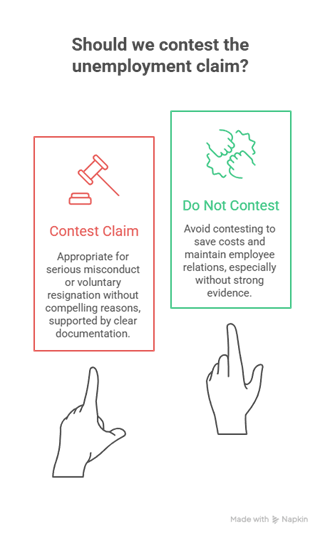
When Should Employers Contest Unemployment Claims?

  • Serious Misconduct or Voluntary Quit:
    Employers should generally only contest claims if the employee was terminated for serious misconduct (such as theft, violence, or repeated policy violations) or if the employee quit without a compelling reason. Contesting claims in other situations can be time-consuming and may not be successful.
  • Clear Documentation:
    Only proceed if you have solid documentation supporting your case, such as written warnings, termination letters, or evidence of policy violations.

Why Employers Should Rarely Fight Claims

  • Cost vs. Benefit:
    While unjustified claims can increase your unemployment insurance costs, fighting every claim is rarely cost-effective. Most HR experts recommend contesting only in clear-cut cases of misconduct or fraud.
  • Employee Relations:
    Aggressively contesting claims can harm your reputation and employee morale. It’s often better to reserve challenges for the most egregious cases.

How to Contest an Unemployment Claim

  1. Respond Promptly:
    When you receive notice of a claim, respond within the required timeframe and provide all requested information.
  2. Present Evidence:
    Be prepared to present evidence that the employee was terminated for misconduct or quit without good cause. This may include documentation of the employee’s duties, violations, and any warnings given.
  3. Participate in Hearings:
    If the claim is appealed, you may need to participate in a hearing. Bring witnesses and documentation to support your case.
  4. Be Honest and Consistent:
    Ensure all statements and evidence are truthful and consistent with previous records. Inconsistencies can undermine your credibility.

Best Practices

  • Maintain Thorough Records:
    Keep detailed records of employee performance, disciplinary actions, and reasons for separation.
  • Evaluate Each Case Individually:
    Assess the merits of each claim before deciding to contest. Blanket opposition to all claims is discouraged.
  • Consult Legal or HR Experts:
    When in doubt, seek advice from HR professionals or legal counsel to ensure compliance with state laws and best practices.
StateMaximum Unemployment BenefitState Agency Website and Phone Number
Alabama$275/weekAlabama DOL
(334)242-8025
Alaska$370/weekAlaska DOL
(907)269-4700
Arizona$240/weekArizona: How to Apply for UI
(877)600-2722
Arkansas$451/weekArkansas DOL
(501)682-2121
California$750/week through September 6, 2021
After this, it will come down to $451/week
California DOL
1(800)300-5616
Colorado$918/week through September 6, 2021
After this, it will come down to $618/week
Colorado DOL
(303)318-8000
Connecticut$949/week through September 6, 2021
After this, it will come down to $649/week
Connecticut DOL
(203)941-6868
Delaware$700/week through September 6, 2021
Then it will come down to $400/week
Delaware DOL
1(800)794-3032
D.C.$744/week through September 6, 2021
After this, it will come down to $444/week
D.C. DOES
(202)724-7000
Florida$275/weekFlorida DEO
1(833)352-7759
Georgia$365/weekGeorgia DOL
1(877)709-8185
Hawaii$948/week through September 6, 2021
After this, it will come down to $648/week
Hawaii DOL
Oahu: (808)586-8970
Hilo: (808)974-4086
Kona: (808)322-4822
Maui: (808)984-8400
Kauai: (808)274-3043
Idaho$463/weekIdaho DOL
(208)332-8942
Illinois$784/week through September 6, 2021
After this, it will come down to $484/week
Illinois DES
1(800)244-5631
Indiana$690/week through September 6, 2021
After this, it will come down to $390/week
Indiana DOL
1(800)891-6499
Iowa$481/weekIowa Workforce Development
1(866)239-0843
Kansas$788/week through September 6, 2021
After this, it will come down to $488/week
Kansas DOL
1(800)292-6333
Kentucky$852/week through September 6, 2021
After this, it will come down to $552/week
Kentucky Career Center
(502)875-0442
LouisianaLouisiana Workforce Commission
1(866)783-5567
Maine$745/week through September 6, 2021
After this, it will come down to $445/week
Maine DOL
1(800)593-7660
Maryland$730/week through September 6, 2021
After this, it will come to $430/week
Maryland DOL
Contact Info
Massachusetts$1,123/week through September 6, 2021
After this, it will come down to $823/week
Mass DUA
1(877)636-6800
Michigan$662/week through September 6, 2021
After this, it will come down to $362/week
Michigan Department of Labor and Opportunity
Contact Info
Minnesota$1,040/week through September 6, 2021
After this, it will come down to $740/week
Minnesota Unemployment Insurance
1-877-898-9090
Mississippi$235/weekMississippi DES
601-321-6000
Missouri$320/weekMissouri DOL
Contact Info
Montana$872/week through June 27, 2021
After this, it will come down to $552/week
Montana Unemployment Insurance Division
406-444-2545
Nebraska$440/weekNE Works
855-995-8863
Nevada$769/week through September 6, 2021
After this, it will come down to $469/week
Nevada DOL
Contact Info
New Hampshire$427/weekNew Hampshire Workforce Connect
1(800)852-3400
New Jersey$1,013/week through September 6, 2021
After this, it will come down to $713/week
New Jersey DOL
Contact Info
New Mexico$811/week through September 6, 2021
After this, it will come down to $511/week
New Mexico Workforce Connection
Contact Info
New York$804/week through September 6, 2021
After this, it will come down to $504/week
New York DOL
1(888)581-5812
North Carolina$650/week through September 6, 2021
After this, it will come down to $350/week
North Carolina DES
1(888)737-0259
North Dakota$618/weekNorth Dakota DOL
(701) 328-4995
Ohio$498/weekOhio Department of Job and Family Services
1(877)644-6562
Oklahoma$539/weekOklahoma ESC
1(800)555-1554
Oregon$973/week through September 6, 2021
After this, it will come down to $673/week
Oregon Employment Department
1(877)345-3484
Pennsylvania$872/week through September 6, 2021
After this, it will come down to $572/week
Pennsylvania Office of Unemployment Compensation
Contact Info
Rhode Island$886/week through September 6, 2021
After this, it will come down to $586/week
Rhode Island DLT
(401)415-6772
South Carolina$326/weekSouth Carolina Department of Employment and Workforce
1(866)831-1724
South Dakota$428/weekSouth Dakota Department of Labor & Regulation
(605)626-2452
Tennessee$275/weekTennessee Department of Labor & Workforce Development
1(877)813-0950
Texas$535/weekTexas Workforce Commission
1(800)628-5115
Utah$580/weekUtah Workforce Services
(801)526-9675
Vermont$831/week through September 6, 2021
After this, it will come down to $531/week
Vermont DOL
1(877) 214-3332
Virginia$678/week through September 6, 2021
After this, it will come down to $378/week
Virginia Employment Commission
Contact Info
Washington$1,144/week through September 6, 2021
After this, it will come down to $844/week
Washington Employment Security Department
1(800)318-6022
West Virginia$424/weekWorkforce West Virginia
1(800)379-1032
Wisconsin$670/week through September 6, 2021
After this, it will come down to $370/week
Wisconsin Department of Workforce Development
(608) 266-3131
Wyoming$508/weekWYUI
(307)473-3789

If the employee is the one asking for time off, though, the requirement is not triggered. This can include a leave of absence, vacation, parental leave, personal leave, or any other type of paid or unpaid leave.

https://gusto.com/resources/articles/benefits/covid-state-unemployment-insurance-benefits

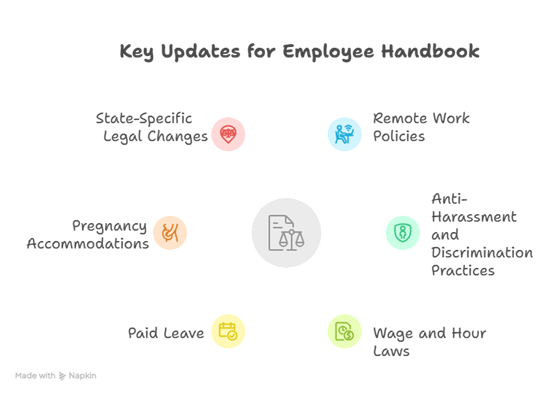
2025-2026 Employee Handbook Review & Updates

  1. Remote Work Policies
    With remote and hybrid work becoming more common, updating policies to clearly define expectations, eligibility, and equipment use is essential.
  2. Anti-Harassment and Discrimination Practices
    • Incorporate updated anti-harassment policies reflecting recent legal developments.
    • The EEOC is focusing on discrimination claims related to hair texture and style, so grooming and dress code policies should be reviewed and updated accordingly .
    • Use inclusive language throughout the handbook, such as gender-neutral pronouns (they/them), to foster inclusivity 
  3. Employee Classifications and Wage Laws
    • Review classifications under the Fair Labor Standards Act (FLSA) to ensure proper exemption status.
    • Stay current with state-specific wage and hour laws, including paid time off and leave policies 
  4. Paid Family and Medical Leave
    • Be aware of state-specific changes, such as Maryland delaying its Paid Family and Medical Leave program contributions until July 1, 2025, with benefits starting July 1, 2026 
  5. Pregnancy Accommodations
    • Update policies to comply with evolving pregnancy accommodation laws and ensure clear procedures for requesting accommodations.
  6. State-Specific Legal Changes
    • California employers should note changes affecting non-discrimination, leave, and vacation policies effective January 2025.
    • New York and New Jersey employers must incorporate recent federal and state legal developments into their handbooks .
  7. Company Culture and Compliance Balance
    • While compliance is critical, also ensure the handbook reflects your organization’s culture and values to engage employees effectively 
  8. General Policy Reviews
    • Regularly review key policies such as leave, attendance, workplace conduct, and disciplinary procedures to maintain compliance and clarity.

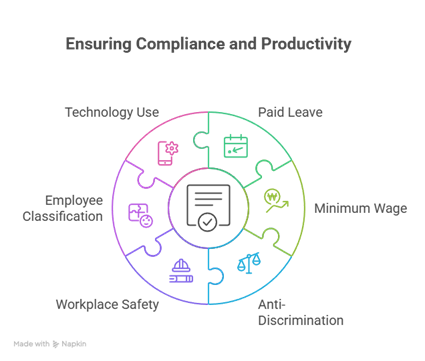
New York State Handbook Review & Update Considerations

  1. Paid Family Leave and Paid Sick Leave:
    New York State has been expanding its paid family leave and paid sick leave laws. Ensure your handbook reflects the latest eligibility, benefits, and procedures for requesting leave under these laws.
  2. Minimum Wage and Overtime Rules:
    New York State and many localities (e.g., NYC, Long Island) have scheduled minimum wage increases. Confirm that wage policies and overtime eligibility align with the current rates and thresholds effective in 2025-2026.
  3. Anti-Discrimination and Harassment Policies:
    Updates to reflect any new protected classes or changes in reporting procedures under New York State Human Rights Law and recent case law. Training requirements for harassment prevention may also have changed.
  4. Workplace Safety and COVID-19 Policies:
    While COVID-19 emergency rules have relaxed, some employers maintain policies on vaccination, testing, or remote work. Review any state or local health guidance that might affect workplace safety protocols.
  5. Employee Classification and Wage Transparency:
    New York has laws addressing gig workers, independent contractors, and wage transparency. Ensure handbook language clarifies employee status and complies with disclosure requirements.
  6. Leave for Voting, Jury Duty, and Military Service:
    Confirm that leave policies comply with New York State laws protecting these rights.
  7. Use of Technology and Social Media:
    Update policies on acceptable use of company devices, data privacy, and social media conduct, reflecting evolving norms and legal standards.

This is a shortlist of potential sections to review and revise in most employee handbooks.  Continue to review local and state changes as well, when reviewing and updating employee handbooks.  Communication, training and setting the expectations is necessary with any organizational change, including employee handbooks.

The EEOC and Fair Employment Practice Agencies (FEPAs) “Work Sharing Agreement”

“Many states, counties, cities, and towns have their own laws prohibiting discrimination, as well as agencies responsible for enforcing those laws. We call these state and local agencies “Fair Employment Practices Agencies” (FEPAs). Usually the laws enforced by these agencies are similar to those enforced by EEOC.”[i]   States and cities (including New York State and New York City) have entered into a work sharing agreement with the EEOC.  What does this mean for our organizations?  Does it have an impact on how we should operate or how we manage workplace allegations and investigations?


Work Sharing Agreements:

  1. Under these terms, both the EEOC and state authority (NYS Division of Human Rights) or City (NYC) can designate the other as its agent for receipt of charges.
  • What does this mean?  If a charge is received by one partner under the agreement, it is deemed received by the other.
  • “Moreover, these agreements typically proved that the state entity can waive its rights to process such a charge referred to it by the EEOC, which as the effect of permitting the federal agency to process the charge without waiting for the 60-day period to expire.
  • Many such agreements have an automatic waiver provision, which means that as soon as the charge is filed with the EEOC, the EEOC can begin processing it without going through the motions of referring it back to the state authority.
  • It also means that the grievant need not file with the state agency within 240 days of the unlawful practice, but, instead, has a full 300 days within which to take the initial step of filing a charge with the federal agency.”[i]
  • “You can file your charge with either the EEOC or with a Fair Employment Practices Agency.  If the charge is initially filed with EEOC and the charge is also covered by state or local law, EEOC dual files the charge with the state or local FEPA (meaning the FEPA will receive a copy of the charge), but ordinarily retains the charge for processing.
  • If a FEPA has a contract with EEOC, a Charging Party may request that the EEOC review the determination of the FEPA. EEOC will conduct a review only if the request is submitted in writing within fifteen (15) days of receipt of the FEPA’s determination.”[ii]

Confused yet?  To summarize, New York State and New York City have a working agreement with the EEOC, if a charge is filed, it is sent with the state or city, it is sent to the EEOC as well, if it falls within the 300-day requirement, under current federal law.  “The EEOC contracts with approximately 90 FEPAs nationwide to process more than 48,000 discrimination charges annually.”[iii]

EEOC State and Local Agencies Work Sharing Link

Fair Employment Practices Agencies (FEPAs) and Dual Filing

Summary of the Agreement’s Impact

In summary, New York State and New York City have a working agreement with the EEOC. If a charge is filed, it is shared with both the state or city agency and the EEOC, provided it falls within the 300-day requirement under current federal law. The EEOC contracts with approximately 90 FEPAs nationwide to process more than 48,000 discrimination charges annually.

Implications for Organizations

So, what does all of this mean for organizations operating in areas with work sharing agreements? Here are some key implications:

  • Awareness of Extended Filing Deadlines: Organizations must be aware that employees have 300 days to file a charge with the EEOC, even if the state or local filing deadline is shorter. This extended timeframe can impact internal investigation timelines and record retention policies.
  • Potential for Dual Investigations: While the EEOC typically retains the charge for processing, organizations should be prepared for the possibility of parallel investigations by both the EEOC and the relevant FEPA. Coordination with legal counsel is crucial in such situations.
  • Importance of Thorough Internal Investigations: Given the potential for charges to be filed with either the EEOC or a FEPA, organizations should conduct thorough and impartial internal investigations of any workplace allegations of discrimination or harassment. A well-documented investigation can be a valuable defense in the event of a formal charge.
  • Review of Policies and Procedures: Organizations should review their anti-discrimination and harassment policies and procedures to ensure they are up-to-date and compliant with both federal and state/local laws. This includes ensuring that employees are aware of their rights and responsibilities under these laws.
  • Training for Managers and Employees: Regular training for managers and employees on anti-discrimination and harassment laws is essential. This training should cover topics such as recognizing and preventing discrimination, handling complaints, and conducting investigations.
  • Consistent Application of Policies: It is crucial to apply policies and procedures consistently across the organization. Inconsistent application can lead to claims of discrimination and undermine the organization’s defense in the event of a charge.
  • Documentation: Maintain thorough and accurate records of all complaints, investigations, and disciplinary actions. This documentation can be critical in defending against discrimination charges.
  • Legal Counsel: Consult with legal counsel experienced in employment law to ensure compliance with all applicable federal, state, and local laws. Legal counsel can also provide guidance on handling specific charges and investigations.

[i] Joel Wm. Friedman, Examples & Explanations: Employment Discrimination. Third Edition (Wolters Kluwer 2017).

[ii] https://www.eeoc.gov/employees/fepa.cfm

[iii] https://www.eeoc.gov/field/newyork/fepa.cfm

[i] https://www.eeoc.gov/employees/fepa.cfm