
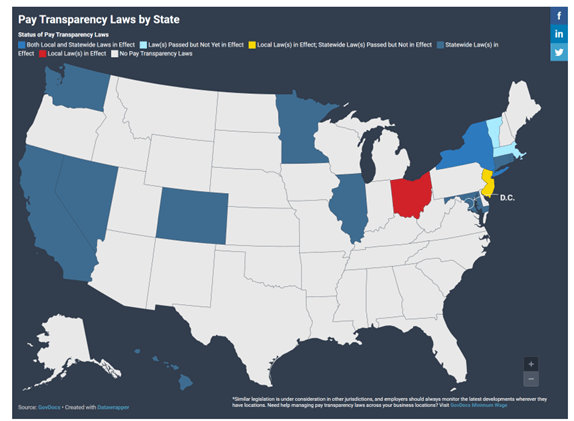
States with Wage Transparency Laws:
- California: Requires employers to include salary ranges in job postings.
- Colorado: Enacted the Equal Pay for Equal Work Act, which includes pay transparency requirements.
- Connecticut: Requires employers to disclose wage ranges in job postings and prohibits seeking salary history.
- Hawaii: Requires employers to disclose salary ranges in job postings.
- Illinois: Has pay transparency requirements, with some guidance rolling out in 2025.
- Maryland: Requires employers to disclose wage ranges in job postings.
- Massachusetts: Requires employers with 100+ employees to submit wage data reports annually.
- Minnesota: Has pay transparency requirements, including disclosure of salary ranges.
- Nevada: Requires employers to disclose wage or salary ranges.
- New Jersey: Has pay transparency requirements.
- New York: Requires employers to disclose salary ranges in job postings.
- Rhode Island: Requires employers to provide the wage range prior to discussing compensation and upon request.
- Vermont: Requires employers to disclose hourly wage or salary, or range, in job postings.
- Washington: Requires employers to include salary ranges in job postings.
- Washington D.C.: Requires employers to disclose wage ranges in job postings.
Pay Transparency Laws by State: Effective Dates
Below is an at-a-glance list of the states and corresponding effective dates that require disclosure of pay range under certain circumstances. Each law is different, so employers should review each specific jurisdiction’s requirements to ensure compliance:
- California – effective Jan. 1, 2023
- Colorado – effective Jan. 1, 2021
- Connecticut – effective Oct. 1, 2021
- District of Columbia – effective June 30, 2024
- Hawaii – effective Jan. 1, 2024
- Illinois – effective Jan. 1, 2025
- Maryland – effective Oct. 1, 2020
- Massachusetts – effective Oct. 29, 2025
- Minnesota – effective Jan. 1, 2025
- New Jersey – statewide law effective June 1, 2025
- New York – effective Sept. 17, 2023
- Nevada – effective Oct. 1, 2021
- Rhode Island – effective Jan. 1, 2023
- Vermont – effective July 31, 2025
- Washington – effective Jan. 1, 2023
As of this writing, several jurisdictions in the U.S. have some form of a pay transparency law. But more could be on the horizon.
Of course, as with all aspects of employment law, each jurisdiction handles these requirements differently.
Starting at a high level, some states have laws that require employers to disclose the pay range for a position if the applicant asks for it:
- California
- Colorado
- Connecticut
- Maryland
- Massachusetts – effective as of Oct. 29, 2025
- Minnesota
- Nevada
- Rhode Island
Even among these states, there is some variation in how they implement their pay transparency laws.
Salary History Bans in the United States
Salary history bans are adjacent to pay transparency laws and generally prohibit employers from asking job applicants about their past or current pay.
These laws preclude employers from relying on pay history to set compensation, part of the growing employment law sector related to the #MeToo movement.
Employers can usually ask for pay expectations but not actual pay history.
What states have salary history bans?
States, or jurisdictions within them, that have salary history bans include:
- Alabama
- California
- Colorado
- Connecticut
- Delaware
- District of Columbia
- Hawaii
- Illinois
- Maine
- Maryland
- Massachusetts
- Minnesota
- Missouri
- Nevada
- New Jersey
- New York State
- Ohio (only Toledo and Cincinnati)
- Oregon
- Pennsylvania (Philadelphia only)
- Rhode Island
- Vermont
- Washington
https://www.govdocs.com/pay-transparency-laws/
Additional Consideration

Best Practices for Employers
1. Regularly Review and Update Compensation Policies
- Conduct regular audits of pay practices to ensure compliance and identify any unjustified pay disparities
- Establish clear, documented guidelines for setting and communicating pay ranges.
2. Standardize Job Postings
- Include required salary ranges and compensation details in all job postings, especially for roles that could be performed in states with transparency laws.
- For multistate employers, consider adopting the strictest applicable standard to streamline compliance
3. Train Managers and HR Staff
- Ensure those involved in hiring and compensation decisions understand the requirements and are prepared to answer questions about pay transparency
4. Prepare for Employee Inquiries
- Be ready to provide pay scale information to current employees and applicants upon request, as required by law
5. Monitor Legal Developments
- Stay informed about new and evolving wage transparency laws, as more states and localities are expected to adopt similar requirements in the coming years
Strategic Opportunities
1. Building Trust and Employer Brand
- Transparent pay practices can enhance employee trust, improve retention, and make the organization more attractive to top talent
2. Promoting Pay Equity
- Wage transparency helps identify and address pay gaps, supporting diversity, equity, and inclusion goals
2023 New York State Wage Transparency September 17, 2023
“As a reminder, the pay transparency law, which is codified at Section 194-b of the New York Labor Law, will require employers with four or more employees to include the following whenever they “advertise” for a job, promotion, or transfer opportunity:
- The compensation or “range of compensation” for the job, promotion, or transfer opportunity.
- The job description for the job, promotion, or transfer opportunity, if one exists.
The original legislation did not define the term “advertise.” The amendment adds the following definition:
“[A]dvertise” shall mean to make available to a pool of potential applicants for internal or public viewing, including electronically, a written description of an employment opportunity.
This is a broad definition and will likely encompass internal postings on an intranet or job board, postings in newspapers and “want ads,” as well as electronic postings on the employer’s website or job posting sites such as Indeed.com or ZipRecruiter.” (https://www.hodgsonruss.com/newsroom-publications-14258.html)
“On Dec. 21, 2022, Gov. Kathy Hochul signed the long-anticipated New York State pay transparency bill into law. The bill amends New York State Labor Law by adding a new section 194-b, which takes effect on Sept. 17, 2023. Labor Law § 194-b continues a recent trend toward pay transparency both nationally and locally, including similar laws in New York City, Albany County, Westchester County and Ithaca.
Employers subject to the law are broadly defined to include nearly every entity with four or more employees, as well as agents and recruiters. Only temporary help firms, as defined under New York State Labor Law § 916(5), are exempt.[1]
Similar to other pay transparency laws, Labor Law § 194-b requires employers to disclose an amount or a range of compensation for any open job, promotion or transfer opportunity that can or will be performed, at least in part, in New York State. The law defines “range of compensation” as “the minimum and maximum annual salary or hourly range of compensation . . . that the employer in good faith believes to be accurate at the time of the posting of an advertisement” for the job, promotion or transfer opportunity. Advertisements for jobs, promotions or transfer opportunities that are paid solely on commission must disclose that in writing. Additionally, the law requires employers to post a job description if one exists.
Labor Law § 194-b does not define “advertisement,” so the breadth of the law’s application to activities such as direct recruitment and internal promotion is unclear. Presumably, the Commissioner of Labor will clarify the scope of coverage by regulations, which the law directs the Commissioner to promulgate.
Employers are required to keep and maintain records in connection to the law, including the history of compensation ranges for each job, promotion or transfer opportunity and the job descriptions for these positions, if such job descriptions exist.
Any person claiming to be aggrieved under Labor Law § 194-b may file a complaint with the Department of Labor, which has the authority to impose civil penalties of up to three thousand dollars for violations of the law or forthcoming regulations. Employers are prohibited from refusing to interview, hire, promote, employ or otherwise retaliate against an applicant or current employee for exercising any rights under this new law.
Finally, Labor Law § 194-b contains a provision stating that it shall not be construed or interpreted to supersede or preempt any local law, rules, or regulation. Most of the existing local pay transparency laws in New York failed to predict a parallel state law (despite the fact that one had already passed in the legislature), so employers subject to these laws will have to comply with overlapping obligations unless the local jurisdictions yield. The Westchester County Salary Transparency Law is the outlier and expressly gives way to “substantially similar” state legislation.” (Bond)
May 12, 2022, the Salary Transparency Law was enacted in New York City, which was postponed to the effective date of November 1, 2022.
“In addition to employers, 134-A specifies that employment agencies, and employees or agents thereof, must also include a salary range or hourly wage range in each advertised position, promotion, or transfer opportunity. Job advertisements for “temporary employment at temporary help firms” are still exempted from the law. Temporary help firms are defined as businesses that recruit and hire their own employees and assign those employees to perform work at or perform services for other organizations or businesses.” (Littler)
- “The civil penalty for the first violation will be $0 if the employer cures the violation within 30 days of receipt of a complaint. The proof of cure may be submitted either electronically or in person and is deemed an admission of liability by the employer.
- In line with the recent CCHR guidance (which has now been updated), the law would apply to job listings for both salaried and hourly positions, and would not apply to any position “that cannot or will not be performed, at least in part, in the city of New York.”
- While an individual may only file a lawsuit based on a violation arising from an advertisement by their current employer, any aggrieved person may file a complaint with the Commission, regardless of whether the alleged violator is the grievant’s current employer.” (Bond)
New York Wage Transparency Law
As assumed, on June 3, 2022, New York State passed a similar law on wage transparency.
“The new law would require covered employers to disclose compensation or a range of compensation to applicants and employees upon issuing an employment opportunity for internal or public viewing, or upon employee request. The Bill is intended to enhance transparency around compensation and reducing any existing wage disparities among employees.
The Bill defines a covered employer as: (i) “any person, corporation, limited liability company, association, labor organization or entity employing four or more employees in any occupation, industry, trade, business or service, or any agent thereof;” and (ii) “any person, corporation, limited liability company, association or entity acting as an employment agent or recruiter, or otherwise connecting applicants with employers, provided that “employer” shall not include a temporary help firm” as the term is defined under New York Labor Law Section 916 (5).
The Bill requires covered employers to disclose the following information in job postings, including for promotions and transfer opportunities, that can or will be performed at least in part in the State of New York:
- The compensation or a range of compensation for such job, promotion, or transfer opportunity; and
- The job description for such job, promotion, or transfer opportunity, if such description exists.
For positions that are paid solely on commission, compliance with the law’s compensation disclosure requirements can be achieved by providing a written general statement that compensation shall be based on commission.
Additionally, the new law would prohibit employers from refusing to interview, hire, promote, employ or otherwise retaliating against an applicant or current employee for exercising their rights under new Section 194-b. The law would allow individuals aggrieved by a violation to file a complaint with the NYS Department of Labor (NYSDOL). Violations of the any of the requirements of the new law or any subsequently published regulations could result in a civil penalty pursuant to NY Labor Law Section 218 which generally provides civil monetary penalties for non-wage related violations ranging from $1,000 to $3,000, to be assessed by the NYSDOL.
Under the new law, covered employers would also be required to maintain records of compliance, including but not limited to the history of compensation ranges for each job, promotion or transfer opportunity as well as the job descriptions for such positions (if applicable).” (Bond)
If enacted, the proposed bill would take effect 270 days after it becomes law.
These are simple changes to make when posting for openings and recruiting. Ensure that you are communicating the anticipated changes throughout your organization. Continue to monitor for any upcoming changes or modifications to the proposed legislation. These changes are a trend nationally.
Ithaca New York Pay Transparency Law Effective September 1, 2022:
“The City of Ithaca will require employers to disclose the minimum and maximum pay in every job posting, starting September 1. The new city ordinance applies to any employer with more than three permanent workers based in Ithaca. That could also include employers of certain Ithaca-based remote workers.”

 BURR CONSULTING, LLC