
Original Post Date: 10/29/2024
Upcoming New York State Minimum Wage, Executive & Administrative Exempt Salary Changes, Farm Overtime Threshold Reductions and Nationwide Changes
The NYS Department of Labor is proceeding with scheduled increases to the state’s minimum wage effective December 31, 2022. While there is no change for New York City employers, Long Island, or Westchester employers, the remainder of upstate New York will see increases. As you know, this will also impact the minimum salary levels to be paid to Executive and Administrative exempt employees. The new minimum wage and minimum salary levels can be found below. Things to keep in mind:
- The updated poster. You will be required to post a new minimum wage poster. You will be able to find the new poster here. Remember, there could be corresponding increases in the tipped wage and wages paid for fast food employees in your area.
- The minimum salary level to be considered exempt from overtime under NYS law for Executive and Administrative employees is tied to the minimum wage and may also be increasing for your industry and area. Remember, there is no NYS minimum salary level for Professional exemptions. For Professional employees you would be subject to the Federal minimum salary level.
Minimum Wage Increases
Once adopted, the FY2024 Budget would establish a new statutory minimum wage rate schedule in Section 652 of the Labor Law as follows:
| Effective Date | New York City, Westchester, Nassau, Suffolk Counties | Upstate New York |
| January 1, 2023 | $15.00 | $14.20 |
| January 1, 2024 | $16.00 | $15.00 |
| January 1, 2025 | $16.50 | $15.50 |
| January 1, 2026 | $17.00 | $16.00 |
| January 1, 2027+ | $17.00 + annual increase | $16.00 + annual increase |
Indexing the Minimum Wage
Starting January 1, 2027, additional annual minimum wage increases would be implemented each year based on the Northeast region measure of consumer price increases for urban wage earners and clerical workers (CPI-W). There would be no increases to the minimum wage if over a period of the prior year, the calculations published by the United States Department of Labor show that:
- The CPI-W for Northeast Region Urban Wage Earners is negative.
- The statewide unemployment rate increases by one-half percentage point or more.
- Total non-farm employment decreases (measured seasonally).
Adjusted minimum wages are required to be published by the State Department of Labor no later than October 1st of each year.
Adjustments to Salary Thresholds, Allowances, and Gratuities
It is worth noting that minimum wage orders in effect would remain in effect, including wage orders that address minimum salary levels for executive and administrative exemptions, gratuities, and allowances for meals, apparel, etc. As these minimum wage increases take effect, the State Department of Labor would amend the wage orders to increase all monetary amounts (i.e., salary levels and allowances) in the same proportion as the increase in the hourly minimum wage. The state is expected to publish the official amounts of these adjustments. We calculate the salary threshold in 2024 for downstate would rise to $1,200 weekly, and the upstate salary basis threshold would rise to $1,125 weekly.
The wage for food service workers who receive tips would remain lower than the regular minimum wage by one-third and rounded to the nearest five cents. While the state has not issued its official calculations, our unofficial calculations for tipped food service workers in the Hospitality Industry would be as follows:
| TIPPED FOOD SERVICE WORKERS | ||
| Year | New York City, Westchester, Nassau, Suffolk Counties | Upstate New York |
| 2024 | $10.70 | $10.00 |
| 2025 | $11.00 | $10.35 |
| 2026 | $11.35 | $10.70 |
| 2027+ | $11.35 + annual increase | $10.70 + annual increase |
Executive and Administrative Employees
New York City and the rest of “downstate” (Nassau, Suffolk, and Westchester counties):
· $1,200 per week ($62,400 per year) on January 1, 2024
· $1,237.50 per week ($64,350 per year) on January 1, 2025
· $1,275 per week ($66,300 per year) on January 1, 2026
The rest of New York State (areas outside of New York City and Nassau, Suffolk, and Westchester counties):
· $1,124.20 per week ($58,458.40 per year) on January 1, 2024
· $1,161.65 per week ($60,405.80 per year) on January 1, 2025
· $1,199.10 per week ($62,353.20 per year) on January 1, 2026
Professional Employees:
Employees who “[w]ork in a bona fide … professional capacity” (ellipsis in original) may also be exempt if they meet the specific requirement of Section 142-2.14 of the NYCRR, which does not include specific salary thresholds for individuals like those working in an executive or administrative capacity. The new NYDOL regulations do not change those rules.
“Effective July 1, 2024, the salary threshold for EAP-exempt workers will increase from the current rate of $684/week ($35,568 annually) to $844/week ($43,888 annually). The salary threshold is slated to increase again on January 1, 2025, to $1,128/week ($58,656 annually). Thus, barring judicial action between now and July 1, 2024, employees who are currently treated as exempt from overtime as EAP-exempt workers must be paid overtime if they work more than 40 hours per workweek unless they receive a salary of at least $844/week.
The Final Rule also modifies the salary threshold for highly compensated employees (HCEs). HCEs are paid on a salary basis and perform office or non-manual work and at least one of the exempt EAP duties. Under current DOL regulations, HCEs must earn a salary of at least $684/week and receive total annual compensation of at least $107,432. However, beginning July 1, 2024, HCEs must be paid at least $844/week on a salary basis and their total annual compensation must equal or exceed $132,964. Then, effective January 1, 2025, HCEs will need to be paid at least $1,128/week on a salary basis and earn a total annual salary of at least $151,164 to remain exempt.
The Final Rule has been the subject of three major legal challenges:
- On May 22, 2024, a group of businesses and business associations filed suit in the Eastern District of Texas, asserting that the DOL exceeded its authority in adopting the Final Rule. (Complaint, Plano Chamber of Commerce, et al. v. Su, 4:24-CV-468 (E.D. Tex., filed May 22, 2024).)
- On June 3, 2024, the State of Texas filed suit – also in the Eastern District of Texas – seeking a preliminary injunction delaying the effective date of, and a permanent injunction enjoining the enforcement of, the Final Rule. (Complaint, State of Texas v. Dep’t of Labor, et al., 4:24-CV-499 (E.D. Tex., filed Jun. 3, 2024).)
- Also on June 3, a software company filed suit seeking preliminary and permanent injunctive relief enjoining the Final Rule. (Complaint, Flint Avenue, LLC v. Su, et al., 5:24-CV-00130-C (N.D. Tex., filed Jun. 3, 2024).).
As the Plano Chamber of Commerce and State of Texas lawsuits were both filed in the same Court and assigned to the same trial judge (Hon. Sean D. Jordan), the court suggested consolidating the cases, with the State of Texas challenge as the lead case. [See 4:24-cv-00468-SDJ, ECF No. 7 (Jun. 5, 2024).] The Plano Chamber of Commerce plaintiffs filed a notice on June 7 agreeing to consolidate their lawsuit with the State of Texas case, and further consenting to the court holding a hearing on Texas’s motion for injunctive relief on June 24, 2024. The DOL filed a notice opposing consolidation, but it has agreed to a hearing on State of Texas’s motion for preliminary injunctive relief on June 24.”
Final Rule Overview
- Effective July 1, 2024:
- The exempt salary increases to $844/week ($43,888 annually). Employees who make less than $844/week are not exempt and are eligible to receive overtime for all hours worked in excess of 40 hours per week.
- •Effective January 1, 2025:
- The exempt salary increases to $1,128/week ($58,656 annually).
- Highly Compensated Employees
- The Final Rule also impacts an exemption for highly compensated employees who do not meet other elements of the “white-collar” exemptions. For highly compensated employees, the minimum salary will be $132,964 on July 1, 2024, and increase to $151,164 on January 1, 2025.
- Automatic Increases Beginning 2027
- The Final Rule creates automatic increases to exempt salary thresholds in the future. The first increase is scheduled for July 1, 2027, and subsequent increases will occur every three years afterward. These increases will be based on up-to-date earnings data.

https://www.dol.gov/agencies/whd/overtime/salary-levels
Continue to monitor for any changes to the implementation of the law, as a reminder a court in Texas stopped the Obama Era FLSA changes with an injunction in late 2015.
The 6 exempt level definitions under the FLSA:
- The Executive Exemption: Primary duties include managing the enterprise, directing the work of at least two or more full-time employees and has the authority to hire and fire employees. The link(s) goes into specific duties tests on the exemptions. NY State Law
- The Administrative Exemption: Primary duties must be the performance of office or non-manual work related to the management of the business and exercising discretion and independent judgement with respect to matters of significance. NY State Law
- The Learned Professional Exemption: Primary duties must be the performance of work requiring advanced knowledge, which is predominantly intellectual in character and requires discretion and judgement.
- Computer Employee Exemption: Primary duties consist of the application of systems analysis techniques, design development, documentation, analysis, creation, modification of computer systems and designing, testing or modifying computer programs. This exemption is complex, ensure you read through the FLSA definition prior to deciding and thoroughly understand the duties test.
- The Outside Sales Exemption: Primary duties must include making sales, obtaining orders or contracts. The employee must be regularly engaged away from the employer’s place of business.
- The Highly Compensated Employees Exemption: They regularly perform at least one of the duties of an exempt executive, administrative or learned professional identified in the standard tests of exemption.
- Other Definitions: Blue Collar Worker
Police Officers, Fire Fighters and First Responders
NYS Reduces Overtime Threshold for Farm Workers to 40 hours Per Week
New York State Department of Labor (NYSDOL) Commissioner Roberta Reardon issued an order accepting the recommendation of the Farm Laborers Wage Board to lower the current 60-hour threshold for overtime pay to 40 hours per week by January 1, 2032, allowing 10 years to phase in the new threshold. NYSDOL will now be undergoing a rule making process which will include a 60-day public comment period. This applies to certain agricultural employers and employees only.
Under proposed language, an employer shall pay an employee for overtime at a wage rate of one- and one-half times the employee’s regular rate of pay for hours worked in excess of the following number of hours in one workweek:
(a) 60 hours on or after January 1, 2020;
(b) 56 hours on or after January 1, 2024;
(c) 52 hours on or after January 1, 2026;
(d) 48 hours on or after January 1, 2028;
(e) 44 hours on or after January 1, 2030;
(f) 40 hours on or after January 1, 2032.
Minimum Wage for Fast Food Employees
The minimum wage for fast food employees working outside of New York City will increase to $14.50 per hour. The final scheduled increase to $15.00 per hour will take effect on July 1, 2021.

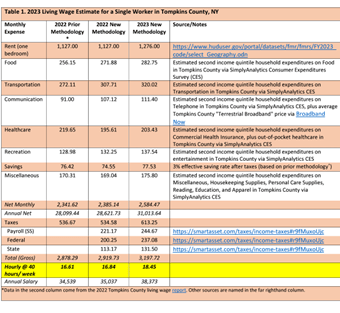
Tompkins County Living Wage Study
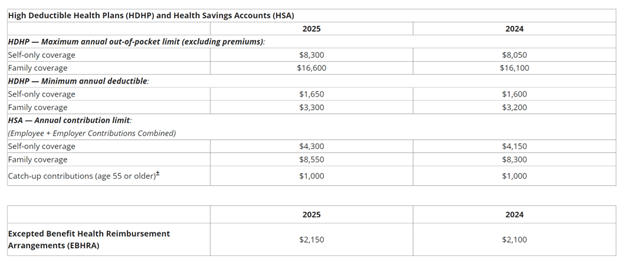
IRS Releases 2025 Cost-of-Living Adjusted Limits for Benefit Plans

https://www.lifetimebenefitsolutions.com/members/resources/irs-limits
- Qualified transportation fringe benefit. For tax year 2025, the monthly limitation for the qualified transportation fringe benefit and the monthly limitation for qualified parking rises to $325, increasing from $315 in tax year 2024.
- Health flexible spending cafeteria plans. For the taxable years beginning in 2025, the dollar limitation for employee salary reductions for contributions to health flexible spending arrangements rises to $3,300, increasing from $3,200 in tax year 2024. For cafeteria plans that permit the carryover of unused amounts, the maximum carryover amount rises to $660, increasing from $640 in tax year 2024.
- Medical savings accounts. For tax year 2025, participants who have self-only coverage the plan must have an annual deductible that is not less than $2,850 (a $50 increase from the previous tax year), but not more than $4,300 (an increase of $150 from the previous tax year).
The maximum out-of-pocket expense amount rises to $5,700, increasing from $5,550 in tax year 2024.
For family coverage in tax year 2025, the annual deductible is not less than $5,700, increasing from $5,550 in tax year 2024; however, the deductible cannot be more than $8,550, an increase of $200 versus the limit for tax year 2024. For family coverage, the out-of-pocket expense limit is $10,500 for tax year 2025, rising from $10,200 in tax year 2024.
The Internal Revenue Service recently announced 2024 dollar limits for qualified retirement plans (including 401(k) plans), deferred compensation plans, and health and welfare plans. Adjustments to certain limits are based on a cost-of-living index.
In addition, the Social Security taxable wage base, which affects qualified retirement plans “integrated” with Social Security, typically adjusts each year. For 2024, the taxable wage base increases to $160,200.
For 2024, most limits increased with the exception of catch-up contributions limits and limits fixed by statute, the latter of which do not adjust based on the cost of living. The increased limits for 2024 are highlighted in bold below.
| 2024 Limit | 2023 Limit | |
| Annual Limit on 401(k)/403(b) Deferral Contributions | $23,000 | $22,500 |
| Annual Limit on Age 50 and Older 401(k)/403(b) Catch-up Contributions | $7,500 | $7,500 |
| Annual Compensation Limit | $345,000 | $330,000 |
| Annual Contribution Limit for Defined Contribution Plans | $69,000 | $66,000 |
| Annual Benefit Limit for Defined Benefit Plans | $275,000 | $265,000 |
| Prior Year Compensation Amount for Determining Highly Compensated Employees | $155,000 | $150,000 |
| Key Employee Compensation Limit | $220,000 | $215,000 |
| Annual Limit on SIMPLE Contributions | $16,000 | $15,000 |
| Annual Limit on Catch-up Contributions to SIMPLE Plans | $3,500 | $3,500 |
| ESOP Account Balance Limit Subject to 5-Year Distribution Period | $1,380,000 | $1,330,000 |
| Incremental Amount Adding Additional Year(s) to ESOP 5-Year Distribution Period | $275,000 | $265,000 |
| Earnings Threshold for SEP Contribution | $750 | $750 |
Deferred Compensation Limits
| 2024 Limit | 2023 Limit | |
| Annual Limit on 457(b) Contributions | $23,000 | $22,500 |
| Annual Limit on Catch-up Contributions to 457(b) Plans | $7,500 | $7,500 |
| 409A Specified Employee Compensation Threshold | $220,000 | $215,000 |
| 409A Involuntary Separation Pay Limit | $690,000 | $660,000 |
Health and Welfare Plan Limits
| 2024 Limit | 2023 Limit | |
| Annual Limit on Salary Reduction Contributions to Health FSA | $3,200 | $3,050 |
| Annual Limit on Health FSA Carryover | $640 | $610 |
| Annual Limit on Salary Reduction Contributions to Dependent Care FSA | $5,000 if married filing jointly or if single $2,500 if married filing separately | $5,000 if married filing jointly or if single $2,500 if married filing separately |
| Annual Limit on HSA Contributions | $4,150 (EE only) $8,300 (family) | $3,850 (EE only) $7,750 (family) |
| Annual Limit on Catch-up Contributions to HSA | $1,000 | $1,000 |
| Annual Minimum Deductible for High Deductible Health Plans | $1,600 (EE only) $3,200 (family) | $1,500 (EE only) $3,000 (family) |
| Annual Limit on High Deductible Health Plan Out-of-pocket Expenses | $8,050 (EE only) $16,100 (family) | $7,500 (EE only) $15,000 (family) |

 BURR CONSULTING, LLC