
Original Posting Date: 11/11/2024
New York State Labor Poster Website
Pennsylvania Labor Poster Website
The DOL’s recent increase of maximum fines for noncompliance may also prompt employers to take a closer look.
The maximum fine amounts for noncompliance with certain federal notice and posting requirements, to include the following:
- Family and Medical Leave Act (FMLA): $189 (from $178)
- “Job Safety and Health: It’s the Law” (Occupational Safety and Health Act): $14,502 (from $13,653)
- Employee Polygraph Protection Act (EPPA): $23,011 (from $21,663)
The DOL’s annual increase in maximum fines illustrates that posting requirements remain on its radar. As such, employers may want to be mindful of more specific posting requirements including the following:
- Notably, the FMLA poster, Equal Employment Opportunity poster, and Employee Polygraph Protection Act poster must be displayed and visible to applicants.
- While the applicable DOL regulations precede the internet’s ubiquity in the employment space, according to guidance issued by the DOL, a prominent notice on an employer’s website with a link to the applicable posters, in most cases, is a necessary supplement but not a substitute for the physical posting required by certain federal statutes.
- Large combination posters are also available for employers that are required to post all posters contained in the DOL’s “six-in-one” poster.
- The Occupational Safety and Health Administration’s (OSHA) poster and the Executive Order 13496: Notification of Employee Rights Under Federal Labor Laws poster (a required notice for federal contractors and subcontractors) have specific size requirements.
Other Thoughts on Posting Requirements:
- “Fair Labor Standards Act (FLSA) regulations, for example, to physically display posters “in conspicuous places in every establishment where such employees are employed so as to permit them to observe readily a copy” (29 C.F.R. §516.4). Required posters must be displayed so they are easily visible to the intended audience, according to the U.S. Department of Labor.
- Executive Order No. 11246, which governs affirmative action by federal contractors, indicates that required posters must be displayed in “conspicuous places accessible to all employees, job applicants and union representatives”(41 C.F.R. §60-1.42).
- The Family and Medical Leave Act (FMLA) regulations, which apply to employers with 50 or more employees, do state that “electronic posting is sufficient to meet this posting requirement as long as it otherwise meets the requirements of this section.” However, the act also requires covered employers to post a notice “prominently where it can be readily seen by employees and applicants for employment” (29 C.F.R. §825.300).”[i]
- “With a few exceptions (FMLA, MSPA and Executive Order 13496), the U.S. Department of Labor’s regulations do not require posting of notices in Spanish or other languages…
- The federal Family and Medical Leave Act (FMLA) regulations state, “Where an employer’s workforce is comprised of a significant portion of workers who are not literate in English, the employer shall provide the general notice in a language in which the employees are literate.” See FMLA regulation 825.300, (4).
- While no similar regulation exists for the Fair Labor Standards Act (FLSA) poster, the Department of Labor (DOL) advises, “Although there is no size requirement for the poster, employees must be able to readily read it” and goes on to list the languages the poster is provided in, adding, “There is no requirement to post the poster in languages other than English.” See The Fair Labor Standards Act…
- OSHA regulations do not specify or require employers to display the OSHA poster in a foreign language. However, OSHA encourages employers with Spanish-speaking workers to also display the Spanish version of the poster…
- State laws and agencies make similar requirements and recommendations. Some states and localities, including but not limited to Arizona, California, Connecticut, Washington, D.C., Illinois, New Jersey, New Mexico, New York and Tennessee, include regulatory requirements for posters to be posted in Spanish when a certain percentage of the workforce uses English as a second language.”[ii]
- “There are three federal employment law posters that must be available to applicants: the FMLA poster, the Equal Employment Opportunity (EEO) poster and the Employee Polygraph Protection Act (EPPA) poster…
- Most of our poster regulations were written before the Internet was used for job postings. Until the regulations are revised, please place a prominent notice on the website where the job postings are listed stating that “Applicants have rights under Federal Employment Laws” and link to the three posters: Family and Medical Leave Act (FMLA) Poster (FMLA regulations were revised to allow for electronic posting as long as such posting otherwise meets the requirements of the regulations.); Equal Employment Opportunity (EEO) Poster; and Employee Polygraph Protection Act (EPPA) Poster. Please note, however, that posting the notice on the employer’s website in this manner is not a substitute for posting these EEO posters in conspicuous places on the employer’s premises where otherwise required.”[iii]
- “Old employment law posters should be saved to help prove past compliance, even though retaining old posters isn’t required, management attorneys say. Employers also should take pictures of old posters with time-and-date stamps to have a physical record that they were displayed…
- “From a best-practices perspective, retaining old posters makes sense to help prove past compliance,” said Aaron Warshaw, an attorney with Ogletree Deakins in New York City. “For example, in the context of employment litigation, posters can sometimes be relevant evidence to show that employees were informed of their applicable rights.”
- He recommended that employers retain old posters in paper or electronic format, “as long as they are clearly marked and not accidentally put back into circulation.” Save them for the applicable time employees have to sue under the law—the “statute of limitations”—such as three years for federal wage and hour posters, he said.””[iv]
State Posting Changes


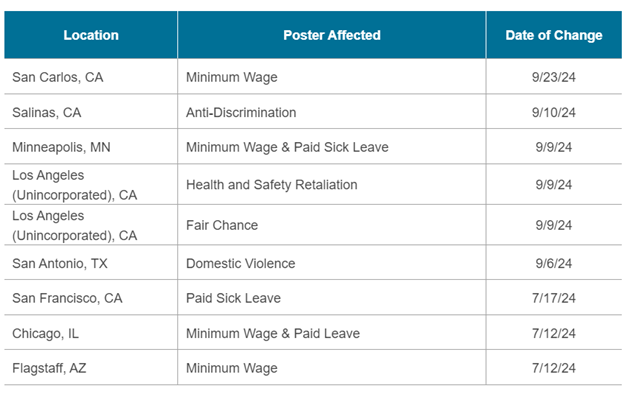
City & County Posting Changes
[i] https://www.shrm.org/resourcesandtools/tools-and-samples/hr-qa/pages/determinetheirpostingrequirements.aspx
[ii] https://www.shrm.org/resourcesandtools/tools-and-samples/hr-qa/pages/laborlawposterrequirementsforthemultilingualworkplace.aspx
[iii] https://www.shrm.org/ResourcesAndTools/tools-and-samples/hr-qa/Pages/postingrequirementsapplicantswhichfederalemploymentpostersmustbeseenbyapplicants,andhowshouldanemployercomplywiththisrequir.aspx
[iv] https://www.shrm.org/resourcesandtools/legal-and-compliance/employment-law/pages/save-and-photograph-old-posters.aspx

 BURR CONSULTING, LLC