
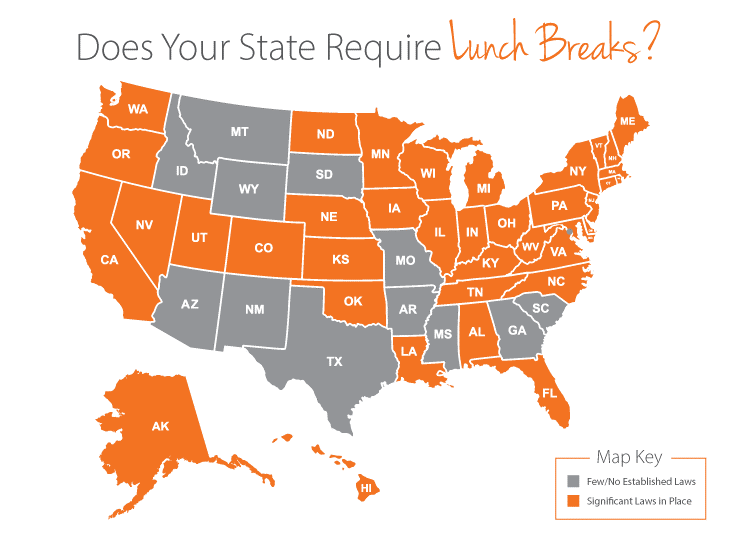
Meal and rest (break) periods continue to be a question in the workplace. These laws can be confusing, based on shift start and hours worked. Certain states’ statues or regulations remain silent on defining meal and break periods, which means they follow federal guidelines. However, New York State has unique laws and regulations on meal and rest periods. Regardless of the laws, organizations should err on the side of caution and provide breaks that are most beneficial to the employee. Breaks and rest periods are good for both the individual and employer. Set the time for breaks and lunches and hold employees accountable to follow the guidelines on meal and rest periods.
The 4 meal and rest requirements in New York State[i]:

“Permitting Shorter Meal Periods
The New York State Department of Labor (“NYSDOL”) can issue a permit allowing shorter fixed meal periods. Such a permit must be in writing and conspicuously posted in the main entrance of the establishment. The NYSDOL can revoke the permit at any time.
The NYSDOL can also permit shorter meal periods without an application by the employer if this shorter break does not create a hardship for employees. Such breaks cannot be shorter than 30 minutes.
The NYSDOL can also issue special permits for shorter meal periods after investigating special or unusual cases, but these meal periods cannot be shorter than 20 minutes.
One-Employee Shift Exception
Section 162 contains a one-employee shift exception where it is permissible for an employee to eat on the job if he or she has voluntarily consented to this arrangement. To obtain an employee’s voluntary consent, the employer must explain to the employee that (1) the nature of the employer’s industry necessitates one-employee shifts, and (2) the employee’s meal periods may be interrupted. The employer must obtain an acknowledgment from the employee, preferably in writing, either when the employee is hired or before the employee would be expected to give up his or her uninterrupted meal periods.
If an employee works through a meal period due to the one-employee shift exception, the employee must be paid for that meal period. Also, the employee must be given an uninterrupted meal period upon request.
Brown Bag Lunches
Some employers host brown bag lunches where employees eat their lunches while listening to a speaker or presentation. If employers require employees to attend brown bag lunches, this does not count as a meal period and must be counted as time worked. On the other hand, if employees voluntarily choose to attend these brown bag lunch events, they are considered to have received a proper period under the law.
Skipping Meal Periods
New York employees may waive their rights to a meal period if there is a collective bargaining agreement. The collective bargaining agreement must provide for a waiver of statutory meal periods in exchange for additional breaks or meal periods that are scheduled at other times. The waiver must include that the operational needs of the industry make it impractical to strictly comply with the meal periods. The waiver must also indicate that it was obtained openly and knowingly without duress or coercion through good faith negotiations.
Rest Periods
Rest Breaks
Rest breaks are short in duration, running from 5 minutes to about 20 minutes. Rest breaks such as coffee or snack breaks are different from meal periods. Unlike meal periods, New York employers are not required to offer rest breaks.
New York employers who do offer rest breaks must consider the time taken for rest breaks as compensable. This time for rest breaks would be included in the sum of hours worked and considered in determining whether the employee worked overtime.
Rest Days
Under Section 161 of the New York State Labor Law, certain New York employees must be provided with at least 24 consecutive hours of rest in any calendar week. This day of rest requirement applies to certain occupations and industries as set forth in Section 161 that require continuous work, such as mercantile establishments, factories, hotels, and restaurants.
Employers must designate this day of rest for each employee and notify employees in advance of their day of rest before operating on Sunday. Employees are not permitted to work on their designated day of rest. Employers are required to maintain a time book that shows the names and addresses of employees and the hours worked by them each day.
Employers may apply for a variance from the day of rest requirement if there are practical difficulties or unnecessary hardships in fulfilling the requirement. However, the variance will be granted only if the employer agrees to certain conditions and the application is approved.”
Additional resources:
https://www.dol.gov/agencies/whd/state/meal-breaks
https://www.nolo.com/legal-encyclopedia/state-laws-meal-rest-breaks.html
https://workforce.com/news/a-snack-sized-guide-to-lunch-break-laws
Meal and Rest Break Policy
It is the policy of [Company Name] to comply with state and federal laws regarding meals and breaks.
Rest periods
All employees are permitted a 15-minute paid rest break for each four-hour work period. Breaks are not permitted at either the beginning or end of the workday to offset arrival and departure times. Employees who voluntarily work through their rest breaks will not be paid additional compensation.
Meal periods
All employees who work eight or more hours in a day are required to take an unpaid meal break of 30 minutes. Meal breaks are not counted toward hours worked.
Employees are to be completely relieved from duty during their meal break. If a nonexempt employee is required to perform any work duties while on his or her meal break period, the employee must be compensated for the time spent performing work duties. The time spent working during the meal break will be counted toward the total hours worked.
Enforcement
Managers are responsible for the scheduling of meal and rest periods. Employees who fail to return on time from breaks or lunch will be subject to disciplinary action and docking of pay for time missed.
[i] Meal and Rest Break Requirements by State, SHRM, Michael Cardman
Original Post Date: April 2024

 BURR CONSULTING, LLC