
US employee assistance program (EAP) statistics
The US has the most saturated market for EAPs in the world:
- 97% of US companies with more than 5000 workers use an EAP. [15]
- 80% of US companies with 1001-5000 workers use an EAP. [15]
- 75% of US companies with 251-1000 workers use an EAP. [15]
- Around 74.1 million employees in the US have access to an EAP. [16]
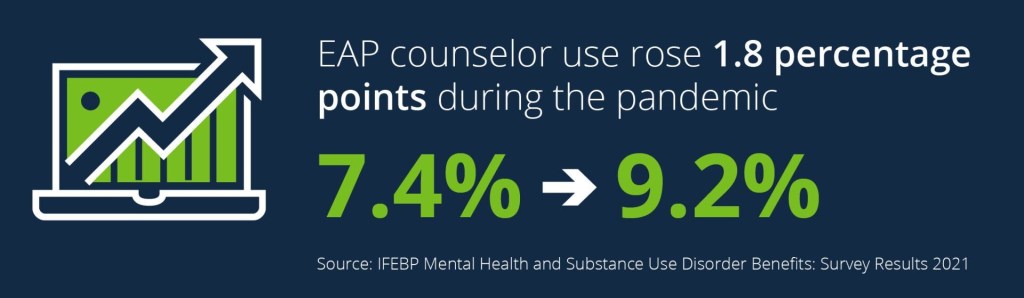
- Average EAP usage in the US is less than 10%. [17]
- The return on investment for EAPs in the US is $3-$10 for every $1 invested. [17]
- Around 78% of US union employees have access to EAPs compared to their non-union counterparts (52%). [18]
https://www.spill.chat/mental-health-statistics/eap-statistics#section-3
What are Employee Assistance Programs (EAPs)?
Employee Assistance Programs have evolved to address issues that could have the biggest impact on employee performance. An EAP is typically a separate benefit offered by an employer to help employees navigate short-term issues that may distress or distract them from work. For example, EAP counseling sessions may address issues such as work-related worries, formal mental health or substance use disorders, relationship issues, and other things that could affect well-being and productivity using problem assessment, short-term counseling, and referrals for additional services.
An EAP typically includes some combination of the following resources:
- Short-term counseling: Limited number of sessions with a counselor to help staff members deal with immediate issues. The counselor might also make use of this time to refer employees to additional services, such as substance abuse support groups
- Financial counseling: Resources for employees to handle debt, manage their budgets, etc.
- Legal services: Free or discounted legal representation for bankruptcy, divorce, and other issues or referrals to legal resources
- Adoption assistance: Free legal and financial support through adoption aid or referrals to adoption agencies
- Child and elder care services: Resources and support for caregivers in the areas of child and elder care
- Substance abuse referral services: Short-term counseling and group support services for employees who are struggling with substance abuse
- Workplace trauma counseling: Support for employees experiencing trauma following acts of workplace violence.
- Education and training: Classes, webinars, videos, and other resources covering stress management, mindfulness, resiliency, conflict management, etc.
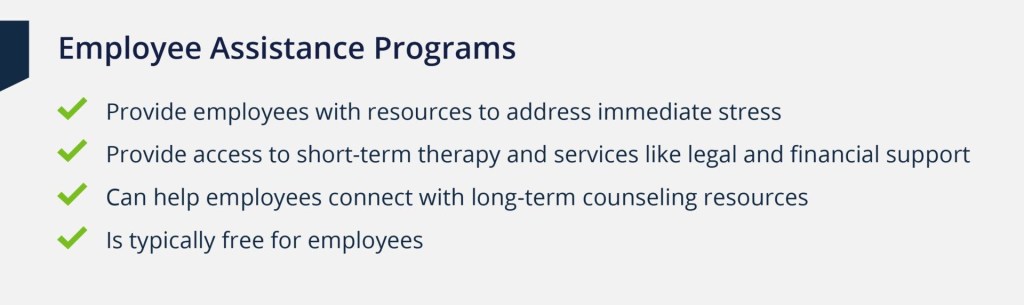
Typically, an EAP provides a limited number of counseling sessions at no cost to the employees. A sample EAP benefit may offer three to 10 no-cost visits (per year), either in person, virtually, or a combination of both. If the issue is not resolved in the number of counseling visits offered, employees may then transition to behavioral health benefits (explained below). Therefore, it’s a good idea to consider EAP benefits as a first option since it does not require fees or filing claims paperwork.
Behavioral Health Programs versus EAPs: What’s the Difference?
Employers can add behavioral health programs as an extra benefit on top of traditional EAP. Alternatively, some behavioral health programs can include EAP as part of their offering.
The main difference between an EAP mental health benefit and a behavioral health program is how they approach addressing issues. An EAP program focuses on external stressors. These include workplace issues, financial difficulties, elder care needs, childcare needs, crisis assistance, or legal issues. EAP counseling sessions are typically offered to employees for a set number of visits at no cost. In comparison, a behavioral health program focuses on the individual and addresses the emotional, mental, and physical sources of stress to promote healthy behaviors.
If an employer offers both, employees can transition from an EAP to behavioral health benefits if they need more assistance. EAP counselors are often also included in the employer’s health plan network of providers. This will allow benefits to continue seamlessly from the EAP to a behavioral health plan for continuity of care.
Below are some differences between behavioral health programs and EAPs:
| Traditional EAP | Behavioral Health Program |
| Used typically for short-term and immediate mental health care | Characterized by establishing a long-term relationship with a counselor |
| Provides three to 10 counseling sessions to address issues such as bereavement, work stress, major life events, depression, and anxiety | Treatments are specifically designed to address behaviors that worsen symptoms and to develop habits that facilitate more positive outcomes |
| Provides crisis response support | Provides therapeutic resources to develop healthy behaviors to nurture overall wellness |
| Offers resources for substance abuse referral services, financial counseling, legal services, adoption assistance, child and eldercare services, and workplace trauma counseling | Includes counseling for mental health disorders, substance abuse, addiction, gambling, and support for healthy eating, movement, and meditation |
Utilization Tips for Employers
Choosing an EAP program is just the first step. An ongoing project is to ensure your program is effective and meets the needs of your employees. Below are some ways to boost EAP program utilization:
- Clearly define the scope of EAP services your organization will cover and thoroughly communicate these to managers, employees, and family members
- Be proactive in managing EAP programs to ensure high-quality and relevant services
- Actively coordinate the roles and responsibilities of EAP with other health and productivity programs
- Utilize the EAP’s organizational services to support human resources and disability management functions
- Discuss ways to analyze EAP performance and employee engagement statistics (data confidentially gathered), including validated outcome measurement tools
- Consider conducting periodic intake and/or case assessments to evaluate the quality of the member experience
- Include diversity, equity, and inclusion (DEI) efforts as well as LGBTQ+ and BIPOC-inclusive messaging
- Consider renaming and rebranding the EAP to highlight the EAP as more than a counseling service, but rather one that can support employee and family issues and concerns objectively
- Promote alternative counseling methods, such as telephonic and text, to assist employees and family members with time or transportation constraints

How to Communicate About Your Program
Unfortunately, the stigma around mental health has not fully disappeared, and employees may be hesitant to ask about the help available. Informing employees about EAP programs and what they provide will help with utilization and ensure that employees know about the resource when they need it.
Here are some ways to educate employees about EAPs and mental health coverage:
- Orientation and onboarding: Provide information right when employees start, emphasizing the program’s confidentiality and ease of access.
- Company intranet: Keep information and relevant links in an easy-to-find location on the intranet.
- Company newsletter: A periodic reminder in the company newsletter keeps the program top of mind.
- Posters and flyers: These can be placed in common areas such as break rooms to increase the visibility of your program.
- Training and development sessions: Provide training to managers, supervisors, and employees about how to recognize signs of stress or mental health issues in themselves or their colleagues. Remind them that the EAP program includes access to mental health resources.
https://www.jdsupra.com/legalnews/how-your-employee-assistance-program-9981507/
Types of EAPs
In-House/Internal Programs
In an in-house or internal program, the EAP professionals are onsite within the workplace to deliver their services. This kind of program is most often found in companies with large numbers of employees in concentrated locations. These professionals may be direct employees of the company, or they may be employees of an EAP vendor that has been contracted to provide onsite services in the workplace.
External Programs
An external program provides employees and their family members with access to a toll-free number for service intake. The EAP intake specialist verifies benefit eligibility and then refers the caller to its specialized network of EAP providers that are geographically convenient to the employee or to the employee’s family member.
Blended Programs
Large corporations with dense pockets of employee concentrations, along with smaller concentrations in multiple locations, may want to consider a blended EAP. Under this structure, an employee can meet with an in-house employee assistance professional, if the location is convenient. Otherwise, the employee can use the vendor EAP network to access EAP counseling services near home.
Management-Sponsored Programs
A management-sponsored program is, as the name indicates, sponsored exclusively by management, as opposed to being sponsored by a union or by both management and a union. Such programs can vary widely in design and scope. Some deal only with substance misuse. Some include proactive prevention and health and wellness activities, as well as problem identification and referral. Some are actively linked to the employee health-benefit structure.
Member Assistance Programs
A member assistance program (MAP) is provided by a union. Like EAPs, MAPs can vary widely in design and scope. Unions have a long history of addressing member, family, health, welfare, and working condition concerns. MAPs support a wide range of prevention, problem identification, referral, and counseling services and activities for workers and their dependents.
Peer-Based Programs
Less common than conventional EAPs, peer-based or coworker-based EAPs offer education, training, assistance, and referrals—all through peers and coworkers. This type of program requires extensive education and training for employees.
https://www.samhsa.gov/workplace/employer-resources/provide-support
Selecting an EAP
Not every EAP will be right for every organization. To determine whether a particular EAP will meet your specific needs, ask the EAP provider the following questions:
- Do members of your staff belong to a professional EAP association, such as the International Employee Assistance Professionals Association (EAPA)?
- Do the staff who will be assigned to my organization hold the Certified Employee Assistance Professional (CEAP) credential?
- What is the education level of each member of your professional staff?
- Do you have references we may contact?
- Do you provide onsite employee education and supervisor training services?
- What fee programs do you offer?
- Will you do onsite visits? Are you able to conduct a needs assessment of our organization?
- What types of counseling services are available to employees? How many sessions?
- How easy will it be for employees to use the EAP? Where and how often is the EAP available to employees?
- To which programs and services do you make referrals, and why?
- Does the EAP have a system for evaluating the effectiveness of the program?
https://www.samhsa.gov/workplace/employer-resources/provide-support
Additional Questions to Consider
- What type of training or degree do the people taking my employees’ calls have?
- Do intake personnel work for the EAP provider or are they outsourced?
- Are counselors available 24/7?
- What type of assistance is available if we have a critical incident?
- Does the provider offer counseling and referrals only, or also manager training on how to spot an employee in crisis? Is such training included in the package or can we pay for them as needed?
- Does the provider offer employees access to a health advocate?
- Will we have a dedicated account representative whom we can call with questions?
- Does the EAP provide reporting on a regular basis? Regular reporting allows HR/benefit professionals to look for trends in calls and add training or wellness programming based on those trends.
- Does the EAP have a local presence and/or participate in benefit fairs? It may be important to some companies to have a smaller EAP that is locally known rather than encouraging employees to contact an organization they are not familiar with.
- Does the EAP have other clients in your industry? It may be valuable to have an EAP that knows about the particular stresses that affect employees in your industry. Also, if your employees work shifts, nights, or weekends, they’ll need an EAP that’s available beyond regular business hours. It’s important to find out if a prospective EAP has the capability to handle different types of employers.
- Does the EAP offer wellness seminars? EAPs can be a great resource to promote the stress management and work/life balance aspects of your wellness programs. Some strong EAP providers have large wellness databases and access to seminars that could greatly enhance your wellness program.
- How can the provider assist us in communicating benefits to employees? If employees get used to contacting the EAP for referrals for financial and legal problems, or childcare, and have a good experience, they may feel more comfortable contacting them at a more difficult time in their lives.
- What is the cost per employee?
- How many sessions are available?
- Are we paying per session or is a total group rate?
- Length of contract
- Usage metrics
- Additional training or resources for onsite or virtual training sessions
- Industry references
- General references
- Communication tools: website, office number, email, etc.
- Security of information & Meetings (data security)
- Leadership training
Draft Policy-EAP
Policy
[Company Name] will provide confidential and voluntaryassistance through its employee assistance program (EAP) to all employees and their family members who may be faced with challenges of financial concerns, legal issues, alcohol or drug problems, marital problems, illness of a family member, emotional worries, child care problems, etc. For the welfare of employees as well as for effective business operations, [Company Name] encourages its employees to take advantage of this valuable benefit.
Procedures
Employees and their family members can refer themselves to the EAP. The program may be reached 24 hours a day on weekdays and weekends.
[Insert EAP contact information]
Meetings with EAP counselors
EAP counselors are available to meet with employees or family members to assess a problem and develop a plan for resolution. The counselors may suggest a referral to an outside resource, such as a therapist, agency, physician, treatment facility or other professional that would be appropriate to assist in resolving the problem or situation.
There is no charge for employees or their families to use the services of the EAP. The EAP counselors will make every effort to coordinate referrals for ongoing treatment with the employee’s health insurance coverage as well as with his or her ability to pay.
EAP visits during work hours
In most cases an EAP visit that is urgent or cannot be scheduled outside of work will be treated similar to other doctor’s appointments. Refer to company paid time off and call-in procedures.
Referrals for employee performance or behavior issues
When an employee’s job performance or attendance is unsatisfactory or there appears to be signs of other problems impacting work performance, the supervisor should counsel the employee in consultation with human resources with an end toward resolving the situation. If the circumstances warrant, the employee may be referred to the EAP to assist in the resolution of the problem. Depending on the situation, the employee may accept or refuse participation in the EAP. However, there may be situations where continued employment at [Company Name] may be contingent on the employee’s calling the EAP for assistance.
Voluntary participation in the EAP does not jeopardize job security or promotional opportunities. However, it does not excuse the employee from following company policies and procedures or from meeting required standards for satisfactory job performance except where specific accommodations are required by law.
Confidentiality
All contact between an employee and the EAP is held strictly confidential. In cases where an employee’s continued employment is contingent on calling the EAP, the EAP counselor will only verify whether the employee has contacted the EAP and, if ongoing treatment is necessary, that the employee is following through on the treatment. Information given to the EAP counselor may be released to [Company Name] only if requested by the employee in writing. All counselors are guided by a professional code of ethics.
Original Post Date: March 2024

 BURR CONSULTING, LLC