
Upcoming New York State Minimum Wage, Executive & Administrative Exempt Salary Changes, Farm Overtime Threshold Reductions and Nationwide Changes
The NYS Department of Labor is proceeding with scheduled increases to the state’s minimum wage effective December 31, 2022. While there is no change for New York City employers, Long Island, or Westchester employers, the remainder of upstate New York will see increases. As you know, this will also impact the minimum salary levels to be paid to Executive and Administrative exempt employees. The new minimum wage and minimum salary levels can be found below. Things to keep in mind:
- The updated poster. You will be required to post a new minimum wage poster. You will be able to find the new poster here. Remember, there could be corresponding increases in the tipped wage and wages paid for fast food employees in your area.
- The minimum salary level to be considered exempt from overtime under NYS law for Executive and Administrative employees is tied to the minimum wage and may also be increasing for your industry and area. Remember, there is no NYS minimum salary level for Professional exemptions. For Professional employees you would be subject to the Federal minimum salary level.
Minimum Wage Increases
Once adopted, the FY2024 Budget would establish a new statutory minimum wage rate schedule in Section 652 of the Labor Law as follows:
| Effective Date | New York City, Westchester, Nassau, Suffolk Counties | Upstate New York |
| January 1, 2023 | $15.00 | $14.20 |
| January 1, 2024 | $16.00 | $15.00 |
| January 1, 2025 | $16.50 | $15.50 |
| January 1, 2026 | $17.00 | $16.00 |
| January 1, 2027+ | $17.00 + annual increase | $16.00 + annual increase |
Indexing the Minimum Wage
Starting January 1, 2027, additional annual minimum wage increases would be implemented each year based on the Northeast region measure of consumer price increases for urban wage earners and clerical workers (CPI-W). There would be no increases to the minimum wage if over a period of the prior year, the calculations published by the United States Department of Labor show that:
- The CPI-W for Northeast Region Urban Wage Earners is negative.
- The statewide unemployment rate increases by one-half percentage point or more.
- Total non-farm employment decreases (measured seasonally).
Adjusted minimum wages are required to be published by the State Department of Labor no later than October 1st of each year.
Adjustments to Salary Thresholds, Allowances, and Gratuities
It is worth noting that minimum wage orders in effect would remain in effect, including wage orders that address minimum salary levels for executive and administrative exemptions, gratuities, and allowances for meals, apparel, etc. As these minimum wage increases take effect, the State Department of Labor would amend the wage orders to increase all monetary amounts (i.e., salary levels and allowances) in the same proportion as the increase in the hourly minimum wage. The state is expected to publish the official amounts of these adjustments. We calculate the salary threshold in 2024 for downstate would rise to $1,200 weekly, and the upstate salary basis threshold would rise to $1,125 weekly.
The wage for food service workers who receive tips would remain lower than the regular minimum wage by one-third and rounded to the nearest five cents. While the state has not issued its official calculations, our unofficial calculations for tipped food service workers in the Hospitality Industry would be as follows:
| TIPPED FOOD SERVICE WORKERS | ||
| Year | New York City, Westchester, Nassau, Suffolk Counties | Upstate New York |
| 2024 | $10.70 | $10.00 |
| 2025 | $11.00 | $10.35 |
| 2026 | $11.35 | $10.70 |
| 2027+ | $11.35 + annual increase | $10.70 + annual increase |
Updated New York Salary Threshold (Reminder FLSA is still moving forward with $55,000 nationally.)
Employers should adjust their minimum exempt salary to $55,341 annually ($1,064.25 weekly) to reflect the increase that took effect December 31st, 2022, throughout the State.
There was no increase for NYC, Long Island, and Westchester which have their own minimum salary threshold. As a reminder to remain in compliance if you have employees working in those regions any exempt executives or administrative employees should be receiving a minimum weekly salary of $1,125.00 (Annual $58,500).
Expect the 2024 threshold to move to $1,125 per week, as of December 31, 2023, no state announcement as of yet.
NYS Reduces Overtime Threshold for Farm Workers to 40 hours Per Week
New York State Department of Labor (NYSDOL) Commissioner Roberta Reardon issued an order accepting the recommendation of the Farm Laborers Wage Board to lower the current 60-hour threshold for overtime pay to 40 hours per week by January 1, 2032, allowing 10 years to phase in the new threshold. NYSDOL will now be undergoing a rule making process which will include a 60-day public comment period. This applies to certain agricultural employers and employees only.
Under proposed language, an employer shall pay an employee for overtime at a wage rate of one- and one-half times the employee’s regular rate of pay for hours worked in excess of the following number of hours in one workweek:
(a) 60 hours on or after January 1, 2020;
(b) 56 hours on or after January 1, 2024;
(c) 52 hours on or after January 1, 2026;
(d) 48 hours on or after January 1, 2028;
(e) 44 hours on or after January 1, 2030;
(f) 40 hours on or after January 1, 2032.
Minimum Wage for Fast Food Employees
The minimum wage for fast food employees working outside of New York City will increase to $14.50 per hour. The final scheduled increase to $15.00 per hour will take effect on July 1, 2021.

Tompkins County Living Wage Information
Additional National Changes:
Notable 2023 Rate-Related Developments
District of Columbia: January 1, 2023, was supposed to be the date when the minimum cash wage for tip credit employees would increase to $6.00 per hour due to voter-approved changes that occurred at the November 8, 2022, election (including the gradual phasing out of the tip credit). However, as it had done previously with proposed changes to tipped employee standards, the District of Columbia enacted legislation that partially overrode the ballot measure and delayed the operative date of these changes from January 1 to May 1, 2023. As a result, D.C. employers are subject to two rate-related changes within, essentially, a two-month period, as the amended law also requires the minimum cash wage to increase to $8.00 per hour on July 1, 2023.
Maryland: With the signing of SB 555 on April 11, 2023, Maryland eliminated its current two-tier minimum wage effective January 1, 2024, at which point a $15.00 per hour minimum wage will apply to all employers (currently the rates are $13.25 and $12.80, depending on whether an employer has 15 or more, or 14 or fewer, employees). Additionally, the legislation removed annual adjustments to the minimum wage, meaning the $15.00 minimum wage will apply from January 1, 2024, until the legislature and governor decide to increase the rate.
Michigan: On January 26, 2023, a three-judge panel of the Michigan Court of Appeals issued a ruling that maintained the status quo concerning Michigan’s minimum wage and tip provisions and reversed a Court of Claims decision that found that the state legislature had violated the Michigan Constitution when it overhauled revisions to the law only months after it had adopted as law a proposed ballot measure covering these topics. The appellate court decision, in turn, has been appealed to the Michigan Supreme Court.
Consumer Price Index Continues to Affect Pay Rates
Although percentage changes to the consumer price index have been trending downward, comparatively speaking more current figures exceed those we saw before inflation began picking up steam around Spring 2021. For example, nationally the March 2021 figures increased around a percentage point compared to those in February 2021, from 1.7 to 2.6% (CPI-U) (Consumers) and from 1.9 to 3% (CPI-W) (Workers). We then saw a point-and-a-half increase when comparing figures in April and March 2021, with increases of 4.2% (CPI-U) and 4.7% (CPI-W). From there, inflation was off to the proverbial races, gradually increasing in 2021, peaking mid-2022, then beginning a gradual descent to where we find ourselves currently: 4.9% (CPI-U) and 4.6% (CPI-W) in April 2023.
This rollercoaster ride plays out in the minimum wage adjustments, with interesting outcomes when we compare 2023 to 2022 adjustments. For example:
- Although some rate changes will occur on the same date for localities within close proximity of each other, the date a location uses to make the calculation adjustment matters. Consider, in California, the City of Los Angeles and the County of Los Angeles. Before July 2022, each location had a $15 minimum wage. For 2022 calculation purposes, inflation was increasing, so, because the county adjustment was based on November figures, its increase was less than the city’s adjustment based on December figures: $15.96 (County) and $16.04 (City). For 2023 calculation purposes, however, inflation had been decreasing, so the city’s later-in-the-year metric means its percentage change was less, which has allowed the county to leapfrog the city even though it started with a lower number to adjust: $16.90 (County) and $16.78 (City).
- We also see CPI switcheroos within the same jurisdiction. Some locations that had comparatively modest rate adjustments in 2022 have more robust increases in 2023, e.g., this occurs under some local laws in California, Maryland, and New Mexico.
Changes to the Minimum Wage, Minimum Cash Wage & Tip Credit
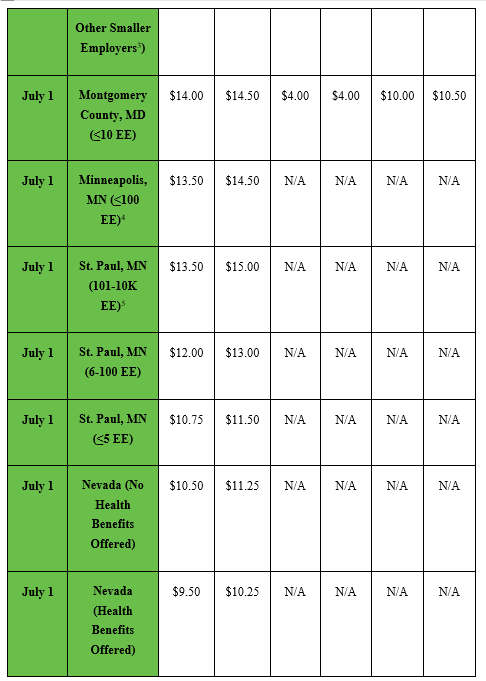
In the below chart (organized chronologically, then by jurisdiction) we include the generally applicable1 minimum wage (MW) and identify the date in 2023 when the change occurred or will occur. We list the rate that applied before the change (Pre) alongside the new rate (Post). In certain jurisdictions – excluding, e.g., California, Minnesota, Nevada, Oregon – employers may be able to count tips an employee receives toward the minimum wage. In those jurisdictions that permit a tip credit (TC), if the direct wage an employer pays (minimum cash wage or MCW) and tips an employee earns equals the minimum wage, an employer satisfies its minimum wage obligation, but, if the direct wage plus tips does not equal the minimum wage, an employer must pay the employee the difference.



Changes to the Exempt Employee Pay
White Collar Employees Covered by Minimum Wage: In various states, employees covered by the executive, administrative, professional, or outside sales exemptions are exempt from state overtime requirements, but not exempt from state minimum wage requirements. In these jurisdictions, such employees must earn at least the applicable minimum wage. In one such state, Nevada, on July 1 the minimum wage will increase to $11.25 or $10.25 per hour, depending on whether an employer offers health benefits. Note that, in Illinois, local minimum wage rates may apply (see above), which could affect executive, administrative, or professional employees.
Commissioned Employee Overtime Exemption: To qualify under the federal FLSA’s 7(i) overtime exception, the regular rate of pay for an employee of a retail or service establishment must exceed one-and-a-half times the federal minimum wage, and more than half the employee’s compensation for a representative period (not less than one month) must represent commissions on goods or services. In the following states with upcoming mid-year 2023 rate changes, the 7(i)-type exception requires – in part – an employee’s pay to either equal or exceed one-and-a-half times the state minimum wage: District of Columbia ($17.00); Nevada ($11.25 or $10.25); Oregon ($15.45, $14.20, or $13.20). Additionally, in Connecticut ($15.00), pay must exceeds two times the state minimum wage.
Nevada Daily Overtime Exception: Nevada law contains both weekly and daily overtime requirements. An exception to daily overtime standard exists, however, for employers whose hourly rate equals or exceeds one-and-a-half times the state minimum wage. For this exception to apply, effective July 1, 2023, the employee’s hourly rate must be at least $16.875 or $15.375 per hour, depending on whether an employer offers health benefits. Note, however, that weekly overtime standards still apply to these employees. (Littler)
2024 New York State Paid Family Leave and Workers Compensation Rates & 2023 PFL Reminders
On Wednesday, August 30, 2023, the New York Department of Financial Services (DFS) announced that in 2024, the maximum contribution rate for Paid Family Leave will go down from 0.455% to 0.373% of an employee’s gross annualized wages, capped at $89,343.80*, which is the updated annualized New York State Average Weekly Wage (learn more about the NYSAWW here). This translates to a maximum annual premium contribution of $333.25 per employee that an employer can withhold – down from $399.43 this year.
The New York Department of Labor released its New York State Average Weekly Wage (NYSAWW),used to calculate 2024 NY Paid Family Leave benefits. As of April 1, 2023, the NYSAWW increased to $1,718.15*. (Shelter Point)

Paid Family Leave by State & City
2023 Paid Family Leave Expansion
Through Legislation S.2928-A/A.06098-A, the definition of “family members” expands to include siblings. This includes biological siblings, adopted siblings, step-siblings and half-siblings. These family members can live outside of New York State, and even outside of the country.
The bill will go into effect on January 1, 2023.
PFL At-A-Glance for 2023 [PDF]
Model Language for Employee Materials – Updated for 2023 (template)
Employee Notice of Paid Family Leave Payroll Deduction for 2023 (template)
Statement of Rights for Paid Family Leave (PFL-271S)
Here are some contribution and benefit examples at different income levels:
- Employees earning $519 a week (about $27,000 a year) will pay about $2.65 per week: $519 x 0.511%. When taking the benefit, these employees will receive $347.73 per week, up to a maximum total benefit of $4,172.76.
- Employees earning $1,000 a week ($52,000 a year) will pay $5.11 per week: $1,000 x 0.511 %. When taking the benefit, these employees will receive $670 per week, up to a maximum total benefit of $8,040.
- Employees earning the SAWW of $1,594.57 (about $83,000 a year) or more will pay 0.511% x their gross wages each pay period until they reach the maximum of $423.71. When taking the benefit, these employees will receive $1,068.36 per week, up to a maximum total benefit of $12,820.32
Draft PFL Policy Language:
NEW YORK STATE PAID FAMILY LEAVE
New York Paid Family Leave provides job-protected, paid time off so employees can:
- bond with a newly born, adopted, or fostered child.
- care for a close relative with a serious health condition; or
- Assist loved ones when a family member is deployed abroad on active military service.
By NYS PFL Definition:
- spouse
- domestic partner (including same and different gender couples; legal registration not required)
- child/stepchild and anyone for whom you have legal custody
- parent/stepparent
- parent-in-law
- grandparent
- grandchild
- sibling (starting in 2023) Workers should check with their employer’s Paid Family Leave insurer to learn when sibling care goes into effect for their policy. For employees who work for self-insured employers, coverage begins January 1, 2023.
Employees who believe they are eligible for Paid Family Leave should contact their _______ as soon as possible. More information can be found at www.ny.gov/programs/new-york-state-paid-family-leave. Organization will abide by all changes to NYSPFL and communicate such changes to the employees. For additional information please alert your President, or the Statement of Rights Posting on Paid Family Leave.
Legal Area’s and Changes to Remember and Communicate:
- Employees have job protection, similar to FMLA.
- Paid Sick Leave policies and procedures.
- Right to keep their health insurance while on leave.
- No retaliation or discrimination against those who take leave.
- Citizenship is never a factor in eligibility for NYSPFL.
- Review the language contained in your employee handbook, policy, or policy manual. Update FMLA and NYSPFL language to reflect changes and communicate the policy to the workforce.
- Communicate PFL payroll deductions for 2020 to the workforce now or during open enrolment. My recommendation is to do this in writing via a template and obtain a signature. NYS has a PDF template referenced above.
- Ensure the NYS PFL statement of rights for Paid Family Leave in 2023 is up-to-date and communicated to the workforce. This includes the postings; disability provider or state is providing these postings to employers. Watch the expiration dates on the postings, this is a common area in an audit that needs to be corrected.
- A proper call-in procedure for intermittent leave is necessary. Do you accept text messages? What about emails? This should all be clearly communicated in a policy or procedure. How much notice?
- New York State Paid Sick Leave
I am happy to work with any employer’s on ensuring policy, communication mechanisms, postings and other NYSPFL material is legal and up to date. Ensure you are reviewing this information annually and communicating changes to PFL rates annually. Work with your payroll provider to ensure and verify the percentage deductions are accurate and live in the payroll system. Remember interns and seasonal employees and communicate if they do or do not qualify for PFL. There are forms to fill out online if they do not qualify to ensure the deduction is not taken.

Frequently Asked Questions
How many weeks of Paid Family Leave are available to employees?
Eligible employees can take up to 12 weeks of Paid Family Leave.
How much will employees get paid when taking Paid Family Leave?
Employees taking Paid Family Leave in 2023 will get 67% of their average weekly wage, up to a cap of 67% of the current NYSAWW of $1,688.19.
What is the maximum weekly benefit?
The maximum weekly benefit for 2023 is $1,131.08.
If I start my continuous leave in one year and it extends into the next, am I eligible for the benefits at the 2023 rate?
You get the benefit rate in effect on the first day of your leave.
If I start my intermittent leave in 2022, and it extends into 2023, am I eligible for the benefits at the 2023 rate?
You get the benefit rate in effect on the first day of a period of leave. When more than three months pass between days of Paid Family Leave, your next day or period of Paid Family Leave is considered a new claim under the law. This means you will need to file a new request for Paid Family Leave and that you may be eligible for the increased benefits available should that day or period of Paid Family Leave begin in 2023.
I am having a new baby in 2022; can I wait until 2023 to take Paid Family Leave?
Yes, you can take (and must complete) Paid Family Leave for bonding with a new child at any time within the first 12 months of the child’s birth, adoption, or foster care placement, provided that you remain an eligible, covered employee.
I used all 12 weeks of Paid Family Leave in the last year; can I take more Paid Family Leave this year if I experience another qualifying event?
You may take up to 12 weeks of Paid Family Leave in every 52-week period. This means that if you used the full 12 weeks of leave, the next time you would be eligible to take Paid Family Leave again is one year from your first day of leave.
What is the weekly employee contribution rate?
If you are paid weekly, the payroll contribution is 0.455% of your gross weekly wages and is capped at an annual maximum of $399.43. If your gross weekly wages are less than the NYSAWW ($1,688.19 per week), you will have an annual contribution amount less than the annual cap of $399.43, consistent with your actual wages.
For example, if you earn about $27,000 a year ($519 a week), you will pay about $2.36 per week.
If you are not paid weekly, the payroll contribution will be 0.455% of your gross wages for the pay period.
What is the maximum amount employees will pay for Paid Family Leave?
The maximum employee contribution for 2023 is $399.43.
On March 31, 2022, New York updated the NYSAWW. When does this NYSAWW take effect for Paid Family Leave deduction and benefit caps?
The new NYSAWW only applies to the 2023 benefit and will not affect Paid Family Leave deductions or benefits until January 1, 2023, if leave was begun on or after that date. The new NYSAWW does not have any impact on Paid Family Leave benefits in 2022.
What is the NYSAWW that will be used for Paid Family Leave benefits in 2023?
$1,688.19
Workers Comp Rates
The maximum weekly benefit rate for workers’ compensation claimants is two-thirds of the New York State average weekly wage for the previous calendar year, as determined by the New York State Department of Labor (Workers’ Compensation Law §§ 2[16] and 15[6]).
The Department of Labor reported to the Superintendent of the Department of Financial Services that the New York State average weekly wage for 2022 was $1,718.15. Accordingly, the maximum weekly benefit rate will be $1,145.43 for compensable lost time for workers’ compensation claims with dates of injury during the period from July 1, 2023, through June 30, 2024.
| Schedule of Benefits | |
| Date of Accident | Weekly Maximum Total / Partial |
| July 1, 2023 – June 30, 2024 | $1,145.43 / $1,145.43 |
| July 1, 2022 – June 30, 2023 | $1,125.46 / $1,125.46 |
| July 1, 2021 – June 30, 2022 | $1,063.05 / $1,063.05 |
| July 1, 2020 – June 30, 2021 | $966.78 / $966.78 |
| July 1, 2019 – June 30, 2020 | $934.11 / $934.11 |
| July 1, 2018 – June 30, 2019 | $904.74 / $904.74 |
| July 1, 2017 – June 30, 2018 | $870.61 / $870.61 |
| July 1, 2016 – June 30, 2017 | $864.32 / $864.32 |
| July 1, 2015 – June 30, 2016 | $844.29 / $844.29 |
| July 1, 2014 – June 30, 2015 | $808.65 / $808.65 |
| July 1, 2013 – June 30, 2014 | $803.21 / $803.21 |
| July 1, 2012 – June 30, 2013 | $792.07 / $792.07 |
| July 1, 2011 – June 30, 2012 | $772.96 / $772.96 |
| July 1, 2010 – June 30, 2011 | $739.83 / $739.83 |
| July 1, 2009 – June 30, 2010 | $600 / $600 |
| July 1, 2008 – June 30, 2009 | $550 / $550 |
| July 1, 2007 – June 30, 2008 | $500 / $500 |
| July 1, 1992 – June 30, 2007 | $400 / $400 |
| July 1, 1991 – June 30, 1992 | $350 / $350 |
| July 1, 1990 – June 30, 1991 | $340 / $280 |
| July 1, 1985 – June 30, 1990 | $300 / $150 |
IRS Releases 2024 Cost-of-Living Adjusted Limits for Benefit Plans
The Internal Revenue Service recently announced 2024 dollar limits for qualified retirement plans (including 401(k) plans), deferred compensation plans, and health and welfare plans. Adjustments to certain limits are based on a cost-of-living index.
In addition, the Social Security taxable wage base, which affects qualified retirement plans “integrated” with Social Security, typically adjusts each year. For 2024, the taxable wage base increases to $160,200.
For 2024, most limits increased with the exception of catch-up contributions limits and limits fixed by statute, the latter of which do not adjust based on the cost of living. The increased limits for 2024 are highlighted in bold below.
Qualified Retirement Plan Limits
| 2024 Limit | 2023 Limit | |
| Annual Limit on 401(k)/403(b) Deferral Contributions | $23,000 | $22,500 |
| Annual Limit on Age 50 and Older 401(k)/403(b) Catch-up Contributions | $7,500 | $7,500 |
| Annual Compensation Limit | $345,000 | $330,000 |
| Annual Contribution Limit for Defined Contribution Plans | $69,000 | $66,000 |
| Annual Benefit Limit for Defined Benefit Plans | $275,000 | $265,000 |
| Prior Year Compensation Amount for Determining Highly Compensated Employees | $155,000 | $150,000 |
| Key Employee Compensation Limit | $220,000 | $215,000 |
| Annual Limit on SIMPLE Contributions | $16,000 | $15,000 |
| Annual Limit on Catch-up Contributions to SIMPLE Plans | $3,500 | $3,500 |
| ESOP Account Balance Limit Subject to 5-Year Distribution Period | $1,380,000 | $1,330,000 |
| Incremental Amount Adding Additional Year(s) to ESOP 5-Year Distribution Period | $275,000 | $265,000 |
| Earnings Threshold for SEP Contribution | $750 | $750 |
Deferred Compensation Limits
| 2024 Limit | 2023 Limit | |
| Annual Limit on 457(b) Contributions | $23,000 | $22,500 |
| Annual Limit on Catch-up Contributions to 457(b) Plans | $7,500 | $7,500 |
| 409A Specified Employee Compensation Threshold | $220,000 | $215,000 |
| 409A Involuntary Separation Pay Limit | $690,000 | $660,000 |
Health and Welfare Plan Limits
| 2024 Limit | 2023 Limit | |
| Annual Limit on Salary Reduction Contributions to Health FSA | $3,200 | $3,050 |
| Annual Limit on Health FSA Carryover | $640 | $610 |
| Annual Limit on Salary Reduction Contributions to Dependent Care FSA | $5,000 if married filing jointly or if single $2,500 if married filing separately | $5,000 if married filing jointly or if single $2,500 if married filing separately |
| Annual Limit on HSA Contributions | $4,150 (EE only) $8,300 (family) | $3,850 (EE only) $7,750 (family) |
| Annual Limit on Catch-up Contributions to HSA | $1,000 | $1,000 |
| Annual Minimum Deductible for High Deductible Health Plans | $1,600 (EE only) $3,200 (family) | $1,500 (EE only) $3,000 (family) |
| Annual Limit on High Deductible Health Plan Out-of-pocket Expenses | $8,050 (EE only) $16,100 (family) | $7,500 (EE only) $15,000 (family) |
(JD SUPRA)

 BURR CONSULTING, LLC