
The 2022 EEO-1 Component 1 data collection will open on Tuesday, October 31, 2023. The EEO-1 online Filer Support Message Center (i.e., filer help desk) will also be available on Tuesday, October 31, 2023, to assist filers with any inquiries they may have regarding the 2022 collection. The deadline to file the 2022 EEO-1 Component 1 report is Tuesday, December 5, 2023.
All updates about the 2022 EEO-1 Component 1 data collection, including the updated 2022 EEO-1 Component 1 Instruction Booklet and the updated 2022 EEO-1 Component 1 Data File Upload Specifications, will be posted to www.eeocdata.org/eeo1 as they become available. The EEOC anticipates posting the updated 2022 EEO-1 Component 1 Instruction Booklet for filers on Wednesday, September 6, 2023. The EEOC anticipates posting the updated 2022 EEO-1 Component 1 Data File Upload Specifications for filers on Wednesday, September 13, 2023.
The EEOC and the U.S. Department of Labor Office of Federal Contract Compliance Programs (OFCCP) regulations require all private sector employers with 100 or more employees, and federal contractors with 50 or more employees meeting certain criteria to file EEO-1 reports annually through the EEOC’s dedicated website for EEO-1 Component 1 data collection.
Federal contractors who have federal contracts or subcontracts totaling $150,000 or more must file the annual VETS-4212 report to the Department of Labor by Sept. 30, 2023. Data reported through form VETS-4212 is used by OFCCP in Vietnam Era Veterans’ Readjustment Assistance Act (VEVRAA) compliance evaluations.
Who Is Required to File EEO-1 Reports?
The EEOC and the U.S. Department of Labor Office of Federal Contract Compliance Programs (OFCCP) regulations require eligible employers to file Standard Form 100 (EEO-1 reports) annually through the EEOC’s dedicated website for EEO-1 Component 1 data collection at www.eeocdata.org/eeo1. The filing of EEO-1 reports is mandatory and not voluntary for “eligible” employers under federal regulations. Those employers covered by the EEO-1 reporting requirement must summarize their workforce’s demographics by race/ethnicity, sex, and job categories.
Employers who are required to file EEO-1 reports include:
- Private-sector employers that are subject to Title VII of the Civil Rights Act of 1964 (Title VII) and have 100 or more employees.
- Employers subject to Title VII with fewer than 100 employees if the employer is affiliated with another company so as to be considered legally as a single enterprise employing a total of 100 or more employees; and
- Certain federal contractors employing 50 or more employees.
What Type of Data Is Required for the EEO-1 Component 1 Report?
An EEO-1 report provides the EEOC with a snapshot of a covered employer’s workforce during a specific payroll period of the applicable year. Employers are required to gather this information from company records and employment documents completed by their employees and enter and/or upload this information through the EEOC’s EEO-1 Online Filing System (OFS). Through the OFS, employers are able to enter and/or update company information; file or upload workforce demographic data either by entering the data into the OFS or uploading a data file using an approved EEOC template; enter any remarks or explanations regarding the report; and certify the accuracy of the information entered through OFS.
The Categories for Workforce Data
According to the EEOC, employee self-identification, especially as to race and ethnicity information, is ideal. However, where an employee declines to self-identify, employment records or observer identification may be used instead. The EEOC has a designated list of race and ethnicity categories that employers should be mindful of when collecting this information from their workforce. The categories include:
- Hispanic or Latino
- White
- Black or African American
- Asian
- American Indian or Alaska Native
- Two or More Races
Employers are also required to provide gender/sex data by an employee’s job category. Although the EEOC added an “X” gender marker as a component of the charge intake process last year, there is no current equivalent for EEO-1 reporting of non-binary individuals. Employers who seek to include this information can do so using the remarks section of the EEO-1 report. Employers are required to retain a copy of the most recent EEO-1 report filed at each reporting unit in the event the EEOC requests this information from the employer.
EEO-1 Reporting Obligation
Businesses with 100 or more employees and some federal contractors with at least 50 employees must submit an annual EEO-1 form, which asks for information from the previous year about the number of employees who worked for the business, sorted by job category, race, ethnicity and gender.
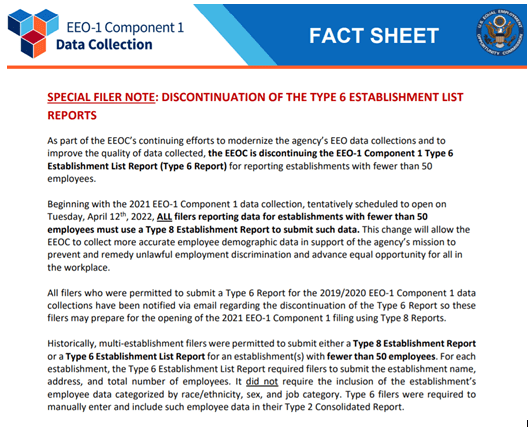
The EEOC also announced the discontinuation of the use of Type 6 reports for multi-establishment employers. Type 6 reports allowed these employers to report only the total number of employees at an establishment with fewer than 50 employees, instead of providing demographic data by EEO-1 category for each location.
Single-Establishment vs. Multi-Establishment Filing
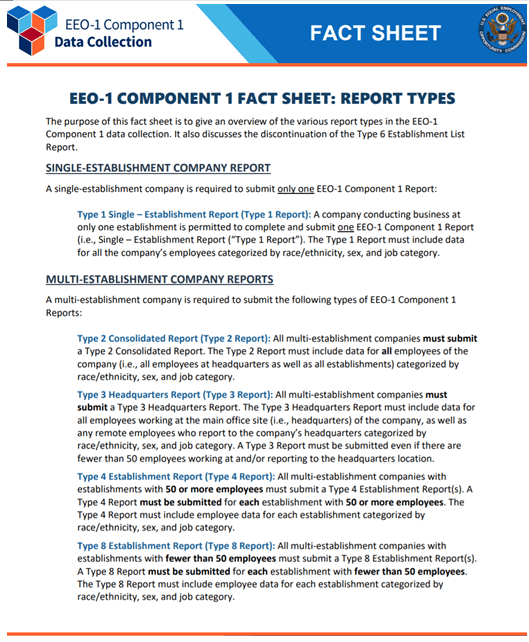
Single-establishment companies are required to submit only one EEO-1 Component 1 data report. Multi-establishment companies must submit:
- A report for the headquarters.
- A report for each establishment of the company with 50 or more employees.
- A report for each establishment with fewer than 50 employees. The Type 8 establishment report, as it’s called, must include employee data for each establishment broken down by job category, race, ethnicity and gender.
- A consolidated report that includes all employees.
(EEOC)
Extensions Last Year
Covered employers had until Oct. 25, 2021, to file their 2019 and 2020 EEO-1 reports. Although the reporting deadline was delayed several times during the COVID-19 pandemic, the agency eventually said it would not authorize any more extensions. The EEOC said it does not intend to collect controversial pay data from Component 2 of the EEO-1 form, which was the source of a heated legal dispute in recent years.
Additional Links:
https://www.eeoc.gov/employers/eeo-data-collections
https://www.eeoc.gov/employers/eeo-1-data-collection
WHO NEEDS TO FILE THE EEO-1
- What companies are required to file the EEO-1 report?
A: All companies that meet the following criteria are required to file the EEO-1 report annually:- Subject to Title VII of the Civil Rights Act of 1964, as amended, with 100 or more employees; or
- Subject to Title VII of the Civil Rights Act of 1964, as amended, with fewer than 100 employees if the company is owned by or corporately affiliated with another company and the entire enterprise employs a total of 100 or more employees: or
- Federal government prime contractors or first-tier subcontractors subject to Executive Order 11246, as amended, with 50 or more employees and a prime contract or first-tier subcontract amounting to $50,000 or more.
- Do I need to file if my company has fewer than 50 employees but does have a federal government contract worth $50,000 or more?
A: No, your company must meet both requirements of 50 employees and the government contract worth $50,000 or more.
https://www.eeoc.gov/employers/eeo1survey/faq.cfm
Legal Requirements
- Recordkeeping Requirements
- Download the “EEO is the Law” Poster in English (including a screen-readable electronic version), Spanish, Arabic, and Chinese
Employers are required to post a notice describing the federal employment discrimination laws. - EEO Reports/Surveys
Employers who have at least 100 employees and federal contractors who have at least 50 employees are required to complete and submit an EEO-1 Report (a government form that requests information about employees’ job categories, ethnicity, race, and gender) to EEOC and the U.S. Department of Labor every year.

 BURR CONSULTING, LLC