2023 New York State Wage Transparency September 17, 2023

“As a reminder, the pay transparency law, which is codified at Section 194-b of the New York Labor Law, will require employers with four or more employees to include the following whenever they “advertise” for a job, promotion, or transfer opportunity:

  • The compensation or “range of compensation” for the job, promotion, or transfer opportunity. 
  • The job description for the job, promotion, or transfer opportunity, if one exists.

The original legislation did not define the term “advertise.” The amendment adds the following definition:

“[A]dvertise” shall mean to make available to a pool of potential applicants for internal or public viewing, including electronically, a written description of an employment opportunity.

This is a broad definition and will likely encompass internal postings on an intranet or job board, postings in newspapers and “want ads,” as well as electronic postings on the employer’s website or job posting sites such as Indeed.com or ZipRecruiter.” (https://www.hodgsonruss.com/newsroom-publications-14258.html)

“On Dec. 21, 2022, Gov. Kathy Hochul signed the long-anticipated New York State pay transparency bill into law. The bill amends New York State Labor Law by adding a new section 194-b, which takes effect on Sept. 17, 2023. Labor Law § 194-b continues a recent trend toward pay transparency both nationally and locally, including similar laws in New York City, Albany County, Westchester County and Ithaca.

Employers subject to the law are broadly defined to include nearly every entity with four or more employees, as well as agents and recruiters. Only temporary help firms, as defined under New York State Labor Law § 916(5), are exempt.[1]

Similar to other pay transparency laws, Labor Law § 194-b requires employers to disclose an amount or a range of compensation for any open job, promotion or transfer opportunity that can or will be performed, at least in part, in New York State. The law defines “range of compensation” as “the minimum and maximum annual salary or hourly range of compensation . . . that the employer in good faith believes to be accurate at the time of the posting of an advertisement” for the job, promotion or transfer opportunity. Advertisements for jobs, promotions or transfer opportunities that are paid solely on commission must disclose that in writing. Additionally, the law requires employers to post a job description if one exists.

Labor Law § 194-b does not define “advertisement,” so the breadth of the law’s application to activities such as direct recruitment and internal promotion is unclear. Presumably, the Commissioner of Labor will clarify the scope of coverage by regulations, which the law directs the Commissioner to promulgate. 

Employers are required to keep and maintain records in connection to the law, including the history of compensation ranges for each job, promotion or transfer opportunity and the job descriptions for these positions, if such job descriptions exist.

Any person claiming to be aggrieved under Labor Law § 194-b may file a complaint with the Department of Labor, which has the authority to impose civil penalties of up to three thousand dollars for violations of the law or forthcoming regulations. Employers are prohibited from refusing to interview, hire, promote, employ or otherwise retaliate against an applicant or current employee for exercising any rights under this new law.

Finally, Labor Law § 194-b contains a provision stating that it shall not be construed or interpreted to supersede or preempt any local law, rules, or regulation. Most of the existing local pay transparency laws in New York failed to predict a parallel state law (despite the fact that one had already passed in the legislature), so employers subject to these laws will have to comply with overlapping obligations unless the local jurisdictions yield. The Westchester County Salary Transparency Law is the outlier and expressly gives way to “substantially similar” state legislation.” (Bond)

May 12, 2022 the Salary Transparency Law was enacted in New York City, which was postponed to the effective date of November 1, 2022. 

“In addition to employers, 134-A specifies that employment agencies, and employees or agents thereof, must also include a salary range or hourly wage range in each advertised position, promotion, or transfer opportunity. Job advertisements for “temporary employment at temporary help firms” are still exempted from the law. Temporary help firms are defined as businesses that recruit and hire their own employees and assign those employees to perform work at or perform services for other organizations or businesses.” (Littler)

  1. “The civil penalty for the first violation will be $0 if the employer cures the violation within 30 days of receipt of a complaint. The proof of cure may be submitted either electronically or in person and is deemed an admission of liability by the employer.
  2. In line with the recent CCHR guidance (which has now been updated), the law would apply to job listings for both salaried and hourly positions, and would not apply to any position “that cannot or will not be performed, at least in part, in the city of New York.”
  3. While an individual may only file a lawsuit based on a violation arising from an advertisement by their current employer, any aggrieved person may file a complaint with the Commission, regardless of whether the alleged violator is the grievant’s current employer.” (Bond)

New York Wage Transparency Law

As assumed, on June 3, 2022, New York State passed a similar law on wage transparency. 

“the new law would require covered employers to disclose compensation or a range of compensation to applicants and employees upon issuing an employment opportunity for internal or public viewing, or upon employee request. The Bill is intended to enhance transparency around compensation and reducing any existing wage disparities among employees.

The Bill defines a covered employer as: (i) “any person, corporation, limited liability company, association, labor organization or entity employing four or more employees in any occupation, industry, trade, business or service, or any agent thereof;” and (ii) “any person, corporation, limited liability company, association or entity acting as an employment agent or recruiter, or otherwise connecting applicants with employers, provided that “employer” shall not include a temporary help firm” as the term is defined under New York Labor Law Section 916 (5).

The Bill requires covered employers to disclose the following information in job postings, including for promotions and transfer opportunities, that can or will be performed at least in part in the State of New York:

  1. The compensation or a range of compensation for such job, promotion, or transfer opportunity; and
  2. The job description for such job, promotion, or transfer opportunity, if such description exists.

For positions that are paid solely on commission, compliance with the law’s compensation disclosure requirements can be achieved by providing a written general statement that compensation shall be based on commission.

Additionally, the new law would prohibit employers from refusing to interview, hire, promote, employ or otherwise retaliating against an applicant or current employee for exercising their rights under new Section 194-b. The law would allow individuals aggrieved by a violation to file a complaint with the NYS Department of Labor (NYSDOL). Violations of the any of the requirements of the new law or any subsequently published regulations could result in a civil penalty pursuant to NY Labor Law Section 218 which generally provides civil monetary penalties for non-wage related violations ranging from $1,000 to $3,000, to be assessed by the NYSDOL.

Under the new law, covered employers would also be required to maintain records of compliance, including but not limited to the history of compensation ranges for each job, promotion or transfer opportunity as well as the job descriptions for such positions (if applicable).” (Bond)

If enacted, the proposed bill would take effect 270 days after it becomes law.

These are simple changes to make when posting for openings and recruiting.  Ensure that you are communicating the anticipated changes throughout your organization.  Continue to monitor for any upcoming changes or modifications to the proposed legislation.  These changes are a trend nationally.

Ithaca New York Pay Transparency Law Effective September 1, 2022:
“The City of Ithaca will require employers to disclose the minimum and maximum pay in every job posting, starting September 1. The new city ordinance applies to any employer with more than three permanent workers based in Ithaca. That could also include employers of certain Ithaca-based remote workers.”

StatePay Equity Laws
AlabamaState Law
AlaskaNone
ArizonaNone
ArkansasNone
CaliforniaState & Local Laws
ColoradoState Law
ConnecticutState Law
DelawareState Law
District of ColumbiaDistrict Law
FloridaNone
GeorgiaLocal Law Only
HawaiiState Law
IdahoNone
IllinoisState & Local Laws
IndianaNone
IowaNone
KansasNone
KentuckyLocal Law Only
LouisianaLocal Law Only
MaineState Law
MarylandState & Local Laws
MassachusettsState Law
MichiganState Law
MinnesotaNone
MississippiLocal Law Only
MissouriLocal Laws Only
MontanaNone
NebraskaNone
NevadaState Law
New HampshireNone
New JerseyState & Local Laws
New MexicoNone
New YorkState & Local Laws
North CarolinaState Law
North DakotaNone
OhioLocal Laws Only
OklahomaNone
OregonState Law
PennsylvaniaState & Local Laws
Rhode IslandState Law
South CarolinaLocal Laws Only
South DakotaNone
TennesseeNone
TexasNone
UtahLocal Law Only
VermontState Law
VirginiaState Law
WashingtonState Laws
West VirginiaNone
WisconsinNone
WyomingNone

https://www.shrm.org/resourcesandtools/hr-topics/talent-acquisition/pages/state-pay-equity-laws.aspx
3 Thoughts on Employees and Social Media

Social media in the workplace and outside of the workplace can be a complicated area for employers to manage, if we see certain posts by employees.  Is an employee protected if the post disparaging content about an employer or another employee on social media?  It depends on the post.  Employees are free to complain about terms and conditions of employment under Section 7 of the National Labor Relations Act (Wagner Act).  Under the Trump Administration and National Labor Relations Board (NLRB), some of the broad Section 7 social media content is being reduced, pro-employer rules on social media content.  However, the employee still has a protected right to complain or discuss terms and conditions of employment (wages, benefits, working conditions, hours of work, seniority, safety issues, grievance and arbitration process, leave of absence, performance reviews, respect, integrity and culture issues) on social media, “water cooler talk.”

Creating a Workplace Culture:

  • Eliminate the Need to Complain on Social Media: Create a culture that there is an open channel of communication and employees have the opportunity to ask questions and discuss concerns with leadership. 
  • Social Media Compliance Policy: The policy needs to clearly communicate anti-harassment, anti-discrimination, anti-bullying, sexual harassment, retaliation, etc.  The policy should also include a social media use policy in the workplace.  The policy cannot be overly broad, this can impact employee’s Section 7 rights.  As social media evolves, so to should our policies.  I’m happy to work on a policy for any organization.
  • Create a Culture: A safe and open workplace that encourages employees to speak-out about any aspect in the work environment.  Not only a safe and open workplace, but a workplace that closes the loop on communication and concerns are addressed with follow-up back to the employee.  Internal complaint procedures (required in New York State for sexual harassment), whistleblower hotlines/policy, supervisor training and an active HR department are suggestions to build a culture such as this.

These are a few suggestions on improving an organization and being consistent with a social media policy in the workplace.  Have the social media policy reviewed prior to implementing in the workplace, once it is implemented, communicate and train employees on the new policy.

New York Labor Law Section 201-d:

This labor law prohibits employers from refusing to hire individuals because of lawful; off-duty recreational activities.  What does this mean for our organizations?  If you review social media or conduct Google searches on applicants prior to the making an offer, be aware of this law.  Social media reviews or searches can lead to bias decision making. 

State Laws Ban Access to Workers’ Social Media Accounts

5 Definitions for Alternative Dispute Resolution

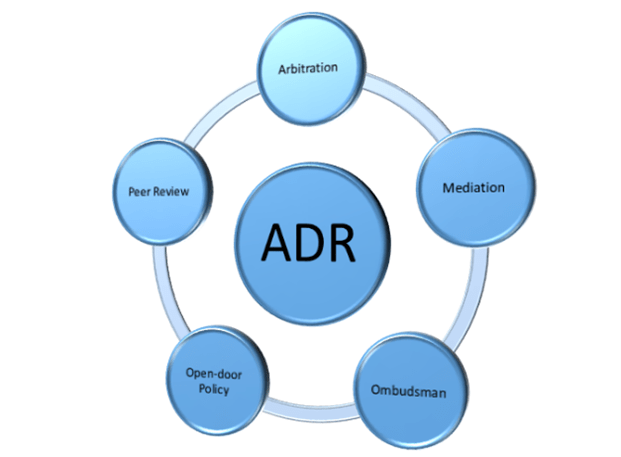
Alternative dispute resolution (ADR), is an umbrella term used for methods to resolve disputes internal to the organization and outside the court system.  Many organizations use one or all of the ADR techniques, with the techniques continuing to grow in popularity.  Union and nonunion organizations use ADR techniques to resolve disputes, large and small.  Dispute resolution is a necessity for any organization, resolution can impact organizational culture, engagement and turnover rates.  The techniques defined below can be used to resolve disputes outside of the workforce as well, we have mediation services in our communities that assist families, neighbors, etc. resolve disputes through proactive channels of communication.

The 5 Definitions of Alternative Dispute Resolution:

  1. “Arbitration: an ad judicatory process in which a neutral third party imposes a final, binding decision to resolve a dispute.
  2. Mediation: an informal process in which a neutral third party assists opposing parties to reach a voluntary, negotiated, non-binding resolution of a dispute; may be conducted internally or externally.
  3. Ombudsman: a neutral third party who is designated to confidentially investigate and propose settlement of complaints brought by employees; may be an insider or outsider.
  4. Open-door policy: a process in which employees are encouraged to discuss problems with their immediate supervisors or others in the chain of command.
  5. Peer review an internal process in which a panel of employees works together to resolve employment complaints.”[i]

Cornell ADR Definitions

Arbitrators, mediators and ombudsmen are trained in dispute resolution techniques.  They know how to fact-find, draft agreements and issues decisions.  An open-door policy is an easy way to resolve disputes.  We listen to the issue (not listen to respond) and address any concerns.  Peer review is another process that can be implemented, this also needs to be managed proactively to ensure it’s legal.   All of the ADR techniques work, the effectiveness will vary by organization.  Select a process that works for your organization and be consistent with dispute resolution.


[i] American Arbitration Association, U.S. EEOC & SHRM Magazine

7 Thoughts on Workplace Bullying Policies

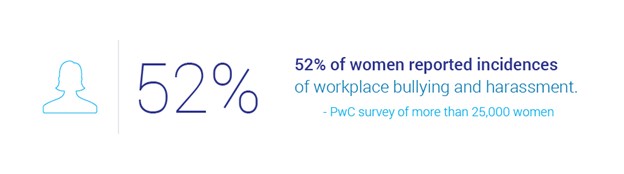
We have seen significant changes in the workplace related to sexual harassment training, policies and employee expectations.  “In two studies noted by The Daily Campus, one in three women (in a survey of more than 2,000 women between the ages of 18-34) “reported experiencing sexual harassment, and 71 percent of those women declined to report it.” According to a PwC survey of more than 25,000 women, 52 percent reported incidences of workplace bullying and harassment.”[i]  Workplace bullying is a common problem throughout organizations and can have long-term detrimental impacts on our workforce including; decreased employee morale, turnover, decreased trust in leadership, employee stress, depression, health issues, absenteeism, workplace violence, retaliation and legal concerns.  As leaders we need to establish a culture of zero-tolerance for workplace bullying, including policies and procedures that employees understand. 

Below are seven thoughts on workplace bullying policies:

  1. Zero-Tolerance Workplace Harassment, Bullying & Retaliation Policy: This is a draft objective statement in a policy that addresses this issue.  “The purpose of this policy is to communicate to all employees, including supervisors, managers and executives, that Organization X will not in any instance tolerate bullying behavior. Employees found in violation of this policy will be disciplined, up to and including dismissal.”[ii]  Short and to the point policy objective.
  2. Defining Workplace Bullying: “Organization X defines bullying as repeated, health-harming mistreatment of one or more people by one or more perpetrators. It is abusive conduct that includes:
    1. Threatening, humiliating or intimidating behaviors.
    1. Work interference/sabotage that prevents work from getting done.
    1. Verbal abuse.”[iii]
  3. Workplace Bullying Examples: “Organization X considers the following types of behavior examples of bullying:
    • Verbal bullying. Slandering, ridiculing or maligning a person or his or her family; persistent name-calling that is hurtful, insulting or humiliating; using a person as the butt of jokes; abusive and offensive remarks.
    • Physical bullying. Pushing, shoving, kicking, poking, tripping, assault or threat of physical assault, damage to a person’s work area or property.
    • Gesture bullying. Nonverbal gestures that can convey threatening messages.
    • Exclusion. Socially or physically excluding or disregarding a person in work-related activities.”[iv]

We could write or maybe could not draft a never-ending list of workplaces bullying situations in our policy.  It is recommended to include examples in the policy and training sessions.  When I train supervisors and managers my advice is this; workplace bullying can take the shape of many forms, and it does.  Current or past examples and scenarios are great opportunities to train employees and leaders.  Ask for their input on this, they have great questions and scenarios.  Years of experience means years of situations.  There are hundreds of examples online to use as potential options and easy to create during the discussion.  I use these with undergrads all the time.      

    4. Employee Training and Awareness Programs:  The focus of this training should include an understanding of why these policies are needed and how employees can report issues or concerns.  These trainings should be conducted on a regular basis and should include; acceptable and unacceptable workplace behavior, recognizing bullying and other forms of harassment, reporting this behavior, retaliation and an overview of the policy. 

    5. Manager and Supervisor Training: If you recall my article published on January 14, 2019, we covered this topic.  Manager’s and supervisors need to understand their role in preventing, enforcing policies and addressing these common workplaces issues.  This training should be tailored for that group of leaders, with roleplay and enforced expectations.

    6. Building a Culture: Yes, it is our responsibility to build a culture where managers, supervisors and employees at any level always behave professionally.  This includes but not limited to, at work, off-site, off-hour gatherings, social media, etc.  If owners, leaders, managers and supervisors at the top of the organization get away with bullying, employees assume this is an acceptable form of behavior.  Over communicate the organizations commitment to ensuring an environment free of workplace bullying and harassment.  Embrace the culture you want in your organization and hold people accountable from top to bottom. 

    7. Reporting a Complaint: Clearly define that process for filing a complaint in the policy or employee handbook.  In New York State we now have a complaint procedure form and process for sexual harassment, we can add bullying and workplace harassment into the same procedure.  Employee’s should have the opportunity to communicate this information through multiple channels in the organization or outside the organization (HR Consultant, compliance line, etc.).  Ensure everyone understands that complaints are taken serious and investigations will take place, as needed.  Training and policy signoffs are recommended.  Make the policy or complaint form visible, hang it near the labor and employment posting requirements, put it on the intranet, cover it in crew meetings.

    This is a high-level overview of a workplace bullying and harassment policies and organizational expectations.  Organizations should tailor any policy or procedure to the needs of the operation, while ensuring the policy is legal.  Train the workforce on expectations and hold everyone accountable.  This is a training I have conducted for years and it continues to be a success in multiple industries.  Develop a culture in which there is no workplace bullying.  Follow-up on any complaints or issues, efficiently, while communicating with parties involved.  It is as simple as holding people at every level accountable.  If you are unclear on how to write a policy, train the workforce or implement a complaint procedure, seek guidance, this is an area I am happy to help with and drive forward.  Culture starts with leadership, embrace the culture you envision for your organizations. 


    [i] https://www.paychex.com/articles/human-resources/workplace-harassment-prevention

    [ii] SHRM Draft Policy

    [iii] SHRM Draft Policy

    [iv] SHRM Draft Policy

    2023 Revised Form I-9 Released August 1, 2023

    The current I-9 Form expired on October 31, 2022, and will be accepted until November 1, 2023.

    2023 Form I-9 Link for August 1, 2023

    “Employers who were participating in E-Verify and created a case for employees whose documents were examined during COVID-19 flexibilities (March 20, 2020, to July 31, 2023), may choose to use the new alternative procedure starting on August 1, 2023 to satisfy the physical document examination requirement by Aug. 30, 2023. Employers who were not enrolled in E-Verify during the COVID-19 flexibilities must complete an in-person physical examination by Aug. 30, 2023.

    The revised Form I-9:

    • Reduces Sections 1 and 2 to a single-sided sheet;
    • Is designed to be a fillable form on tablets and mobile devices;
    • Moves the Section 1 Preparer/Translator Certification area to a separate, standalone supplement that employers can provide to employees when necessary;
    • Moves Section 3, Reverification and Rehire, to a standalone supplement that employers can print if or when rehire occurs or reverification is required;
    • Revises the Lists of Acceptable Documents page to include some acceptable receipts as well as guidance and links to information on automatic extensions of employment authorization documentation;
    • Reduces Form instructions from 15 pages to 8 pages; and
    • Includes a checkbox allowing employers to indicate they examined Form I-9 documentation remotely under a DHS-authorized alternative procedure rather than via physical examination.

    The revised Form I-9 (edition date 08/01/23) will be published on uscis.gov on Aug. 1, 2023. Employers can use the current Form I-9 (edition date 10/21/19) through Oct. 31, 2023. Starting Nov. 1, 2023, all employers must use the new Form I-9.” (USCIS)

    “What’s New in the Revised Form I-9?

    USCIS made the following updates to the Form I-9:

    • Reduced Sections 1 and 2 to a single-sided sheet. No previous fields were removed. Rather, multiple fields were merged into fewer fields when possible.
    • Moved the Section 1 Preparer/Translator Certification area to a separate, standalone supplement (Supplement A) that employers can provide to employees when necessary. Employers may attach additional supplement sheets as needed. 
    • Moved the Section 3 Reverification and Rehire area to a separate, standalone supplement (Supplement B) that employers can print if or when rehire occurs or reverification is required. Employers may attach additional supplement sheets as necessary.
    • Removed use of “alien authorized to work” in Section 1 and replaced it with “noncitizen authorized to work” as well as clarified the difference between “noncitizen national” and “noncitizen authorized to work.”
    • Ensured the form can be filled out on tablets and mobile devices.
    • Removed certain features to ensure the form can be downloaded easily. This also removes the requirement to enter N/A in certain fields.
    • Updated the notice at the top of the form that explains how to avoid discrimination in the Form I-9 process.
    • Revised the Lists of Acceptable Documents page to include some acceptable receipts as well as guidance and links to information on automatic extensions of employment authorization documentation. Added a box that eligible employers must check if the employee’s Form I-9 documentation was examined under a DHS-authorized alternative procedure rather than via physical examination.  

    USCIS also updated the following in the Form I-9 instructions:

    • Reduced length of instructions from 15 pages to 8 pages.
    • Added definitions of key actors in the Form I-9 process.
    • Streamlined the steps each actor takes to complete their section of the form.
    • Added instructions for use of the new checkbox for employers who choose to examine Form I-9 documentation under an alternative procedure.
    • Removed the abbreviations charts and relocated them to the M-274, Handbook for Employers: Guidance for Completing Form I-9.” (SHRM)

    “To utilize remote document verification on or after August 1, 2023, an employer must take the following actions:

    1. An employer must be enrolled in E-Verify and submit the newly hired employee’s information to E-Verify for review;
    2. An employer must verify the newly hired employee’s I-9 documents via live video interaction and indicate the use of remote verification on the I-9 form; and 
    3. An employer must retain a copy of both sides of the documents the employee presented with the I-9 form for the appropriate retention period.

    Employers who participated in E-Verify and submitted their employees to E-Verify during the COVID-19 pandemic (March 20, 2020, to July 31, 2023), may choose to use the new alternative procedure starting on August 1, 2023 to satisfy the physical document examination requirement. Although DHS does not say this in so many words, it appears that employers who complied with the newly announced remote document verification procedures during the pandemic need not revalidate their employee’s documents. Employers should examine their remote document verification process carefully before electing not to re-verify their employees’ documents.

    Although enrollment in E-Verify is required to utilize the new remote document verification rules, employers are not required to enroll in E-Verify. Employers who are not enrolled in E-Verify must physically inspect its newly hired employee’s documents. Employers who were not enrolled in E-Verify during the COVID-19 pandemic and utilized the COVID-19 remote document inspection rules must complete an in-person physical examination of all remotely verified employees’ documents by August 30, 2023.

    The new rules give both employers and employees choices. Employers who are eligible to participate in the new remote document verification may choose to utilize remote verification for some worksites and physical inspection for others. Employees have a choice too. Employers may not compel newly hired employees to remotely verify their documents. Employees may elect to physically present their documents to the employer.” (JDSUPRA)

    E-Verify Link

    Form I-9 Audits & Compliance Suggestions:

    Retaining I-9’s

    Terminated Employee Retention Record Keeping

    Correcting Form, I-9

    “Employers may only correct errors made in Section 2 or Section 3 of Form I-9, Employment Eligibility Verification.

    If you discover an error in Section 1 of an employee’s Form I-9, you should ask your employee to correct the error.

    To correct the form: 

    • Draw a line through the incorrect information.
    • Enter the correct information.
    • Initial and date the correction.
    • To correct multiple recording errors on the form, you may redo the section on a new Form I-9 and attach it to the old form. A new Form I-9 can also be completed if major errors (such as entire sections being left blank, or Section 2 being completed based on unacceptable documents) need to be corrected. A note should be included in the file regarding the reason you made changes to an existing Form I-9 or completed a new Form I-9.
    • Be sure not to conceal any changes made on the form (other than simple notation errors when copying document information). Doing so may lead to increased liability under federal immigration law.
    • If you have made changes on a Form I-9 using correction fluid, we recommend that you attach a signed and dated note to the corrected Forms I-9 explaining what happened.
    • U.S. Immigration Customs and Enforcement and the Immigrant and Employee Rights Section (IER) have provided joint guidance to help employers perform internal audits. Audits allow employers to ensure Forms I-9 have been completed correctly, and to make corrections if errors are found. Learn more about Guidance for Employers Conducting Internal Employment Eligibility Verification Form I-9 Audits.” (USCIS)


    Which forms to use & revision dates

    “This act led to creation of Form I-9, Employment Eligibility Verification. All employers must use Form I-9 for all employees hired on or after Nov. 6, 1986, who are working in the U.S.

    Several versions of Form I-9, Employment Eligibility Verification, have been issued since the form was first introduced in 1987. Not all versions are valid for use. To determine whether you are using the correct version of Form I-9, look at the revision date printed on the bottom left corner of the form, and not the expiration date printed at the top of the form.

    Currently, only the forms showing the following revision date are valid:

    Rev. 07/17/2017 N*

    Listed below are the dates Form I-9 was revised. An “N” next to the revision date means that Form I-9 with earlier revision dates can no longer be used to verify employment eligibility.  A “Y” next to the revision date means the form is valid until USCIS issues a new form with a revision date containing an “N”.

    Frequently Asked Questions

    I failed to sign and/or date Section 2: What can I do to correct this?

    If an employer discovers that he or she has omitted information in Section 2 of Form I-9, he or she should enter the omitted information and initial and date the addition. The employer should attach a written explanation of what happened to Form I-9.

    Do not back-date Form I-9; the employer should enter the current date and initial by the date field.

    My employee did not sign and/or date the attestation in Section 1: What can I do to correct this?

    If you discover your employee has omitted information in Section 1 of Form I-9, the employer must ask the employee to enter the missing information. When correcting Section 1, the employee should:

    • Enter the missing information
    • Initial and date the newly entered information
    • Attach a written explanation as to what happened.

    Do not back-date Form I-9; the employee should enter the current date and initial by the date field.

    If the employee’s employment was terminated, the employer should attach a written explanation about the omission to the employee’s Form I-9.

    I am missing Forms I-9 for several employees: What can I do to correct this?

    If an employer discovers a missing Form I-9, the employer and employee must complete a new Form I-9. The newly completed form should not be back dated. If the employee cannot produce acceptable documentation or refuses to complete Section 1 of the Form I-9, he or she cannot work for pay. For more information on correcting Forms I-9 visit I-9-Central.

    Employers are not required to have Forms I-9 for employees hired on or before November 6, 1986.

    What should I do if the wrong version of Form I-9 was completed?

    As long as the Form I-9 documentation presented was acceptable under the Form I-9 rules that were current at the time of hire, employers may correct the error by stapling the outdated completed form to a blank current version, and signing the current blank version noting why the current blank version is attached (e.g., wrong edition was used at time of hire). In the alternative, employers may draft an explanation and attach it to the outdated completed Form I-9 explaining that the wrong form was filled out correctly and in good faith.” (UCSIS)

    Do the owners of a company have to complete Form I-9? What if one of the company’s owners refuses to complete Form I-9?

    Form I-9 requirements are triggered by the hire of an individual for employment in the United States. A “hire” is the actual commencement of employment of an employee for wages or other remuneration.  If any of the owners are “employees” of the company, then each owner must complete Form I-9.  Failure to comply with all Form I-9 requirements could result in civil penalties against the employer.

    These are just a few suggestions on internal audits and compliance with current laws and regulations.  If your organization uses E-Verify, there are additional requirements to consider.  Compliance audits on Form I-9’s is necessary to ensure legal processing and storage.  I’m happy to work with any organization to audit and train owners, managers and supervisors on how to complete, store and correct a Form I-9 mistakes.  Continue to monitor for the updated form and seek guidance if you are unclear on compliance auditing and mandatory legal requirements.