2022 New York State Amendments to the Nursing Mothers in the Workplace Act
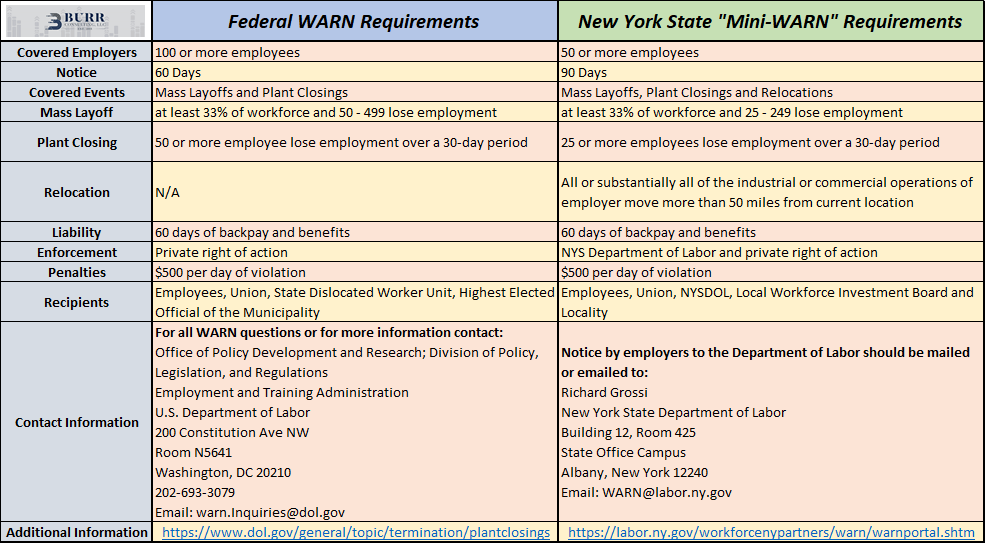
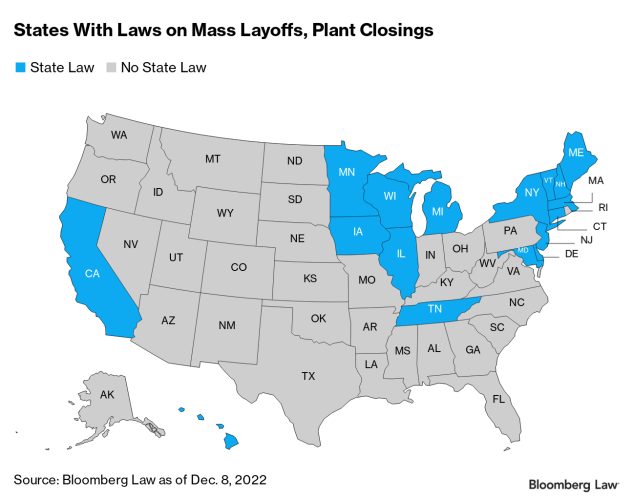
The WARN Act protects workers, families and communities if an organization has a foreseen or unforeseen plant closure or mass layoff. The goal for all of our organizations is to never be in a position for mass layoffs however, understanding the difference in Federal vs. New York State specific laws is necessary, to ensure legal compliance. New York State is one of the few states that has a “Mini-WARN” Act with stricter regulations than federal law.
Federal:
Requiring employers with 100 or more employees (generally not counting those who have worked less than six months in the last 12 months and those who work an average of less than 20 hours a week) to provide at least 60 calendar days advance written notice of a plant closing and mass layoff affecting 50 or more employees at a single site of employment. WARN makes certain exceptions to the requirements when layoffs occur due to unforeseeable business circumstances, faltering companies, and natural disasters. Advance notice gives workers and their families some transition time to adjust to the prospective loss of employment, to seek and obtain other jobs, and if necessary, to enter skill training or retraining that will allow these workers to compete successfully in the job market. Regular federal, state, local, and federally recognized Indian Tribal government entities that provide public services are not covered. (DOL)
State:
The WARN Act applies to private businesses with 50 or more full time workers in New York State. It covers:
Closings affecting 25 or more workers
Mass layoffs involving 25 or more full-time workers (if the 25 or more workers make up at least 33% of all the workers at the site)
Mass layoffs involving 250 or more full-time workers
Certain other relocations and covered reductions in work hours
This means that covered businesses must provide all employees with notice 90 days prior to a:
Plant closing
Mass layoff
Relocation
Other covered reduction in work hours
Businesses that do not provide notice may be required to:
Pay back wages and benefits to workers
Pay a civil penalty
Early warning gives the DOL and the LWIB the chance to work with the business early on and provide employees with information about:
Unemployment Insurance (UI)
Workforce Programs
Resources designed to get employees back to work quickly
Early warning also benefits the business. It can shorten the time that workers are on UI. It therefore may lower the UI charges associated with the layoff or closing. (NYS DOL)
“An amendment to the Age Discrimination in Employment Act (ADEA), the OWBPA is a federal law that requires employers to offer older workers (those who are at least 40 years old) benefits that are equal to or, in some cases, cost the employer as much as, the benefits it offers to younger workers. The OWBPA also sets minimum standards for an employee waiver of the right to sue for age discrimination, designed to ensure that the waiver is knowing and voluntary.” (Cornell Legal Information Institute)
The purposes of the Older Workers Benefit Protection Act (OWBPA) are to make it illegal for an employer to:
use an employee’s age as the basis for discrimination in benefits
target older workers for their staff-cutting programs, and
require older workers to waive their rights without observing certain safeguards.
“California’s WARN Act (Cal WARN) takes an approach to counting employees and layoffs that differs from the federal WARN Act, Hathaway noted. Cal WARN applies to “facilities” that have employed 75 or more people within the past 12 months. If 50 employees—employed for at least six months—are let go within a 30-day period, Cal WARN is triggered. Also, any closing of a covered facility triggers Cal WARN, even if fewer than 50 employees are let go, he explained.
The Iowa, New Hampshire, New York and Wisconsin WARN laws apply to layoffs involving as few as 25 employees, Hathaway said.
“New York requires 90 days’ notice, and New Jersey has a revision to its WARN law that has not yet gone into effect that also requires 90 days’ notice, plus separation pay equal to one week of pay per year of service,” he noted.
The mini-WARN Act in Illinois applies to employers with 75 or more full-time employees when: 1) 25 or more full-time employees are laid off if they constitute one-third or more of the full-time employees at the site or 2) 250 or more full-time employees are laid off, Hollis said.
Wisconsin’s mini-WARN Act applies to employers with at least 50 employees, he added.
“States continue to pass WARN-like requirements,” Hathaway said. “Be sure to know which states have done so.”
A city also can have a mini-WARN law. “As an example, Philadelphia has such a law, which can be surprising to employers.” (SHRM)
Published by Mathew W. Burr, MJ-LEL, MBA, MHRIR, GPHR, SHRM-SCP, SPHR, CPHR-INT, Chartered CIPD
Mathew W. Burr, MJ-LEL, MBA, MHRIR, GPHR, SHRM-SCP, SPHR, CPHR-INT, Chartered MCIPD
Lean Six Sigma Black Belt
ABOUT:
Matthew Burr has over 18-years of experience working in the human resources field, starting his career as an Industrial Relations Intern at Kennedy Valve Manufacturing to most recently founding and managing a human resource consulting company; Burr Consulting, LLC, Talentscape, LLC and Co-Owner of Labor Love, a Labor, and Employment Law poster printing company. Prior to founding the consulting firm, the majority of his career was heavy industry manufacturing and healthcare. He specializes in compliance auditing, training labor and employment law, conflict resolution, performance management, labor, and employment relations. Matthew has a generalist background in HR and operations, while providing strategic HR and operational solutions to his clients, focusing on small and medium sized organizations. He works as an Adjunct at Alfred State University, Tompkins Cortland Community College, and Montgomery Community College. He successfully designed an HR Concentration in the business management major that aligned with both SHRM and HRCI certifications, providing opportunities for students to sit for both the SHRM-CP and aPHR certifications upon completion of the degree, concentration, and internship hours as an Assistant Professor of Management at Elmira College (Retired January 2022). Matthew is also the SHRM Certification Exam Instructor, with a current pass rate of 92% on the SHRM-SCP and 83% pass rate on the SHRM-CP and a combined 88% on both exams over a 7-year period of instructing the course (Elmira College, Collin College & The College of St. Rose). Matthew works as a trainer at Tompkins Cortland Community College, Corning Community College, Broome Community College, and HR Instructor for Certification Preparation for the Human Resource Certification Institute (HRCI). He also acts as an On-Call Mediator and Factfinder through the Public Employment Relations Board in New York State, working with public sector employers and labor unions.
PUBLICATIONS:
Matthew has over 70+ publications including, American Bar Association (ABA) Experience Magazine, Cornell HR Review, Business Insider, New York State Bar Association (NYSBA), PayScale, Society of Human Resource Management (SHRM), and Expert 360 (in Australia). In early 2017, he published his first book, “$74,000 in 24 Months: How I killed my student loans (and you can too!),” proceeded by his second book, which was published in January 2021, “Slay the Student Loan Dragon: Tips and Tricks on How to Conquer the Student Loan Game” and his most recent book, “Unbox Your HR Career” in July 2023.
VOLUNTEER WORK:
Matthew is currently the New York State Society of Human Resource Management (NYSSHRM) District-Director.
EDUCATION & TRAINING:
Additional Training & Development:
SHRM Workplace Coaching and Mentoring Recertification Program, 2020
SHRM Foundation Employing Abilities @Work Certificate, 2020
SHRM Foundation Veterans at Work Certificate Program, 2018
Delta County Chamber of Commerce: Delta Force Leadership Program, 2013
FEATURED IN & ON:
Matthew was featured on CNN Money, Fast Company, Fits Small Business, Fox News, Magnify Money, Monster.com, My Twin Tiers, Namely, Student Loan Hero, Smart Sheet and CEO Blog Nation, Human Resource Certification Institute (HRCI), Society of Human Resource Management (SHRM).
Burr Consulting, LLC Capabilities Statement
General Information:
Burr Consulting, LLC
Owner: Matthew W. Burr
Mission Statement:
“Strategically Aligning HR as a Partner for the Success of Your Business”
Contact Information:
Burr Consulting, LLC
What's New in HR Blog
Talentscape, LLC
Labor Love, LLC (Labor Posters)
The HR Support Center
The Upstate HR Podcast
(607)227-4386
Matthew@Burrconsultingllc.com
Facebook: Burr Consulting, LLC
LinkedIn: Burr Consulting, LLC
Twitter: @Burrconsulting
Online Certification Verification: Credibly
Dun & Bradstreet (D&B) Number: 080776443
NAICS Codes: 541612, 923130, 54161, 541611,
541613, 611430, 541618, 561312, 561311
SIC: 8742, 8748, 9441, 8748001, 8748026
Our Services
HR MANAGEMENT
New Hire Orientation; Temporary HR Support; Recruiting and Application Tracking; HR Compliance (ADA, FMLA); Employee Handbook; Policy and Procedure; HRIS; HR Audits; Job Profile Design and Revision; HR Key Performance Indicators; EEO Reporting and Classification; State Unemployment Insurance Services
TRAINING & TRAINING DEVELOPMENT
Organizational Development; Employee Relations; Workplace Violence; Harassment & Sexual Harassment; Union Awareness; Managerial
EMPLOYEE & LABOR RELATIONS
Employee Relations Training; Conflict Resolution; Mentoring; Workplace Investigations; Labor Contract Costing; Mediation & Arbitration Prep; Fact-Finding; Workplace Investigations; Coaching & Counseling; Performance Reviews; Contingency Plan Development; Contingency Plan Training; State of New York Public Employment Relations Board (PERB)PERB Mediation and Fact-Finding Panels (Albany, NY covering the Elmira, NY Area)
HIRING & RECRUITMENT
Applicant Tracking Systems; Metric Development; Interview Training; Workforce Planning; Recruitment; Interviews; Job Offers; New Hire Process
POLICY & COMPENSATION
Group Plans – Healthcare, Dental, Vision, Group Life, Short- and Long-Term Disability; Retirement – 401(k), Profit Sharing, Roth; Workers Compensation; Total Compensation Design and Strategy; Deferred Compensation Plans; Salary Surveys; Reward Systems; Online Payroll; Customized Payroll Processing; Employee Self Service; Customized Reporting
HR COMPLIANCE MATERIALS
Burr Consulting, LLC is excited to announce a new partnership with Labor Love LLC, expanding our services to include HR printed materials compliant with industry standards.
View all posts by Mathew W. Burr, MJ-LEL, MBA, MHRIR, GPHR, SHRM-SCP, SPHR, CPHR-INT, Chartered CIPD


 BURR CONSULTING, LLC