2023 New York State Minimum Wage, Executive & Administrative Exempt Salary Changes and Farm Overtime Threshold Reductions

The NYS Department of Labor is proceeding with scheduled increases to the state’s minimum wage effective December 31, 2022. While there is no change for New York City employers, Long Island, or Westchester employers, the remainder of upstate New York will see increases. As you know, this will also impact the minimum salary levels to be paid to Executive and Administrative exempt employees. The new minimum wage and minimum salary levels can be found below. Things to keep in mind:

  • A new poster. You will be required to post a new minimum wage poster. You will be able to find the new poster here. Remember, there could be corresponding increases in the tipped wage and wages paid for fast food employees in your area. 
  • The minimum salary level to be considered exempt from overtime under NYS law for Executive and Administrative employees is tied to the minimum wage and may also be increasing for your industry and area. Remember, there is no NYS minimum salary level for Professional exemptions. For Professional employees you would be subject to the Federal minimum salary level

*Future increases will be based on an indexed schedule to be set by the Director of the Division of the Budget in consultation with the Department of Labor following an annual review of the impact.

Minimum Salary Level – NYS Executive and Administrative Exemptions
 Location Effective 12/31/2022
NYC-Large Employers (11 or more) $1,125/week ($58,500 annualized)
NYC-Small Employers (10 or less) $1,125/week ($58,500 annualized)
Long Island & Westchester $1,125/week ($58,500 annualized)
Remainder of the NY State $1,065/week ($55,380 annualized)


NYS Reduces Overtime Threshold for Farm Workers to 40 hours Per Week

New York State Department of Labor (NYSDOL) Commissioner Roberta Reardon issued an order accepting the recommendation of the Farm Laborers Wage Board to lower the current 60-hour threshold for overtime pay to 40 hours per week by January 1, 2032, allowing 10 years to phase in the new threshold. NYSDOL will now be undergoing a rule making process which will include a 60-day public comment period. This applies to certain agricultural employers and employees only.

Under proposed language, an employer shall pay an employee for overtime at a wage rate of one- and one-half times the employee’s regular rate of pay for hours worked in excess of the following number of hours in one workweek:

(a) 60 hours on or after January 1, 2020;
(b) 56 hours on or after January 1, 2024;
(c) 52 hours on or after January 1, 2026;
(d) 48 hours on or after January 1, 2028;
(e) 44 hours on or after January 1, 2030;
(f) 40 hours on or after January 1, 2032.

Minimum Wage for Tipped Employees in the Hospitality Industry

New York State has separate minimum wage rules for employees in the hospitality industry. These rules apply to businesses running a restaurant or hotel.

The minimum wage rates for most non-tipped employees in the hospitality industry are set as per the schedule above. However, employers may count a portion of certain tipped employees’ gratuities toward the minimum wage requirements. This is known as a “tip credit.”

New York State has two separate cash wage and tip credit schedules for tipped hospitality employees who qualify as “food service workers” and “service employees.”

Food Service Workers

food service worker is any employee who is primarily engaged in serving food or beverages to guests, patrons, or customers in the hospitality industry who regularly receive tips. This includes wait staff, bartenders, captains, and busing personnel. It does not include delivery workers.

Hospitality Industry Tipped Minimum Wage Rate Schedule (Food Service Workers)
Location12/31/2112/31/22
NYC – Large Employers
(of 11 or more)
$10.00 Cash $5.00 Tip$10.00 Cash $5.00 Tip
NYC – Small Employers
(10 or less)
$10.00 Cash $5.00 Tip$10.00 Cash $5.00 Tip
Long Island & Westchester$10.00 Cash $5.00 Tip$10.00 Cash $5.00 Tip
Remainder of New York State$8.80 Cash $4.40 Tip$9.45 Cash $4.75 Tip

Service Employees

The next schedule applies to other service employees. A service employee is one who is not a food service worker or fast food employee who customarily receives tips above an applicable tip threshold (which also follows schedules, not shown here).

Hospitality Industry Tipped Minimum Wage Rate Schedule (Service Employees)
Location12/31/2112/31/22
NYC – Large Employers
(of 11 or more)
$12.50 Cash $2.50 Tip$12.50 Cash $2.50 Tip
NYC – Small Employers
(10 or less)
$12.50 Cash $2.50 Tip$12.50 Cash $2.50 Tip
Long Island & Westchester$12.50 Cash $2.50 Tip$12.50 Cash $2.50 Tip
Remainder of New York State$11.00 Cash $2.20 Tip$11.85 Cash $2.35 Tip

Minimum Wage for Fast Food Employees
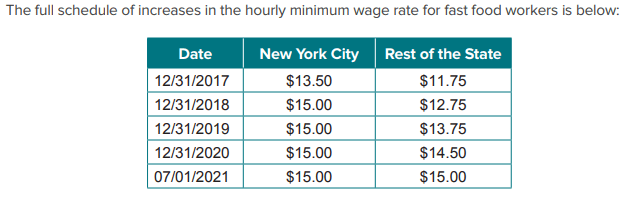
The minimum wage for fast food employees working outside of New York City will increase to $14.50 per hour. The final scheduled increase to $15.00 per hour will take effect on July 1, 2021.
Tompkins County Living Wage Information

2021 Living Wage Report

25 Common Compensation, Salary, and Wage Definitions

  1. Job Descriptions A critical component of both compensation and selection systems, job descriptions define in writing the responsibilities, requirements, functions, duties, location, environment, conditions, and other aspects of jobs. Descriptions may be developed for jobs individually or for entire job families.
  2. Job Analysis The process of analyzing jobs from which job descriptions are developed. Job analysis techniques include the use of interviews, questionnaires, and observation.
  3. Job Evaluation A system for comparing jobs for the purpose of determining appropriate compensation levels for individual jobs or job elements. There are four main techniques: RankingClassificationFactor Comparison, and Point Method.
  4. Pay Structures Useful for standardizing compensation practices. Most pay structures include several grades with each grade containing a minimum salary/wage and either step increments or grade range. Step increments are common with union positions where the pay for each job is pre-determined through collective bargaining.
  5. Salary Surveys Collections of salary and market data. May include average salaries, inflation indicators, cost of living indicators, salary budget averages. Companies may purchase results of surveys conducted by survey vendors or may conduct their own salary surveys. When purchasing the results of salary surveys conducted by other vendors, note that surveys may be conducted within a specific industry or across industries as well as within one geographical region or across different geographical regions. Know which industry or geographic location the salary results pertain to before comparing the results to your company.” (HR Guide)
  6. Total Compensation Total compensation refers to the complete pay package awarded to employees on an annual basis, including all direct and non-direct compensation such as salary, health care and retirement benefits, incentive pay, and paid time off. 
  7. Red Circle A red circle rate is a pay rate that is above the maximum range assigned to the job grade. Employees who are “red circled” are usually not eligible for additional pay increases until the range maximums are increased above the individual pay rate or the employee transfers to a job with a higher pay range. 
  8. Compa Ratio Compa-ratio is a measure that expresses current pay rates as a percentage of range midpoints. Where the midpoint of a pay range represents full market pay, the ratio of the employee’s actual salary to that midpoint indicates whether the employee is paid below, at or above market rates.
  9. Broadbanding Broadbanding is a pay structure that consolidates a large number of narrower pay grades into fewer bands with wider salary ranges.
  10. Cost-per-hire Cost-per-hire is an HR metric that measures the costs associated with filling a vacancy. This includes the internal, external, direct and indirect costs associated with sourcing, recruiting and staffing an open position.
  11. Exempt Position Exempt positions are jobs that qualify for an exemption from overtime pay under the Fair Labor Standards Act (FLSA) white-collar and industry exemptions. Employees in exempt positions must generally be paid on a salary basis with limited exceptions.  
  12. Discretionary Bonus A discretionary bonus is a form of variable pay where an employer provides additional compensation to an employee for reasons that are not pursuant to any prior contract, agreement or promise that would lead the employee to expect the payments regularly. 
  13. Nonexempt Position A nonexempt position, under the Fair Labor Standards Act (FLSA), is one that must be paid overtime for hours worked beyond 40 in a workweek. By definition, it does not meet any of the exemptions to the FLSA that would allow an employer not to pay overtime. 
  14. Salaried Nonexempt The designation of an employee as “salaried, nonexempt” means that the employer has designated an employee as nonexempt from the federal Fair Labor Standards Act (FLSA), and chooses to pay a weekly salary that equates to at least minimum wage for all hours worked. On a federal level, this designation means the employee is entitled to overtime pay in addition to the salary for work weeks in which his or her time worked exceeds 40 hours. Some state laws may require daily overtime calculations.
  15. Pay Compression Pay compression, also referred to as salary or wage compression, occurs when the pay of one or more employees is very close to the pay of more-experienced employees in the same job, or even those in higher-level jobs, including managerial positions. Often, it is the result of a market rate for a given job surpassing the increases historically awarded to long-term employees. 
  16. Pay Equity Pay equity is the practice of ensuring fair and equal pay practices to all employees regardless of gender, race, age or other protected characteristics.
  17. Pay Grade A pay grade refers to a grouping of jobs at an organization that have approximately the same relative internal worth and are paid at the same or similar rate.
  18. Pay Range A pay range, also known as a salary range, sets the upper and lower compensation limits for jobs within a particular pay grade at an organization. 
  19. Performance-Based Pay Performance-based pay, also called pay for performance, is a variable pay strategy that pays employees based on their individual performance and contributions, rather than the value of the job they are performing. 
  20. Green Circle Rate green circle rate is an individual salary that’s below the pay range minimum for their jobs. This instance of underpaid employees usually occurs when an organization adjusts their pay range upwards while an employee’s salary remains static.
  21. Skill-Based Pay Skill-based pay is a system which makes the base rate contingent on how many job-related skills the employee has learned, the level of skills mastery or a combination of both.
  22. Wage Compression Wage compression, also known as salary or pay compression, occurs when newly-hired, less-experienced employees earn close to what current employees make.
  23. Salary Inversion Salary inversion refers to situations in which the starting salaries for new recruits to an organization increase faster than those for existing employees.
  24. Wage Creep the gradual movement of a wage earner into a higher federal income-tax bracket as a result of wage increases intended to help offset inflation.
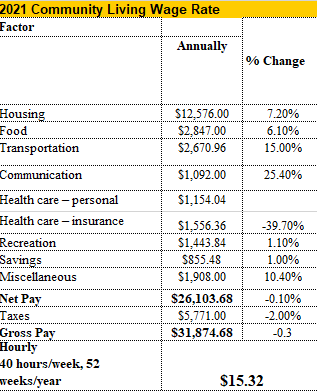
  25. Living Wage, The term living wage refers to a theoretical income level that allows individuals or families to afford adequate shelter, food, and other necessities. The goal of a living wage is to allow employees to earn enough income for a satisfactory standard of living and prevent them from falling into poverty. Economists suggest it should be enough to ensure that no more than 30% of this income gets spent on housing.1 As such, living wages are often substantially higher than the legal minimum wage.

6 Considerations When Preparing for an Unemployment Hearing

As many of us know, unemployment hearings can be a process that is time consuming and emotionally frustrating.  Regardless of the outcome of the hearing, there are multiple appeal procedures (varying by state), that can add complexity to the process.  Throughout the process, we need to proactively prepare and submit information prior to attending the hearing. 

Below are 6 considerations when preparing for an unemployment hearing:

  1. Take the hearing and process seriously.  Submit all forms and required information timely and follow the guidelines as outlined by the state.
  2. Ensure witnesses are prepared to make statements and answer any potential questions asked during the hearing.  Do not call a supervisor in right before the hearing starts.  They need to prepare, review information and practice questions prior to the hearing.
  3. Be very organized with information and paperwork.  Have all the information you need for the hearing organized and near you for the call/hearing.  Taking valuable time to find information and personnel files slows the process and can frustrate the judge.
  4. Practice makes improved.  Practice asking questions, understanding what the answer could be and asking follow-up questions.  Remember that the employee will also ask questions, prepare for these potential questions as well.  Practice makes us sound more organized, and it will streamline the hearing procedure.
  5. Active listening.  Be prepared to actively listen to the defense, write down inconsistencies or improper testimony and use this information to cross-examine.  It can strengthen your case.  Stick to the facts!
  6. Respect and the closing statement.  Address the judge as “Your Honor” and continue to show respect throughout the process.  Do not talk over the judge or defendant.  Prepare a closing statement.  Many employers will pass on the closing statement, due to lack of preparation.  This is a great opportunity to summarize the evidence presented and petition the judge to rule in the organizations favor.  Practicing the closing statement will ensure information is communicated clearly and effectively. 

Unemployment hearings can be a very emotional process.  We need to control the emotion in the room and stick to the facts, through preparation and accuracy.  The more we practice, the better prepared we will be to cross-examine and actively listen.  Follow the process; send the information as requested by the state, submit any follow-up information as requested during or after the hearing and ask the judge when a ruling is expected.  If you do lose an unemployment hearing, do not be afraid to appeal the ruling by following the process, as outlined by the state.  Keep in mind the soft costs associated with appealing, preparing and fighting unemployment.  If you have questions preparing or working through the process, ask for assistance, unemployment hearings can be a timely, frustrating and complex process.

7 Reasons to Implement Stay Interviews in Your Organization

What is a stay interview?  “A stay interview is a structured discussion a leader conducts with an individual employee to learn specific actions the leader can take strengthen the employee’s engagement and retention with the organization.”[i]  What is the value of the stay interview?  The organization hears directly from the employee in a one-on-one discussion (not related to performance), with any issues, concerns and opportunities leadership improvement.  This provides us as leaders the opportunity to engage, communicate and retain the workforce.  The stay interviews should be conducted by the leader of the organization, with HR’s support.  I have used effectively used stay interviews.

Below are the thoughts on implementing stay interviews:

  1. Start at the Top:  The leader at the top of the organization should set the tone for the organization and conduct stay interviews with their direct reports.  The process should cascade down throughout the rest of the organization to front-line supervisors and employees.  Employees at every level should take part in a stay interview, to ensure an effective and successful process.
  2. In Person: Stay interviews should not be conducted over the phone or via a video conferencing system, if possible.  Remote workers should have the opportunity to sit one-on-one with their supervisor and have a discussion. 
  3. Expectations of the Stay Interview:  Ensure the employee understands the reason for the stay interview and how these interviews will focus on area’s that the manager can influence.  Not all of us can change company policy, mission statements and strategic goals.  However, if a trend in these interviews is consistent, we might have more say in strategic objectives.
  4. Schedule Time: “Most stay interviews take 20 minutes or less to conduct, but some will carry on longer. Leaders should consider telling employees to allow 20 minutes for their meeting, but even then, leaders should allow thirty minutes on their calendars.”[ii]  Treat the employee as you want to be treated during the stay interview.
  5. Leave Performance Out of It: There is a time and place to discuss performance expectations.  Stay interviews should remain focused on engagement, retention feedback, communication and concerns.  Scripted open ended questions are necessary.
  6. No Advanced Questions: This can limit the conversation to a list of memorized demands and responses.  Open ended discussion with note taking, listening and probing for additional information will add tremendous value to the stay interview.
  7. Opening Script: The pre-drafted script is a great way to open the meeting.  This will provide additional information to the employee on what the process will look like and the direction of the interview.  The messages will be consistent throughout the organization.

The Why of Stay Interviews:

  • “Employees hear directly from their supervisor that they care and want them to stay and grow with the company. 
  • Supervisors further accept retention and engagement within their sphere of responsibility. 
  • Employees are more likely to accept responsibility for staying. 
  • Stay interviews build trust.”[iii]

Stay Interview Draft Template:
To open the stay interview, a manager may use the following (or similar) statements:

  • I would like to talk with you about the reasons you stay with ____, so I understand what I might be able to do to make this a great place to work.
  • I’d like to have an informal talk with you to find out how the job is going, how the job will change, so I can do my best to support you as your manager, particularly with issues within my control. 
  • I will be taking notes throughout our discussion and might ask you to repeat yourself if I do not capture everything.
  • Do you have any questions before we get started?

Review Job Description and Changing Expectations:

  • These are the current changes to the job description
  • These will be the changes to the position and current expectations/accountabilities
  • Discuss the reporting structure
  • Communication expectations
  • System reporting expectations
  • Do you have any questions or concerns?

Questions:
The following are questions you may ask during a stay interview. You should have several open-ended questions on hand. It’s important to listen and gather ideas from the employee about how you and your organization can retain him or her.

  • Tell me specifically, what factors cause you to enjoy your current job and work situation (including people, job, rewards, job content, coworkers, management etc.), and as a result, they contribute to your staying at our firm as long as you have?
  • What gets your excited to come to work here every day?
  • What do you look forward to when you come to work each day?
  • What do you like most or least about working here?
  • What keeps you working here?
  • If you could change something about your job, what would that be?
  • What would make your job more satisfying?
  • How do you like to be recognized?
  • What talents are not being used in your current role?
  • What would you like to learn here?
  • What motivates (or demotivates) you?
  • What can I do to best support you?
  • What can I do more of or less of as your manager?
  • What can we be doing differently as a management team?  Communication, meetings, etc.
  •  If you “managed yourself,” what would you do differently (in relation to managing “you”), that I, as your current manager, don’t currently do?
  • What might tempt you to leave?

[i] https://www.shrm.org/resourcesandtools/hr-topics/employee-relations/pages/stay-interview-how-to-core-features-and-advantages.aspx

[ii] https://www.shrm.org/resourcesandtools/hr-topics/employee-relations/pages/stay-interview-how-to-core-features-and-advantages.aspx

[iii] https://www.shrm.org/resourcesandtools/hr-topics/employee-relations/pages/stay-interview-how-to-core-features-and-advantages.aspx