6 Thoughts on Compensation Data

I am often asked about compensation data, salary and benefit surveys for the Southern Tier of NY and Northern Tier of PA.  The last comprehensive survey that was done for our surrounding communities was completed in 2012-2013, or earlier.  That specific survey was comprehensive and included a variety of industries, which provided significant information on comp and benefits.  The survey also included information on benefits and perks.  Where do we go now for information?  The compensation data is not readily available, graded and aged consistently.  Below are options to consider if you are looking for compensation and benefits data.

Below are my 6 thoughts on compensation data:

  1. Occupational Wages- NYS Department of Labor: The employment and wage data, by occupation is based on survey data which is collected from 51,000 businesses.  The current data is based on November 2014-May 2017 dates and adjusted for 2018 COLA’s.  This is a website I use, it is easy to navigate.  Pennsylvania Information Here.
  2. United States Department Bureau of Labor Statistics: The data was collected in May of 2017, with data collected from employers in all industry sectors in both metropolitan and nonmetropolitan areas throughout New York.  Not as easy to navigate as the NYS website, but there is valuable information on this site as well for benchmarking.
  3. Alternatives Federal Credit Union Living Wage Survey: “In 1994, Alternatives Credit Union did its first Living Wage Study to address internal staff concerns about compensation levels. Rather than looking at what competitors paid, or what the statutory minimum wage was, the Credit Union wanted to look at what it took to support a person above the poverty level. It has continued to update this study every two years.”[i]  The most recent living wage survey was successfully completed in 2021.  Mid 2023, we will see a new survey.  A great option to review living wage numbers for COLA’s.
  4. Other Website Options: Additional options include;payscale.com, indeed.com, salary.com, glassdoor.com.  These websites provide useful information, the concern is the accuracy of the information being posted.  Salary.com and Payscale.com are comprehensive websites that breakdown information in an easy to search option.  Not every job title is listed, your organizations will need to compare and adjust accordingly. 
  5. Society of Human Resource Management Compensation Data Center: “SHRM, in collaboration with Willis Towers Watson, provides SHRM members with accurate and customized salary information for an entire spectrum of jobs ranging from top executive to entry-level positions through the SHRM Compensation Data Center.”  The website provides data on 204 individual job titles, with multiple reporting options available.  I have never purchased data from the website, but this is an additional option to obtain compensation data, in specific reporting formats.  A nice place to benchmark. 
  6. Industry Specific Salary Surveys: Industry specific data or survey information might also be available.  Manufacturing, nonprofit, healthcare, financial industry, etc.  This can be state, regional or national data.  In order to obtain the information, your organization will more than likely need to participate in the survey.  If you belong to any alliances, coalitions, chambers, etc. compensation data or survey participation might be available. 

Federal & New York State Antitrust (Collusion Laws)

Enacted in 1890, the Sherman Act is among our country’s most important and enduring pieces of economic legislation. The Sherman Act prohibits any agreement among competitors to fix prices, rig bids, or engage in other anticompetitive activity. Criminal prosecution of Sherman Act violations is the responsibility of the Antitrust Division of the United States Department of Justice.  New York’s antitrust law, sections 340-347 of New York’s General Business Law, is known as the Donnelly Act and was enacted in 1899.  Through amendment and interpretation, the Donnelly Act has come to follow closely the federal Sherman Act, although it differs in some key aspects.  Pennsylvania has similar laws regarding collusion.[ii]

If your organization is interested in conducting a salary and/or benefits survey for the surrounding areas, my recommendation is to ensure a third-party is responsible for collecting and distributing the compiled data to all participants (consultant, comp specialist, retired HR professional, etc.).  A third-party that is neutral and not a participating member of the survey, this will ensure the data is not skewed or misinterpreted.  There should be enough participants to ensure the data provides relevant and comprehensive information.  If you have any questions regarding compensation and benefits surveys or salary data, seek guidance.  There is information available, we just need to understand accurate from fictitious or exaggerated information.
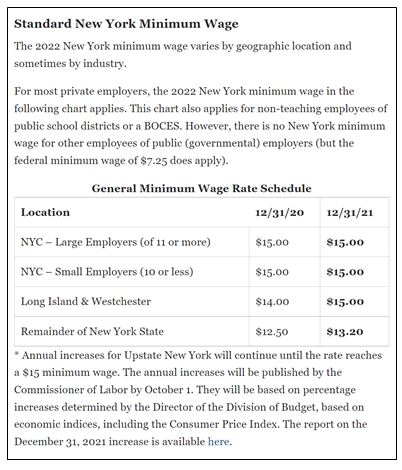
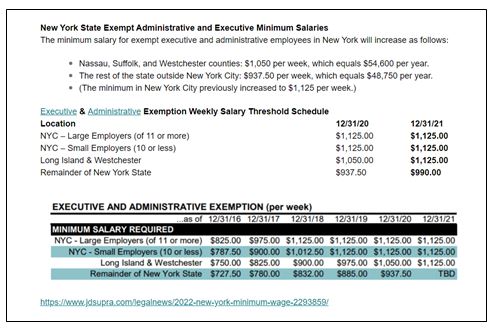
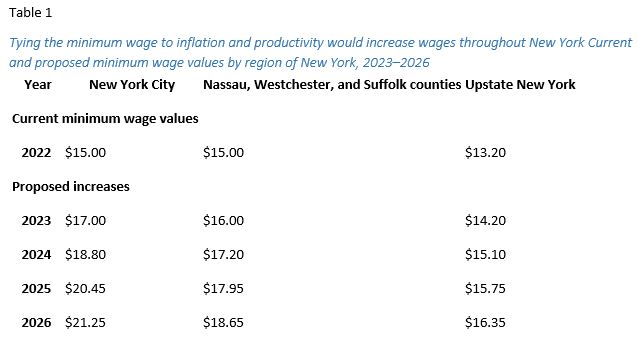
Note: Labor productivity based on Bureau of Labor Statistics data available as of April 12, 2022. Inflation projections WSJ Economic Forecasting Survey as of April 11, 2022. Further adjustments made to moderate the first-year increases and smooth out increases. 

Source: EPI analysis of S3062C and A7503B.

[i] https://www.alternatives.org/social-responsibility/impacting-our-community/living-wage-study.html

[ii] http://www.justice.gov/atr/price-fixing-bid-rigging-and-market-allocation-schemes

http://www.ag.ny.gov/antitrust/antitrust-enforcement

3 Daylight Savings Time Wage & Hour Considerations

Yesterday, Sunday, November 6, 2022, at 2:00 a.m., the daylight savings ended in most states.  The clocks were set back one hour, causing confusion and challenges for employers with nonexempt employees who were working during the time the clocks fell back.  How do we pay employees during this time?  What is our legal obligation related to hours worked and paid?

Below are three wage and hour answers, for daylight savings time change(s):

  1. Pay and Hours Worked:  Employers are required to pay employees for all hours worked.  Nonexempt employees working last night at 2:00 a.m., must be paid one additional hour of pay, “unless the start/end times of their shifts are adjusted in anticipation of the time change.  In essence, such an employee will have worked the hour from 1:00 a.m. to 2:00 a.m. twice.”[i]
  2. Overtime:  The one additional hour must be considered into the overtime compensation/calculation for the entire week.  If the nonexempt employee is scheduled for 40-hours this week, the additional hour would put the employee at 41-hours, one hour of overtime, at least time and one-half the normal hourly rate. 
  3. Overtime Rate: “In addition, employers must take this additional hour of work into account when computing the employee’s regular rate of pay for purposes of calculating the employee’s overtime rate.”[ii]

Additionally, ensure that your payroll systems fell back during the time change on Sunday.  I have seen issues with timekeeping and payroll systems not resetting for the one-hour time change, which will cause additional issues when processing payroll. 

1. Does Double Pay Apply for 1:00 a.m. to 2:00 a.m.?
Employers whose nonexempt employees are in the midst of a shift at 2:00 a.m. on November 4, when that time becomes 1:00 a.m., may be required to pay these employees for one additional hour of work—if, in fact, the time change extends the number of hours actually worked. This is because federal law requires employers to pay employees for all hours worked, and these employees will have essentially worked the hour from 1:00 a.m. to 2:00 a.m. twice (and that “extra” hour will carry over throughout the remainder of the shift). To avoid this, employers could alter the start or end times of these nonexempt employees’ shifts on November 4.

2. Employers’ Overtime Obligations
If an employer in the above scenario does pay its nonexempt employees for an additional hour of work, it might be on the hook for overtime compensation as well. That is, the hour from 1:00 a.m. to 2:00 a.m. that equals two hours of work might result in a workweek of over 40 hours or a workday in excess of 8 hours. Employers may need to consider that additional hour of work in determining employees’ overtime compensation for the day and week.

3. Regular Rate of Pay
The Fair Labor Standards Act (FLSA) requires employers to pay employees one-and-one-half times their regular rate of pay for all overtime hours worked. For some employees—those paid on commission, tipped workers, and employees who receive bonuses, to name a few—this regular rate is a bit more difficult to determine. Under federal law, an employee’s regular rate of pay is the employee’s hourly rate for all of his or her non overtime hours worked in a single workweek. When calculating an employee’s regular rate, employers must consider all compensation that the employee received in one workweek, including the additional hour of compensation to which a nonexempt employee may be entitled if he or she is working during the time change. Thus, employers that have workers on the clock at 2:00 a.m. might need to take this into account when computing employees’ regular rate of pay for the week for purposes of calculating an employees’ overtime rate.

4. What About the Beginning of Daylight Saving Time?
Forward-thinking employers may also want to take the start of daylight saving time into account. Nonexempt employees who are working on Sunday, March 12, 2023, at 2:00 a.m.—when clocks will “spring forward” to 3:00 a.m.—may be entitled to one fewer hour of pay for their shifts because, essentially, they would not have worked from 2:00 a.m. to 3:00 a.m. For example, if an employee is scheduled to work a shift from 11:00 p.m. to 7:30 a.m., he or she will have worked only seven hours. Once again, employers may adjust their nonexempt employees’ schedules for that day to give them an additional hour of work.

Note, however, that the FLSA does not require employers that decide to pay a worker for a full eight-hour shift even if he or she worked only seven hours to include that extra hour of pay in calculating the employee’s regular rate of pay for overtime purposes. The FLSA also prohibits employers from crediting that extra “nonworked” hour of pay toward any overtime compensation due to the employee.

As in every situation, employers will want to take into account any additional obligations under a collective bargaining agreement or state law.

States That Deviate From the Daylight Saving Standard
Note that Arizona (with the exception of the Navajo Nation) and Hawaii do not observe daylight saving time. Not to be outdone, Florida and Nevada have passed bills that would ensure that daylight saving time is observed year-round. Though their respective state legislatures approved these bills and their governors signed them, they are still awaiting federal approval. And, of course, there’s California, which just a few days after the end of daylight saving time will vote on a proposition to move the state to year-round daylight saving time as well. Even if that proposition passes, it will require congressional approval for the change to become permanent.” (JDSUPRA)


[i] https://www.shrm.org/resourcesandtools/hr-topics/compensation/pages/daylight-saving-time-wage-hour-problems.aspx
 

[ii] https://www.shrm.org/resourcesandtools/hr-topics/compensation/pages/daylight-saving-time-wage-hour-problems.aspx
 

[iii] https://www.shrm.org/resourcesandtools/hr-topics/compensation/pages/daylight-saving-time-wage-hour-problems.aspx

Labor Law and Regulations Poster Compliance Requirements

This tends to be an area that many of us forget, if we do not subscribe to a poster service that sends our organization an updated poster as laws and regulations change.  Employers are required to have labor posters conspicuously posted at each organizational facility.  What if we do not have a facility, but have a traveling workforce (cleaning crew, landscapers, etc. that do not meet) or telecommuters?  Employers are not required to post federal and state posters in a home office.  However, we are responsible to ensure all of these employees have access to these postings.  We can post these on an intranet site, send a link to the intranet site, we can e-mail, mail or fax when there are updates.  For the traveling workforce, my recommendation is to create laminated binders to keep in vehicles and update any postings as laws and regulations change.  We also need to communicate these changes to the workforce.

Other Thoughts on Posting Requirements:

  1. “Fair Labor Standards Act (FLSA) regulations, for example, to physically display posters “in conspicuous places in every establishment where such employees are employed so as to permit them to observe readily a copy” (29 C.F.R. §516.4). Required posters must be displayed so they are easily visible to the intended audience, according to the U.S. Department of Labor.
  2. Executive Order No. 11246, which governs affirmative action by federal contractors, indicates that required posters must be displayed in “conspicuous places accessible to all employees, job applicants and union representatives” (41 C.F.R. §60-1.42).
  3. The Family and Medical Leave Act (FMLA) regulations, which apply to employers with 50 or more employees, do state that “electronic posting is sufficient to meet this posting requirement as long as it otherwise meets the requirements of this section.” However, the act also requires covered employers to post a notice “prominently where it can be readily seen by employees and applicants for employment” (29 C.F.R. §825.300).”[i]
  4. “With a few exceptions (FMLA, MSPA and Executive Order 13496), the U.S. Department of Labor’s regulations do not require posting of notices in Spanish or other languages…
    1. The federal Family and Medical Leave Act (FMLA) regulations state, “Where an employer’s workforce is comprised of a significant portion of workers who are not literate in English, the employer shall provide the general notice in a language in which the employees are literate.” See FMLA regulation 825.300, (4).
    2. While no similar regulation exists for the Fair Labor Standards Act (FLSA) poster, the Department of Labor (DOL) advises, “Although there is no size requirement for the poster, employees must be able to readily read it” and goes on to list the languages the poster is provided in, adding, “There is no requirement to post the poster in languages other than English.” See The Fair Labor Standards Act
    3. OSHA regulations do not specify or require employers to display the OSHA poster in a foreign language. However, OSHA encourages employers with Spanish-speaking workers to also display the Spanish version of the poster…
    4. State laws and agencies make similar requirements and recommendations. Some states and localities, including but not limited to Arizona, California, Connecticut, Washington, D.C., Illinois, New Jersey, New Mexico, New York and Tennessee, include regulatory requirements for posters to be posted in Spanish when a certain percentage of the workforce uses English as a second language.”[ii]
  5. “There are three federal employment law posters that must be available to applicants: the FMLA poster, the Equal Employment Opportunity (EEO) poster and the Employee Polygraph Protection Act (EPPA) poster…
    1. Most of our poster regulations were written before the Internet was used for job postings. Until the regulations are revised, please place a prominent notice on the website where the job postings are listed stating that “Applicants have rights under Federal Employment Laws” and link to the three posters: Family and Medical Leave Act (FMLA) Poster (FMLA regulations were revised to allow for electronic posting as long as such posting otherwise meets the requirements of the regulations.); Equal Employment Opportunity (EEO) Poster; and Employee Polygraph Protection Act (EPPA) Poster. Please note, however, that posting the notice on the employer’s website in this manner is not a substitute for posting these EEO posters in conspicuous places on the employer’s premises where otherwise required.”[iii]
  6. “Old employment law posters should be saved to help prove past compliance, even though retaining old posters isn’t required, management attorneys say. Employers also should take pictures of old posters with time-and-date stamps to have a physical record that they were displayed…
    1. “From a best-practices perspective, retaining old posters makes sense to help prove past compliance,” said Aaron Warshaw, an attorney with Ogletree Deakins in New York City. “For example, in the context of employment litigation, posters can sometimes be relevant evidence to show that employees were informed of their applicable rights.”
    2. He recommended that employers retain old posters in paper or electronic format, “as long as they are clearly marked and not accidentally put back into circulation.” Save them for the applicable time employees have to sue under the law—the “statute of limitations”—such as three years for federal wage and hour posters, he said.””[iv]

State Posting Changes (Posters Issued)


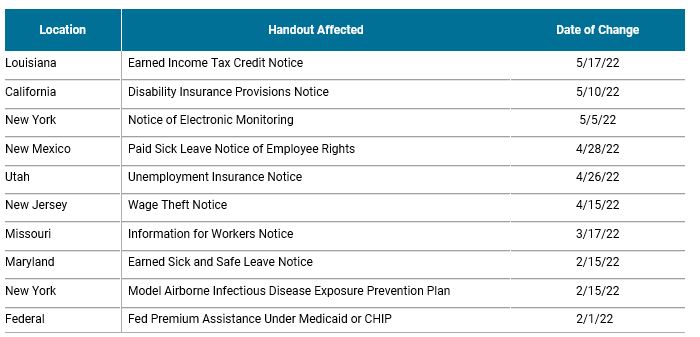
State & Federal Handout Changes (Handout Issued)

[i] https://www.shrm.org/resourcesandtools/tools-and-samples/hr-qa/pages/determinetheirpostingrequirements.aspx

[ii] https://www.shrm.org/resourcesandtools/tools-and-samples/hr-qa/pages/laborlawposterrequirementsforthemultilingualworkplace.aspx

[iii] https://www.shrm.org/ResourcesAndTools/tools-and-samples/hr-qa/Pages/postingrequirementsapplicantswhichfederalemploymentpostersmustbeseenbyapplicants,andhowshouldanemployercomplywiththisrequir.aspx

[iv] https://www.shrm.org/resourcesandtools/legal-and-compliance/employment-law/pages/save-and-photograph-old-posters.aspx

4 Thoughts on Avoiding Halloween Pitfalls in the Workplace

Tis the season for Halloween decorations, office parties and costumes. Holiday parties can be a terrific opportunity for employee engagement, communication, team building and simply having fun with coworkers. There are tremendous benefits to gatherings such as this in the workplace. However, we should recognize when decorations, parties or costumes go awry, we will need to address these concerns. Not all employees want to participate in decorating the office, participate in the office party or wear a costume to work (me included). Leaders need to recognize that workplace rules and dress code policies still exist, while maintaining workplace professionalism. Have fun but be accountable.

Below are my 4 thoughts on Halloween pitfalls:

  1. Manger and Supervisor Training: “Some employees may be offended or even afraid to celebrate something they associate with evil, and supervisors need to be sensitive to that…Any parties, department decorations or costume contests should be clearly presented as voluntary, and equal support should be given to those who don’t participate and those who do.”[i]
  2. What Dress Code: “People magazine and Amazon have identified some popular 2018 Halloween costumes that raise red flags:
    1. An inflatable, giant “poop” emoji.
    2. A Bill Cosby costume that depicts the comedian hauling away an unconscious woman.
    3. Costumes that depict celebrities who have recently died from overdoses or committed suicide.
    4. A President costume, complete with a garish, comb-over wig. 
    5. Sexy costumes inspired by the dramatic series “The Handmaid’s Tale,” which explores themes of women in subjugation.”[ii]

Halloween parties, costume events and even athletic jersey days allow employees to depart from the normal dress code, we normally expect at work. However, the dress code policy still needs to be enforced. Advice from SHRM is a simple metric, employees should be covered from shoulders to knees. Organizations should give examples of appropriate and inappropriate costumes, jerseys, or other dress down days to ensure adherence to the dress code and to proactively avoid any future pitfalls. What if an employee violates the policy? Simple, send them home to change or ask them to cover the inappropriate attire. Coach and council or discipline as needed. Set the example and hold folks accountable.

  1. Halloween Decorations: “Generally speaking, I would not advise companies to decorate,” Wilson said. “If employees want to put a small pumpkin on their desk, which can be a personal decision, but perhaps send an e-mail advising all employees that any gruesome or graphic or otherwise distracting decor is not allowed… witches, demons and goblins can be unprofessional and potentially offensive to co-workers and customers.”[iii] 
  2. Is this Mandatory: The organization should make clear, that participation in any Halloween festivities; decorating, party or costumes will be voluntary, and no one will be forced to participate.

Seasonal parties can be a magnificent event for team building, communication and having fun as an organization. As leaders, we still need to enforce rules and ensure there are no issues related to inappropriate decorations, dress code violating costumes and/or mandatory parties. Communicate expectations and hold everyone accountable. The tone is always set at the top.


[i] https://www.shrm.org/hr-today/news/hr-magazine/pages/1015-solutions.aspx

[ii] https://www.shrm.org/resourcesandtools/hr-topics/employee-relations/pages/halloween-at-work-2018.aspx

[iii] https://www.shrm.org/resourcesandtools/hr-topics/employee-relations/pages/halloween-at-work-2018.aspx
 

2022 New York Voting Leave Laws and Additional State Information

As we approach November 2022, it is necessary for all organizations to review laws and regulations regarding voting leave laws.  I highly encourage all organizations to review current policies, procedures, and postings.  New York State has specific regulations on when postings need to be up in the workplace, in a breakroom or virtual.

Example Policy:
“Employees will be considered to have sufficient time to vote outside their scheduled work hours if they have four consecutive hours between the polls opening and the beginning of their work shift, or four hours after the polls close.  Employees who need time to vote need to communicate the request to HR or management prior to the day of voting, per New York State and federal law.  PTO time can be used for time off to vote.” 

New York State Time Off to Vote 2020 Legislation:
New York State Election Law (As amended by Chapter 56 of the Laws of 2020) § 3-110.
Time allowed employees to vote.

  1. If a registered voter does not have sufficient time outside of his or her scheduled working hours, within which to vote on any day at which he or she may vote, at any election, he or she may, without loss of pay for up to two hours, take off so much working time as will, when added to his or her voting time outside his or her working hours, enable him or her to vote.
  2. If an employee has four consecutive hours either between the opening of the polls and the beginning of his or her working shift, or between the end of his or her working shift and the closing of the polls, he or she shall be deemed to have sufficient time outside his or her working hours within which to vote. If he or she has less than four consecutive hours he or she may take off so much working time as will, when added to his or her voting time outside his or her working hours enable him or her to vote, but not more than two hours of which shall be without loss of pay, provided that he or she shall be allowed time off for voting only at the beginning or end of his or her working shift, as the employer may designate, unless otherwise mutually agreed.
  3. If the employee requires working time off to vote the employee shall notify his or her employer not more than ten nor less than two working days before the day of the election that he or she requires time off to vote in accordance with the provisions of this section.
  4. Not less than ten working days before every election, every employer shall post conspicuously in the place of work where it can be seen as employees come or go to their place of work, a notice setting forth the provisions of this section. Such notice shall be kept posted until the close of the polls on election day.

ATTENTION ALL EMPLOYEES Time allowed employees to vote on election day
N.Y. ELECTION LAW SECTION 3-110i states that:

  • IF YOU DO NOT HAVE 4 consecutive hours to vote, either from the opening of the Polls to the beginning of YOUR WORKING shift, or between the end of your working shift and the closing of the polls, YOU MAY TAKE OFF UP TO 2 HOURS, without loss of pay, TO ALLOW YOU TIME TO VOTE if you are a registered voter.
  • You may take time off at the beginning or end of your working shift, as your employer may designate, unless otherwise mutually agreed.
  • YOU MUST NOTIFY YOUR EMPLOYER Not less than 2 days, but not MORE THAN 10 days, before THE DAY OF THE ELECTION THAT YOU WILL TAKE TIME off to vote.

Revised 4.14.2020

i Employers: Not less than ten working days before any Election Day, every employer shall post conspicuously in the place of work where it can be seen as employees come or go to their place of work, a notice setting forth the provisions of this law. Such notice shall be kept posted until the close of the polls on Election Day

New York State Employer Posting Link (10 Working Days)

Current State of Pennsylvania Voting Leave Legislation:

  1. “Time off Allotted: The statute does not provide for any period of leave. It is unlawful for a person to use force, violence, restraint, or to inflict or threaten to inflict injury, damage, harm or loss on a person to induce or compel such person to vote or refrain from voting.”[i]

State Laws
Here’s a list of jurisdictions that require time off for voting:

  • Alabama.
  • Alaska.
  • Arizona.
  • Arkansas.
  • California.
  • Colorado.
  • Connecticut.
  • District of Columbia.
  • Georgia.
  • Illinois.
  • Iowa.
  • Kansas.
  • Kentucky.
  • Maryland.
  • Massachusetts.
  • Minnesota.
  • Missouri.
  • Nebraska.
  • Nevada.
  • New Mexico.
  • New York.
  • North Dakota.
  • Ohio.
  • Oklahoma.
  • South Dakota.
  • Tennessee.
  • Texas.
  • Utah.
  • West Virginia.
  • Wisconsin.
  • Wyoming.

Additional Information

State of Pennsylvania Draft Organizational Policy (this is an example):
“Organization ________believes that it is the responsibility and duty of employees to exercise the privilege of voting in elections. In accordance with this philosophy, the company will grant its employees approved time off to vote if necessary due to work schedules.

Time Off for Voting:
All employees should be able to vote either before or after regularly assigned work hours. However, when this is not possible due to work schedules, managers are authorized to grant a reasonable period of time, up to three hours, during the workday to vote. Time off for voting should be reported and coded appropriately on timekeeping records.”[i][ii]


[i] https://www.shrm.org/resourcesandtools/tools-and-samples/policies/pages/cms_009836.aspx

[ii] Burr Consulting, LLC Article 11.2018