EEO-1 2021 Collection of Component 1 Data April – May 2022

The U.S. Equal Employment Opportunity Commission (EEOC) has announced its tentative schedule for the 2021 EEO-1 Component 1 data collection portal, which is set to open on April 12 with a filing deadline of May 17.

EEO-1 Reporting Obligation

Businesses with 100 or more employees and some federal contractors with at least 50 employees must submit an annual EEO-1 form, which asks for information from the previous year about the number of employees who worked for the business, sorted by job category, race, ethnicity and gender.

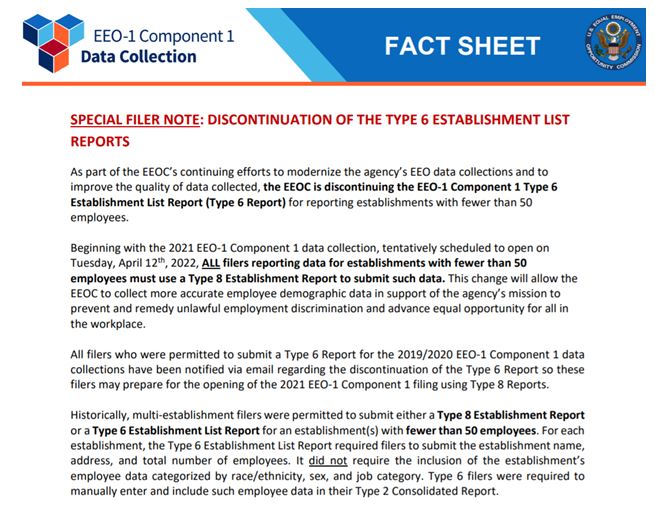
The EEOC also announced the discontinuation of the use of Type 6 reports for multi-establishment employers. Type 6 reports allowed these employers to report only the total number of employees at an establishment with fewer than 50 employees, instead of providing demographic data by EEO-1 category for each location.

Single-Establishment vs. Multi-Establishment Filing

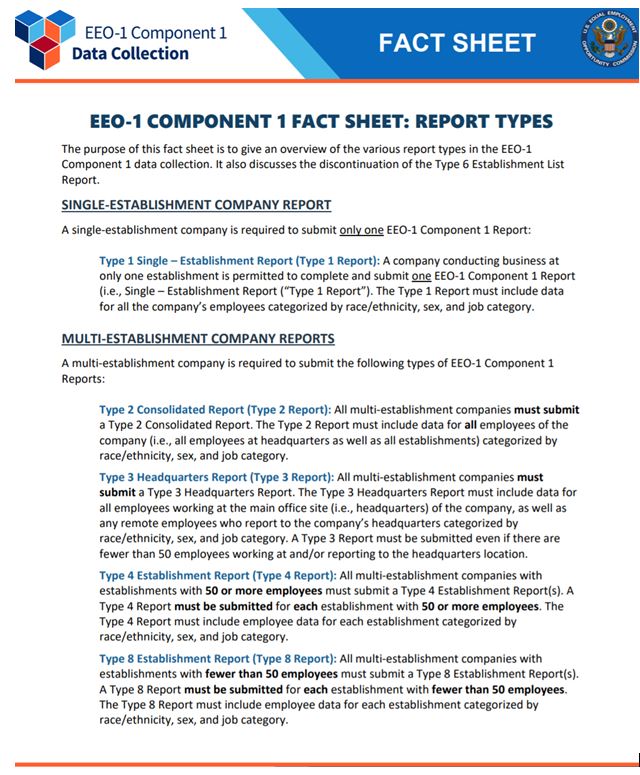
Single-establishment companies are required to submit only one EEO-1 Component 1 data report. Multi-establishment companies must submit:

  • A report for the headquarters.
  • A report for each establishment of the company with 50 or more employees.
  • A report for each establishment with fewer than 50 employees. The Type 8 establishment report, as it’s called, must include employee data for each establishment broken down by job category, race, ethnicity and gender.
  • A consolidated report that includes all employees.

(EEOC)

Extensions Last Year

Covered employers had until Oct. 25, 2021, to file their 2019 and 2020 EEO-1 reports. Although the reporting deadline was delayed several times during the COVID-19 pandemic, the agency eventually said it would not authorize any more extensions. The EEOC said it does not intend to collect controversial pay data from Component 2 of the EEO-1 form, which was the source of a heated legal dispute in recent years.

Additional Links:

https://eeocdata.org/

https://www.eeoc.gov/employers/eeo-data-collections

https://www.eeoc.gov/employers/eeo-1-data-collection

https://www.eeocdata.org/eeo1

WHO NEEDS TO FILE THE EEO-1

  1. What companies are required to file the EEO-1 report?

    A: All companies that meet the following criteria are required to file the EEO-1 report annually:
    1. Subject to Title VII of the Civil Rights Act of 1964, as amended, with 100 or more employees; or
    1. Subject to Title VII of the Civil Rights Act of 1964, as amended, with fewer than 100 employees if the company is owned by or corporately affiliated with another company and the entire enterprise employs a total of 100 or more employees; or
    1. Federal government prime contractors or first-tier subcontractors subject to Executive Order 11246, as amended, with 50 or more employees and a prime contract or first-tier subcontract amounting to $50,000 or more.
  2. Do I need to file if my company has fewer than 50 employees but does have a federal government contract worth $50,000 or more?

    A: No, your company must meet both requirements of 50 employees and the government contract worth $50,000 or more.

https://www.eeoc.gov/employers/eeo1survey/faq.cfm

Legal Requirements

  • Recordkeeping Requirements
  • Download the “EEO is the Law” Poster in English (including a screen-readable electronic version), Spanish, Arabic, and Chinese
    Employers are required to post a notice describing the federal employment discrimination laws.
  • EEO Reports/Surveys
    Employers who have at least 100 employees and federal contractors who have at least 50 employees are required to complete and submit an EEO-1 Report (a government form that requests information about employees’ job categories, ethnicity, race, and gender) to EEOC and the U.S. Department of Labor every year.
DOL Federal Labor and Employment Law Posting Violations Increase 2022

Original article date: 3/14/22

Maximum penalties for federal posting violations are now going up by more than $2,000 under the increases just announced by the Department of Labor.

The department outlined the increases in a rule published in the federal register on January 14, 2022. They apply to penalties assessed after January 15, 2022.
The new maximum fine amounts are:
• Family and Medical Leave Act (FMLA): $189
• Job Safety and Health: It’s the Law (OSHA): $14,502
• Employee Polygraph Protection Act (EPPA): $23,011
F

Federal Poster (20″ x 26″) includes these postings:
Minimum Wage (FLSA)
Job Safety and Health “It’s the Law!” (OSHA 3165)
Employee Polygraph Protection Act (EPPA)
Equal Employment Opportunity Is The Law (EEO)
Family and Medical Leave Act (FMLA)
Uniformed Services Employment and Reemployment Rights Act (USERRA)


Federal Department of Labor Poster Website
OSHA Posting Requirements
New York State Posting Requirements
New York State Unemployment Posting Request Form
New York State Time Off to Vote Posting

Reminder of the whistleblower law and upcoming technology monitoring changes in 2022.

New York City Postings
• Fulfills the requirement for employers to post an anti-sexual harassment rights and responsibilities poster under Title 8 of the New York City Administrative Code, §8-107-29
• Fulfills the Temporary Work Schedule Changes posting requirement for covered employers. The posting requirement is found in Title 20 of the New York City Administrative Code, §20-1205 (b)
• Also fulfills the requirement for employers in New York City to notify employees of their right to be free from discrimination in relation to pregnancy, childbirth, or related medical conditions under Title 8 of the New York City Administrative Code, §8-107-22
• Includes the Earned Sick Time Act Notice of Employee Rights, which may be posted to inform employees of their right to sick leave under Title 20 of the New York City Administrative Code, §20-919

Pennsylvania Labor Posting Requirements

Texas Labor Posting Requirements
All Texas employers must display posters containing information on the Workers’ Compensation Program, the Uniformed Services Employment and Reemployment Rights Act, the Fair Labor Standards Act, the Employee Polygraph Protection Act, and the Occupational Safety and Health Act. Employers subject to the Texas Payday Law must display a poster containing employee information on it. Employers liable under the Texas Unemployment Compensation Act must display a poster that includes information about both unemployment compensation and the Texas Payday Law. Also, every employer with 15 or more employees, and smaller employers with federal grants and contracts, must post the notice entitled “Equal Employment Opportunity Is the Law,” which contains information about the Equal Employment Opportunity/Americans with Disabilities Act laws.


TWC Required & Optional Posters
Payday law
All Texas employers subject to the Texas Payday Law must display a poster prominently in the workplace.


• Texas Payday Law Poster – English
Texas Payday Law Poster – Spanish (Spanish-language version optional)
Texas employers not liable under the Texas Unemployment Compensation Act, but subject to the Texas Payday Law, must display the Texas Payday Law poster. Print it from the links above or request it from the TWC Labor Law unit at 800-832-9243 or 512-475-2670.


Unemployment Compensation
Businesses whose employees are entitled to file for state unemployment benefits and are also covered by the Texas Payday Law should request the poster that combines both laws: Texas Unemployment Compensation Act and Texas Payday Law.


Note: We have removed account specific information from this poster.


You can download the poster below or through Unemployment Tax Services, or request a copy by email or fax, or by contacting your tax office:
• Download the poster:
Unemployment & Payday Law Poster – English
Unemployment & Payday Law Poster – Spanish (Spanish-language version optional)
• Request the same poster online using Unemployment Tax Services
• Call: 512-463-2731
• Email: tax.statussection@twc.texas.gov
• Fax: 512-936-3205

When requesting by email or fax, include your mailing address and specify whether you want English or Spanish.


Optional Posters
• Information on Equal Employment Opportunity laws in Texas, as regulated by TWC’s Civil Rights Division.
The Law in Texas
• Information on the Child Labor laws in Texas, as regulated by TWC’s Labor Law Department.
Child Labor Law in Texas Poster – English
Child Labor Law in Texas Poster – Spanish
• Information on Filing a Wage Claim under the Texas Payday Law, as regulated by TWC’s Labor Law Department
Are You Owed Wages poster – English
Le deben salarios atrasados poster – Español

Required Posters
https://www.twc.texas.gov/news/efte/required_posters.html

  1. Comprehensive information and links to required posters (all free of charge) are found at https://twc.texas.gov/businesses/posters-workplace.
  2. Posters should be displayed in such a way that each employee can readily see them (generally, the requirements have language such as “conspicuously placed” and “readily accessible” to employees). That would mean that employees who do not normally get to certain offices would not be served by posters displayed at those offices. The offices, or sub-offices, where those employees normally congregate would need to have the posters displayed for the benefit of the employees who are served by each such location.
  3. Posters and other kinds of required notices do not have to be placed in individual locations that are only temporary worksites. Example: construction workers building homes in a subdivision would not need to have posters in each house, but rather only in a company jobsite trailer for the project.
  4. In case of a co-employment situation, such as temporary employees assigned to client companies, the employees working at client sites are co-employed by the staffing firms and their clients under various state and federal employment laws. The notice statutes merely require the posters to be in the workplace. The enforcing agencies do not care who actually places the notices where the employees work, as long as the posters are up and visible to the employees. Thus, as long as the client companies have the applicable notices properly posted, their compliance with the notice requirements inures to the staffing firm’s benefit. By the same token, if the clients do not have the notices posted, the staffing firm would be co-liable with them for non-compliance with the laws. Bottom line: the staffing firm needs to determine whether the appropriate notices are posted in the clients’ locations, and if they are not posted, cooperate with its clients to get the posters displayed.
  5. In a virtual office situation, where the company does not maintain a physical location where employees normally congregate, assemble, or show up for work-related purposes, post copies of the posters on the company’s web site section restricted to staff and send an e-mail, “read receipt requested”, to all affected employees listing and identifying the posters, complete with links to the posters on the web site, and reminding the employees that the posters are there for their benefit and that they should keep the e-mail archived so that they can easily find the links to the posters if needed.

New York City Salary Range in Job Postings Law

Original article date: 3/7/22

Beginning on May 15, 2022, “the New York City Human Rights Law (NYCHRL) to require that employers disclose a salary range “from the lowest to the highest salary the employer in good faith believes at the time of the posting it would pay for the advertised job, promotion or transfer opportunity” on all job advertisements for positions located in New York City. Employers will also have to include the salary range in all announcements or postings regarding promotion or transfer opportunities.


As the term “salary” is not defined, employers should comply with the new law regardless of whether a position is a salaried, exempt, or hourly non-exempt position. Failure to include a salary range would be considered a discriminatory practice under the NYCHRL. The posting requirement will not apply to temporary positions listed by temporary help firms.” (DWT)

“Kelly Cardin, an attorney in the Stamford, Conn., and New York City offices of Ogletree Deakins, said that the law would apply to employers with four or more employees, including independent contractors, but does not apply to job postings by staffing firms for temporary positions.


“Existing provisions … authorize the New York City Commission on Human Rights to impose civil penalties of up to $125,000 for unlawful discriminatory practices or acts,” Cardin noted.” (SHRM)


So far, only Colorado’s law, like the recent New York City bill, requires employers to include salary ranges in job postings.


Other jurisdictions are considering wage transparency laws. The New York State Senate and Assembly have proposed legislation, S5598A / A6529, which, like the New York City law, would require employers to disclose salary range information to applicants “upon issuing an employment opportunity for internal or public viewing.” Wage transparency bills have also been introduced in Massachusetts and Pennsylvania.

NYC Salary Range in Job Posting Legislation

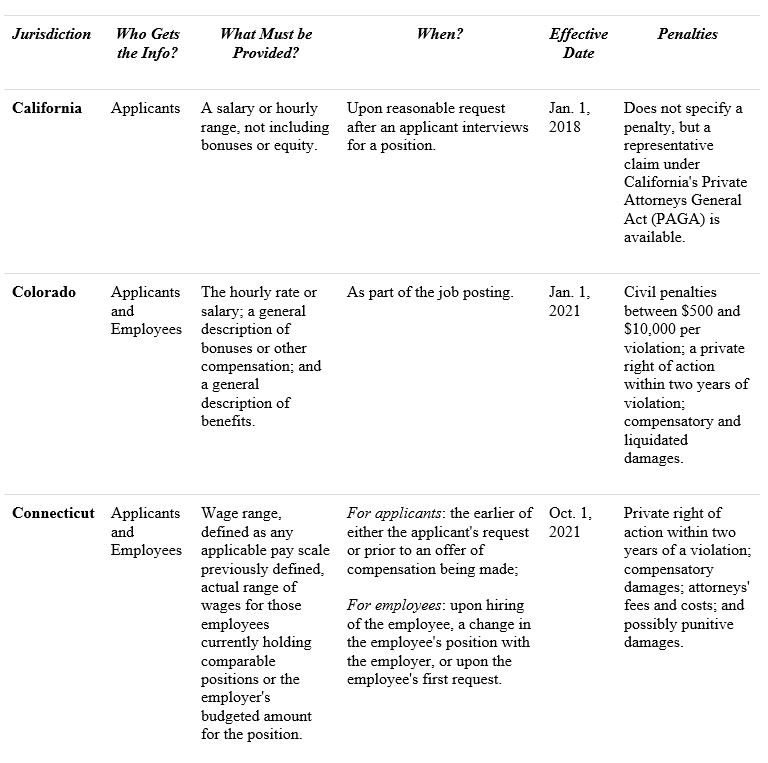
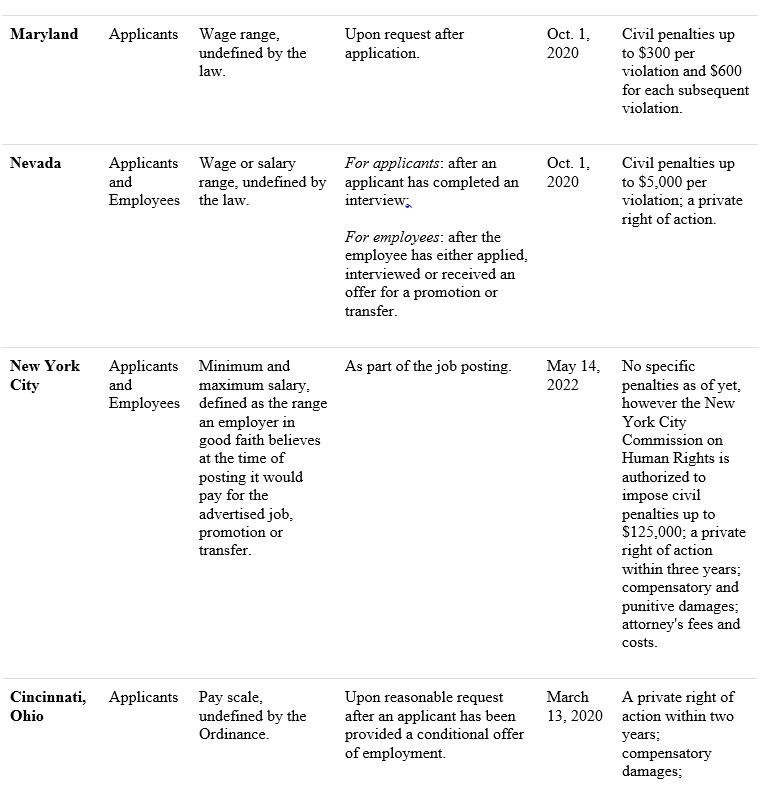
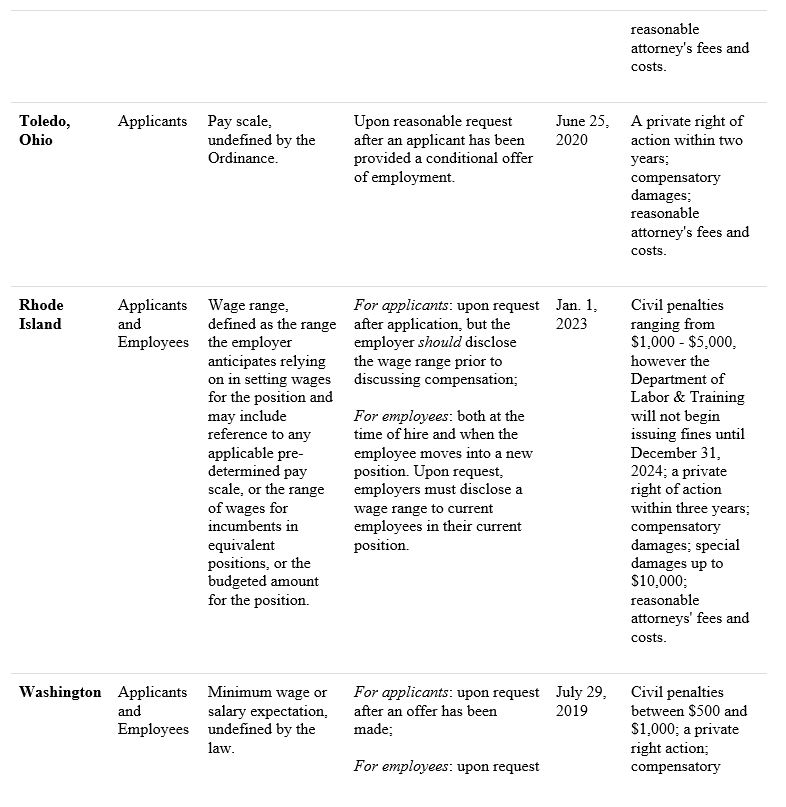
“Employers in 10 jurisdictions (and counting) are now subject to wage disclosure requirements. Colorado and New York City have made headlines as the first jurisdictions to mandate such disclosures. Employers must review the laws of each individual jurisdiction to remain compliant with this growing collection of wage disclosure laws. The following table provides an overview of these jurisdictions and what they require:

While these laws seem similar on their face, each has its own nuance. As a result, using a uniform policy may prove to be a challenge for a multistate employer. For instance, in Rhode Island, employers must not only disclose a wage range for applicants and employees upon transfer or promotion but also must respond to an employee’s request for a wage range for their current position. California, Washington, Connecticut, and Maryland all require disclosure upon request, but Nevada mandates automatic disclosure after an interview for an applicant, or after an application for a current employee.


The New York City law appears to apply to jobs located within New York City only, which leaves an open question as to remote work; Colorado, on the other hand, has taken the position that remote positions require wage disclosure and any employer seeking to get around this requirement by specifically excluding Colorado applicants is not compliant with the law.


In practical effect, the onus is on employers to document their rationale for their hiring and pay decisions. Employers can:
– Document formal job descriptions for both new applicants and promotion/transfer opportunities.
– Determine salary ranges for each job classification using existing data or on a good-faith basis.
– Create internal policies regarding promotion/transfer opportunities within an organization. Develop internal systems for handling employee requests for salary reviews.” (SHRM)

Labor Law Postings Visible to Onsite and Online Applicants

Original date: 2/28/22

Six federally mandated labor law posters employers are required to display, four must be visible to job applicants. These include:
• Family and Medical Leave Act (FMLA) — Explains employee leave eligibility and benefits, as well as employer responsibilities
• Equal Employment Opportunity Commission (EEOC) — Covers anti-discrimination provisions and legally protected characteristics
• Employee Polygraph Protection Act (EPPA) — Describes the rules around lie detector tests in employment (even if you don’t use them)
• Uniformed Services Employment and Reemployment Rights Act (USERRA) — Addresses re-employment after military leave, anti-discrimination provisions and health insurance issues. (While not specifically mandated, this poster is recommended because the law applies to applicants).

For online job applicants, the Department of Labor (DOL) recommends that you include a notice near the application form that states: “Applicants have rights under Federal Employment Laws,” and include links to the required posters.


Do not forget any local or state posters that also need to be available to onsite and online applicants during the interview process.

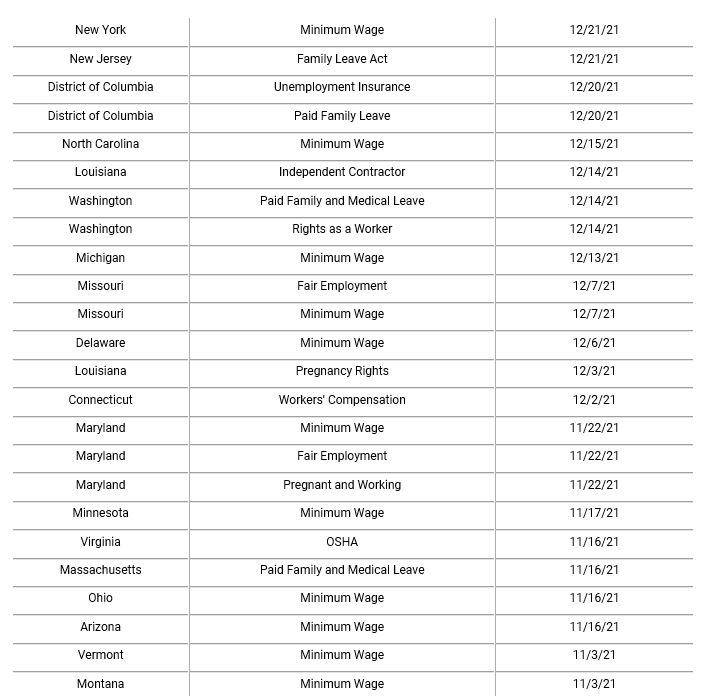
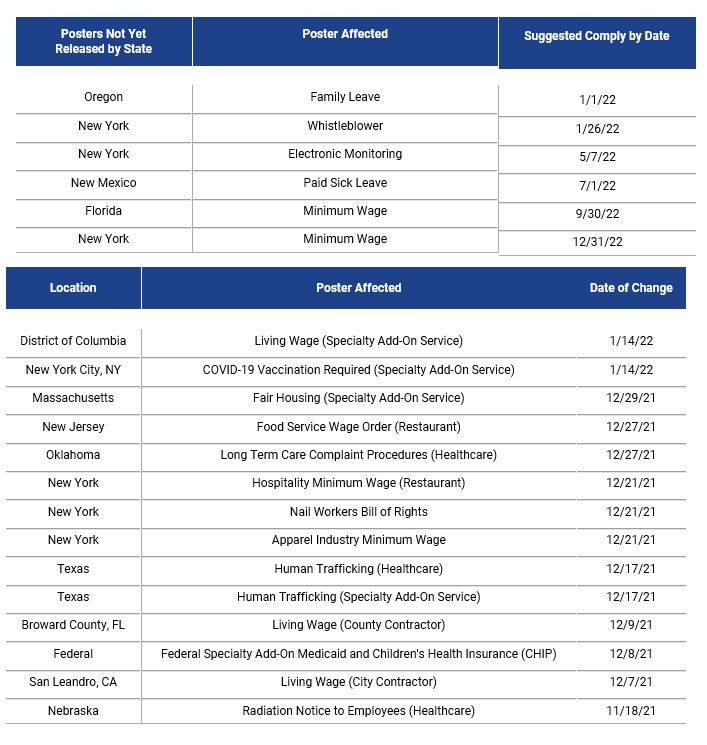
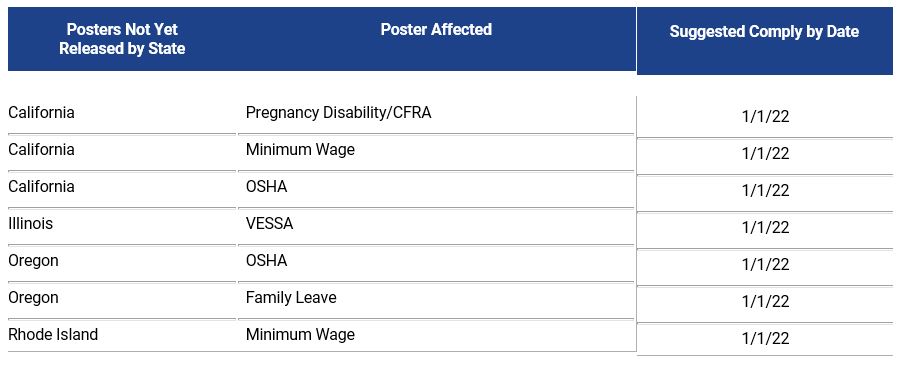
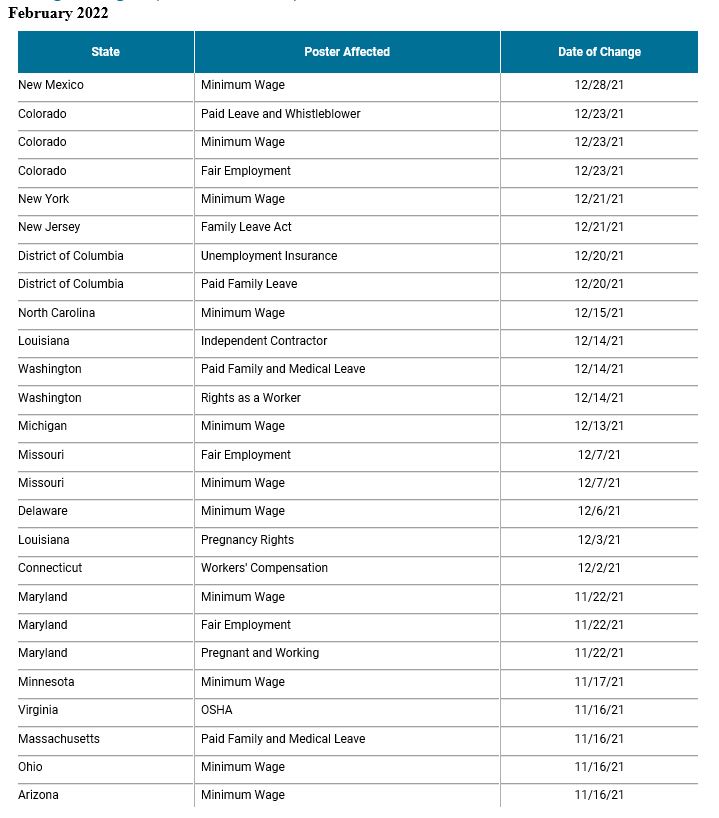
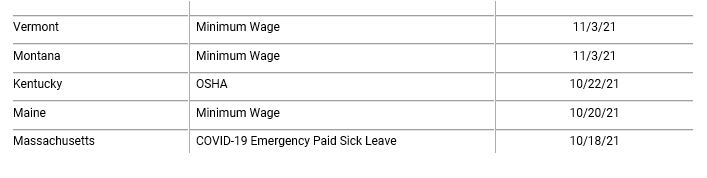
State Posting Changes (Posters Issued)

Set Up Properly When Launchinga Home-Based Business

Original post date: 2/21/22

Written by: Carla Lopez of boomerbiz.org

Starting your own business is an exciting thing. Being your own boss and being able to spend more time at home can be a dream come true, but figuring out the logistics of running your business from home can be challenging. These tips from Burr Consulting can help you establish your business and set up the perfect home office space, so you can get down to business right away.

Establishing Your Business

One of the first steps of opening a business is deciding how you want to file. Do you want to form a corporation, be a sole proprietor, organize a partnership or something else? As you weigh your options, note that for small businesses, filing as a limited liability company, or LLC, can have many advantages. As the name implies, an LLC limits the liability you incur as a business owner. Unlike a partnership or sole proprietorship, owners of LLCs don’t risk losing personal assets to repay debts or settle lawsuits if their business gets into trouble.

Along with creating an entity for your business, you’ll need to file an annual report each year. While this isn’t a huge project, it will take some of your focus away from running your business. The filing process can be simplified by filing online.

Setting Up Your Office Space

Once you have all of the paperwork out of the way, it’s time to set up the perfect office space in your home. Your office should be a place where you feel comfortable, relaxed, happy and productive. Investing in your home office can do wonders for your job satisfaction and the success of your business. First, Architectural Digest explains you’ll need to determine how much space you need, any business-specific needs and the style that you want. Then, you can get to planning!

Some homes just don’t have enough space to accommodate an office, and a small home shouldn’t hold your business back. If you need more room, research your market and talk to a realtor about buying a new home. You can explain your price range and exactly what you want for your home office and living space, and receive personalized help finding the perfect house that fits all of your needs and your budget.

Sometimes, a house has a room that would be perfect for an office, but it needs a little bit of TLC to spruce the place up. If that’s the case for you, then consider renovating the existing space. Small changes, such as adding new lighting, replacing furniture, adding an area rug, and hanging up some wall art can go a long way in creating your dream office. These quick and easy projects will help set up an incredible office in no time, so you can get to work right away.

If you already have a home office but the area has some room for improvement, consider redesigning your office space. You can build an addition to increase your office space, remove walls to improve the layout or make cosmetic changes. These design changes will help you create a brand new office that’s perfect for you and your business.

Whatever you decide to do, be diligent about keeping and storing receipts and any necessary documentation. Purchases for your business can be included as tax deductions, while renovations can increase your home’s value and need a paper trail to back it up. Stay organized by keeping all your files digitally organized in one place. You can even combine PDFs into one file so that you’ve got everything in a single place.

There’s a lot of work that goes into running a home business, but the payoff is well worth it. Setting up your home-based business right from the beginning puts you on a strong foundation for success.

Burr Consulting can help your business solve critical HR issues. Reach out to learn how we can help your organization. 607-227-4386

2022 New York Employer Notification of Phone, Email, and Internet Use Legislation

Original post date: 2/14/2022

On November 8, 2021 New York governor Kathy Hochul signed a new law which will require all employers to provide an electronic monitoring notice to all employees.

The law will take effect on May 6, 2022 and will require all private employers to provide a written notice to all new employees upon hire if the employer plans to monitor any telephone calls, internet use or emails. The notice must be in writing or in an electronic form and must be acknowledged by the employee. Employers are also required to post the notice in the workplace where it can be available for viewing. 

“Under a new statute, New York employers are required to notify employees if they intend to monitor their company-controlled phones, email, or internet use.

Requires all private employers to notify their employees of their intention to monitor work phones, email, or internet use. The law is effective as of May 6, 2022.

Under the new law, any employer that monitors or otherwise intercepts email or transmissions by employees must provide them with written notice upon hiring.  (The law does not specifically address notice requirements for current employees.)  The notice must be in writing or electronic format and must be acknowledged in writing or electronically by the employee.

Additionally, employers must post a notice in a “conspicuous place which is readily available for viewing by its employees.”  The notice must advise employees that “any and all telephone conversations or transmissions, electronic mail or transmissions, or internet access or usage by an employee by any electronic device or system, including but not limited to the use of a computer, telephone, wire, radio or electromagnetic, photoelectronic or photo-optical systems may be subject to monitoring at any and all times and by any lawful means.”

According to the “justification” section of the bill provided by the sponsors, employers “will retain the right to monitor computer usage, simply with the stipulation that employees are informed of surveillance practices,” which they say “will increase transparency within the organization,” “help to avoid lawsuits and litigation regarding invasion of privacy,” and “permit employees to make informed decisions about their internet use with full knowledge of the ramifications of their actions, while supporting companies’ ability to monitor Internet activity within their organization.” 

The bill specifically provides that it does not apply to processes that (1) are designed to manage the type or volume of incoming or outgoing electronic mail or telephone voice mail or internet usage, (2) are not targeted to monitor or intercept the activities of a particular individual, and (3) are performed solely for the purpose of computer system maintenance and/or protection.

Any employer that violates the law will be subject to a maximum civil penalty of $500 for the first offense, $1,000 for the second offense, and $3,000 for the third and each subsequent offense. The law will be enforced by the state Attorney General, not the Department of Labor, and does not provide for a private right of action. (The statute is an amendment to the state’s Civil Rights Law, not the Labor Law or the Human Rights Law.)” (https://www.jdsupra.com/legalnews/new-york-employers-must-notify-3192761/)

It is recommended to review any handbook, policies, and procedures throughout your organization. Ensure any changes are communicated to the workforce and new policies have signature pages. Continue to watch for any labor and employment posting changes or requirements based on the changes to this legislation.