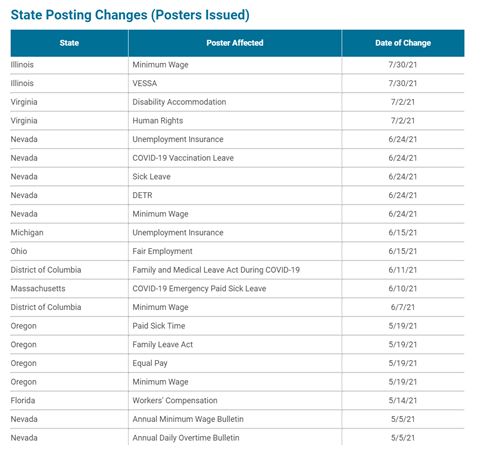
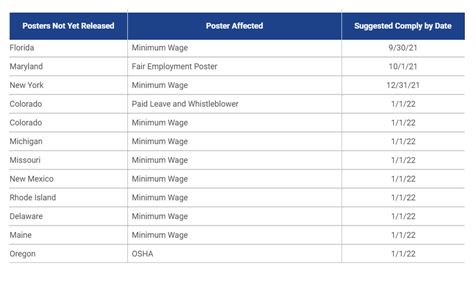
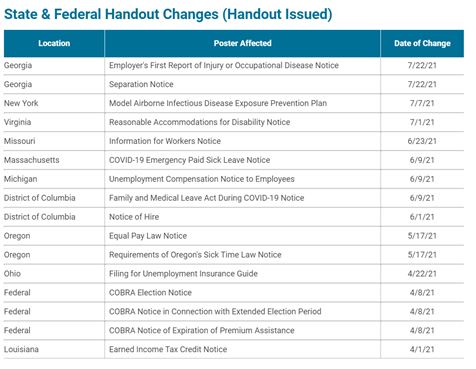
Labor and Employment Posters- Remote Worker Requirements

When are electronic postings required?
 
When all employees work remotely, the Department of Labor (DOL) says a business can use electronic postings to satisfy posting requirements. Essentially, they are required if everyone is remote. The DOL also notes that, for electronic posters to be compliant, employees need to have readily available access to them. In addition, workers need to usually get information electronically.

Some of our employees are remote and others are in the office. Do we need electronic posters?
 
The DOL encourages the use of electronic posters in this situation but doesn’t require them. It’s certainly a best practice to make them available, as they’re a great way to show that you’re providing workers with information about their rights. In addition, they might be required under a state law. At the office, you’ll need to display paper posters
 
Which electronic posters do we need?
 
All employees need access to federal postings. They also need access to state and local postings that relate to where they are working, so if they work from home they need to have access to posters for the state (and maybe the city) they live in.
 
Our employees work at a customer’s location. Do they need electronic posters?
 
If employees have access to the paper posters at the customer’s location, that should satisfy your posting obligations. You’ll want to make sure the posters are up-to-date and that all required postings are displayed. If the customer’s posters are in an area your employees can’t access, work with the customer to see if you can put up a set of posters in a place where they’re visible to your employees.
 
How quickly do employees need to receive their electronic posters?
 
There is no specific time frame or grace period for providing electronic posters to remote employees. If all workers are remote, it’s best to make the effort to provide them as soon as possible and document your efforts. When some workers are remote, and electronic posters aren’t required, it’s still a good idea to provide access as soon as you can. This shows a good faith effort to make all employees aware of their rights. (JJ Keller)
 
As many of our organizations have been implementing and utilizing remote worker options, we cannot forget the requirements for labor and employment law posters.  Local, State and Federal laws have different requirements and definitions for remote workers.
 
Broad Definition of Remote Workers:
·         Works at home
·         Does not report to a physical job site
·         Is an employee
 
Other Considerations:
·         Independent Contractors: Organization is not required
·         Digital Nomads: Organization is not required
·         Gig Workers: Depends on payrolling of the individual
·         Temporary Workers: Depends on payrolling
·         Workers on site at customer’s office: If the customer’s office has posters, more than likely no, but you do want to work with the customer to ensure compliance.
 
General Posting Requirements:
·         Visible
·         Conspicuous Location
·         Readable
·         Not Defaced
·         Post Where Employees Report to Work Each Day
 
Remote Workers with Internet Access:
·         Internal website link
·         Conspicuously Displayed: Ensure it is easy to find on your intranet portal and not buried in folders.
·         Ensure workers are aware of how to access
·         Make remote workers aware of their rights
·         Can send them their own set of posters
·         Electronic posters = best practice
·         Still need paper posters at main office and other locations
 
EEOC: In most cases, electronic posting supplements physical posting but does not itself fulfill the employer’s basic obligation to physically post the required information in its workplaces.
 
The majority of the agencies, laws and regulations were written prior to the remote work became a popular model for organizations to implement.  However, there are a few federal and state laws that have implemented electronic posting language.
 
·         USERRA Notice: May be posted or distributed in other ways.
·         FMLA Notice: May be distributed electronically if all other requirements are met.
·         EEOC: employers are encouraged to post the electronic notice on their internal websites in a conspicuous location
·         Colorado Paid Leave, Whistleblowing & PPE: Provide through electronic communication, or conspicuous posting in the web-based platform
·         FFCRA: An employer may also directly mail the required notice to any employees who are not able to access information at the worksite, through email, or online.

Other Considerations:
 
·         Traveling Workforce: Cleaning Crews, Landscapers, etc. 
·         Create Binders of PDF postings or work with your poster provider
 
These are a few thoughts on the evolving labor and employment law posting requirements throughout the country.  There are a number of changes expected at the end of 2021 and early 2022.  Ensure you are monitoring for changes to Paid Sick Leave posting requirements in New York State.  I am happy to work with any organization to ensure you are compliant with posters, remote worker options, intranet options and creating PDF binders for work vehicles.  We can design a process that will ensure legal compliance.  I do suggest semiannual audits to all posters throughout the workplace.
 

New York HERO Act Communication Plan

NY Department of Labor published the model workplace airborne infectious exposure prevention standards, a general airborne infectious disease exposure prevention standard, and several template prevention plans for the following areas/industries: Agriculture, Construction, Delivery Services, Domestic Workers, Emergency Response, Food Services, Manufacturing and Industries, Personal Services, Private Education, Private Transportation, and Retail.

Exposure Prevention Plan During an Airborne Infectious Disease Outbreak

When a highly contagious communicable disease is designated by the Commissioner of Health as presenting a serious risk of harm to the public health, employers must:

  • Immediately review their exposure prevention plans and update the plans, if necessary, to ensure that they incorporate current information, guidance, and mandatory requirements issued by federal, state, or local governments related to the infectious agent of concern;
  • Finalize and promptly activate the worksite exposure prevention plan;
  • Provide a verbal review of the employer’s safety policies, employees’ rights under the HERO Act, and the written exposure prevention plan (which can be conducted via audio or video conference technology);
  • Provide each employee with a copy of the exposure prevention plan in English or in the language identified as the primary language of such employees, if the NYSDOL makes a translation available;
  • Post a copy of the exposure prevention plan in a visible and prominent location at the worksite; and
  • Ensure that a copy of the exposure prevention plan is accessible to employees during all work shifts.

While the airborne infectious disease designation remains in effect, the General Standard states that employers must ensure that their exposure prevention plans are effectively followed by:

  • Assigning enforcement responsibilities and ensuring that adequate enforcement of the exposure prevention plan takes place;
  • Monitoring and maintaining exposure controls (as defined below); and
  • Regularly checking for updated information and guidance provided by the NYSDOH and the CDC concerning the airborne infectious disease and updating the exposure prevention plan, when necessary, so that the plan reflects current NYSDOH and CDC recommended control measures. (National Review)

The NYDOL guidance and model plans can be found here:  https://dol.ny.gov/ny-hero-act

2021 New York State Sexual Harassment Training Annual Reminder (Yes, It’s Annually Required, this is Your Early in the Year Reminder)

Revised: March 2021

Updated: October 2020

Updated Publication Date: September 9, 2019

Original Publication Date: April 29, 2019

As a reminder on, October 9, 2019 is the date set by New York State for all employers to have the mandatory sexual harassment training completed for all employees (including governmental employees), interns, etc.  This is an annual training requirement.  The annual refresher training will soon be upon us. The state has broadened the laws regarding filing a claim of sexual harassment, making it easier for claims to be filed against an employer.

Sexual Harassment Policy Updates with recent legislation changes:

  • Eliminate the language “severe and pervasive”
  • Modify Division of Human Rights claim from 1-year to 3-years
  • Policy, handbook, PPT slides and any training material should be updated to reflect these changes
  • Communicate these changes as part of the annual training, with examples

Training Considerations:

  • Update slides with new legislative changes
  • Train new hires as soon as possible (as outlined by the state, watch NYC requirements)
  • I recommend training Board of Directors (even if its policy related) and volunteer groups

New York State Recommended Posting:

  • This is not mandated but recommended.  I recommend utilizing the posting and posting a copy of the sexual harassment policy near labor and employment law posters.
  • New York City has posting requirements

New York State Sexual Harassment Website:

  • No updates have been made to the state website, I will update in upcoming articles with any policy or training slides that the state updates.

I am happy to work with any organization to establish the Sexual Harassment policy, update a policy, train the workforce (managers and supervisors should be trained separately), design training material and/or work on the posting material. 

Additional Considerations:

  • Posting & Communication Material
  • Sexual Harassment Quiz (I utilize one with 10-questions, requiring the trainer and employee to signoff)
  • Annual Notice (Available through state website or me)
  • Supervisor & Managers should be in a separate training
  • Monitor for changes in NYC & any specific state requirements (California, Illinois, etc. have differing requirements than New York State.)

Original Publication 4/29/2019:

As all of us are aware, on October 1, 2018, New York State released final guidance on the state’s new sexual harassment prevention laws and regulations. The new legislation requires all employers in New York State to publish policies concerning sexual harassment, adopt a sexual harassment complaint form, and conduct sexual harassment training.  The state also recommends a posting as part of the policy and complaint procedure.  The advice I provide to all of my clients is, to utilize the state recommended posting and post the policy and complaint form near the labor posters as well.  New York City requires employers to have a posting in the workplace, with differing requirements then the state regarding training, policy, etc.     

Legal Requirements in New York State:

  1. New York State Claim Filing (1-year to file with the NYS Department of Human Rights & 3-years to file in NYS Supreme Court)
  2. Damages & Remedies (Back Pay, Front Page, Compensatory Damages, Interest on Back Pay & Attorney’s Fees)
  3. Not Training Employees (Civil Fine up to $100,000.00, Litigation Penalty, Order to Comply, Contempt of Court & Stop Work Order)
  4. First Round of Training done by 10/9/2019
  5. New Hires after 10/9/2019 (as quickly as possible)
  6. Examples and explanations are imperative in the training, remember to engage the workforce
  7. Training Recommendations (Board of Directors & Volunteers)
  8. Training Considerations (Sign-in/Sign-Out Sheet, Training Materials, Video of Training, Certificate of Completion)
  9. Interactive (Web-based questions at the end of section, answers to questions, option to submit a question online and receive an answer, questions throughout a live training, feedback survey for employees to turn in after they have completed the training, roleplaying, open discussion, scenarios, open activities, small group activities, etc.)

These are just a few of the legal requirements as outlined by New York State and the Department of Human Rights.  All employers should be committed to training employees, managers, board of directors and volunteers annually.  There is no justification not to train, as it is required under the new law.  A quick policy review training, will not suffice the requirements as outlined by New York State and the Department of Human Rights.  This is not a complex training and can be completed in 2-hours, or less.  The majority of my trainings last between 2 and 2.5 hours.  Great discussions in a small group setting, with interactive case discussions.

Below are Training Reminders:

  • An explanation of sexual harassment and specific examples of inappropriate conduct that would constitute unlawful sexual harassment.
  • Detailed information concerning federal, state and local laws and the remedies available to victims of harassment. 
  • A review of any additional local policies, employer’s standards and organizational practices.
  • Detail regarding any internal process that employees are encouraged to use to complain, and the contact information with specific names and offices with which employees should file their complaints.
  • A review of supervisor and managers responsibilities in addressing this form of employee misconduct. (as needed in supervisor/management sessions)
  • An explanation of employees’ external rights of redress and the available administrative and judicial forums for bringing complaints.
  • A review of the employer complaint form.
  • Employer procedure for the timely and confidential investigation of complaints that ensures due process for all parties.
  • Retaliation against individuals who complain of sexual harassment or who testify or assist in any investigation or proceeding involving sexual harassment is unlawful.
  • Quiz design and use to end the session. (discussion cases throughout)
  • Question and answer session with feedback
  • All other requirements as outlined under federal and state law
  • Any and all over legally required information by New York State, NYC or local legislation

The tools and resources that were released on October 1 include:

  • Updated website with resources for employers, employees, state contractors and targets of sexual harassment
  • Updated model sexual harassment prevention policy
  • Updated model sexual harassment complaint form
  • Updated model training (script book and PowerPoint presentation)
  • Updated minimum standards for sexual harassment prevention policies and trainings
  • Updated FAQs
  • Toolkits for employers and employees and a sexual harassment prevention policy poster are also being made available.

Sexual Harassment in the Workplace

Employer Resource Link

Frequently Asked Questions Link

New York: NYC Mandates Annual Anti-Harassment Training (4/1/19)[i]

“The Stop Sexual Harassment in NYC Act requires New York City employers with 15 or more employees to provide annual interactive training to prevent sexual harassment for all employees, including interns and supervisory and managerial employees.

Such training is also required for new employees within 90 days of hire (however, an employee who has received sexual-harassment training at one employer within the required training cycle does not need to receive additional training at another employer until the next cycle).

The act defines “interactive training” as “participatory teaching whereby the trainee is engaged in a trainer-trainee interaction, use of audio-visuals, computer or online training program or other participatory forms of training as determined by the commission.””[ii]


[i] Burr Consulting Article 4/1/2019

[ii] SHRM Update

7 Definitions for Sexual Harassment Claims under the EEOC

Original article date: June 3, 2019

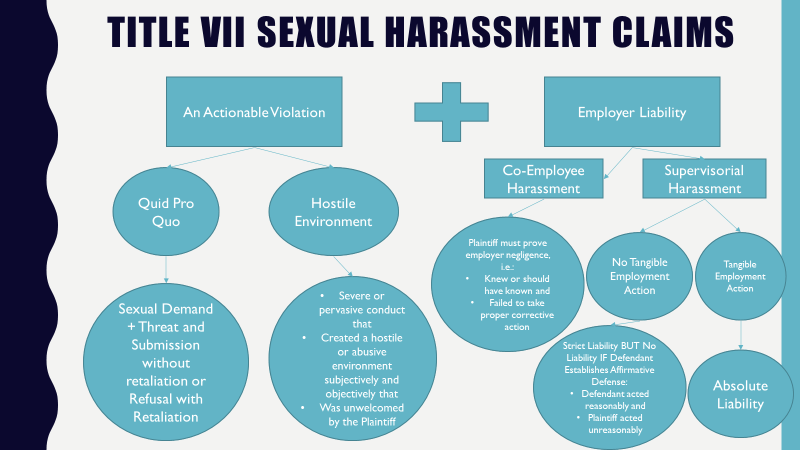
The Equal Employment Opportunity Commission (EEOC) is the federal agency that can and will investigate sexual harassment allegations, along with other discriminatory allegations made against an organization, supervisors, managers or employees.   An individual can file a complaint with the EEOC anytime within 300 days from the alleged sexual harassment or discriminatory allegation, as defined by the federal law.  As outlined in the NYS Sexual Harassment training slides, the individual does not need an attorney to file and the individual must file the complaint with the EEOC prior to filing in federal court.  What does the EEOC look for in a sexual harassment allegation against an organization or the employees in the organization?  How have they defined severe and pervasive?  Can this change?  Yes, and it can change quick during the #MeToo environment. 

Convincing a fact-finder:

  • Severe or Pervasive: enough to create a work environment that a reasonable person would consider intimidating, hostile, or abusive.
  • Unwelcomed: individual has to prove to the fact-finder the conduct was unwarranted and unwelcome.
  • Rendered the plaintiff’s working environment both objectively and subjectively hostile/abusive.

Courts Defining Severe or Pervasive:

  • The level of offensiveness of the unwelcomed speech or conduct.
  • The frequency of occurrence of such conduct or speech.
  • Length of time over which the alleged harassment occurred.
  • The context in which the challenged conduct occurred.

EEOC Sexual Harassment Website

NYS Division of Human Rights (DHR)

A complaint alleging violation of the Human Rights Law may be filed either with DHR or in NYS Supreme Court.  Complaints may be filed with DHR any time within one year of the alleged sexual harassment, no attorney needed to file.  Filing in the NYS Supreme Court can occur any time within three years.

“Although the Human Rights Law applies generally to employers with four or more employees, the sexual harassment provisions apply to ALL employers in New York State, regardless of the number of employees. Sexual Harassment in the Workplace Sexually harassing conduct can consist of unwanted verbal or physical sexual advances, sexually explicit statements, or discriminatory remarks that are off­ensive or objectionable to the recipient.

Examples include:

  • Requests for sexual favors, which may be accompanied by implied or overt threats concerning one’s job performance evaluation or promotion.
  • Subtle or obvious pressure for unwelcome sexual activities.
  • Verbal harassment or abuse in the form of a pattern of sexual comments or questions.
  • Unnecessary or inappropriate physical contact.
  • Displays of lewd photographs or drawings.

Unwelcome sexual advances, requests for sexual favors, and other verbal or physical conduct of a sexual nature constitute unlawful sexual harassment when:

  • Submission to such conduct is made (either explicitly or implicitly) a term or condition of employment;
  • Submission to, or rejection, of such conduct is used as a basis for decisions aff­ecting one’s employment; or
  • Such conduct has the purpose or e­ffect of interfering with an individual’s work performance, or creating an intimidating, hostile or o­ffensive working environment.”[i]

NYS Sexual Harassment Information Link

[ii]

Potential Future Changes in NYS:

A bill has been introduced in the NYS Legislature that would add language to the Human Rights Law which includes; “Harassment is not limited only to those actions that are severe or pervasive.”  The law currently reads, “Harassment includes the types of actions that have been found by the courts to create a hostile environment or a tangible job detriment.  Such actions are an unlawful discriminatory practice when they result in a person or persons being treated not as well as others because of a protected characteristic.  Harassment does not include what a reasonable person with the same protected characteristic would consider petty slights or trivial inconveniences.” A broad expansion to the law has the potential of expanding what harassment and sexual harassment how the state and court system define workplace harassment.  Continue to monitor for any changes and updates to this legislation, it will impact all organizations throughout the state. 

[iii]

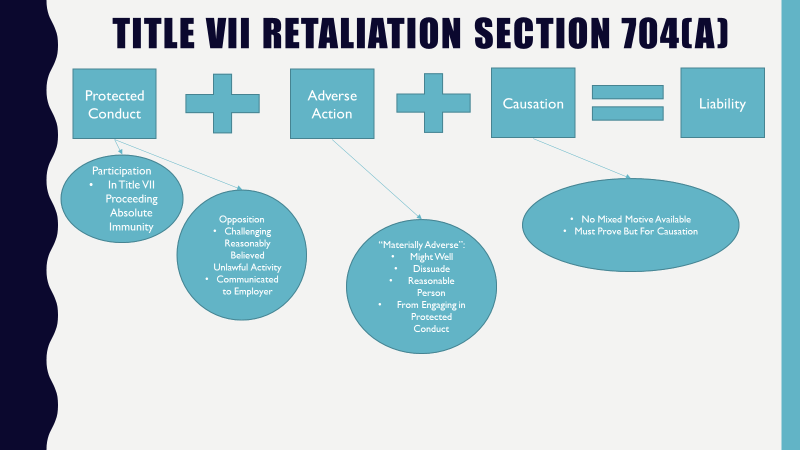
*This can include retaliation on other protected categories under Title VII

California Sexual Harassment Laws

“California Code of Civil Procedure Section 1001 prohibits public and private employers of any size from settling lawsuits and administrative claims using agreements that prevent the disclosure of factual information regarding:

  • Sexual assault.
  • Sexual harassment.
  • Workplace harassment or discrimination based on sex.
  • The failure to prevent acts of workplace harassment or sex discrimination.
  • Retaliation against workers who report sexual harassment or sex discrimination.

Section 1001 was enacted to eliminate secret settlements that historically silenced survivors of harassment and assault and kept them from revealing the details of sexual-harassment cases.”[iv]

2020 vs. 2019 HSA Contribution Limits

Contribution and Out-of-Pocket Limits
20202019Change
HSA contribution limit(employer + employee)Self-only: $3,550 
Family: $7,100
Self-only: $3,500 
Family: $7,000
Self-only: +$50 
Family: +$100
HSA catch-up contributions (age 55 or older)$1,000$1,000No change
HDHP minimum deductiblesSelf-only: $1,400 
Family: $2,800
Self-only: $1,350 
Family: $2,700
Self-only: +$50 
Family: +100
HDHP maximum out-of-pocket amounts (deductibles, co-payments and other amounts, but not premiums)Self-only: $6,900 
Family: $13,800
Self-only: $6,750 
Family: $13,500
Self-only: +$150 
Family: +$300
Source: IRS, Revenue Procedure 2019-25.

[v]

NYS Worker’s Compensation Board Updates to Disability Benefits Claim Forms 5/28/19

The New York State Workers’ Compensation Board (WCB) has made updates to forms that are used for disability benefits claims. Two disability benefits claim forms have been updated to streamline the process of reviewing a total or partial payer rejection of a disability benefits claim, while two other disability benefits forms have been made obsolete. In addition, the mailing address of the Board’s Disability Benefits Bureau has changed.

Notice and Proof of Claim for Disability Benefits (Form DB-450)

The Notice and Proof of Claim for Disability Benefits (Form DB-450) has been updated to collect additional clarifying information regarding eligibility and collection of other benefits (e.g., workers’ compensation, unemployment insurance, etc.) that impact eligibility for disability benefits.

Part A must be completed by the claimant, and Part B must be completed by the claimant’s health care provider prior to submission. The form may be submitted to either the claimant’s employer or payer but must be submitted within 30 days of the first day of work missed due to disability.

Claimants may visit Forms or contact their employer or payer to obtain this form. Use of version 5/19 of the form will be effective June 1, 2019. Version 9/17 of the form will continue to be accepted through September 30, 2019.

Notice of Total or Partial Rejection of Claim for Disability Benefits (Form DB-451)

The Notice of Total or Partial Rejection of Claim for Disability Benefits (Form DB-451) has been updated to provide a more comprehensive list of rejection reasons and provide clearer instructions on how the form and different rejection reasons should be used.”[vi]

Notice and Proof of Claim for Disability Benefits DB-450 Form


[i] https://dhr.ny.gov/sites/default/files/pdf/sexual-harassment.pdf

[ii] Joel Wm. Friedman, Examples & Explanations: Employment Discrimination. Third Edition (Wolters Kluwer 2017).

[iii] Joel Wm. Friedman, Examples & Explanations: Employment Discrimination. Third Edition (Wolters Kluwer 2017).

[iv] SHRM Article

[v] SHRM Email

[vi] http://www.wcb.ny.gov/content/main/SubjectNos/sn046_1173.jsp