
What are labor law posters and who is required to display them?
Labor law posters are the mandated state and federal employment law notices that employers with at least one employee or more are required to conspicuously post in an area frequented by all employees. Failure to display the correct state and federal employment law notices can result in penalties, fines and lawsuits.
Do we need to have our posters in Spanish?
If more than 5% of your employees use English as a second language (ESL), then Spanish versions of the labor law posters are required in the following states: Arizona, California, Florida, Georgia, New Mexico, North Carolina, New York and Texas.
Employers required to display the Family Medical Leave Act (FMLA) Poster must consider the employees who will read the poster and provide it in their primary language, including Spanish.
It is highly recommended that employers with Spanish speaking employees post labor law posters in both English and Spanish because it is the employers’ responsibility to ensure that each employee is informed of their workplace rights under state and federal employment laws.
Is it true that we need separate labor law posters for applicants?
Yes. The following employment law notices for applicants to access must be displayed under federal law: “EEO is the Law” (EEOC), Family and Medical Leave Act (FMLA) and the Employee Polygraph Protection Act (EPPA).
If your business participates in the E-Verify™ program, then you must display the English and Spanish version of the “E-Verify & Anti-Discrimination Notice” for job applicants to see.
Please note that some state employment postings are required to display for applicants. The law itself will state for whom it must be displayed.
Can we use electronic labor law posters to meet posting requirements?
Physical posting of state and federal employment notices are required by law. Employers must display the labor law posters in an area visited regularly by employees. The Department of Labor is looking at the possibility of online posting as a legal option for employers, either in addition to or in replacement of, physical labor law posters. However employers must currently continue to display physical posters at their workplace.
How do I display labor law posters for electronic applicants?
State and federal employment law notices must be physically displayed. Electronic labor law posters do not meet the legal posting requirements by both the state and federal agencies. Although some laws allow you to post electronic notices in addition to the physical posting requirement. Applicants will access the posters when they visit your workplace for an in-person interview.
What are the employment law posting requirements for employees that work from home?
Employers must inform all employees, no matter where they work from, of their rights under state and federal employment laws. An employer has two options for satisfying this requirement with employees that work from home: you can send each home-based employee their own copy of the labor law poster or you can post the electronic labor law posters to a company intranet for them to access.
If you have telecommuter employees—employees that visit an office on a regular basis—then displaying the labor law posters at the office will meet your obligations.
We have employees that work from remote job sites or in a kiosk with limited to no wall space. Can we just resize the employment law notices to fit in a binder?
No. Certain employment law notices are sized to meet the regulating agency’s requirements. By resizing the notice to a font that does not meet agency requirements or is difficult to read, you can be found out of compliance. For example, the “OSHA Job Safety and Health: It’s the Law Poster” must be at least 8.5″ x 14″ inches with 10 point type. If you were to resize this notice, you will be out of compliance with OSHA requirements.
For more than one remote worker in a single location, the state and federal employment law notices should be in area that all remote workers visit regularly. Specific regulations for one remote worker, like those that work from home, have not been passed. Employers can ensure that these remote workers have access and are informed of their state and federal labor laws by issuing electronic labor law posters. These posters can be sent via email or posted to a company intranet for their remote worker to access.
If my state’s minimum wage is higher than the federal, do I still have to post the federal minimum wage?
Yes. The state and federal minimum wage posters both must be displayed, but employers will still pay whichever rate is higher. Please note that rules can differ for bonus, tip share, commission or stipend employees, but you are not exempt from posting the minimum wage notices for state and federal.
I am a federal contractor, do I have different labor law posters to display?
All federal Contractors have six notices that are specifically required:
- EEO is the Law Notice – includes GINA
- OSHA’s Employee Whistle-Blower Rights Notice
- Walsh-Healey Public Contracts Act
- E-Verify & Anti-Discrimination Notice
- National Labor Relations Act Notice (NLRA)
- You Have the Right to Work Notice
Where do I display the labor law posters for employees?
Labor law posters should be “conspicuously” displayed in area that is frequented by all employees on a regular basis. Examples of such locations include: designated bulletin boards in the break room, above time clocks, in the employee lounge, in a cafeteria or a lunch room.
We have multiple buildings at our workplace, do we have to post the employment law notices in each building?
The posting requirements for state and federal employment notices are that posters must be accessible by all employees on a regular or daily basis. If all your employees do not report to a central location on a regular basis, then you are required to post the notices at each building to meet your obligations.
However, if all employees are required to meet at a central location or headquarters regularly, and have the opportunity to view the postings, then you meet state and federal requirements.
Our company has one building with multiple floors. Are we required to display the employment law notices on each floor in the break room or can we just display them in the cafeteria?
It depends. If you can demonstrate that all employees regularly visit one floor or location, such as the cafeteria, then posting the employment law notices there is compliant. If all employees do not regularly visit the one location, then you are required to display the notices in each break room or other central locations on each floor.
When should I update or replace my labor law posters?
State and federal labor law posters must be replaced whenever the language of the employment law changes. These are classified as mandatory changes or updates. Employers are required to post the correct version of the notice at their workplace. Failure to post the required version can lead to penalties and fines, just as if you had not posted anything at all. Always check your posters on a regular basis to ensure you have the current version posted.
Can I be fined for not having labor law posters or not updating them?
Yes. Failure to post the required, current state and federal employment law notices can result in fines up to $17,000.
- Fines vary by poster and the agency requiring the poster. Fines range from $110 to $10,000.
- The maximum fine is usually applied only if the employer repeatedly or knowingly violated the law.
It is not common for state or federal agencies to inspect your workplaces specifically for labor law posters, although it can happen. In most cases, a federal or state agency investigates your workplace and having the correct labor law posters displayed are part of their investigation.
What is a mandatory and non-mandatory update?
A mandatory update is a legislative change or new bill passed that makes the related employment law notice out of compliance. Usually the language of the law on the poster has changed and that is why the update is mandatory. The government agency who releases the new notice indicates that it must be displayed and older versions are not compliant. Employers must replace their labor law posters for ones with the mandatory update.
A non-mandatory update is a minor revision to the poster itself and the regulating government agency confirms that prior versions of the poster, as well as the revised version, are compliant. Examples of non-mandatory changes include adding/removing office addresses, updating the governor’s name or changes in poster format.
What is included on each labor law poster?
The mandated state and federal employment law notices for general businesses are included on each poster. This includes state minimum wage, federal minimum wage, GINA, OSHA, EEOC, FMLA and USERRA. If you purchase a labor law poster specifically for federal contractors, it includes NLRA, EEOC with GINA, OSHA Employee Whistleblower Rights, Walsh-Healey Public Contracts Act, E-Verify and Right to Work.
The “No Smoking” notice and industry-specific notices are not included with your state and federal labor law poster, but can be purchased separately or in a package kit. These notices usually apply to customers and employees; and sometimes need to be posted in areas separate from the labor law posters. (Labor Law Center)
Are my labor law posters current? Am I in compliance?
I am happy to work with any organization and conduct a thorough audit of all labor and employment law posters.
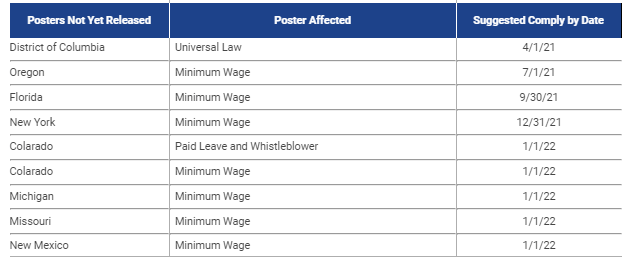
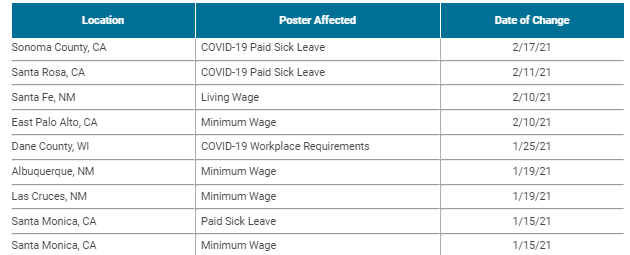
Additional Updates:
Illinois VESSA poster has been updated to reflect that victims of gender violence are entitled to the same protections provided to victims of domestic and sexual violence. This posting appears on the Illinois Combination Poster. This is a mandatory change.



 BURR CONSULTING, LLC