The Families First Coronavirus Response Act expired on December 31, 2020, with tax credits extended through March 31, 2021 for any employer opting to continue providing the paid leave. Under the current administration, there has been a proposed reinstatement option for the FFCRA, which would reinstate paid leave through September 30, 2021.
Below is additional information on the Biden proposal:
All employers, including businesses with fewer than 50 or more than 500 employees, along with the federal government will be required to provide FFCRA leave.
Healthcare workers and first responders will be entitled to FFCRA leave under the new proposal.
Other considerations- the amount and the potential duration of FFCRA benefits might increase under the new plan.
End date of September 30, 2021.
New York COVID Sick Leave Update:
Number of Employees (As of Jan. 1, 2020)
Amount of Sick Leave
Supplemental Benefits
0-10 employees; net income of $1 million or less in the prior tax year
Unpaid leave for duration of the order
Combined COVID-19 Paid Family Leave (PFL) and Disability Leave Benefits (DBL) for the duration of the order
0-10 employees; net income of more than $1 million in the prior tax year
5 days of paid sick leave
Combined PFL and DBL for the duration of the order
11-99 employees
5 days of paid sick leave
Combined PFL and DBL for the duration of the order
100+ employees
14 days of paid sick leave
Public employers must also provide 14 days of sick leave at the employee’s regular rate of pay when an employee is covered by the NY COVID-19 sick leave law.
The Jan. 20, 2021 guidance states that employees are entitled to COVID-19 sick leave under the following circumstances:
If an employee tests positive for COVID-19 following a period of mandatory quarantine or isolation, the employee cannot report to work, is automatically deemed subject to a subsequent mandatory order of isolation from the Department of Health and is entitled to paid sick leave under the NY COVID-19 sick leave law (even if the employee already received NY COVID-19 sick leave for the first period of mandatory quarantine or isolation). In order to receive NY COVID-19 sick leave for the second time, the employee is required to submit documentation of the positive COVID-19 test result from a licensed medical provider or testing facility to the employer or to the employer’s insurance carrier, if applicable (unless the employer gave the employee the COVID-19 test).
If an employee is subject to an order of quarantine or isolation and continues to test positive for COVID-19 at the end of the quarantine or isolation period, the employee may not return to work, is automatically deemed subject to an additional mandatory order of isolation and is entitled to COVID-19 sick leave for the second period of isolation. The employee is required to submit documentation of the subsequent positive COVID-19 test result from a licensed medical provider or testing facility to the employer or to the employer’s insurance carrier, if applicable (unless the employer gave the employee the COVID-19 test that showed the positive result). (BSK)
Offering EPSL and EFMLA after December 31 will become optional for employers.
An employee will no longer be entitled by law to take EPSL or EFMLA, even if they have a qualifying reason.
Employers who choose to offer these paid leaves can still receive a tax credit if they follow the current EPSL and EFMLA rules, including job protection.
The extension of the tax credit will be available for leaves taken through March 31, 2021.
Employees will not get new hours to use—the unused portion of their original allotment that remains on January 1 is how much they will be able to use through March 31. For instance, if an employee who was entitled to 80 hours of EPSL between April 1 and December 31 used 40 of those hours in 2020, they would have 40 hours left to use between January 1 and March 31, 2021.
There is a possible exception when an employee’s EFMLA bank could reset if employers use the calendar year or another fixed FMLA tracking period that starts before March 31 and the DOL fails to readopt the regulations they wrote related to EFMLA. We expect the IRS, DOL, or both, to provide guidance soon that will clear up whether certain employers will need to offer additional hours. We will update the HR Support Center as information becomes available. (HR On the Move)
Other Considerations:
Frequently asked questions on the DOL
Current employer policy and procedures
Labor and Employment Law Posters (mandatory or recommended)
Continue to monitor for updates by the local, state, and federal government. These changes do impact organizations both large and small. Review call-in procedures and create a form that is easy for tracking leave usage as well. I am happy to work with any organization that has questions or concerns regarding current leave.
EMPLOYEE REQUEST FOR EMERGENCY FAMILY AND MEDICAL LEAVE
Employees requesting Emergency FMLA (EFMLA) pursuant to the Families First Coronavirus Response Act (FFCRA) must complete this form. You must provide as much advance notice as is reasonably practicable. Upon completion of this form, submit it to Human Resources for processing.
Employers in New York are subject to different minimum wages, allowable tip credits, and minimum exempt employee salaries based on where employees work and what kind of work they do. The wage increases listed below took effect on December 31, 2020.
Minimum Wage in Nassau, Suffolk, and Westchester Counties The minimum wage in these counties will increase to $14 per hour.
Minimum Wage in the Rest of the State The statewide minimum wage will increase to $12.50 per hour. This applies to employees outside of New York City and Nassau, Suffolk, and Westchester Counties, except for fast food employees.
(New York City’s minimum wage previously increased to $15 and applies to all workers in NYC.)
Minimum Wage for Fast Food Employees The minimum wage for fast food employees working outside of New York City will increase to $14.50 per hour. The final scheduled increase to $15.00 per hour will take effect on July 1, 2021
Tipped Employee Minimum Cash Wage The minimum cash wage for tipped employees will increase as follows:
Service employees (other than at resort hotels) covered by the Hospitality Wage Order:
Nassau, Suffolk, and Westchester counties: $11.65
The rest of the state: $10.40
(New York City’s minimum previously increased to $12.50)
Food service employees:
Nassau, Suffolk, and Westchester counties: $9.35
The rest of the state: $8.35
(New York City’s minimum previously increased to $10.00)
Tip Credit Eliminated in Miscellaneous Industries Employers of employees covered by the Minimum Wage Order for Miscellaneous Industries won’t be able to take a tip credit as of December 31, 2020.
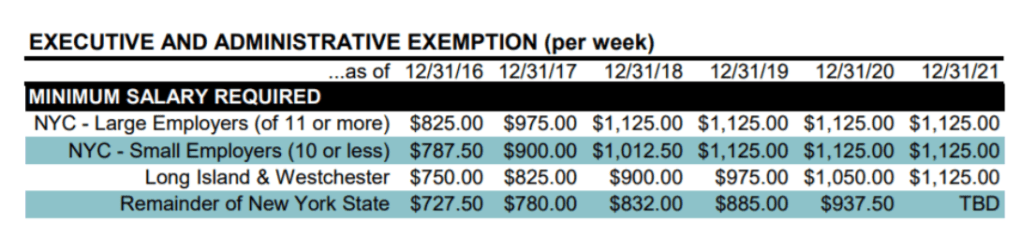
Exempt Administrative and Executive Minimum Salaries The minimum salary for exempt executive and administrative employees in New York will increase as follows:
Nassau, Suffolk, and Westchester counties: $1,050 per week, which equals $54,600 per year.
The rest of the state outside New York City: $937.50 per week, which equals $48,750 per year.
(The minimum in New York City previously increased to $1,125 per week.)
(HR On the Move Article)
Now is the opportunity to review payrates and job descriptions. Is the position truly an exempt executive or administrative position? Ensure that job duties align with requirements under the Fair Labor Standards Act. I am happy to work with any organization to determine exempt vs. non-exempt duties and responsibilities. Continue to monitor for any significant changes at the federal level in 2021 as well, minimum wage has not been increased federally since July 2009.
“Employers are aware of the effects of student loan debt, according to HR consultancy Buck’s annual Financial Wellbeing and Voluntary Benefits Survey Report, based on input from 164 employers with 500 or more employees, polled from late 2019 through February 2020. Some key findings:
41 percent of employers—compared to 23 percent in 2017—said that student loan debt was a top motivator for their financial wellness offerings.
Student loan repayment contributions were viewed as one of the best solutions for addressing financial stress, ranking just behind financial coaching and supplemental medical plans.” (SHRM)
Additional Information on Current Legislation:
Employer-provided student loan repayment. The CARES Act temporarily allowed employers to provide student loan repayment as a benefit to employees through Dec. 31, 2020. Under the provision, an employer may contribute up to $5,250 annually toward an employee’s student loans, and such payment would be excluded from the employee’s income. The $5,250 cap applies to both the new student loan repayment benefit as well as other educational assistance (e.g., tuition, fees, and books) provided by the employer under current law. The provision is extended through Dec. 31, 2025.
Developing the Policy:
Objective
The objective of this policy is to assist in repaying student loan debt to further the financial well-being of employees.
Policy
The student loan assistance program provides eligible employees up to [$] per month paid directly to the employee’s student loan servicer. Employees are expected to continue to make minimum monthly payments to the loan servicer in addition to the assistance provided under this policy. Student loan assistance is limited to [$] per year with a [$] cap and is reported as taxable income on the employee’s W-2.
Eligibility (Ensure this is Consistent)
Eligible employees include full-time employees who have received a graduate or undergraduate degree within [amount of time] of the date the employee first applies for assistance under this policy. New employees are eligible after [amount of time] of continuous employment with [Company Name].
Student loan assistance payments will continue for employees on an unpaid leave of absence for up to [amount of time].
Loans eligible for repayment assistance include U.S.-based education loans borrowed by the employee for the employee’s own education.
Procedures
Eligible employees must complete a student loan assistance application and provide proof of graduation documentation and loan documentation. Loan documentation must include:
Employee’s name.
Loan servicer’s name.
Loan account number.
Current balance.
Required monthly payment amount.
Monthly payment due date.
The amount of student loan assistance paid to the loan servicer each month will be the employee’s minimum monthly payment or [$], whichever is less.
Student loan assistance payments will begin on the [date] of the month following receipt and approval of a completed application. Employees will receive written notice of approval or denial of the loan assistance application.
Termination
Loan assistance payments will cease immediately upon an employee’s voluntary or involuntary termination from employment with [Company Name] or change in eligibility status, such as a reduction to part-time hours. Does the employee have to repay any amount paid by the organization if they do not fulfill a certain time with the organization? Similar to relocation or bonuses.
Create a policy and program that fits the organization and the culture of the organization. Very few organizations are taking advantage of student loan assistance for employees. This is a great opportunity to create a unique perk, while recruiting and retaining top talent. Survey the workforce to understand the financial wellness needs of employees. Communicate the results and develop programs that will make a positive impact on employees.
Originally published in 2018
11 Student Loan Repayment Perks Offered by Organizations
Below are 11 of the perks now being offered by organizations throughout the country:
“Price Waterhouse Coopers (PwC) launched its Student Loan Paydown program in 2016. Forty-five percent of the firm’s 46,000 junior employees (with six years’ experience or less) signed up to receive up to $1,200 annually for six years. The firm has found that this program has become a contributing factor in the job acceptance rate among applicants.
Starting this summer, PWC will give employees $100 a month (amounting to $1,200 each year) to help pay down student loans. The company’s offer is good for up to six years. That is a big draw for the company, which recruits 11,000 new employees from college on campuses each year.
Fidelity’s holistic approach to addressing employee student loan debt includes a Student Loan Repayment Program (SLRP) (that pays $2,000 per year with a $10,000 cap), and financial counseling and education for employees at all career and life stages. In the development of the program, Fidelity leaders often heard employees express regret that they wish they had known more when they were in high school and making decisions about how to finance their college education. In response, Fidelity Labs, an in-house product incubator, created an online education platform called the Student Debt Tool to help employees better understand their situation and their options. The tool includes a student loan refinancing platform to help consolidate loans to achieve lower lending rates. It also offers tools and advice to help employees save for future college costs for themselves and their children.”[i]
“Freedom 2 Save program works at Abbott, a research and development company headquartered in Lake Bluff, Ill. Full- and part-time employees who qualify for the company’s 401(k) and are also contributing 2 percent of their eligible pay toward their student loans through payroll deductions receive an amount equivalent to the company’s traditional 5 percent 401(k) match, deposited to their 401(k) accounts. The twist is that program recipients will receive the match without being required to make any 401(k) contributions of their own, allowing them to use more of their earnings to pay off student debt. Abbott’s approach avoids the taxes triggered when an employer directly gives employees funds to help pay off their student loans.”[ii]
“New York Life recently launched a student-loan repayment program offering up to $10,200 over five years for eligible employees—which tops out at $170 a month.
Rise Interactive launched its program by offering a loan-repayment contribution of $50 per month.”[iii]
“Startup lenders CommonBond and LendEDU both pledges to pay off your entire student loan balance, regardless of how much debt you have, if you’re an employee. Common Bond will provide $100 a month and LendEDU $200 a month until your debt is settled. Unfortunately, the odds of being an employee at either company are slim: Common Bond has less than 100 employees and LendEDU has just six.
Natixis Global Asset Management, the Boston-based division of French investment bank Natixis, rewards loyalty with $5,000 put toward employees’ student loan balance after their five-year work anniversary. They also receive $1,000 a year for the next five years.
Online homework helper Chegg offers employees a $1,000 annual contribution, after taxes, toward their student loan balance. It also provides an online student loan management tool to help workers maximize their payments.
Nevada’s Moonlite Bunny Ranch will match their employees’ student loan payments 100% for two months. When you consider that employees reportedly make about $3,000 a week at the brothel, the program could work out to be a lucrative offer.”[iv]
“The American Bankers Association said that next month it would begin helping employees with their college-related debts. The ABA will pay up to $1,200 per year per eligible employee toward student loans, above and beyond salary and any other benefits. The organization, which represents banks that employ more than 2 million people, said it is encouraging each member bank to take a similar step.”[v]
Below are relocation options, currently being offered or being developed:
“Rural Opportunity Zones consists of 77 counties in Kansas offer tax waivers and or a student loan payment program up to $15,000.
Niagara Falls, New York is developing a program that could save a student up to $7,000.00 in student loan debt.”[vi]
Memphis, Tennessee, the first City Government to offer the student loan program.
“The 20th largest city in the country, Memphis will contribute $50 a month to the student loan account of any employee who’s worked for the city for at least a year.”[vii]
“Relocating to Saskatchewan, Canada could save a student up to $20,000.00 in student loan debt if you graduated after 2010.
Currently, only 4% of employers are now offering perks outlined above. As the war for talent continues to increase and turnover continues to be a driving concern in organizations, these perks will grow in popularity. Will these perks work for your organization? Maybe or maybe not. However, 44+ million people with student loan debt is a tremendous labor pool. Before implementing a program such as this, benchmark options, know the tax advantages and disadvantages and ask your current workforce. I personally believe there is value in programs such as this and would be happy to work with any organization in implementing a student loan repayment option for the workforce. It will separate you from your competitors.
“On Aug. 17, the IRS made public its Private Letter Ruling (PLR) 201833012, which was issued to the requesting company on May 22. The letter responds to an unnamed employer that proposed amending its 401(k) plan to offer a student-loan benefit program under which it would make special 401(k) contributions into the accounts of employees who are making student loan repayments.”[i]
Nevada OSHA poster has been updated to reflect new mandatory penalty amounts for each serious violation, non-serious violation, and daily penalty for failing to correct a violation. This posting appears on the Nevada Combination Poster. This is a mandatory change.
Virginia Pregnancy Accommodation poster has been updated to reflect a new agency name for employees to file discrimination complaints within the Office of the Attorney General. The Virginia Division of Human Rights has been changed to the Virginia Office of Civil Rights. This posting appears on the Virginia Combination Poster. This is a mandatory change.
District of Columbia Family and Medical Leave Act During COVID-19 poster has been updated to reflect that the temporary amendments to the District of Columbia Family and Medical Leave Act to create new job-protected leave for employees for various COVID-19 reasons has been extended through May 22, 2021. This is a mandatory change.
Utah Unemployment Insurance poster has been updated to clarify how employees can file unemployment insurance claims. The poster was also updated to reflect a change to the website address and to the phone numbers and addresses for several state employment centers. This posting appears on the Utah Combination Poster. This is a mandatory change.
California Fair Employment poster has been updated to reflect recent amendments to the California Fair Employment and Housing Act. A new leave law amendment expands the definition of family member to include grandparent, grandchild, or sibling, and permits leave for certain military exigencies and also expands the law to now apply to employers with five or more employees. This posting appears on the California Combination Poster, Part 1. This is a mandatory change.
Michigan Paid Medical Leave poster has been updated to reflect a correction when filing a complaint. An employee may file a complaint with the Department of Labor and Economic Opportunity (LEO) within 6 months of the violation. This posting appears on the Michigan Combination Poster. This is a mandatory change.
The U.S. Department of Labor (DOL) recently provided guidance on complying with its notices and posting requirements when in a remote work environment.
Posting Guidance:
(1) all of the employer’s employees exclusively work remotely,
(2) all employees customarily receive information from the employer via electronic means, and
(3) all employees have readily available access to the electronic posting at all times. This ensures the electronic posting satisfies the statutory and regulatory requirements that such postings be continuously accessible to employees. Where an employer has employees on-site and other employees teleworking full-time, for example, the employer may supplement a hard-copy posting requirement with electronic posting and the Department would encourage both methods of posting.
If an employer seeks to meet a worksite posting requirement through electronic means, such as on an intranet site, internet website, or shared network drive or file system posting, the electronic notice must be as effective as a hard-copy posting. As a number of the statutory provisions below require that affected individuals be able to readily see a copy of the required postings, where an employer chooses to meet a worksite posting requirement through electronic means, the same requirements apply in the electronic format. As a practical matter, a determination of whether affected individuals can readily see an electronic posting depends on the facts. For instance, the affected individuals must be capable of accessing the electronic posting without having to specifically request permission to view a file or access a computer.
Design an easily accessible space in your company intranet or employee portal for federal and state posters. “Consider making your company intranet or portal appear automatically on employees’ computers upon logging in,” he said.
Use your employee handbook or handbook acknowledgment page to inform employees of the virtual location of postings.
Incorporate all required notices in your applicant portal and applicant tracking system if hiring is conducted remotely.
Work with your labor poster provider and seek guidance with any questions or concerns related to remote postings. Remember, there are local and state requirements as well, with remote workers. I am happy to answer any questions regarding posting requirements.
Washington Paid Family and Medical Leave poster has been updated to reflect an increase to the cap of weekly benefits by the Washington Employment Security Department. The maximum allowed for weekly benefits increased from $1,000 to $1,206. This posting appears on the Washington Combination Poster. This is a mandatory change.
California Pregnancy Disability and CFRA Leave poster has been updated to reflect recent amendments to the California Family Rights Act (CFRA). A new law expands the definition of family member for CFRA purposes and also expands the CFRA to now apply to employers with five or more employees. This posting appears on the California Combination Poster, Part 2. This is a mandatory change.
California Industrial Welfare Commission Wage (IWC) Industry Wage Orders have been updated to reflect the 2021, 2022 and 2023 increases to the state minimum wage and revised updated meal and lodging credit amounts. The web address for computer software employees overtime exemptions has also been revised. This is a mandatory change.
Alaska Minimum Wage poster has been updated to reflect an increase in the minimum wage. The minimum wage rate will increase from $10.19 per hour to $10.34 per hour effective January 1, 2021. This posting appears on the Alaska Combination Poster. This is a mandatory change.
Oklahoma Workers’ Compensation poster has been updated to reflect a change to the state’s workers’ compensation law adding chiropractic services to allowable medical treatment. This posting appears on the Oklahoma Combination Poster. This is a mandatory change.
California Fair Employment poster has been updated to reflect recent amendments to the California Fair Employment and Housing Act. A new leave law amendment expands the definition of family member to include grandparent, grandchild, or sibling, and permits leave for certain military exigencies and also expands the law to now apply to employers with five or more employees. This posting appears on the California Combination Poster, Part 1. This is a mandatory change.



 BURR CONSULTING, LLC