7 Notices of Pay Rate Requirements in New York State

Original Date: July 2, 2018

As many of us know, The Wage Theft Prevention Act (WTPA) took effect in New York State on April 9, 2011.  The current law requires employers to provide written notice of wage rates to each new hire and requires organizations to provide notice when rates change (demotion, annual increase, COLA’s, career progression, etc.).  On December 29, 2014, Governor Cuomo signed a bill eliminating the requirement that before February 1 of each year, employers must notify and receive written acknowledgement from every worker about their rate of pay.  Just to clarify, we do not have to do this.  The required notices (new hire, wage movement) should be part of our new hire orientation process and potentially the annual review process, to ensure we are providing legal and accurate information to the workforce.

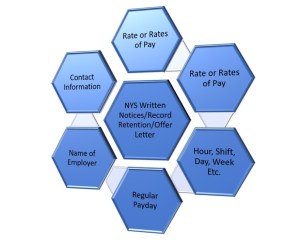
The 7 notices in New York State:

  1. “Rate or rates of pay, including overtime rate of pay (if it applies)
  2. How the employee is paid: by the hour, shift, day, week, commission, etc.
  3. Regular payday
  4. Official name of the employer and any other names used for business (DBA)
  5. Address and phone number of the employer’s main office or principal location
  6. Allowances taken as part of the minimum wage (tips, meal and lodging deductions)”[i]
  7. Under the New York Wage Theft Protection Act, employers are also required to maintain 6 years of acknowledgements confirming receipt of notification of wages and other information required to be provided by employers under the law.
  8. Bonus Information: Organizations may provide their own notice, as long as it includes all of the required information. (Offer letter or wage change letter) Must include signatures.

Wage Prevention Fact Sheet

Wage Prevention Frequently Asked Questions

Notice of Pay for Hourly Employees

Notice for Exempt Employees

Notice for Employees Paid a Weekly Rate or a Salary for a Fix Number of Hours (40 of Fewer in a Week)

The forms are posted online for employers to use as part of the new hire and change(s) in rate process.  However, if the offer letters and change forms check the boxes of the required information by the state, employers do not need to use the forms recommended by the state.  We must get a signature on any of the forms used during either process, offer letter or salary increase letter.  A copy should be provided to the employee and one for the employer’s records.  Also, remember, these forms do change, the most recent form was updated in January of 2017.  Monitoring for updates to ensure we are using accurate forms is necessary.  During my audits, this has been a form that was not always used or not updated as the state changed the form.  It is recommended to audit your records in relation to this form and any other forms required by the local, state or federal government, annually or semiannually.  If you are confused, seek guidance, to ensure your organization is providing timely, accurate and legal forms/information to the workforce.
burr

– Matthew Burr, HR Consultant

[i] https://labor.ny.gov/workerprotection/laborstandards/employer/wage-theft-prevention-act.shtm

16 NLRB Changes to Employee Handbooks

Original Post: June 25, 2018

The National Labor Relations Board General Counsel Peter Robb’s released a memo on June 6, 2018 that outlined changes to three major categories of rules found in many of our policies or employee handbooks; rules that are generally lawful, provisions warranting individualized scrutiny and rules that are unlawful.  The NLRB will offer far less scrutiny under the Trump administration then we have seen under the Obama administration, in relation to policies and handbooks.  These changes include; civility standards, insubordination rules and prohibitions on taking pictures in the workplace, as shown below:

The 17 changes to employee handbooks:

Lawful civility rules might state, for example:

  • Behavior that is rude, condescending or otherwise socially unacceptable is prohibited.
  • Disparaging the company’s employees is prohibited.
  • Employees may not post any statements, photographs, video or audio that reasonably could be viewed as disparaging to workers.

Rules against defamation or misrepresentation are generally allowed. Examples of such rules are:

  • Misrepresenting the company’s products, services or employees is prohibited.
  • E-mail messages that are defamatory are prohibited.
  • Disorderly conduct on the employer’s premises and/or during working hours for any reason is strictly prohibited.”[i]

Rules that protect confidential, proprietary and customer information are generally lawful under the new rules.  No-photography rules and no-recording rules are viewed as generally lawful under the current memo issued in early June 2018.

“Provisions Warranting Individualized Scrutiny

Rules that may be subject to board scrutiny include:

  • Broad conflict-of-interest rules.
  • Confidentiality rules broadly encompassing “employer business” or “employee information.”
  • Rules regarding disparagement or criticism of the employer.
  • Policies regulating use of the employer’s name.
  • Rules restricting speaking to the media or third parties, as opposed to speaking to the media on the employer’s behalf.
  • Policies banning off-duty conduct that might harm the employer.
  • Rules against making false or inaccurate statements, as opposed to defamatory statements.

Unlawful Rules

Unlawful rules include confidentiality rules regarding wages, benefits or working conditions.

The following confidentiality rules are unlawful:

  • Employees are prohibited from disclosing salaries and contents of employment contracts.
  • Workers shall not disclose any information pertaining to the wages, commissions, performance or identity of employees of the employer.
  • Employees are prohibited from disclosing to any media source information regarding employment at the employer, the workings and conditions of the employer, or any staff member.”[ii]

Additional unlawful handbook language that can be scrutinized under the new memo is, prohibiting employees from joining outside organizations (example: labor unions) and/or voting on matters concerning the employer.  The Society of Human Resource Management suggest that employers revisit handbook language, policies and procedures that might have changed under the Obama administration, this language might have been deemed unlawful.  Remember, the key word is generally lawful, that does not mean all language or overreaching policies are lawful.  Annually reviewing handbook language is a proactive approach to the major changes we have seen under local, state and federal laws recently.  Remember, we all need to revise our handbooks and policies for the upcoming sexual harassment requirements in New York State and additional local laws in New York City (if you have offices there).  If you are confused on handbook and policy language, seek guidance.  Employee handbooks, policies and procedures are important for all of our organizations and need to be legally compliant, at all levels.

– Matthew Burr, HR Consultant

[i] https://www.shrm.org/resourcesandtools/legal-and-compliance/employment-law/pages/labor-relations-nlrb-general-counsel-memo-employee-handbooks.aspx

[ii] https://www.shrm.org/resourcesandtools/legal-and-compliance/employment-law/pages/labor-relations-nlrb-general-counsel-memo-employee-handbooks.aspx